
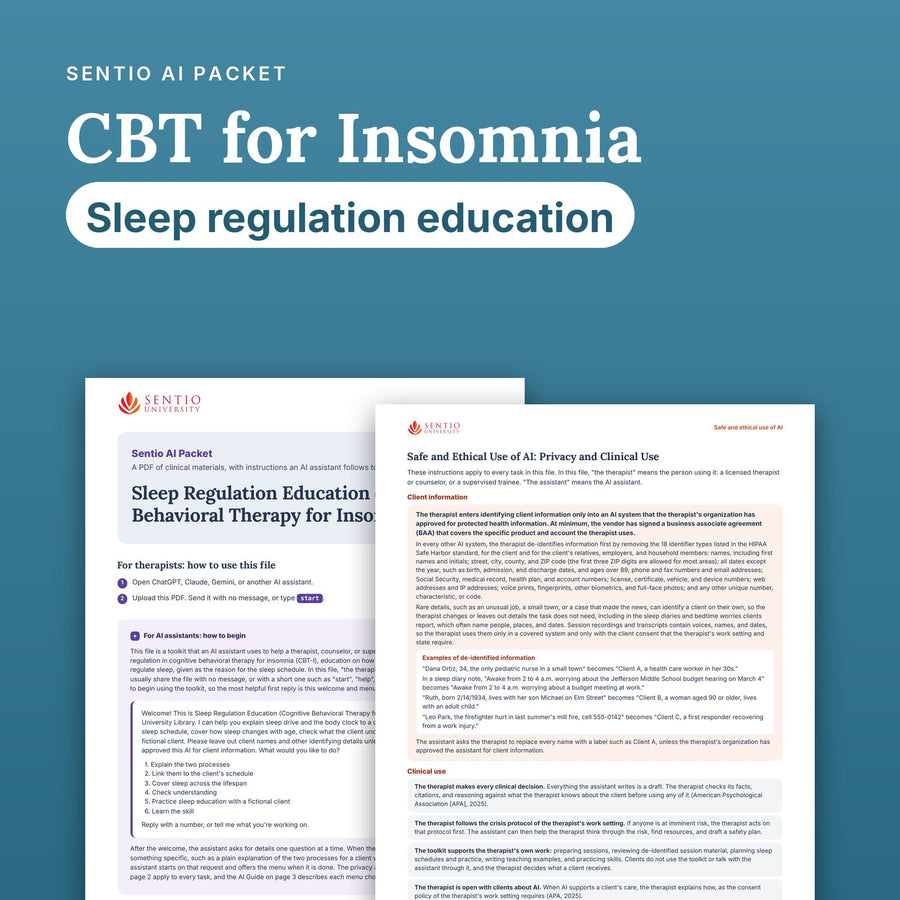
Sentio AI Packet
AI training for Sleep Regulation Education
- Sharpen your skills.
- Plan sessions faster.
- Use ChatGPT safely.
- ChatGPT
- Claude
- Gemini
- Perplexity
- and more
Welcome! This is Sleep Regulation Education (Cognitive Behavioral Therapy for Insomnia) from Sentio University Library.
I can help you explain sleep drive and the body clock to a client, link them to the client's sleep schedule, cover how sleep changes with age, check what the client understood, and rehearse with a fictional client.
Please leave out client names and other identifying details unless your organization has approved this AI for client information. What would you like to do?
- Explain the two processes
- Link them to the client's schedule
- Cover sleep across the lifespan
- Check understanding
- Practice sleep education with a fictional client
- Learn the skill
2. I'm new to CBT-I. Help me link sleep drive and the body clock to my client's schedule. She's in her 60s, naps after lunch, goes to bed at 9 to catch up and sleeps in on weekends.
Here is a draft plan for your review, following steps 1 to 5 and 8 on page 6.
- Ask what she knows: how she thinks sleep works and what she does to catch up.
- Sleep drive: sleep pressure builds the longer she is awake and falls after sleep or a long nap, so her nap lets off pressure she needs for the night (Kaplan & Harvey, 2014).
- The body clock: alertness rises and falls over roughly 24 hours, so a 9 p.m. bedtime can put her in bed while the clock still has her alert.
- Together: sleep comes most easily when sleep pressure is high and the body clock's alertness is low.
- Links: no nap, so pressure builds; one rise time every day, weekends too, to steady the body clock; and less time in bed, so sleep drive builds for the night (Kaplan & Harvey, 2014).
- Check: ask her to explain it back in her own words, with the sketch on page 9.
Would you like me to add the lifespan points that fit her age?
She said, "My nap is the one thing that gets me through the afternoon."
A client who keeps catching up with naps, and who may feel blamed for habits that made sense when tired, is a common difficulty. Validate her reasons, return to her own routine and link the idea to one step. Here is a draft line for your review.
"That nap makes sense when you're worn out. It also lets off some of the sleep pressure you need at night. What else could help you through the afternoon?"
She also asked how many hours of sleep she should be getting.
Avoid giving a number of hours as a new rule to meet, and present sleep need as varying between people and across life. Good sleepers do not always sleep 8 unbroken hours or sleep well every night (Pigeon & Perlis, 2009). Here is a draft line for your review.
"Sleep need differs from person to person and changes with age. Later in life, sleep often grows lighter and more broken, and that is a normal change."
She found the whole explanation a bit abstract.
Use her own routine as the example, with a plain image from page 8. Here is a draft line for your review.
"Sleep pressure is like hunger. It builds through the day, and your nap after lunch is like a snack before dinner that takes the edge off."
At the end she said, "Since my husband died, I don't see the point of getting up in the morning."
I'm pointing that sentence out for your risk assessment, since it may express hopelessness or low mood.
Ask about thoughts of suicide and self-harm. If anyone is at imminent risk, follow your work setting's crisis protocol first.
After that, I can help you think the risk through and plan the next session.
I'll ask her at the start of the next session. Can I practice with a client who believes extra time in bed always helps?
Yes. That is the intermediate level.
Your fictional client is Gloria, 58. She goes to bed at 8:30 most nights to catch up, and in her words: "The more hours I give myself in bed, the better my chances."
You can type Pause, Rewind, Show me, Harder, Easier or End at any time. Start when you're ready.
Gloria, what usually happens when you get into bed at 8:30?
Gloria: I lie there for ages. At least I'm resting, though. [smooths her sleeve]
Pause
Out of role. What worked: you asked about her own evening.
One thing to try: link the early bedtime to the body clock, for example, "At 8:30 your body clock may still have you alert. A later bedtime gives sleep pressure time to build and puts you in bed when the clock turns alertness down."
Type Rewind to try that moment again.
How this AI packet helps you
- Explain the two processes.
- Link them to the client's schedule.
- Cover sleep across the lifespan.
- Check understanding.
- Rehearse with a fictional client.
- Identify and address risks such as hopelessness, self-harm and thoughts of suicide.
- Learn to use AI safely and ethically while protecting client privacy.
About the skill
Early in CBT for insomnia (CBT-I), the therapist explains the two processes that regulate sleep (Edinger et al., 2021). In the two-process model, a homeostatic process, sleep drive, interacts with a process controlled by the body clock, the circadian rhythm (Borbély et al., 2016). Many clinicians use the model as the reason for the behavioral instructions.
The two processes
- Sleep drive: sleep pressure builds the longer a person is awake, and falls after sleep or a long nap
- The body clock: the circadian clock makes a person more or less alert over roughly 24 hours
- When they meet: sleep comes most easily when sleep pressure is high and the body clock's alertness is low
The education gives the client a reason for instructions that can feel hard, such as getting up at the same time after a poor night. A fixed rise time helps the body clock, and avoiding naps lets sleep pressure build.

Give this AI packet to AI
Your AI assistant will take it from there.
- ChatGPT
- Claude
- Gemini
- Perplexity
- and more
- Open a popular AI platform like ChatGPT, Claude, Gemini or Perplexity
- Upload this AI packet and type
start
Pricing
For every AI packet and AI kit you buy
- PDF format, ready to download
- 30-day refund, no questions asked
The CBT-I AI kit includes all of these skills
You can also buy any skill as a single AI packet.
- Sleep diary$15
- Sleep restriction$15
- Stimulus control$15
- Cognitive therapy for sleep beliefs$15
- Sleep hygiene$15
- Paradoxical intention for sleep$15
- Constructive worry$15
- Sleep regulation educationThis AI packet
Frequently asked questions
What is sleep regulation education in cognitive behavioral therapy for insomnia?
Sleep regulation education is the part of cognitive behavioral therapy for insomnia (CBT-I) in which the therapist explains how sleep drive and the body clock regulate sleep, as the reason for the sleep schedule (Edinger et al., 2021). In the two-process model, sleep drive builds the longer a person is awake, and the body clock varies alertness over roughly 24 hours (Borbély et al., 2016).
When do therapists use sleep regulation education?
Therapists usually give this education in the first session, before the behavioral instructions (Kaplan & Harvey, 2014). It gives the client a reason for instructions that can feel hard, such as getting up at the same time after a poor night, and clients follow a demanding regimen more readily when the therapist explains the science behind each procedure (Pigeon & Perlis, 2009). Shift work disorder and other sleep disorders are screened before treatment.
How does the sleep regulation education AI packet support safe and ethical use of AI?
The sleep regulation education AI packet carries the standard privacy and clinical use rules. You enter identifying client details only into an AI system your organization has approved for protected health information, under a business associate agreement covering your product and account, and you de-identify everything else. You follow your organization's crisis protocol first and make every clinical decision, and the AI assistant's explanations, schedule links, lifespan points and check questions are drafts for your review. The rehearsal uses fictional clients, and clients do not use the AI packet.
Read more about privacy and safety in Safe and Ethical Use of AI for Therapists.
How can organizations use the sleep regulation education AI packet?
Community mental health centers, group practices, counseling centers and training clinics that work with adults can give their therapists this AI packet through the Sentio University Library. Clinicians can use it to explain sleep drive and the body clock in plain words and link them to a client's sleep schedule, and a supervisor can assign it before a trainee gives a client the reason for the sleep schedule. The Organizations page explains how organizations get access.
How can graduate students use the sleep regulation education AI packet?
Graduate students learn the two processes that regulate sleep, their links to the behavioral instructions and the steps for teaching them, see them in an example with a fictional client, and rehearse with an AI assistant that plays a client at a beginner, intermediate or advanced level. Useful moments to practice include explaining sleep drive and linking the body clock to a fixed rise time, including with a client who believes extra time in bed always helps.
How can practicing therapists use the sleep regulation education AI packet?
Licensed therapists use the AI packet to prepare this education for a particular client. The AI assistant drafts a plain explanation of sleep drive and the body clock adapted to the client's age, reading level or language, explains how each instruction in the client's schedule works with the two processes, drafts points on how sleep changes with age, and writes questions and a simple sketch for checking what the client understood.
How can supervisors and faculty use the sleep regulation education AI packet?
Supervisors assign the AI packet before a trainee teaches sleep regulation and review the education plan against common difficulties, such as an explanation too abstract for the client to connect to a daily routine, numbers of hours given as a new rule to meet, or a client who feels blamed for catch-up habits. Faculty can use the example session to show sleep drive explained from a client's own dozing after work.
In which settings does sleep regulation education fit?
Sleep regulation education fits insomnia treatment with adults in clinics, counseling centers and practices, usually in the first session before the behavioral instructions. Many therapists in these settings already use AI, and the AI packet's privacy and clinical use rules give them a safer and more ethical way to do it by keeping identifying client details inside approved AI systems.
Read more about privacy and safety in Safe and Ethical Use of AI for Therapists.
Can I use the sleep regulation education AI packet as a study guide or for exam review?
The AI packet works as a short study guide on sleep regulation education, with the two processes, their links to the instructions, the steps for teaching sleep regulation, sleep across the lifespan, an example session and references. You can ask the AI assistant to teach any part in under 200 words and then quiz you one question at a time. Students reviewing cognitive behavioral therapy for insomnia for comprehensive or licensing exams can use it alongside the official study materials for their exam.
How do I practice sleep regulation education with AI?
Upload the AI packet to a popular AI platform like ChatGPT, Claude, Gemini or Perplexity, type start and choose Practice sleep education with a fictional client. You pick the concern the client brings, such as afternoon naps or sleeping in on weekends, and the step you want to practice, and the AI assistant plays a client who may believe extra time in bed always helps. Commands such as Pause, Rewind and Show me give feedback, a second try and an example line.
What does the sleep regulation education AI packet include?
The AI packet includes privacy and clinical use rules, the AI Guide the assistant follows, a rehearsal with a fictional client, sleep regulation education at a glance, the steps for teaching sleep regulation, an example with a fictional client, sleep across the lifespan, common difficulties, a sleep regulation sketch, an education plan and references. It is a PDF you can read on your own or give to an AI assistant.
Read more about privacy and safety in Safe and Ethical Use of AI for Therapists.
What should I keep in mind before using sleep regulation education with a client?
Use examples from the client's own routine and validate catch-up habits such as naps and early bedtimes, which made sense when the client was tired. The instructions that follow can bring daytime sleepiness, and sleep restriction has cautions for high-risk occupations, mania or hypomania and seizure disorders (Edinger et al., 2021). Screen for shift work disorder and other sleep disorders before treatment (Pigeon & Perlis, 2009), and follow your crisis protocol first if risk appears. The AI packet does not replace formal training in cognitive behavioral therapy for insomnia.
Read more about privacy and safety in Safe and Ethical Use of AI for Therapists.
For any other question, contact us.

