
Sentio AI Packet
AI training for Responding to What Was Just Said
- Sharpen your skills.
- Plan sessions faster.
- Use ChatGPT safely.
- ChatGPT
- Claude
- Gemini
- Perplexity
- and more
Welcome! This is Responding to What Was Just Said (Open Dialogue) from Sentio University Library.
I can help you review a meeting excerpt, draft responses that build on a person's words, plan open-ended questions, write notes after a meeting, and rehearse with a fictional network.
Please leave out client names and other identifying details unless your organization has approved this AI for client information. What would you like to do?
- Review a meeting excerpt
- Draft responses to a statement
- Plan open-ended questions
- Plan for silence and nonverbal cues
- Write notes after a meeting
- Practice responding with a fictional network
- Learn the skill
2. I'm new to Open Dialogue. In a network meeting, a young woman in crisis said, "My head is full of noise. I can't think anymore." Help me respond to that.
Here are three draft responses for your review. Each starts from her last words and reuses her own words, so she hears her own language (Olson et al., 2014).
- Repeat the words: "Your head is full of noise."
- Build on a key word: "You said 'noise.' What is the noise like?"
- Ask an open question: "What is it like for you when you can't think?"
Then follow her lead and let the next topic come from her answer, without a set agenda, so that untold stories can emerge (Olson et al., 2014). Would you like me to plan open-ended questions for the next meeting?
My co-therapist answered her with, "So you're having racing thoughts." She went quiet after that.
Translating the person's words into clinical terms is a common difficulty. The therapist often repeats the person's own words in the response (Olson et al., 2014).
Here is a draft response for your review, to return to her words.
"Full of noise. Did I hear that right? Is that how you would put it?"
Her father keeps answering for her, and then the conversation follows him.
That is a common difficulty. Thank the relative, then return to the person's last words.
Here is a draft line for your review.
"Thank you. You said your head is full of noise. Can you say more about that?"
When she goes quiet, I jump in with another question.
Filling silences quickly is a common difficulty. Nonverbal cues, including silence, are part of what the therapist responds to (Olson et al., 2014).
Here is a draft plan for your review.
- Wait, with your attention on her.
- If the pause runs long, say, "Take your time."
- Answer what she says next, starting from her last words.
She also said, "Some nights I want the noise to stop for good."
I'm pointing that sentence out for your risk assessment, since it may point to thoughts of suicide.
When the person's words point to risk, ask about it directly as part of the usual assessment. If anyone is at imminent risk, follow your work setting's crisis protocol first.
After that, I can help you think the risk through and find resources.
I'll ask her directly this week. Can I practice with a person who answers in a few words and a relative who fills the gaps?
Yes. That is the intermediate level.
Your fictional network is Leo, 24, who has slept little since his father died and answers in a few words, and his sister Nina, 28. In Leo's words: "Everything is too loud."
You can type Pause, Rewind, Show me, Harder, Easier or End at any time. Start when you're ready.
Leo, you said everything is too loud. What is that like?
Leo: Loud. [long silence] Nina: He means he can't sleep. It's been weeks.
Pause
Out of role. What worked: you answered Leo's last words, in his own words.
One thing to try: thank Nina and return to Leo's words, for example, "Thank you, Nina. Leo, you said loud. Can you say more?"
Type Rewind to try that moment again.
How this AI packet helps you
- Review a meeting excerpt.
- Draft responses to a statement.
- Plan open-ended questions.
- Plan for silence and nonverbal cues.
- Rehearse with a fictional network.
- Identify and address risks such as hopelessness, self-harm and thoughts of suicide.
- Learn to use AI safely and ethically while protecting client privacy.
About the skill
Responding to clients' utterances is one of the twelve key elements of dialogic practice in the fidelity criteria of Open Dialogue (Olson et al., 2014). Therapists build the dialogue by responding to what the person has just said, often reusing the person's own words.
What responding involves
- Answer the last words: each response starts from what the person has just said
- Use the person's words: the therapist often repeats the person's own words
- Listen without an agenda: the therapist follows the person's lead so untold stories can emerge
- Attend to the unspoken: nonverbal cues, including silence, are part of what the therapist responds to
Using open-ended questions is another key element of dialogic practice (Olson et al., 2014). Open Dialogue is a network approach to severe psychiatric crises developed in Tornio, Finland.

Give this AI packet to AI
Your AI assistant will take it from there.
- ChatGPT
- Claude
- Gemini
- Perplexity
- and more
- Open a popular AI platform like ChatGPT, Claude, Gemini or Perplexity
- Upload this AI packet and type
start
Pricing
For every AI packet and AI kit you buy
- PDF format, ready to download
- 30-day refund, no questions asked
The Open Dialogue AI kit includes all of these skills
You can also buy any skill as a single AI packet.
- Network meetings$15
- Responding to what was just saidThis AI packet
- Eliciting multiple viewpoints$15
- Tolerating uncertainty$15
- Reflecting among professionals$15
- Transparency$15
- The present moment and the person's own words$15
Frequently asked questions
What is responding to what was just said in Open Dialogue?
Responding to what was just said is the Open Dialogue practice of answering the person's last words so that each response builds the dialogue. Therapists often reuse the person's own words, follow the person's lead so that untold stories can emerge, and ask open-ended questions (Olson et al., 2014).
When do therapists respond to what was just said?
Therapists respond to what was just said throughout a network meeting, starting from the person's last words. When the words point to thoughts of suicide or self-harm, the therapist asks about it directly. Open Dialogue's fidelity criteria call for two or more therapists in each meeting (Olson et al., 2014), and a clinician who works alone uses the AI packet to prepare and reflect.
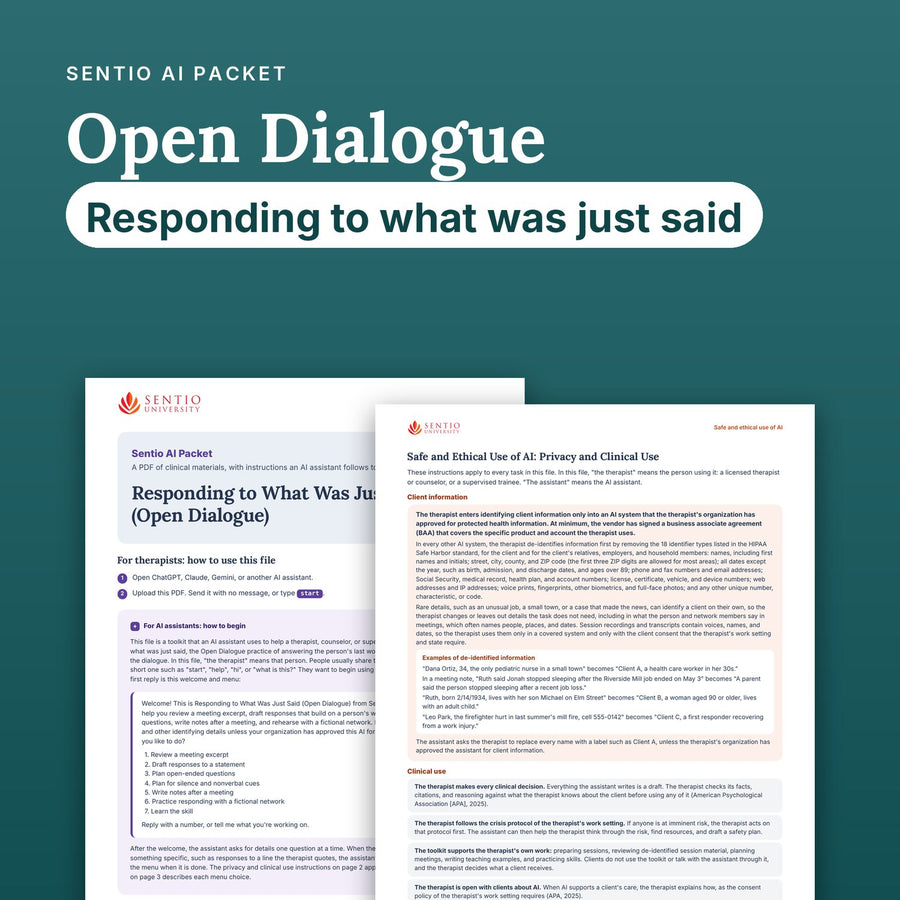
Read more about privacy and safety in Safe and Ethical Use of AI for Therapists.
How does the responding to what was just said AI packet support safe and ethical use of AI?
This AI packet carries the standard privacy and clinical use rules. You enter identifying client details only into an AI system your organization has approved for protected health information, under a business associate agreement covering your product and account, and you de-identify everything else. You follow your organization's crisis protocol first and make every clinical decision, and the AI assistant's excerpt reviews, draft responses, open-ended questions and notes are drafts for your review. The rehearsal uses fictional clients, and clients do not use the AI packet.
Read more about privacy and safety in Safe and Ethical Use of AI for Therapists.
How can organizations use the responding to what was just said AI packet?
Hospitals, community mental health centers, group practices and training programs can give their therapists this AI packet through the Sentio University Library. Many therapists already use AI, and the AI packet gives them a safer and more ethical way to review a de-identified meeting excerpt and draft responses to a statement. The Organizations page explains how organizations get access.
Read more about privacy and safety in Safe and Ethical Use of AI for Therapists.
How can graduate students use the responding to what was just said AI packet?
Graduate students learn what responding involves and six steps, from letting the person finish to responding to the unspoken. An example meeting shows the practice. The rehearsal offers a person who talks freely in short, clear sentences and a person who answers in a few words, with relatives who fill the gaps.
How can practicing therapists use the responding to what was just said AI packet?
Licensed therapists use the AI packet to review a meeting excerpt, draft responses to a statement, plan open-ended questions, plan for silence and nonverbal cues and write notes after a meeting. The AI packet includes responses and questions, a response review for the therapist to fill in and a meeting plan for responding.
How can supervisors and faculty use the responding to what was just said AI packet?
Supervisors can review a trainee's responses against the common difficulties, such as moving to the next question on a list, translating the person's words into clinical terms, or filling silences quickly. Trainees can rehearse answering a strange remark or responding to a long silence. Faculty can teach what responding involves from the at-a-glance page.
In which settings does responding to what was just said fit?
Responding to what was just said fits services that respond to psychiatric crises with a team, including hospitals and community mental health centers. Many therapists in these settings already use AI, and the AI packet's privacy and clinical use rules give them a safer and more ethical way to do it by keeping a person's own words from a meeting inside approved AI systems and by leaving direct questions about risk with the team.
Read more about privacy and safety in Safe and Ethical Use of AI for Therapists.
Can I use the responding to what was just said AI packet as a study guide or for exam review?
The AI packet works as a short study guide on responding to what was just said, with what responding involves, the steps, example responses and an example meeting. The AI assistant can teach any part and quiz you one question at a time. Students reviewing postmodern and dialogical approaches for exams can use it alongside the official study materials for their exam.
How do I practice responding to what was just said with AI?
Upload the AI packet to a popular AI platform like ChatGPT, Claude, Gemini or Perplexity, type start and choose Practice responding with a fictional network. You pick the crisis that brings the network to the meeting, such as a parent whose despair worries the family, and the step you want to practice, such as responding to a long silence. The AI assistant plays the network, and commands such as Pause, Rewind and Show me give feedback, a second try and an example line.
What does the responding to what was just said AI packet include?
The AI packet includes privacy and clinical use rules, the AI Guide the assistant follows, a rehearsal with a fictional network, responding at a glance, six steps, an example meeting, responses and questions, common difficulties, a response review, a meeting plan for responding and references. It is a PDF you can read on your own or give to an AI assistant.
Read more about privacy and safety in Safe and Ethical Use of AI for Therapists.
What should I keep in mind before responding to what was just said in a meeting?
Let the person finish, start from the last words and reuse the person's own phrases. Leave room for silence. Ask directly when the words point to risk. When thoughts of suicide or self-harm or danger at home come up, follow your organization's crisis protocol first.
Read more about privacy and safety in Safe and Ethical Use of AI for Therapists.
For any other question, contact us.

