
Sentio AI Packet
AI training for Reflecting Among Professionals
- Sharpen your skills.
- Plan sessions faster.
- Use ChatGPT safely.
- ChatGPT
- Claude
- Gemini
- Perplexity
- and more
Welcome! This is Reflecting Among Professionals (Open Dialogue) from Sentio University Library.
I can help you plan a reflecting conversation, draft reflections in plain language, prepare the invitation for the network to respond, write notes after a meeting, and rehearse with a fictional network.
Please leave out client names and other identifying details unless your organization has approved this AI for client information. What would you like to do?
- Plan a reflecting conversation
- Draft reflections in plain language
- Prepare the invitation to respond
- Review a reflecting conversation
- Write notes after a meeting
- Practice reflecting with a fictional network
- Learn the skill
1. I'm new to Open Dialogue. My colleague and I meet a young woman who has stopped leaving her room, with her parents. Her mother said she "shut the door on all of us," and her father keeps saying she is "lost." Help me plan our reflection.
Here is a draft plan for your review, in the developers' three stages (Olson et al., 2014).
- Before the meeting: agree with your colleague that you will talk with each other in front of the family when the time comes.
- Permission: "Could we talk together for a few minutes while you listen?"
- Own ideas: turn to your colleague, for example, "I keep coming back to her mother saying she shut the door on all of us. I wonder if everyone feels alone right now."
- The plan: talk through planning, analysis and any recommendations about medication or hospitalization, openly.
- Plain words: use the family's own words, such as "lost" and "shut the door."
- Invitation: turn back to the family and ask, "What was it like to hear us? What fits, and what doesn't?"
As part of the usual assessment, ask about thoughts of suicide and self-harm and about safety at home. Would you like me to draft the reflections in plain language?
When I practiced, I said "social withdrawal" and "negative symptoms."
Jargon or diagnostic terms taking over is a common difficulty. Use plain language and build on themes the family has raised (Olson et al., 2014).
Here is a draft reflection for your review.
"Her father keeps saying she is lost. I keep coming back to that word. What do you make of it?"
Last time my colleague turned to the parents and explained what they should do.
Talking to the family and lecturing them is a common difficulty. The professionals speak to one another while the network listens (Olson et al., 2014).
Here is a draft next step for your review.
- Turn back to your colleague: "I'm thinking about what the parents said. What do you think?"
- Then invite the family to respond to what they heard.
Her mother then said, "You make it sound like it's my fault."
A reflection that sounds like blame is a common difficulty. Thank the person for saying so, ask what she heard, and let the next reflection take up her response.
"Thank you for saying so. Which part landed that way?"
Her father also told us she said, "There's no point to any of it anymore."
I'm pointing that sentence out for your risk assessment, since it may express hopelessness.
Ask her about thoughts of suicide and self-harm, and about safety at home, as part of the usual assessment. If anyone is at imminent risk, follow your work setting's crisis protocol first.
After that, I can help you think the risk through and find resources.
I'll ask her at the next meeting. Can I practice with a parent who interrupts the reflection to correct it?
Yes. That is the intermediate level. You speak every professional's lines.
Your fictional network is Ivy, 20, who has stayed in her room for weeks since leaving college, and her father Mark, 52. In Mark's words: "She's lost, and nobody can reach her."
You can type Pause, Rewind, Show me, Harder, Easier or End at any time. Start when you're ready.
(to my colleague) I keep coming back to Mark's word, lost. I wonder if Ivy has been carrying a lot alone.
Mark: [interrupts] That's wrong. She has us. She won't talk to us. Ivy: [looks at the floor]
Pause
Out of role. What worked: you built the reflection on Mark's own word.
One thing to try: thank Mark, ask what he heard and take it up in the next reflection, for example, "Thank you, Mark. What did you hear us say?"
Type Rewind to try that moment again.
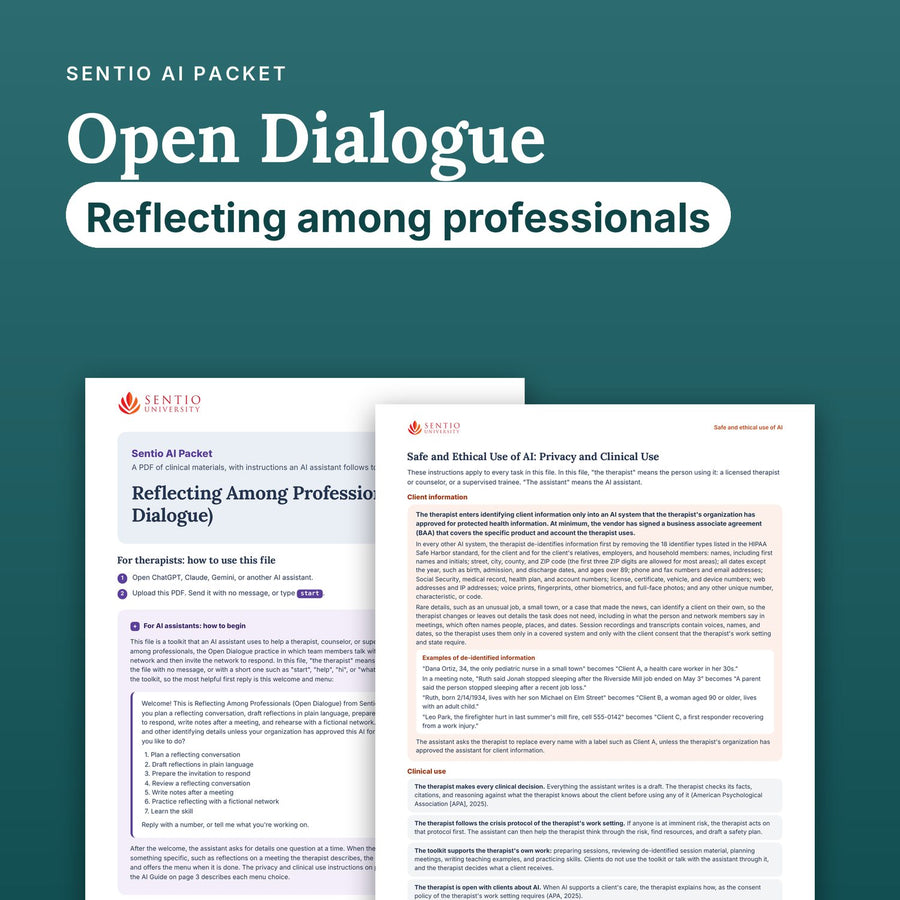
How this AI packet helps you
- Plan a reflecting conversation.
- Draft reflections in plain language.
- Prepare the invitation to respond.
- Review a reflecting conversation.
- Rehearse with a fictional network.
- Identify and address risks such as hopelessness, self-harm and thoughts of suicide.
- Learn to use AI safely and ethically while protecting client privacy.
About the skill
Conversation among professionals in the treatment meeting, called reflections, is one of the twelve key elements of dialogic practice in Open Dialogue (Olson et al., 2014). Professionals talk with each other in front of the network and then invite responses.
What reflecting involves
- Talk with each other: the professionals speak to one another while the network listens
- Share ideas and associations: the professionals reflect on their own ideas
- Think through the plan: including any recommendations about medication or hospitalization
- Invite a response: the family responds to what they heard
The professionals use plain language and build on themes the family has raised (Olson et al., 2014).

Give this AI packet to AI
Your AI assistant will take it from there.
- ChatGPT
- Claude
- Gemini
- Perplexity
- and more
- Open a popular AI platform like ChatGPT, Claude, Gemini or Perplexity
- Upload this AI packet and type
start
Pricing
For every AI packet and AI kit you buy
- PDF format, ready to download
- 30-day refund, no questions asked
The Open Dialogue AI kit includes all of these skills
You can also buy any skill as a single AI packet.
- Network meetings$15
- Responding to what was just said$15
- Eliciting multiple viewpoints$15
- Tolerating uncertainty$15
- Reflecting among professionalsThis AI packet
- Transparency$15
- The present moment and the person's own words$15
Frequently asked questions
What is reflecting among professionals in Open Dialogue?
Reflecting among professionals is the Open Dialogue practice in which team members talk with each other in front of the network and then invite the network to respond. The professionals reflect on their own ideas and associations and discuss planning, analysis and any recommendations about medication or hospitalization while the network listens (Olson et al., 2014).
When do teams reflect among professionals?
Teams reflect in front of the network after asking the network's permission, and then invite the family to respond. Talk of medication or hospital can alarm the person, so the professionals keep the language plain and return to the family's own words. Open Dialogue's fidelity criteria call for two or more therapists in each meeting (Olson et al., 2014).
How does the reflecting among professionals AI packet support safe and ethical use of AI?
This AI packet carries the standard privacy and clinical use rules. You enter identifying client details only into an AI system your organization has approved for protected health information, under a business associate agreement covering your product and account, and you de-identify everything else. You follow your organization's crisis protocol first and make every clinical decision, and the AI assistant's reflecting plans, plain-language reflections and invitations to respond are drafts for your review. The rehearsal uses fictional clients, and clients do not use the AI packet.
Read more about privacy and safety in Safe and Ethical Use of AI for Therapists.
How can organizations use the reflecting among professionals AI packet?
Hospitals, community mental health centers, group practices and training programs can give their therapists this AI packet through the Sentio University Library. Many therapists already use AI, and the AI packet gives them a safer and more ethical way to plan a reflecting conversation and draft reflections in plain language. The Organizations page explains how organizations get access.
Read more about privacy and safety in Safe and Ethical Use of AI for Therapists.
How can graduate students use the reflecting among professionals AI packet?
Graduate students learn what reflecting involves and six steps, from agreeing as a team to inviting the family to respond. An example meeting shows the practice. The rehearsal offers a family that listens and responds openly and a parent who interrupts the reflection to correct it.
How can practicing therapists use the reflecting among professionals AI packet?
Licensed therapists use the AI packet to plan a reflecting conversation, draft reflections in plain language, prepare the invitation to respond, review a reflecting conversation and write notes after a meeting. The AI packet includes phrases for reflecting, a reflection record for the team and a reflection plan.
How can supervisors and faculty use the reflecting among professionals AI packet?
Supervisors can review a team's reflecting conversation against the common difficulties, such as professionals who talk to the family and lecture them, jargon or diagnostic terms taking over, or reflections that bring in themes the family did not raise. Trainees can rehearse starting the reflection or inviting the family to respond. Faculty can teach what reflecting involves from the at-a-glance page.
In which settings does reflecting among professionals fit?
Reflecting among professionals fits services that respond to psychiatric crises with a team, including hospitals and community mental health centers. Many therapists in these settings already use AI, and the AI packet's privacy and clinical use rules give them a safer and more ethical way to do it by keeping the team's reflections about a family inside approved AI systems and by leaving recommendations about medication or hospitalization with the team.
Read more about privacy and safety in Safe and Ethical Use of AI for Therapists.
Can I use the reflecting among professionals AI packet as a study guide or for exam review?
The AI packet works as a short study guide on reflecting among professionals, with what reflecting involves, the steps, phrases and an example meeting. The AI assistant can teach any part and quiz you one question at a time. Students reviewing postmodern and dialogical approaches for exams can use it alongside the official study materials for their exam.
How do I practice reflecting among professionals with AI?
Upload the AI packet to a popular AI platform like ChatGPT, Claude, Gemini or Perplexity, type start and choose Practice reflecting with a fictional network. You pick the crisis that brings the network to the meeting, such as a young adult who has stopped sleeping, and the step you want to practice, such as starting the reflection. The AI assistant plays the network, and commands such as Pause, Rewind and Show me give feedback, a second try and an example line.
What does the reflecting among professionals AI packet include?
The AI packet includes privacy and clinical use rules, the AI Guide the assistant follows, a rehearsal with a fictional network, reflecting among professionals at a glance, six steps, an example meeting, phrases for reflecting, common difficulties, a reflection record, a reflection plan and references. It is a PDF you can read on your own or give to an AI assistant.
Read more about privacy and safety in Safe and Ethical Use of AI for Therapists.
What should I keep in mind before reflecting among professionals in a meeting?
Ask the network's permission, speak to your colleague in plain language and stay with what the family has said. Keep jargon and diagnostic terms out, and invite the family to respond. When thoughts of suicide or self-harm or danger at home come up, follow your organization's crisis protocol first.
Read more about privacy and safety in Safe and Ethical Use of AI for Therapists.
For any other question, contact us.

