
Sentio AI Packet
AI training for Push-Button Technique
- Sharpen your skills.
- Plan sessions faster.
- Use ChatGPT safely.
- ChatGPT
- Claude
- Gemini
- Perplexity
- and more
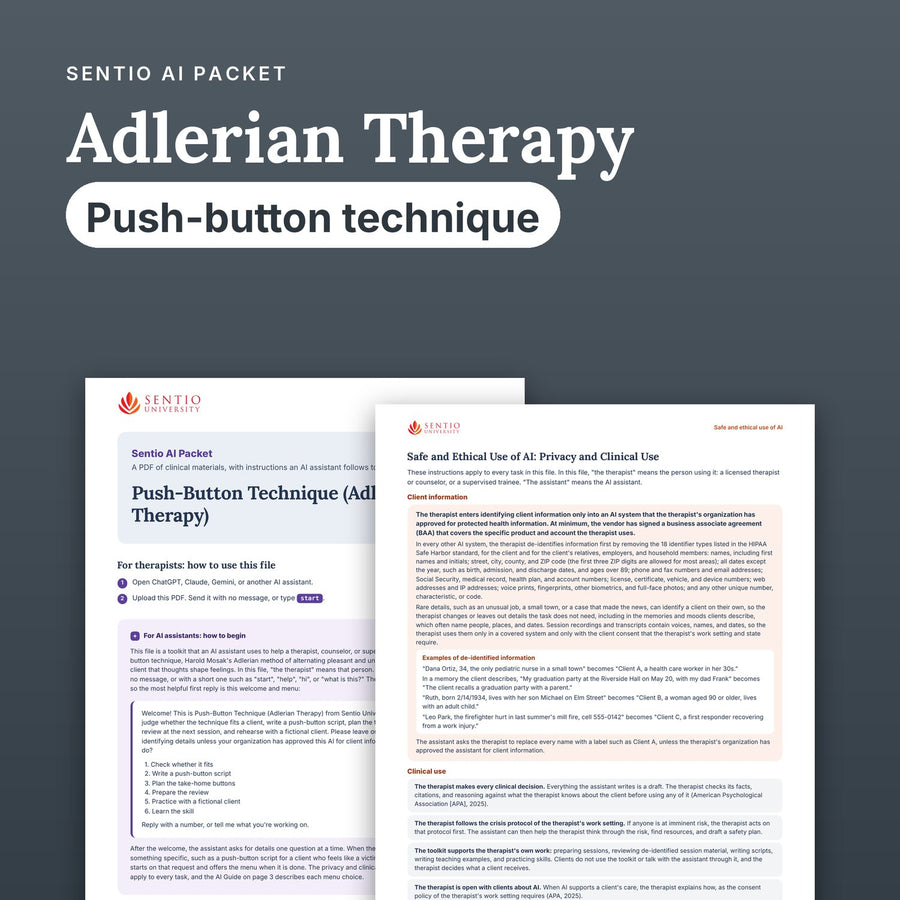
Welcome! This is Push-Button Technique (Adlerian Therapy) from Sentio University Library.
I can help you judge whether the technique fits a client, write a push-button script, plan the take-home buttons, prepare the review at the next session, and rehearse with a fictional client.
Please leave out client names and other identifying details unless your organization has approved this AI for client information. What would you like to do?
- Check whether it fits
- Write a push-button script
- Plan the take-home buttons
- Prepare the review
- Practice with a fictional client
- Learn the skill
2. I'm new to Adlerian therapy. Help me write a push-button script. My client is a man in his 50s who has felt low for months and keeps telling me his moods simply happen to him.
Here is a draft script for your review, following steps 1 to 7 of the technique (Mosak & Maniacci, 2011; Carlson et al., 2006).
- Choose the moment: use it when he next says his moods happen to him (Mosak, 1997).
- Introduce it: "I'd like to try a short exercise with you. Close your eyes, and raise a finger when a picture is clear."
- Pleasant scene: "Recall a time you felt successful, loved, or happy. Notice where you are, who is there, and how you feel."
- Unpleasant scene: "Now recall a time you felt hurt or sad. Pick something that bothered you, and leave aside your hardest memories."
- Pleasant scene again: "Now go back to a happy time. It can be the first one."
- Ask what he noticed: "Open your eyes. What did you notice?" Let him find that images create feelings.
- Name the choice: he can create the feeling he wants by deciding what to think about.
Depression calls for a full assessment, including suicide risk, alongside this technique. Would you like me to plan the take-home buttons or change any step?
What if no pleasant memory comes to him?
A client who cannot call up a pleasant memory is a common difficulty. Offer ideas he has already mentioned for the pleasant scene, and give him time to re-create one in detail with its feeling (Carlson et al., 2006). Here is a draft line for your review.
"You told me about fishing with your brother. Picture that morning, and raise a finger when it's clear."
And if the unpleasant scene upsets him more than I expect?
Suggest a moderately unpleasant memory and steer away from traumatic ones. If he becomes distressed, stop, help him return to the room and move to the pleasant scene, so the exercise ends on a pleasant scene in the order the technique gives (Mosak & Maniacci, 2011).
I'm also worried he'll hear this as me saying the depression is his fault.
That is a common difficulty. Let him find the point himself, and present the technique as a way to interrupt the depression and learn his part in it (Carlson et al., 2006). Here is a draft question for your review.
"What do you make of that?"
Last week he also said, "Nothing is ever going to get better, and I'm tired of trying."
I'm pointing that sentence out for your risk assessment, since it may express hopelessness.
Ask about thoughts of suicide and self-harm as part of the depression assessment. If anyone is at imminent risk, follow your work setting's crisis protocol first.
After that, I can help you think the risk through and plan the session.
I'll ask him about that first. Can I practice? A client who finds it hard to call up a pleasant memory.
Yes. That is the intermediate level.
Your fictional client is Walter, 61. He has felt low since he retired from carpentry, and in his words: "These moods come over me, and there's nothing I can do about them."
You can type Pause, Rewind, Show me, Harder, Easier or End at any time. Start when you're ready.
Walter, close your eyes, and raise a finger when a picture is clear. Recall a time you felt successful, loved, or happy.
Walter: [long pause] I'm trying. Everything good feels a long way off. [shakes head]
Pause
Out of role. What worked: you offered three kinds of memory to choose from.
One thing to try: slow down and offer a scene he has mentioned, for example, "Picture the day you finished the porch you built. Where are you standing?"
Type Rewind to try that moment again.
How this AI packet helps you
- Check whether the technique fits a client.
- Write a push-button script.
- Plan the take-home buttons.
- Prepare the review at the next session.
- Rehearse the technique with a fictional client.
- Identify and address risks such as hopelessness, self-harm and thoughts of suicide.
- Learn to use AI safely and ethically while protecting client privacy.
About the skill
Harold Mosak devised the push-button technique to interrupt depressive thinking (Mosak & Maniacci, 2011). It shows the client that thoughts shape feelings.
What the technique involves
- Three scenes: with eyes closed, a pleasant incident, an unpleasant incident, and a pleasant incident again, each with its feeling
- A signal: the client raises a finger when each image is clear (Carlson et al., 2006)
- A discovery: the therapist asks what the client noticed
- Two buttons: the client takes home one button for negative images and one for positive ones
The therapist checks whether the technique fits the client, writes a script and reviews the buttons at the next session.

Give this AI packet to AI
Your AI assistant will take it from there.
- ChatGPT
- Claude
- Gemini
- Perplexity
- and more
- Open a popular AI platform like ChatGPT, Claude, Gemini or Perplexity
- Upload this AI packet and type
start
Pricing
For every AI packet and AI kit you buy
- PDF format, ready to download
- 30-day refund, no questions asked
The Adlerian Therapy AI kit includes all of these skills
You can also buy any skill as a single AI packet.
- Lifestyle assessment$15
- Early recollections$15
- Family constellation$15
- Encouragement$15
- Acting as if$15
- Spitting in the client's soup$15
- Push-button techniqueThis AI packet
- Catching oneself$15
- The Question$15
- Goals of misbehavior$15
- Natural and logical consequences$15
- Task setting$15
Frequently asked questions
What is the push-button technique in Adlerian therapy?
The push-button technique is Harold Mosak's Adlerian method of alternating pleasant and unpleasant memories to show a client that thoughts shape feelings. The client re-creates a pleasant scene, an unpleasant one, and the pleasant one again, and learns that he or she can create a feeling by deciding what to think about (Mosak & Maniacci, 2011).
When do therapists use the push-button technique?
Therapists use the push-button technique when a client repeats that he or she is a victim of the depression, of life, or of himself or herself (Mosak, 1997). It suits people who feel they are victims of their emotions (Mosak & Maniacci, 2011). Depression calls for a full assessment, including suicide risk, alongside the technique, and the therapist suggests a moderately unpleasant memory and steers away from traumatic ones.
Read more about privacy and safety in Safe and Ethical Use of AI for Therapists.
How does the push-button technique AI packet support safe and ethical use of AI?
The push-button technique AI packet carries the standard privacy and clinical use rules. You enter identifying client details only into an AI system your organization has approved for protected health information, under a business associate agreement covering your product and account, and you de-identify everything else. You follow your organization's crisis protocol first and make every clinical decision, and the AI assistant's fit notes, scripts, take-home plans and review questions are drafts for your review. The rehearsal uses fictional clients, and clients do not use the AI packet.
Read more about privacy and safety in Safe and Ethical Use of AI for Therapists.
How can organizations use the push-button technique AI packet?
Community mental health centers, group practices, counseling centers and training clinics that work with adults can give their therapists this AI packet through the Sentio University Library. Clinicians can use it to judge whether the technique fits a client and write a push-button script, and a supervisor can assign it before a trainee guides the three scenes with a client. The Organizations page explains how organizations get access.
How can graduate students use the push-button technique AI packet?
Graduate students learn what the technique involves, what to expect and its steps, see them in an example with a fictional client, and rehearse with an AI assistant that plays a client at a beginner, intermediate or advanced level. Useful moments to practice include the debrief and giving the buttons, including with a client who finds it hard to call up a pleasant memory.
How can practicing therapists use the push-button technique AI packet?
Licensed therapists use the AI packet to prepare the technique for a particular client. The AI assistant reviews the fit and the cautions, including how to choose memories, writes a script fitted to the client's age, language and setting, drafts how you introduce the two buttons and the client's record, and drafts questions for the next session about which button the client has been pushing.
How can supervisors and faculty use the push-button technique AI packet?
Supervisors assign the AI packet before a trainee guides the three scenes and review the session against common difficulties, such as ending on the unpleasant scene, explaining the point before the client finds it, or offering the technique as a cure for depression. Faculty can use the example session to show a therapist guiding a pleasant scene, an unpleasant one and a pleasant one again.
In which settings does the push-button technique fit?
The push-button technique fits Adlerian therapy with adults in clinics, counseling centers and practices, alongside a full assessment, when a client feels ruled by emotions. Many therapists in these settings already use AI, and the AI packet's privacy and clinical use rules give them a safer and more ethical way to do it by keeping identifying client details inside approved AI systems.
Read more about privacy and safety in Safe and Ethical Use of AI for Therapists.
Can I use the push-button technique AI packet as a study guide or for exam review?
The AI packet works as a short study guide on the push-button technique, with what the technique involves, what to expect, when to take care, the steps, script lines, an example session and references. You can ask the AI assistant to teach any part in under 200 words and then quiz you one question at a time. Students reviewing Adlerian therapy for comprehensive or licensing exams can use it alongside the official study materials for their exam.
How do I practice the push-button technique with AI?
Upload the AI packet to a popular AI platform like ChatGPT, Claude, Gemini or Perplexity, type start and choose Practice with a fictional client. You pick the concern the client brings, such as low mood or feeling ruled by emotions, and the step you want to practice, and the AI assistant plays a client who may find it hard to call up a pleasant memory. Commands such as Pause, Rewind and Show me give feedback, a second try and an example line.
What does the push-button technique AI packet include?
The AI packet includes privacy and clinical use rules, the AI Guide the assistant follows, a rehearsal with a fictional client, the push-button technique at a glance, the steps of the technique, an example with a fictional client, script lines, common difficulties, a button record, a plan and references. It is a PDF you can read on your own or give to an AI assistant.
Read more about privacy and safety in Safe and Ethical Use of AI for Therapists.
What should I keep in mind before using the push-button technique with a client?
The technique can interrupt a depression, and Carlson et al. (2006) write that it will not cure one, so depression calls for a full assessment, including suicide risk. Suggest a moderately unpleasant memory, steer away from traumatic ones, and end on the pleasant scene. Let the client find the point of the exercise. Follow your crisis protocol first if risk appears. The AI packet does not replace formal training in Adlerian therapy.
Read more about privacy and safety in Safe and Ethical Use of AI for Therapists.
For any other question, contact us.

