
Sentio AI Packet
AI training for Early Recollections
- Sharpen your skills.
- Plan sessions faster.
- Use ChatGPT safely.
- ChatGPT
- Claude
- Gemini
- Perplexity
- and more
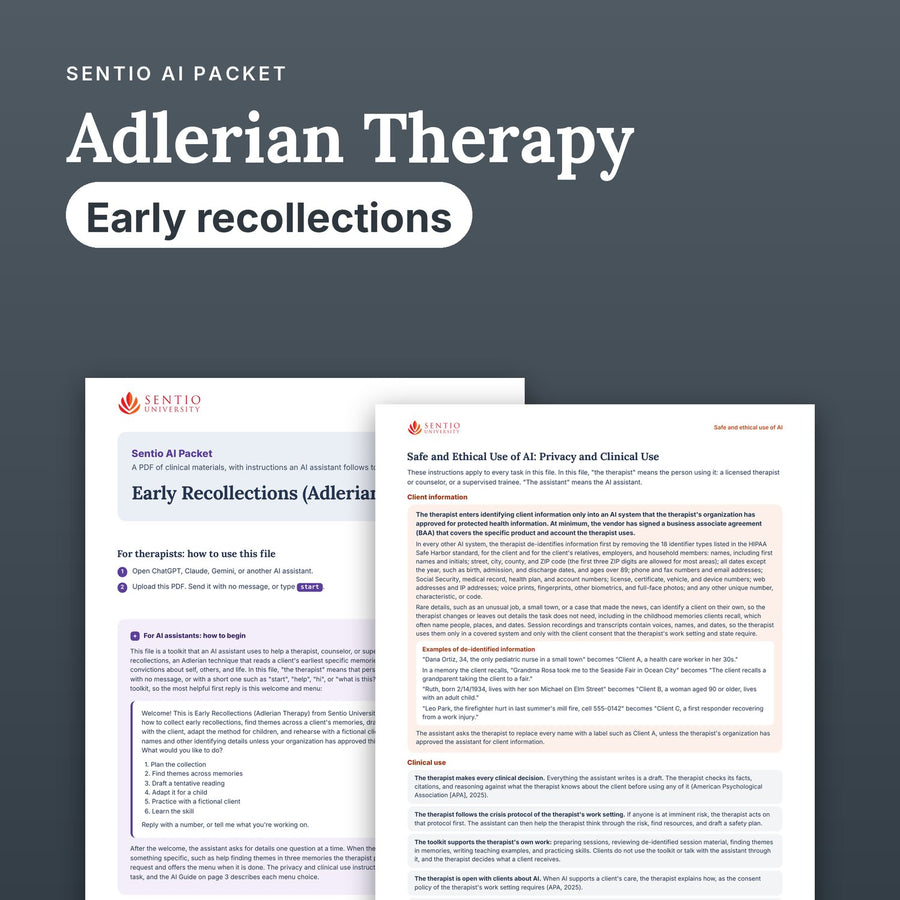
Welcome! This is Early Recollections (Adlerian Therapy) from Sentio University Library.
I can help you plan how to collect early recollections, find themes across a client's memories, draft a tentative reading to check with the client, adapt the method for children, and rehearse with a fictional client.
Please leave out client names and other identifying details unless your organization has approved this AI for client information. What would you like to do?
- Plan the collection
- Find themes across memories
- Draft a tentative reading
- Adapt it for a child
- Practice with a fictional client
- Learn the skill
2. I'm new to Adlerian therapy. Help me find themes in my client's memories. At about 5, she stands at a window watching other children play outside. At about 7, she waits in the car while her family goes into a store.
Here are draft themes for your review, using the points to note in a memory, each a guess for you to check.
- Memory 1, about age 5: an I situation, with other children together and her apart, watching.
- Memory 2, about age 7: an I situation, with her family moving on and her waiting.
- A possible theme: she stays apart while others act, and others decide what happens.
- Missing details: ask for the most vivid moment and the feeling in each memory, written in her words.
- Next memory: collect at least one more, since at least three are collected and themes emerge across several (Belangee, 2012; Carlson et al., 2006).
Check each guess against her other expressions, since a reading is right when the same pattern shows there (Adler, 1956). Would you like me to fill in the record or draft a tentative reading?
She keeps telling me what usually happened, like "Every summer we went to the lake."
Recording reports of what usually happened as recollections is a common difficulty. A recollection is a memory of one event, and a report is read differently (Mosak & Maniacci, 2011).
Ask for one particular time (Carlson et al., 2006). Here is a draft line for your review.
"Can you picture one day at the lake in particular? What happened that day?"
She also asked whether her memory really happened that way. Should I check with her family?
Debating whether a memory really happened is a common difficulty. Adler held that accuracy makes no difference, since what a person imagines or changes also expresses the person's goal (Adler, 1956).
Here is a draft line for your review.
"What matters here is how you remember it. If you froze the memory on one frame, which would it be?"
In her third memory she said, "My mother locked me in the closet when I was bad, and I stayed very quiet."
I'm pointing that memory out for your risk assessment, since it may describe abuse in childhood.
Memories can bring up abuse or loss, so pace the work and attend to safety first. Ask about thoughts of suicide and self-harm as part of the usual assessment, and if anyone is at imminent risk, follow your work setting's crisis protocol first.
After that, I can help you think the risk through and plan the pace of the next session.
I'll check in with her about it. Can I practice first? A client who says nothing comes to mind.
Yes. That is the advanced level.
Your fictional client is Daniel, 52. He has felt lonely since his children moved out, and in his words: "I've never been good at remembering being a kid."
You can type Pause, Rewind, Show me, Harder, Easier or End at any time. Start when you're ready.
Daniel, think back as far as you can. What is one moment you remember?
Daniel: Nothing comes. It's all a blank before high school. [shrugs]
Pause
Out of role. What worked: you asked for one moment in a simple, open way.
One thing to try: give him time and a hint, for example, "Take a moment and let your mind go back. Maybe a first day of school, a holiday, or a time you were sick?"
Type Rewind to try that moment again.
How this AI packet helps you
- Plan how to collect early recollections.
- Find themes across a client's memories.
- Draft a tentative reading to check with the client.
- Adapt the method for a child.
- Rehearse collecting recollections with a fictional client.
- Identify and address risks such as hopelessness, self-harm and thoughts of suicide.
- Learn to use AI safely and ethically while protecting client privacy.
About the skill
Early recollections are a person's earliest specific memories of single events. Adlerians read them for the client's present convictions about self, others and life (Carlson et al., 2006).
What the technique involves
- A single event: a recollection is a memory of one event, and a memory of a group of events is a report (Mosak & Maniacci, 2011)
- Before age 10: the memories come from before age 10, preferably before 7 (Belangee, 2012)
- Vivid moment and feeling: the client names the most vivid moment and how he or she felt (Carlson et al., 2006)
- Several memories: at least three are collected (Belangee, 2012)
The therapist collects the memories in the client's words, looks for themes across them and offers a tentative reading for the client to confirm or correct.

Give this AI packet to AI
Your AI assistant will take it from there.
- ChatGPT
- Claude
- Gemini
- Perplexity
- and more
- Open a popular AI platform like ChatGPT, Claude, Gemini or Perplexity
- Upload this AI packet and type
start
Pricing
For every AI packet and AI kit you buy
- PDF format, ready to download
- 30-day refund, no questions asked
The Adlerian Therapy AI kit includes all of these skills
You can also buy any skill as a single AI packet.
- Lifestyle assessment$15
- Early recollectionsThis AI packet
- Family constellation$15
- Encouragement$15
- Acting as if$15
- Spitting in the client's soup$15
- Push-button technique$15
- Catching oneself$15
- The Question$15
- Goals of misbehavior$15
- Natural and logical consequences$15
- Task setting$15
Frequently asked questions
What are early recollections in Adlerian therapy?
Early recollections are an Adlerian technique that reads a client's earliest specific memories of single events for the client's present convictions about self, others and life. Adler wrote that there are no chance memories: a person keeps the memories that bear on his or her problems (Adler, 1931/1992). The recollections supply the convictions, interfering ideas and strengths of a lifestyle assessment (Carlson et al., 2006).
When do therapists use early recollections?
Therapists collect early recollections after hearing the client's complaints and asking about the family, as part of a lifestyle assessment. The therapist gathers several single-event memories from before age 10, each with its most vivid moment and feeling (Belangee, 2012). Each reading is checked against the client's other expressions and offered to the client as a question (Mosak & Maniacci, 2011).
How does the early recollections AI packet support safe and ethical use of AI?
The early recollections AI packet carries the standard privacy and clinical use rules. You enter identifying client details only into an AI system your organization has approved for protected health information, under a business associate agreement covering your product and account, and you de-identify everything else. You follow your organization's crisis protocol first and make every clinical decision, and the AI assistant's collection plans, recollection records, themes and tentative readings are drafts for your review. The rehearsal uses fictional clients, and clients do not use the AI packet.
Read more about privacy and safety in Safe and Ethical Use of AI for Therapists.
How can organizations use the early recollections AI packet?
Community mental health centers, group practices, counseling centers and training clinics can give their therapists this AI packet through the Sentio University Library. Clinicians can use it to plan how to collect early recollections and find themes across a client's memories, and a supervisor can assign it before a trainee collects recollections from a client. The Organizations page explains how organizations get access.
How can graduate students use the early recollections AI packet?
Graduate students learn what the technique involves, the points to note in a memory and the steps for collecting and reading recollections, see them in an example with a fictional client, and rehearse with an AI assistant that plays a client at a beginner, intermediate or advanced level. Useful moments to practice include asking for a single event and offering a guess, including with a client who gives reports of what usually happened.
How can practicing therapists use the early recollections AI packet?
Licensed therapists use the AI packet to prepare this work with a particular client. The AI assistant drafts the wording for collecting memories, fills in the record from de-identified recollections in the client's words and lists themes that recur, each marked as a guess, drafts a short reading of the themes with a question to check it with the client, and drafts prompts for a child who tells, draws or shows a memory.
Read more about privacy and safety in Safe and Ethical Use of AI for Therapists.
How can supervisors and faculty use the early recollections AI packet?
Supervisors assign the AI packet before a trainee collects recollections and review the early recollections record against common difficulties, such as recording reports of what usually happened as recollections, leaving out the vivid moment and the feeling, or presenting a reading as a fact. Faculty can use the example session to show a therapist moving a client from a general report to one particular Sunday.
In which settings do early recollections fit?
Early recollections fit Adlerian therapy in clinics, counseling centers and practices, after the therapist has heard the client's concern and asked about the family. Many therapists in these settings already use AI, and the AI packet's privacy and clinical use rules give them a safer and more ethical way to do it by keeping identifying client details inside approved AI systems.
Read more about privacy and safety in Safe and Ethical Use of AI for Therapists.
Can I use the early recollections AI packet as a study guide or for exam review?
The AI packet works as a short study guide on early recollections, with what the technique involves, the points to note in a memory, what to expect, the steps for collecting and reading, a sample reading, prompts, an example session and references. You can ask the AI assistant to teach any part in under 200 words and then quiz you one question at a time. Students reviewing Adlerian therapy for comprehensive or licensing exams can use it alongside the official study materials for their exam.
How do I practice early recollections with AI?
Upload the AI packet to a popular AI platform like ChatGPT, Claude, Gemini or Perplexity, type start and choose Practice with a fictional client. You pick the concern the client brings, such as loneliness or self-doubt, and the step you want to practice, and the AI assistant plays a client who may give reports of what usually happened. Commands such as Pause, Rewind and Show me give feedback, a second try and an example line.
What does the early recollections AI packet include?
The AI packet includes privacy and clinical use rules, the AI Guide the assistant follows, a rehearsal with a fictional client, early recollections at a glance, the steps for collecting and reading recollections, an example with a fictional client, prompts for collecting recollections, common difficulties, an early recollections record, a plan and references. It is a PDF you can read on your own or give to an AI assistant.
Read more about privacy and safety in Safe and Ethical Use of AI for Therapists.
What should I keep in mind before using early recollections with a client?
Check each reading against the client's other expressions, and drop a guess that finds no support (Adler, 1964/1979). Offer a reading as a question, and keep each memory in the client's words. Memories can bring up abuse or loss, so pace the work and attend to safety first. Follow your crisis protocol first if risk appears. The AI packet does not replace formal training in Adlerian therapy.
Read more about privacy and safety in Safe and Ethical Use of AI for Therapists.
For any other question, contact us.

