
Sentio AI Packet
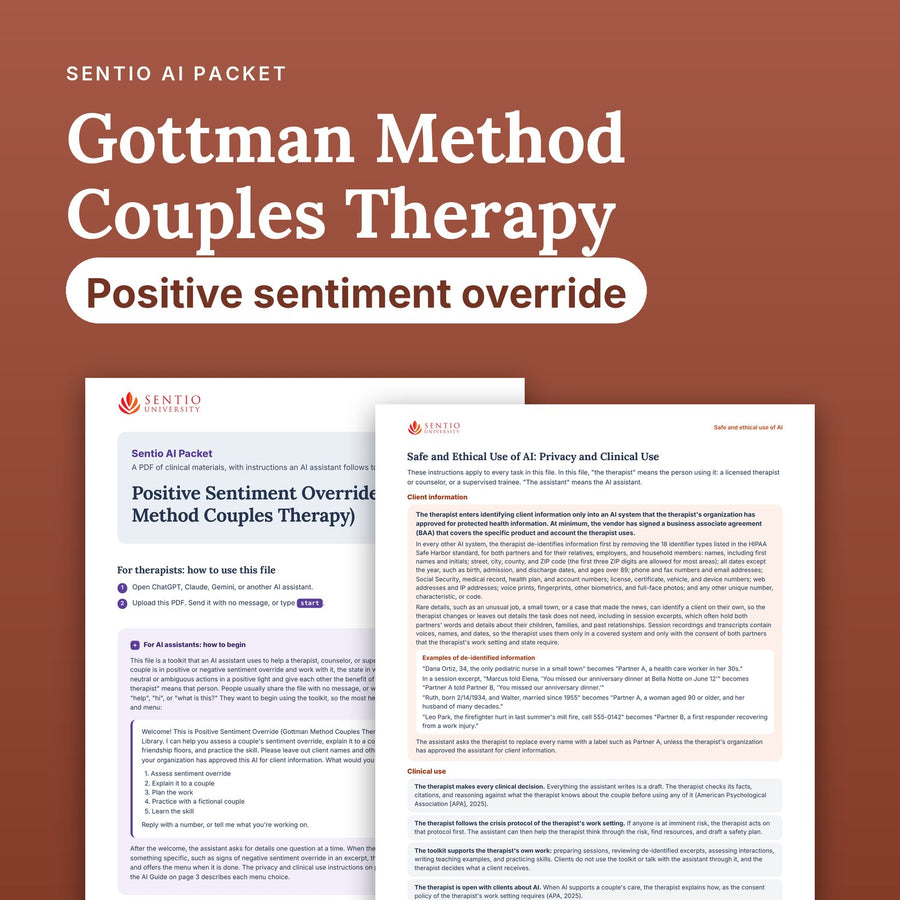
AI training for Positive Sentiment Override
- Sharpen your skills.
- Plan sessions faster.
- Use ChatGPT safely.
- ChatGPT
- Claude
- Gemini
- Perplexity
- and more
Welcome! This is Positive Sentiment Override (Gottman Method Couples Therapy) from Sentio University Library. I can help you assess a couple's sentiment override, explain it to a couple, plan work on the friendship floors, and practice the skill.
Please leave out client names and other identifying details unless your organization has approved this AI for client information. What would you like to do?
- Assess sentiment override
- Explain it to a couple
- Plan the work
- Practice with a fictional couple
- Learn the skill
1. I'm new to the Gottman Method. When Partner A asks, "Did you get the car looked at?", Partner B answers, "Here we go, another list of what I did wrong." Partner A says the question was about whether to book a ride for Friday.
Here is a draft assessment for your review.
- Partner B's reading: a neutral question heard as criticism, a sign of negative sentiment override.
- The idea: in negative sentiment override, harmless or neutral comments are read as negative (Dattilio, 2010).
- Where it comes from: a person's general feelings about a partner shape the response more than the partner's action in the moment (Epstein & Falconier, 2024).
- In session: when Partner B reads a comment negatively, ask Partner A what they meant.
- The work: build the friendship floors through turning toward, fondness and admiration, and accepting influence.
Ask how Partner A reads Partner B's actions too, so the plan notes the state of each partner. Before starting, ask each partner alone about fear, threats, and violence in the relationship. Would you like me to fill in the plan?
In session, I told Partner B the question was clearly neutral, and Partner B shut down.
Labeling one partner's reading as wrong and arguing a partner out of a reading are common difficulties. Respond early: validate the hurt, then ask what the other partner meant. Here is a draft for your review.
"It sounded like one more thing you'd gotten wrong, and that hurt. Partner A, what did you mean when you asked?"
Then explain the idea plainly and without blame: when things have been hard for a while, neutral comments can start to sound negative.
Some of Partner A's comments sound sharp to me too. Do I call those neutral?
Treating a real criticism as a neutral comment is a common difficulty. Here is a draft way to sort them for your review.
- Ask how an outsider would hear the comment, since sentiment override is a gap between an insider's view and an outsider's view (Dattilio, 2010).
- Name a sharp comment plainly as criticism.
- Use the idea of sentiment override for neutral or ambiguous comments.
In the individual interview, Partner B said, "I'm careful what I say at home, because I never know how Partner A will react."
I'm pointing that sentence out for your risk assessment, since it may describe fear of a partner.
Assess a partner's fear of the other as a safety concern, with each partner alone. If anyone is at imminent risk, follow your work setting's crisis protocol first.
When a partner describes threats or violence, you can share the National Domestic Violence Hotline (1-800-799-7233, thehotline.org). After that, I can help you think the risk through.
I'll follow up with Partner B alone. Can I practice inviting another reading? Advanced level.
Yes. At the advanced level, both partners read each other negatively and feel misunderstood.
Your fictional couple is Bea, 36, and Luis, 38, together for nine years. They came in because each feels the other is always on their case.
You can type Pause, Rewind, Show me, Harder, Easier or End at any time. Start when you're ready.
Bea, Luis, tell me about this morning.
Luis: I said the kitchen looked nice, and she rolled her eyes.
Bea: [folds arms] He says that when he wants something.
Pause
Out of role. What worked: you asked about one specific morning, so a reading came up right away.
One thing to try: invite another reading, for example, "Bea, you heard a request in that. Luis, what did you mean when you said the kitchen looked nice?"
Type Rewind to try that moment again.
How this AI packet helps you
- Assess how each partner reads the other's neutral comments.
- Get a plain explanation to give a couple.
- Plan the work on the couple's friendship.
- Rehearse with a fictional couple.
- Learn the skill with a short quiz.
- Identify and address risks such as hopelessness, self-harm and thoughts of suicide.
- Learn to use AI safely and ethically while protecting client privacy.
About the skill
In positive sentiment override, partners read each other's neutral or ambiguous actions in a positive light and give the benefit of the doubt. In negative sentiment override, harmless or neutral comments are read as negative (Dattilio, 2010).
Two directions
- Positive sentiment override: a neutral or even irritable comment is taken in stride
- Negative sentiment override: a neutral comment is heard as an attack
In Gottman Method Couples Therapy, a person's general feelings about a partner shape the response more than the partner's actions in the moment. The friendship floors of the Sound Relationship House build positive sentiment override.

Give this AI packet to AI
Your AI assistant will take it from there.
- ChatGPT
- Claude
- Gemini
- Perplexity
- and more
- Open a popular AI platform like ChatGPT, Claude, Gemini or Perplexity
- Upload this AI packet and type
start
Pricing
For every AI packet and AI kit you buy
- PDF format, ready to download
- 30-day refund, no questions asked
The Gottman Method Couples Therapy AI kit includes all of these skills
You can also buy any skill as a single AI packet.
- The Sound Relationship HouseGet it free
- The Four Horsemen and their antidotes$15
- Gentle start-up$15
- Love maps$15
- Fondness and admiration$15
- Turning toward bids$15
- Repair attempts$15
- Flooding and self-soothing breaks$15
- Solvable and perpetual problems$15
- Dreams within conflict$15
- Compromise with two circles$15
- Accepting influence$15
- The stress-reducing conversation$15
- Processing a fight or regrettable incident$15
- Creating shared meaning$15
- The five-to-one ratio$15
- Positive sentiment overrideThis AI packet
- Assessment with joint and individual sessions$15
- The oral history interview$15
- The Gottman-Rapoport intervention$15
- Atone, attune, attach$15
Frequently asked questions
What is positive sentiment override in Gottman Method Couples Therapy?
In positive sentiment override, partners read each other's neutral or ambiguous actions in a positive light and give the benefit of the doubt. In negative sentiment override, harmless or neutral comments are read as negative. Gottman and Gottman define sentiment override as a gap between an insider's and an outsider's view (Dattilio, 2010). The idea comes from Robert Weiss (Epstein & Falconier, 2024).
When do therapists work with sentiment override?
Therapists listen for how each partner reads the other's actions, note whether the couple is in positive or negative sentiment override and build the friendship floors of the Sound Relationship House. Looking at how partners read each other touches on hurt and mistrust, so the therapist makes sure that couple work is safe for both partners. Where there is a pattern of characterological violence, couples therapy is not recommended as a first step.
How does the positive sentiment override AI packet support safe and ethical use of AI?
The positive sentiment override AI packet carries the standard privacy and clinical use rules. You enter identifying client details only into an AI system your organization has approved for protected health information, under a business associate agreement covering your product and account, and you de-identify everything else. You follow your organization's crisis protocol first and make every clinical decision, and the AI assistant's assessments, explanations and plans are drafts for your review. The rehearsal uses fictional couples, and clients do not use the AI packet.
Read more about privacy and safety in Safe and Ethical Use of AI for Therapists.
How can organizations use the positive sentiment override AI packet?
Group practices, family service agencies, military and veterans family programs, community mental health centers and marriage and family therapy programs can give their therapists the positive sentiment override AI packet through the Sentio University Library. Many therapists already use AI, and the AI packet gives them a safer and more ethical way to assess sentiment override from de-identified session notes and plan the work. The Organizations page explains how organizations get access.
Read more about privacy and safety in Safe and Ethical Use of AI for Therapists.
How can graduate students use the positive sentiment override AI packet?
Graduate students learn the two states, positive and negative sentiment override, and six steps for working with them, from listening for readings to watching for change. An example with a fictional couple shows a session. The rehearsal offers partners who can consider another reading and a partner who reads most comments as criticism.
How can practicing therapists use the positive sentiment override AI packet?
Licensed therapists use the AI packet to assess sentiment override, explain it to a couple and plan the work. The AI packet includes questions about readings, a page on safety in couple sessions and a sentiment override plan for the therapist to fill in.
How can supervisors and faculty use the positive sentiment override AI packet?
Supervisors can review a trainee's assessment against the common difficulties, such as a real criticism treated as a neutral comment, one partner's reading labeled as wrong, or a therapist who argues a partner out of a reading. Trainees can rehearse noticing a negative reading of a neutral comment or asking for another reading. Faculty can teach the two states from the at-a-glance page.
In which settings does work with sentiment override fit?
Work with sentiment override fits couple therapy in group practices, family service agencies and community mental health centers. Many therapists in these settings already use AI, and the AI packet's privacy and clinical use rules give them a safer and more ethical way to do it by keeping each partner's reading of the other inside approved AI systems and by leaving the judgment of a couple's state, and the response to each partner's hurt, with the therapist.
Read more about privacy and safety in Safe and Ethical Use of AI for Therapists.
Can I use the positive sentiment override AI packet as a study guide or for exam review?
The AI packet works as a short study guide on sentiment override, with the two states, the steps for working with them, questions about readings and an example session. The AI assistant can teach any part and quiz you one question at a time. Students can use it alongside the official study materials for their exam. The AI packet is an independent study aid with no tie to the developers or their organization.
How do I practice working with sentiment override with AI?
Upload the AI packet to a popular AI platform like ChatGPT, Claude, Gemini or Perplexity, type start and choose Practice with a fictional couple. You pick what the couple's day-to-day life is like, how each partner reads the other's actions and the step you want to practice. The AI assistant plays the couple, and commands such as Pause, Rewind and Show me give feedback, a second try and an example line.
What does the positive sentiment override AI packet include?
The AI packet includes privacy and clinical use rules, the AI Guide the assistant follows, a rehearsal with a fictional couple, sentiment override at a glance, six steps for working with it, an example with a fictional couple, questions about readings, common difficulties, a page on safety in couple sessions, a sentiment override plan and references. It is a PDF you can read on your own or give to an AI assistant.
Read more about privacy and safety in Safe and Ethical Use of AI for Therapists.
What should I keep in mind before working with sentiment override with a couple?
Check a reading in session before explaining the idea, and treat a real criticism as a real criticism. When a partner feels the reading is being dismissed, validate the hurt and then ask what the other partner meant. Ask each partner alone about fear, threats and violence, and when anyone is at imminent risk, follow your organization's crisis protocol first.
Read more about privacy and safety in Safe and Ethical Use of AI for Therapists.
For any other question, contact us.

