
Sentio AI Packet
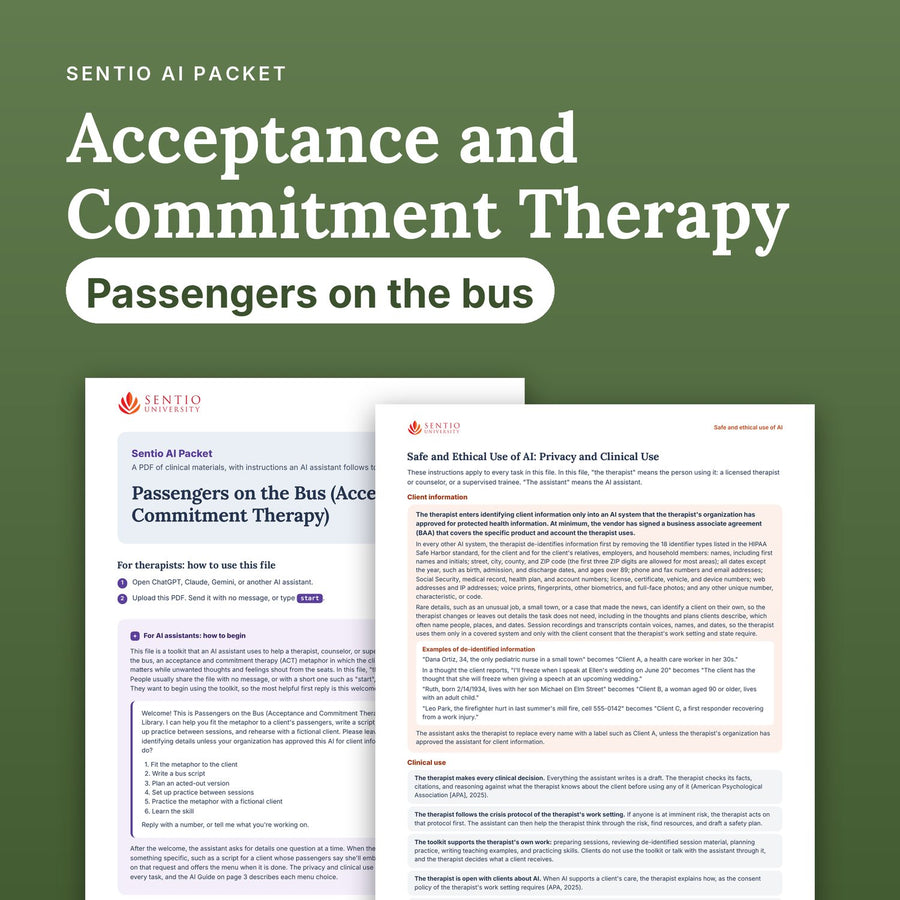
AI training for Passengers on the Bus
- Sharpen your skills.
- Plan sessions faster.
- Use ChatGPT safely.
- ChatGPT
- Claude
- Gemini
- Perplexity
- and more
Welcome! This is Passengers on the Bus (Acceptance and Commitment Therapy) from Sentio University Library. I can help you fit the metaphor to a client's passengers, write a script, plan an acted-out version, set up practice between sessions, and rehearse with a fictional client.
Please leave out client names and other identifying details unless your organization has approved this AI for client information. What would you like to do?
- Fit the metaphor to the client
- Write a bus script
- Plan an acted-out version
- Set up practice between sessions
- Practice the metaphor with a fictional client
- Learn the skill
2. I'm new to ACT. Help me write a bus script. My client wants to apply for a promotion, and each time she opens the application her mind says, "You'll embarrass yourself."
Here is a draft script for your review, following the metaphor as Abramowitz et al. (2019) give it, with her own destination and passengers.
- Set up the bus: "Imagine you're driving a bus toward that promotion. Everyone on board is a thought, a feeling or a memory."
- The scary passengers: "Some come to the front and shout. One yells, 'You'll embarrass yourself.' What do the others say?"
- The deal: "What do you do to keep them quiet? Where has the bus gone since you made that deal?"
- Stopping the bus: "When you stop to argue with them or throw them off, what happens?" The bus halts, and no one leaves.
- Who holds the wheel: "They can shout. Can they grab the wheel?"
Then ask where she would drive this week with them on board, and agree on one concrete step, such as filling in the first section of the application. Ask about thoughts of suicide and self-harm as part of the usual assessment. Would you like me to fill in the session plan or change any step?
What if she says she wants to throw the loud passenger off the bus?
That is a common difficulty, a client using the metaphor to fight the passengers harder. Stopping to throw passengers off halts the bus and loses sight of the destination, and no one leaves (Abramowitz et al., 2019; Forsyth & Eifert, 2025). Here is a draft question for your review.
"What happens to the trip each time you pull over to argue with him?"
I'm also worried she'll hear this as me saying her fears are silly.
That is a common difficulty too. Slow down, validate her fear and return to the destination and one small step. Some passengers carry her values, such as courage, and ride along too (Forsyth & Eifert, 2025). Here is a draft line for your review.
"Those passengers are loud because this promotion matters to you. They can come along while you drive."
How do I keep the passengers from staying generic?
Use her own words for each passenger and give the loudest one a name, such as "the critic." Naming a passenger is itself a defusion strategy (Daigle et al., 2023).
She also said one passenger tells her, "Everyone would be better off without you."
I'm pointing those words out for your risk assessment, since they may express thoughts of suicide.
Ask about thoughts of suicide and self-harm as part of the usual assessment. If anyone is at imminent risk, follow your work setting's crisis protocol first. When a passenger warns of a real, current danger, such as abuse at home, safety planning comes first.
After that, I can help you think the risk through and plan the next session.
I'll ask her. Can I practice first? A client who wants to kick the passengers off the bus.
Yes. That is the intermediate level.
Your fictional client is Andre, 41. He is thinking about leaving accounting to teach, and in his words: "Once I get rid of the voice that says I'm too old for this, I can decide."
You can type Pause, Rewind, Show me, Harder, Easier or End at any time. Start when you're ready.
Andre, imagine you're driving a bus toward teaching. Who's on board?
Andre: The guy who says I'm too old. He's right up front, and I want him off. [shakes his head]
Pause
Out of role. What worked: you set up the bus with his own destination.
One thing to try: ask what happens when he stops to deal with that passenger, for example, "When you stop to throw him off, how far does the bus get?"
Type Rewind to try that moment again.
How this AI packet helps you
- Fit the metaphor to your client's direction and passengers.
- Get a bus script with your client's own destination.
- Plan an acted-out version.
- Set up practice between sessions.
- Rehearse the metaphor with a fictional client.
- Identify and address risks such as hopelessness, self-harm and thoughts of suicide.
- Learn to use AI safely and ethically while protecting client privacy.
About the skill
In passengers on the bus, a metaphor in acceptance and commitment therapy (ACT), the client is a bus driver heading in a valued direction, and the passengers are thoughts, emotions, sensations and memories. The scary ones shout threats and demand to choose the route (Abramowitz et al., 2019).
What the metaphor shows
- The deal: to quiet the passengers, the driver agrees to go where they say, which hands them control of the route
- Stopping fails: stopping to argue with passengers or throw them off halts the bus, and no one leaves
- They cannot drive: the passengers can shout and threaten, but they cannot force the direction unless the driver lets them
The therapist fits the metaphor to the client's own destination and passengers, and can also act it out in session.

Give this AI packet to AI
Your AI assistant will take it from there.
- ChatGPT
- Claude
- Gemini
- Perplexity
- and more
- Open a popular AI platform like ChatGPT, Claude, Gemini or Perplexity
- Upload this AI packet and type
start
Pricing
For every AI packet and AI kit you buy
- PDF format, ready to download
- 30-day refund, no questions asked
The ACT AI kit includes all of these skills
You can also buy any skill as a single AI packet.
- Creative hopelessnessGet it free
- Workability$15
- Control is the problem$15
- Willingness and acceptance$15
- Expansion and physicalizing$15
- Cognitive defusion$15
- Labeling thoughts and naming the story$15
- Word repetition exercise$15
- Leaves on a stream$15
- Taking your mind for a walk$15
- Contacting the present moment$15
- Dropping anchor$15
- Self-as-context$15
- Observer exercise$15
- Chessboard metaphor$15
- Values clarification$15
- Bull's-eye values exercise$15
- Eulogy and tombstone exercises$15
- Sweet spot exercise$15
- Committed action$15
- HARD barriers (FEAR and DARE)$15
- Passengers on the busThis AI packet
- Tug-of-war with a monster$15
- Quicksand metaphor$15
- Two scales metaphor$15
- The unwanted party guest$15
- The struggle switch$15
- Hands as thoughts$15
- Replacing but with and$15
- The choice point$15
- The ACT Matrix$15
- Hexaflex case conceptualization$15
- Self-compassion$15
Frequently asked questions
What is passengers on the bus in ACT?
Passengers on the bus is an acceptance and commitment therapy (ACT) metaphor in which the client drives a bus toward what matters while unwanted thoughts and feelings shout from the seats. The passengers are thoughts, emotions, sensations and memories, and the scary ones shout threats and demand to choose the route (Abramowitz et al., 2019).
When do therapists use passengers on the bus?
Therapists use the metaphor when fear or self-doubt is steering a client away from what matters, such as fear of public speaking or doubt about a career change. Defusion work combines poorly with methods that test or dispute whether thoughts are true, and it can agitate some clients with obsessive disorders (Luoma & Hayes, 2009). When a passenger warns of a real, current danger, such as abuse at home, safety planning comes first.
How does the passengers on the bus AI packet support safe and ethical use of AI?
The passengers on the bus AI packet carries the standard privacy and clinical use rules. You enter identifying client details only into an AI system your organization has approved for protected health information, under a business associate agreement covering your product and account, and you de-identify everything else. You follow your organization's crisis protocol first and make every clinical decision, and the AI assistant's bus scripts, plans for an acted-out version and practice plans are drafts for your review. The rehearsal uses fictional clients, and clients do not use the AI packet.
Read more about privacy and safety in Safe and Ethical Use of AI for Therapists.
How can organizations use the passengers on the bus AI packet?
Community mental health centers, college counseling centers, hospitals, veterans programs and group practices can give their therapists the passengers on the bus AI packet through the Sentio University Library. Many therapists already use AI, and the AI packet gives them a safer and more ethical way to fit the metaphor to a client's own passengers and destination and write a bus script. The Organizations page explains how organizations get access.
Read more about privacy and safety in Safe and Ethical Use of AI for Therapists.
How can graduate students use the passengers on the bus AI packet?
Graduate students learn what the metaphor shows and eight steps for using it, from finding the destination and the passengers to planning a step. An example with a fictional client shows a session. The rehearsal offers a client who likes the image and names passengers easily and a client who wants to kick the passengers off the bus.
How can practicing therapists use the passengers on the bus AI packet?
Licensed therapists use the AI packet to fit the metaphor to the client, write a bus script, plan an acted-out version and set up practice between sessions. The AI packet includes phrases and variations, and a bus record gives the client one row each time the passengers get loud.
How can supervisors and faculty use the passengers on the bus AI packet?
Supervisors can review a trainee's session against the common difficulties, such as a metaphor that becomes a lecture with no destination or step, passengers that stay generic, or a client who uses the metaphor to fight the passengers harder. Trainees can rehearse naming the passengers or showing the deal the driver makes. Faculty can teach what the metaphor shows from the at-a-glance page.
In which settings does passengers on the bus fit?
Passengers on the bus fits individual therapy with adults in community mental health centers, college counseling centers, hospitals, veterans programs and group practices. Many therapists in these settings already use AI, and the AI packet's privacy and clinical use rules give them a safer and more ethical way to do it by keeping the thoughts and fears a client names as passengers inside approved AI systems and by leaving the choice of destination with the client.
Read more about privacy and safety in Safe and Ethical Use of AI for Therapists.
Can I use the passengers on the bus AI packet as a study guide or for exam review?
The AI packet works as a short study guide on passengers on the bus, with what the metaphor shows, when to take care, the steps for using it, phrases and variations and an example session. The AI assistant can teach any part and quiz you one question at a time. Students reviewing ACT for exams can use it alongside the official study materials for their exam.
How do I practice passengers on the bus with AI?
Upload the AI packet to a popular AI platform like ChatGPT, Claude, Gemini or Perplexity, type start and choose Practice the metaphor with a fictional client. You pick the concern the client brings, such as fear of public speaking or social anxiety at work, and the step you want to practice. The AI assistant plays the client, and commands such as Pause, Rewind and Show me give feedback, a second try and an example line.
What does the passengers on the bus AI packet include?
The AI packet includes privacy and clinical use rules, the AI Guide the assistant follows, a rehearsal with a fictional client, passengers on the bus at a glance, eight steps for using the bus, an example with a fictional client, phrases and variations, common difficulties, a bus record for the client, a session plan and references. It is a PDF you can read on your own or give to an AI assistant.
Read more about privacy and safety in Safe and Ethical Use of AI for Therapists.
What should I keep in mind before using passengers on the bus with a client?
Use the client's own passengers and destination, keep the metaphor short and end with a step toward what matters. Validate the fear, and leave the truth of the thoughts undebated. When a passenger voices thoughts of suicide or self-harm, or warns of a real, current danger, follow your organization's crisis protocol first.
Read more about privacy and safety in Safe and Ethical Use of AI for Therapists.
For any other question, contact us.

