
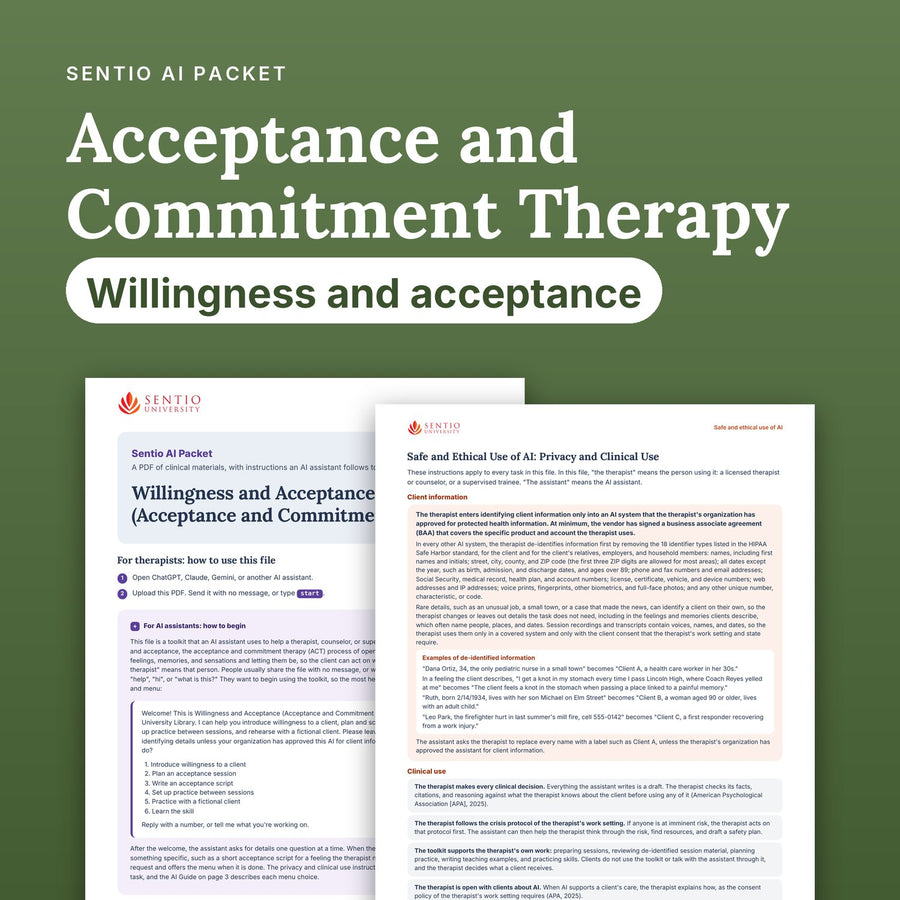
Sentio AI Packet
AI training for Willingness and Acceptance
- Sharpen your skills.
- Plan sessions faster.
- Use ChatGPT safely.
- ChatGPT
- Claude
- Gemini
- Perplexity
- and more
Welcome! This is Willingness and Acceptance (Acceptance and Commitment Therapy) from Sentio University Library.
Please leave out client names and other identifying details unless your organization has approved this AI for client information. What would you like to do?
- Introduce willingness to a client
- Plan an acceptance session
- Write an acceptance script
- Set up practice between sessions
- Practice with a fictional client
- Learn the skill
2. I'm new to ACT. Help me plan an acceptance session. My client feels a wave of dread before driving on the freeway, so he takes back roads and has stopped visiting his daughter, who lives an hour away. He wants to see her more.
Here is a draft plan for your review, following the steps.
- Link to values: "If I waved a magic wand so this dread couldn't hold you back, what would you do differently?"
- Ask permission: give him a choice, and say he can stop at any point.
- Find the struggle: ask where he feels the dread most strongly and how much he is struggling with it, from 0 to 10.
- Acknowledge: he notices the feeling with curiosity and says, "I'm noticing a feeling of dread."
- Allow and make room: invite him to breathe into the feeling and open up around it, with no need to like it.
- Check the struggle again, and call any easing a bonus.
- Ask the willingness question: is he willing to have the dread while he takes a step that matters, such as planning one drive to see his daughter?
Would you like me to fill in the session plan or write a script for the three As?
Before the plan, what if he hears acceptance as giving up?
That is a common difficulty. Clients often think acceptance means resigning themselves to a feeling or liking it, so early in therapy Harris (2019) tends to avoid the word.
Use words such as willingness, making room or dropping the struggle, and keep the link to his visits with his daughter. Here is a draft line for your review.
"You don't have to like the dread. Would you be willing to make a little room for it, for the sake of seeing your daughter?"
What if the dread drops and he says, "Great, this makes it go away"?
Call the easing a bonus and say so, then return to the aim of dropping the struggle. Clients who use acceptance to get rid of feelings soon report that it isn't working (Harris, 2019). Here is a draft line for your review.
"That's a bonus when it happens. Some days the dread will stay, and the practice is to make room for it either way."
He also says his boss yells at him in meetings. Should he practice accepting that too?
Acceptance in ACT applies to inner experiences, and ACT supports action to improve a situation that can be changed (Harris, 2019; McCracken, 2022). Help him make room for the feelings the meetings bring, and support the steps he chooses to address the yelling.
Last week he also said, "Some nights I wish I could disappear."
I'm pointing that sentence out for your risk assessment, since it may express thoughts of suicide.
Ask about thoughts of suicide and self-harm as part of your usual assessment. If anyone is at imminent risk, follow your work setting's crisis protocol first.
After that, I can help you think the risk through and plan the acceptance work.
I'll ask him at the start of the next session. Can I practice first with a client who thinks acceptance means giving up?
Yes. That is the intermediate level.
Your fictional client is Tess, 45. Her dog died two months ago, and she keeps the radio on all day so the sadness can't settle. In her words: "Accepting it feels like giving up on feeling better."
You can type Pause, Rewind, Show me, Harder, Easier or End at any time. Start when you're ready.
Tess, I'd like you to accept the sadness and let it be there.
Tess: Accept it? That sounds like giving up. [crosses her arms]
Pause
Out of role. What worked: you named the sadness directly.
One thing to try: link the work to what matters and ask permission, for example, "If this sadness couldn't hold you back, what would you do? Would you be willing to try something with it, for the sake of that?"
Type Rewind to try that moment again.
How this AI packet helps you
- Introduce willingness in plain words that fit your client.
- Plan an acceptance session.
- Get an acceptance script for the feeling you name.
- Set up practice between sessions.
- Rehearse with a fictional client.
- Identify and address risks such as hopelessness, self-harm and thoughts of suicide.
- Learn to use AI safely and ethically while protecting client privacy.
About the skill
Acceptance in acceptance and commitment therapy (ACT) means opening up to inner experiences, such as thoughts, memories, feelings, urges and sensations, and allowing them to be as they are. The client makes room for them, drops the struggle with them and lets them come and go in their own time (Harris, 2019).
The three As
- Acknowledge: notice the experience with curiosity and name it without judgment
- Allow: give it permission to stay and let it be
- Accommodate: make room for it and adapt to having it there for as long as it stays
Willingness has two meanings: making room for thoughts and feelings, and acting willingly and wholeheartedly. Acceptance applies to inner experiences. ACT advocates taking action to improve the client's situation, and acceptance gives no license for accepting mistreatment, danger or abuse.

Give this AI packet to AI
Your AI assistant will take it from there.
- ChatGPT
- Claude
- Gemini
- Perplexity
- and more
- Open a popular AI platform like ChatGPT, Claude, Gemini or Perplexity
- Upload this AI packet and type
start
Pricing
For every AI packet and AI kit you buy
- PDF format, ready to download
- 30-day refund, no questions asked
The ACT AI kit includes all of these skills
You can also buy any skill as a single AI packet.
- Creative hopelessnessGet it free
- Workability$15
- Control is the problem$15
- Willingness and acceptanceThis AI packet
- Expansion and physicalizing$15
- Cognitive defusion$15
- Labeling thoughts and naming the story$15
- Word repetition exercise$15
- Leaves on a stream$15
- Taking your mind for a walk$15
- Contacting the present moment$15
- Dropping anchor$15
- Self-as-context$15
- Observer exercise$15
- Chessboard metaphor$15
- Values clarification$15
- Bull's-eye values exercise$15
- Eulogy and tombstone exercises$15
- Sweet spot exercise$15
- Committed action$15
- HARD barriers (FEAR and DARE)$15
- Passengers on the bus$15
- Tug-of-war with a monster$15
- Quicksand metaphor$15
- Two scales metaphor$15
- The unwanted party guest$15
- The struggle switch$15
- Hands as thoughts$15
- Replacing but with and$15
- The choice point$15
- The ACT Matrix$15
- Hexaflex case conceptualization$15
- Self-compassion$15
Frequently asked questions
What are willingness and acceptance in ACT?
Willingness and acceptance is the acceptance and commitment therapy (ACT) process of opening up to unwanted thoughts, feelings, memories and sensations and letting them be, so the client can act on what matters. The client makes room for them, drops the struggle with them and lets them come and go in their own time (Harris, 2019).
When do therapists teach willingness and acceptance?
Acceptance fits when avoiding inner experiences gets in the way of values-based living, and in many ACT protocols it follows creative hopelessness and dropping the struggle (Harris, 2019). It applies to inner experiences. A situation that can be changed, such as mistreatment, calls for action. With a highly avoidant client the therapist starts with a short exercise and watches for overwhelm.
How does the willingness and acceptance AI packet support safe and ethical use of AI?
This AI packet carries the standard privacy and clinical use rules. You enter identifying client details only into an AI system your organization has approved for protected health information, under a business associate agreement covering your product and account, and you de-identify everything else. You follow your organization's crisis protocol first and make every clinical decision, and the AI assistant's introductions to willingness, session plans and acceptance scripts are drafts for your review. The rehearsal uses fictional clients, and clients do not use the AI packet.
Read more about privacy and safety in Safe and Ethical Use of AI for Therapists.
How can organizations use the willingness and acceptance AI packet?
Hospitals, pain and primary care clinics, community mental health centers, veterans programs and college counseling centers can give their therapists the willingness and acceptance AI packet through the Sentio University Library. Many therapists already use AI, and the AI packet gives them a safer and more ethical way to script acceptance practice for a client's feeling, described without identifying details. The Organizations page explains how organizations get access.
Read more about privacy and safety in Safe and Ethical Use of AI for Therapists.
How can graduate students use the willingness and acceptance AI packet?
Graduate students learn the two meanings of willingness and the three As: acknowledge, allow and accommodate. An example with a fictional client shows a session. The rehearsal offers a client who thinks acceptance means giving up and a client who uses each exercise to try to make the feeling go away.
How can practicing therapists use the willingness and acceptance AI packet?
Licensed therapists use the AI packet to introduce willingness to a particular client, plan an acceptance session, write an acceptance script and set up practice between sessions. A willingness log gives the client one row for each time a difficult feeling shows up, with a rating of the struggle.
How can supervisors and faculty use the willingness and acceptance AI packet?
Supervisors can review a trainee's session against the common difficulties, such as a client who hears acceptance as resignation, tolerance or approval, acceptance practiced with no link to what matters to the client, or a long exercise that comes too early. Trainees can rehearse the magic wand question. Faculty can use the distinction between willingness and tolerance in an ACT course.
In which settings does willingness and acceptance fit?
Willingness and acceptance fits individual therapy with adults in hospitals, pain and primary care clinics, community mental health centers, veterans programs and college counseling centers. Many therapists in these settings already use AI, and the AI packet's privacy and clinical use rules give them a safer and more ethical way to do it by keeping identifying client details inside approved AI systems and by leaving the pace and length of each exercise with the therapist, who can see how the client is responding.
Read more about privacy and safety in Safe and Ethical Use of AI for Therapists.
Can I use the willingness and acceptance AI packet as a study guide or for exam review?
The AI packet works as a short study guide on acceptance in ACT, with its definition, the two meanings of willingness, the three As, the steps for teaching it, techniques and an example session. The AI assistant can teach any part and quiz you one question at a time. Students reviewing ACT for exams can use it alongside the official study materials for their exam.
How do I practice willingness and acceptance with AI?
Upload the AI packet to a popular AI platform like ChatGPT, Claude, Gemini or Perplexity, type start and choose Practice with a fictional client. You pick the feeling the client struggles with, such as anxiety before a job interview or shame, and the step you want to practice. The AI assistant plays the client, and commands such as Pause, Rewind and Show me give feedback, a second try and an example line.
What does the willingness and acceptance AI packet include?
The AI packet includes privacy and clinical use rules, the AI Guide the assistant follows, a rehearsal with a fictional client, willingness and acceptance at a glance with the three As, the steps for teaching acceptance, an example with a fictional client, acceptance techniques and words, common difficulties, a willingness log for the client, a session plan and references. It is a PDF you can read on your own or give to an AI assistant.
Read more about privacy and safety in Safe and Ethical Use of AI for Therapists.
What should I keep in mind before teaching willingness and acceptance to a client?
Link acceptance to what matters to the client, and choose words with care, since clients often think acceptance means resignation or liking a feeling. Shorten the exercise to one or two techniques early in therapy. Treat any easing of the feeling as a bonus, because the aim is acting on values (Harris, 2019).
For any other question, contact us.

