
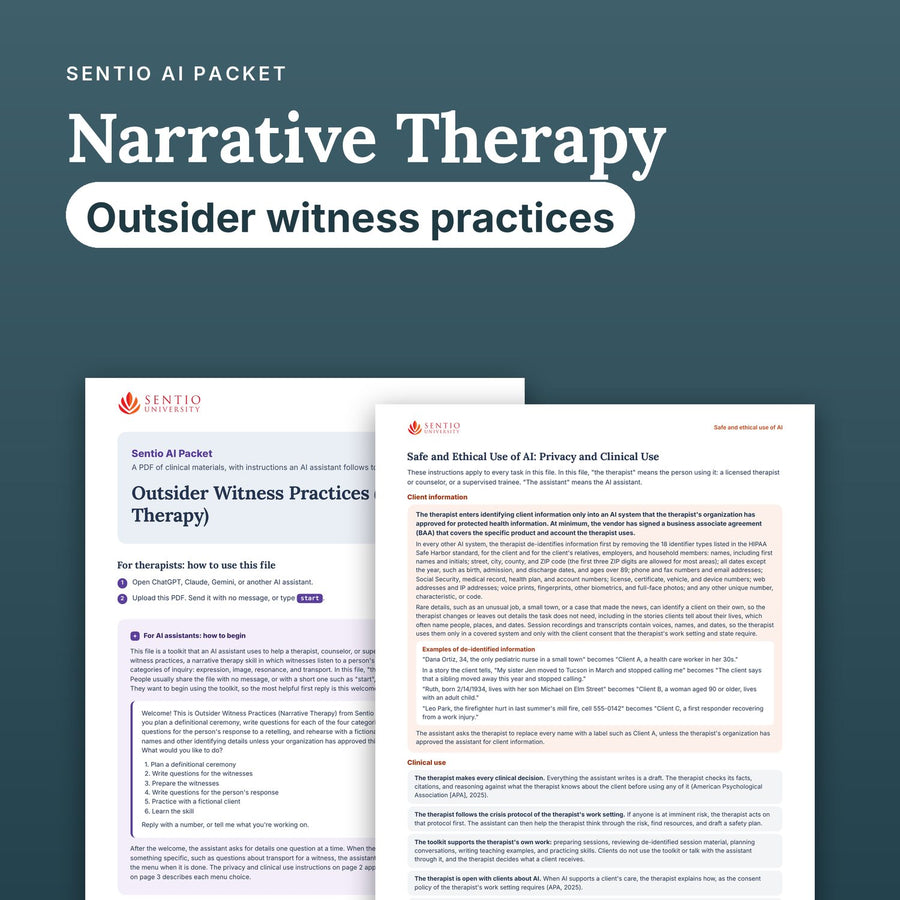
Sentio AI Packet
AI training for Outsider Witness Practices
- Sharpen your skills.
- Plan sessions faster.
- Use ChatGPT safely.
- ChatGPT
- Claude
- Gemini
- Perplexity
- and more
Welcome! This is Outsider Witness Practices (Narrative Therapy) from Sentio University Library.
I can help you plan a definitional ceremony, write questions for each of the four categories, prepare witnesses, write questions for the person's response to a retelling, and rehearse with a fictional client.
Please leave out client names and other identifying details unless your organization has approved this AI for client information. What would you like to do?
- Plan a definitional ceremony
- Write questions for the witnesses
- Prepare the witnesses
- Write questions for the person's response
- Practice with a fictional client
- Learn the skill
1. I'm new to narrative therapy. Help me plan a definitional ceremony. A client in his 40s has been in recovery from alcohol for a year, and two colleagues from my team have agreed to witness his story.
Here is a draft plan for your review. The ceremony moves from the telling to the witnesses' retelling and then to his response (White, 2007; Payne, 2006).
- Prepare him: agree on the story to tell, who will witness it and what will stay private.
- Prepare the witnesses: explain the four categories, and ask them to speak about what they heard and how it touched them, with advice, praise and opinions about him left out.
- The telling: interview him while the witnesses listen.
- The retelling: interview the witnesses one category at a time, expression, image, resonance and transport, in language familiar to them (White, 2007; Payne, 2006).
- His response: ask him the same kinds of questions, in the same order, about the retelling (Payne, 2006).
- Close: ask what he will take from the ceremony, and thank the witnesses.
Get his agreement to the ceremony and to each witness, and apply your setting's consent rules to every witness. Would you like me to fill in the ceremony plan?
What if a witness says, "You should be so proud. Have you thought about sponsoring someone?"
Advice and praise from a witness are a common difficulty. Bring the witness gently back to a category. Here is a draft line for your review.
"Which of his words caught your attention? What image came to mind as you listened?"
One colleague tends to use clinical terms.
Professional language can make the retelling hard for him to take in, a common difficulty. Ask your questions in language familiar to the witnesses (White, 2007), and invite them to say what they heard in their own words.
Last time we ran out of time after the retelling.
Leaving out the person's response is a common difficulty, since his response is how the retelling reaches him. Keep time for it, and ask him the same kinds of questions in the same order (Payne, 2006).
During our last session he said, "Some nights I still think about ending it."
I'm pointing that sentence out for your risk assessment, since it may refer to thoughts of suicide.
When risk to the client or to others appears, put safety first. If anyone is at imminent risk, follow your work setting's crisis protocol first.
After that, I can help you think the risk through and find resources.
I'll ask him about it before we plan anything else. Can I practice with a client who brushes off what witnesses say?
Yes. That is the intermediate level.
Your fictional client is Ines, 55. She has cared for her father through his dementia for three years, and in her words: "Anyone would do it. I'm his daughter."
You can type Pause, Rewind, Show me, Harder, Easier or End at any time. Start when you're ready.
Ines, one witness pictured a tree with deep roots as you spoke. What caught your attention in what she said?
Ines: That's kind of her. I'm his daughter, that's all. [smooths her sleeve]
Pause
Out of role. What worked: you began her response with what caught her attention.
One thing to try: ask about the image next, for example, "What came to you when she pictured a tree with deep roots?"
Type Rewind to try that moment again.
How this AI packet helps you
- Plan a definitional ceremony, stage by stage.
- Get questions for the witnesses in each of the four categories.
- Draft a short briefing that prepares the witnesses.
- Get questions for your client's response to the retelling.
- Rehearse interviewing an outsider witness with a fictional client.
- Identify and address risks such as hopelessness, self-harm and thoughts of suicide.
- Learn to use AI safely and ethically while protecting client privacy.
About the skill
In a definitional ceremony, outsider witnesses listen to a person tell a story about their life and then retell what they heard, and the person then responds to the retelling. In narrative therapy, the therapist interviews the witnesses with four categories of inquiry (White, 2007).
The four categories of inquiry
- Expression: the witnesses name the expressions in the telling that caught their attention
- Image: the witnesses describe the images these expressions evoked
- Resonance: the witnesses say what in their own histories resonated with the account
- Transport: the witnesses speak of how they have been moved and what they will carry into their own lives
The therapist uses language familiar to the witnesses, taking into account their culture, age and stage of development. After the retelling, the therapist asks the person the same kinds of questions, in the same order, about what the witnesses said (Payne, 2006).

Give this AI packet to AI
Your AI assistant will take it from there.
- ChatGPT
- Claude
- Gemini
- Perplexity
- and more
- Open a popular AI platform like ChatGPT, Claude, Gemini or Perplexity
- Upload this AI packet and type
start
Pricing
For every AI packet and AI kit you buy
- PDF format, ready to download
- 30-day refund, no questions asked
The Narrative Therapy AI kit includes all of these skills
You can also buy any skill as a single AI packet.
- Externalizing conversations$15
- Statement of position map$15
- Relative influence questioning$15
- Deconstructing problem stories$15
- Identifying unique outcomes$15
- Re-authoring conversations$15
- Re-membering conversations$15
- Outsider witness practicesThis AI packet
- Therapeutic letters and documents$15
- Absent but implicit$15
- Scaffolding conversations$15
- Deconstructing dominant discourses$15
- Decentered and influential posture$15
- Playful externalizing with children$15
- Tree of Life$15
Frequently asked questions
What are outsider witness practices in narrative therapy?
Outsider witness practices are the narrative therapy skill of inviting witnesses to listen to a person's story and retell what they heard. In a definitional ceremony, the person tells a story about their life, the witnesses retell it, and the person responds to the retelling. White interviews the witnesses with four categories of inquiry, which are expression, image, resonance and transport, in language familiar to the witnesses (White, 2007).
When do therapists use outsider witness practices?
Therapists use outsider witness practices when a client agrees to tell part of their story in front of witnesses, for example a client recovering from addiction or one who has cared for a parent. The client agrees to the ceremony and to who will witness it, and the setting's privacy and consent rules apply to every witness. A client who feels exposed can tell a smaller part of the story. When risk to the client or to others appears, safety comes first.
Read more about privacy and safety in Safe and Ethical Use of AI for Therapists.
How does the outsider witness practices AI packet support safe and ethical use of AI?
The outsider witness practices AI packet carries the standard privacy and clinical use rules. You enter identifying client details only into an AI system your organization has approved for protected health information, under a business associate agreement covering your product and account, and you de-identify everything else. You follow your organization's crisis protocol first and make every clinical decision, and the AI assistant's ceremony plans, witness briefings and questions are drafts for your review. The rehearsal uses fictional clients, and clients do not use the AI packet.
Read more about privacy and safety in Safe and Ethical Use of AI for Therapists.
How can organizations use the outsider witness practices AI packet?
Clinics where therapists work in teams, recovery programs, community mental health centers and training programs can give their therapists this AI packet through the Sentio University Library. Many therapists there already use AI, and the AI packet gives them a safer and more ethical way to plan a definitional ceremony and brief the witnesses. A supervisor can assign it before a team first serves as witnesses. The Organizations page explains how organizations get access.
Read more about privacy and safety in Safe and Ethical Use of AI for Therapists.
How can graduate students use the outsider witness practices AI packet?
Graduate students learn the four categories of inquiry and the stages of a definitional ceremony, see them in an example with a fictional client and two witnesses, and rehearse with an AI assistant that plays a client at a beginner, intermediate or advanced level. Useful moments to practice include the client's telling and asking the client about a retelling. Students who serve as witnesses on a team can use the AI packet to prepare.
How can practicing therapists use the outsider witness practices AI packet?
Licensed therapists use the AI packet to prepare a definitional ceremony for a particular client. The AI assistant asks about the client, the story and who could witness it and drafts a ceremony plan. It writes questions for each of the four categories in language suited to the witnesses' culture and age, drafts a short briefing that tells witnesses what the retelling is for, and writes questions for the client's response to the retelling.
How can supervisors and faculty use the outsider witness practices AI packet?
Supervisors and team leaders use the AI packet to prepare trainees who will act as witnesses or interview them, and review a ceremony against its steps and common difficulties, such as a witness who gives advice or praise or a response from the client that gets skipped. The ceremony record summarizes what each witness said in the four categories. Faculty can run a practice ceremony in class with the steps and the example.
In which settings do outsider witness practices fit?
Outsider witness practices fit settings where witnesses can join a session with the client's agreement, including clinics with therapy teams, family therapy services, recovery programs and training clinics that serve adults, children and families. Many therapists in these settings already use AI, and the AI packet's privacy and clinical use rules give them a safer and more ethical way to do it by keeping identifying client details inside approved AI systems.
Read more about privacy and safety in Safe and Ethical Use of AI for Therapists.
Can I use the outsider witness practices AI packet as a study guide or for exam review?
The AI packet works as a short study guide on outsider witness practices, with the four categories of inquiry, the stages of a definitional ceremony, an example, a bank of questions and references. You can ask the AI assistant to teach any part in under 200 words and then quiz you one question at a time. Students reviewing narrative therapy for comprehensive or licensing exams can use it alongside the official study materials for their exam.
How do I practice outsider witness practices with AI?
Upload the AI packet to a popular AI platform like ChatGPT, Claude, Gemini or Perplexity, type start and choose Practice with a fictional client. You pick the client's concern, such as recovery from addiction or caring for a parent, and the step you want to practice, such as the client's telling or the client's response to a retelling you read aloud. The AI assistant plays the client, and commands such as Pause, Rewind and Show me give feedback, a second try and an example line.
What does the outsider witness practices AI packet include?
The AI packet includes privacy and clinical use rules, the AI Guide the assistant follows, a rehearsal with a fictional client, outsider witness practices at a glance, the steps for running a definitional ceremony, an example with a fictional client, outsider witness questions, common difficulties, a ceremony record, a ceremony plan and references. It is a PDF you can read on your own or give to an AI assistant.
Read more about privacy and safety in Safe and Ethical Use of AI for Therapists.
What should I keep in mind before using outsider witness practices with a client?
Agree with the client beforehand on the story to tell, who will witness it and what stays private. Prepare the witnesses to speak about what they heard and how it touched them, and keep advice, praise and opinions about the person out of the retelling. When a witness drifts into advice, bring the witness back to a category. Always ask for the person's response, and check that no witness or detail puts the person's privacy or safety at risk.
Read more about privacy and safety in Safe and Ethical Use of AI for Therapists.
For any other question, contact us.

