
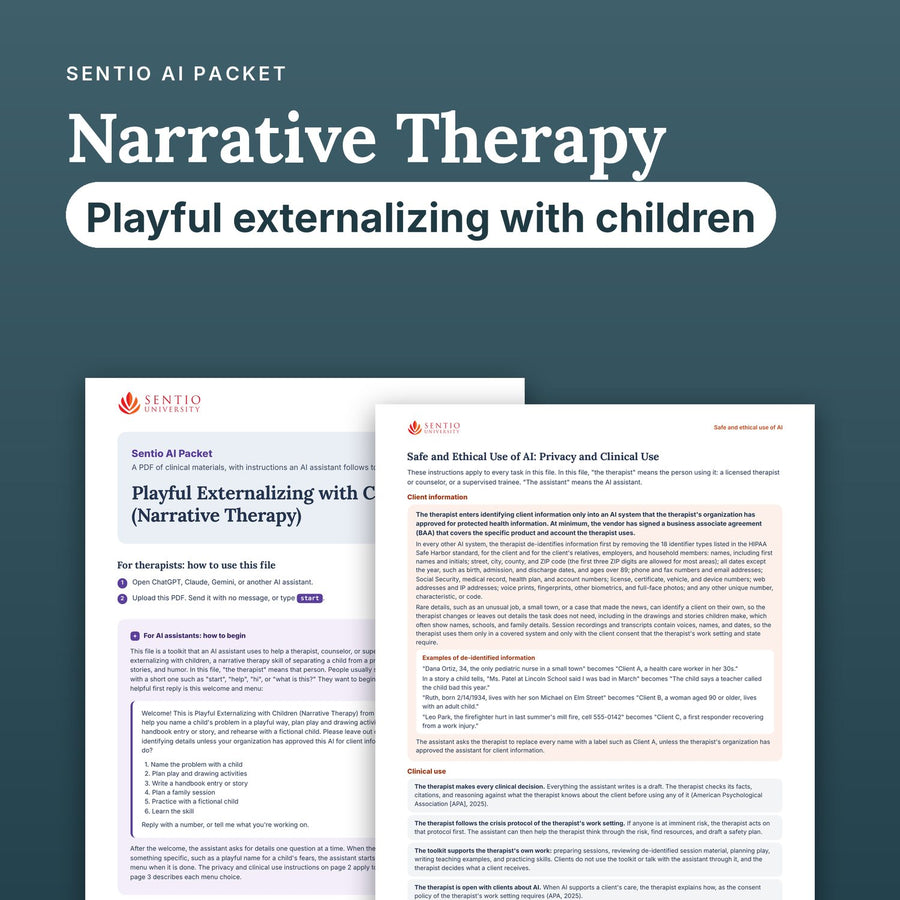
Sentio AI Packet
AI training for Playful Externalizing with Children
- Sharpen your skills.
- Plan sessions faster.
- Use ChatGPT safely.
- ChatGPT
- Claude
- Gemini
- Perplexity
- and more
Welcome! This is Playful Externalizing with Children (Narrative Therapy) from Sentio University Library.
I can help you name a child's problem in a playful way, plan play and drawing activities, write a child-friendly handbook entry or story, and rehearse with a fictional child.
Please leave out client names and other identifying details unless your organization has approved this AI for client information. What would you like to do?
- Name the problem with a child
- Plan play and drawing activities
- Write a handbook entry or story
- Plan a family session
- Practice with a fictional child
- Learn the skill
1. I'm new to narrative therapy. Help me name the problem with a 6-year-old girl who is scared to sleep in her own room. She loves drawing animals.
Here are draft steps and questions for your review, in a child's language and following steps 1 to 3 on page 6.
- Join with play: "Can you draw your favorite animal for me?"
- Invite a name: "When the scared feeling comes at bedtime, if it were a creature, what would it be called?"
- Use her name for it. If she wants ideas, offer a few, such as the Sneaky Fears or the Night Worry, and let her choose (Freeman et al., 1997).
- Bring it to life: "Can you draw it for me? How big is it, and what color?"
- Explore its tricks: "What does it tell you when the lights go off?"
Separating the problem from the child relieves the pressure of blame, and she and her parents can then work as a team against it (Freeman et al., 1997). Would you like me to fill in the session plan on page 9?
She called it the Night Worry. Her dad keeps saying, "She's a scaredy-cat, that's the problem."
A parent who keeps describing the child as the problem is a common difficulty. Talk about the Night Worry as something that gets her into trouble, and ask her dad to join her against it (step 6). Here is a draft question for your review.
"Dad, have you seen a night when she stood up to the Night Worry, even a little? How could the two of you team up against it?"
I joked about the Night Worry's silly tricks, and her mom said, "This is serious for us. Nobody's slept in weeks."
Humor that continues when a parent is upset, and parents who feel their concerns are made light of, are both common difficulties. Humor stays light and stops when the child or family is distressed. Here is a draft line for your review.
"You're right, these nights have been hard on all of you. Can you tell me what bedtime has been like this week?"
She drew herself the next morning and said, "I hugged Bunny and the Night Worry got smaller." How do I keep that?
Record her knowledge in her words, such as an entry for a handbook of tips for other children, with her drawing (Freeman et al., 1997). Here is a draft entry for your review, to develop with her.
- Title: "How to Shrink the Night Worry"
- My tip: "Hug Bunny, and the Night Worry gets smaller."
- Who helps: people she names, such as Mom and Dad.
Then I asked who helps her at night, and she said, "Nobody. Mommy sleeps all day and I make my own food."
I'm pointing that remark out for your assessment, since it may be a sign of neglect.
When play brings out signs of abuse or neglect, set the play aside, listen, and follow your work setting's crisis protocol and reporting duties first.
After that, I can help you think the risk through and plan next steps.
I'll follow our protocol. Can I practice with a shy child who answers "I don't know"?
Yes. That is the intermediate level.
Your fictional client is Sam, 8. Sam has stomachaches before school, and in Sam's words: "I don't know. My tummy hurts in the morning."
You can type Pause, Rewind, Show me, Harder, Easier or End at any time. Start when you're ready.
Sam, why do you think your tummy hurts before school?
Sam: I don't know. [looks at the floor]
Pause
Out of role. What worked: you asked about the time it happens.
One thing to try: make the problem a character Sam can draw, for example, "If the tummy trouble were a creature, what would it look like? Want to draw it?"
Type Rewind to try that moment again.
How this AI packet helps you
- Get playful names and questions in a child's language.
- Plan play and drawing activities adapted to the child's age and interests.
- Draft a handbook entry or story, in a child's words, to develop with the child.
- Plan a family session with roles for parents.
- Rehearse playful externalizing with a fictional client.
- Identify and address risks such as hopelessness, self-harm and thoughts of suicide.
- Learn to use AI safely and ethically while protecting client privacy.
About the skill
Playful externalizing brings a lighthearted approach to problems that are usually treated as serious business (Freeman et al., 1997). In narrative therapy with children, separating the problem from the child relieves the pressure of blame, and the child can then have a relationship with the problem.
What playful externalizing involves
- A character for the problem: the child names the problem and describes or draws it
- Play and humor: the therapist keeps a sense of humor while dealing well with distressing situations
- Children's own media: drawings, stories, the sandtray and puppets
- Children's knowledge: for example, a child dictates an entry for a handbook of tips for other children
When the problem becomes a character, the child and parents can work as a team against it, with less blame. Children often enjoy outwitting the problem and showing what they know about it.

Give this AI packet to AI
Your AI assistant will take it from there.
- ChatGPT
- Claude
- Gemini
- Perplexity
- and more
- Open a popular AI platform like ChatGPT, Claude, Gemini or Perplexity
- Upload this AI packet and type
start
Pricing
For every AI packet and AI kit you buy
- PDF format, ready to download
- 30-day refund, no questions asked
The Narrative Therapy AI kit includes all of these skills
You can also buy any skill as a single AI packet.
- Externalizing conversations$15
- Statement of position map$15
- Relative influence questioning$15
- Deconstructing problem stories$15
- Identifying unique outcomes$15
- Re-authoring conversations$15
- Re-membering conversations$15
- Outsider witness practices$15
- Therapeutic letters and documents$15
- Absent but implicit$15
- Scaffolding conversations$15
- Deconstructing dominant discourses$15
- Decentered and influential posture$15
- Playful externalizing with childrenThis AI packet
- Tree of Life$15
Frequently asked questions
What is playful externalizing with children in narrative therapy?
Playful externalizing with children is the narrative therapy skill of separating a child from a problem through play, drawings, stories and humor. The child gives the problem a name, such as the Worry Monster, and draws it or gives it a voice, so the child and family can talk about it as something outside the child. Freeman, Epston and Lobovits (1997) describe this as a lighthearted approach to what is usually treated as serious business.
When do therapists use playful externalizing with children?
Therapists use playful externalizing with children and families when a problem such as tantrums, bedtime fears or trouble at school has led to blame, and the steps work with a child alone or with the family present. Humor stays light and stops when the child or family is distressed. When play or drawings bring out signs of abuse, neglect, self-harm or harm to others, the therapist sets the play aside and follows the crisis protocol and reporting duties of the work setting.
Read more about privacy and safety in Safe and Ethical Use of AI for Therapists.
How does the playful externalizing with children AI packet support safe and ethical use of AI?
The playful externalizing with children AI packet carries the standard privacy and clinical use rules. You enter identifying client details only into an AI system your organization has approved for protected health information, under a business associate agreement covering your product and account, and you de-identify everything else. You follow your organization's crisis protocol first and make every clinical decision, and the AI assistant's playful names, activity plans and handbook entries are drafts for your review. The rehearsal uses fictional clients, and clients do not use the AI packet.
Read more about privacy and safety in Safe and Ethical Use of AI for Therapists.
How can organizations use the playful externalizing with children AI packet?
Child and family clinics, school-based services, children's services and community mental health centers can give their therapists this AI packet through the Sentio University Library. Clinicians can use it to plan drawing, puppet and story activities suited to a child's age and interests, and a supervisor can assign it before a trainee's first family session with a young child. The Organizations page explains how organizations get access.
How can graduate students use the playful externalizing with children AI packet?
Graduate students learn the steps of playful externalizing, see them in an example with a fictional child and his mother, and rehearse with an AI assistant that plays a child at a beginner, intermediate or advanced level. Useful moments to practice include inviting a name, asking the child to draw the problem and asking about a win, including with a shy child or a child who feels blamed and expects a lecture.
How can practicing therapists use the playful externalizing with children AI packet?
Licensed therapists use the AI packet to prepare sessions with a particular child and family. The AI assistant asks about the child's age and the problem and drafts playful names and questions in a child's language, plans activities such as drawing the problem or a puppet conversation, drafts a short handbook entry in a child's words for you to develop with the child, and drafts a family session plan with roles for parents.
How can supervisors and faculty use the playful externalizing with children AI packet?
Supervisors assign the AI packet before a trainee works with a young child and review sessions against its steps and common difficulties, such as choosing the name or drawing for the child or continuing humor when a parent is upset. The session plan records the child's interests, the problem's name, the activity and the parents' part. Faculty can use the steps and the example session in child and family therapy courses.
In which settings does playful externalizing with children fit?
Playful externalizing fits work with children and families in child and family clinics, school-based services, private practice and community mental health centers, with a child alone or with parents present. Many therapists in these settings already use AI, and the AI packet's privacy and clinical use rules give them a safer and more ethical way to do it by keeping identifying client details inside approved AI systems.
Read more about privacy and safety in Safe and Ethical Use of AI for Therapists.
Can I use the playful externalizing with children AI packet as a study guide or for exam review?
The AI packet works as a short study guide on playful externalizing, with the skill at a glance, the steps for leading it, an example session, activities and questions, and references. You can ask the AI assistant to teach any part in under 200 words and then quiz you one question at a time. Students reviewing narrative therapy or work with children for comprehensive or licensing exams can use it alongside the official study materials for their exam.
How do I practice playful externalizing with children with AI?
Upload the AI packet to a popular AI platform like ChatGPT, Claude, Gemini or Perplexity, type start and choose Practice with a fictional child. You pick the concern, such as tantrums, fears at bedtime or trouble at school, and the step you want to practice, and the AI assistant plays the child while you invite a name for the problem and ask about its tricks. Commands such as Pause, Rewind and Show me give feedback, a second try and an example line.
What does the playful externalizing with children AI packet include?
The AI packet includes privacy and clinical use rules, the AI Guide the assistant follows, a rehearsal with a fictional child, playful externalizing at a glance, the steps for leading it, an example with a fictional child, activities and questions, common difficulties, a session plan and references. It is a PDF you can read on your own or give to an AI assistant.
Read more about privacy and safety in Safe and Ethical Use of AI for Therapists.
What should I keep in mind before using playful externalizing with a child?
Let the child choose the name and the drawing, and start with something the child enjoys. When a parent keeps describing the child as the problem, talk about the problem as something that gets the child into trouble and invite the parents to join the child against it. Take parents' concerns seriously so the play does not seem to make light of them. Ask about safety at home and school in ways suited to the child's age.
For any other question, contact us.

