
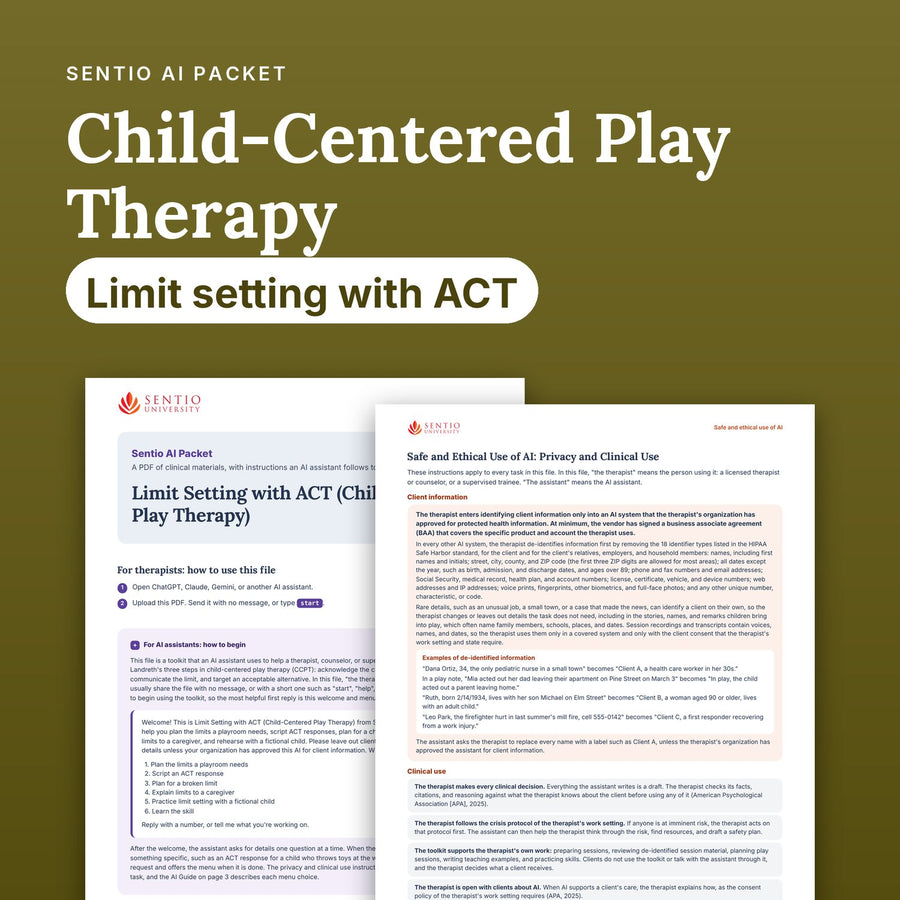
Sentio AI Packet
AI training for Limit Setting with ACT
- Sharpen your skills.
- Plan sessions faster.
- Use ChatGPT safely.
- ChatGPT
- Claude
- Gemini
- Perplexity
- and more
Welcome! This is Limit Setting with ACT (Child-Centered Play Therapy) from Sentio University Library.
I can help you plan the limits a playroom needs, script ACT responses, plan for a child who breaks a limit, explain limits to a caregiver, and rehearse with a fictional child.
Please leave out client names and other identifying details unless your organization has approved this AI for client information. What would you like to do?
- Plan the limits a playroom needs
- Script an ACT response
- Plan for a broken limit
- Explain limits to a caregiver
- Practice limit setting with a fictional child
- Learn the skill
3. I'm new to child-centered play therapy. Help me plan for a broken limit. A boy, 8, referred for fighting at school, kept hitting me with a foam sword in his third session after I set a limit, and he laughed each time.
Here is a draft plan for your review, following steps 6 to 8 on page 6.
- Stay with him: keep reflecting his feelings and restate the limit firmly, with no threats, debate, long explanations or punishment (Landreth, 2023).
- Repeat ACT at least three times before any final choice (Landreth, 2023).
- Final choice, kept for rare moments and stated in his terms: "If you choose to hit me again, you choose not to play with the sword for the rest of today" (Landreth, 2023).
- Follow through calmly: once he chooses, keep to the choice with patience and understanding, and use leaving the playroom only as a last resort (Landreth, 2023).
- Acting sooner: if he swings at the mirror or a window, you may state the limit first and then acknowledge the wish, and a risk of injury calls for the final choice sooner (Landreth, 2023).
I can fill in the final choice and the safety risks in the limits plan on page 9. Would you like to change any step?
At first I said, "You can't hit me so hard," and he argued about how hard was too hard.
A conditional limit such as that one invites arguments, a common difficulty. Acknowledge his feeling first, then state a specific, total limit calmly, with the focus on him (Landreth, 2023). Here is a draft ACT line for your review.
"You're really angry at me. I'm not for hitting. The bop bag is for hitting."
The week before, I told him after his first swing that the sword would go on the shelf if he did it again.
Moving to a final choice before ACT has been tried several times is a common difficulty. Go through ACT at least three times first, reflecting his feeling each time, and keep the final choice for rare moments (Landreth, 2023).
When he chose to hit again and the sword went on the shelf, he cried, so I gave it back.
Undoing a choice the child has made is a common difficulty. Once he chooses, keep to the choice with patience and understanding, and reflect his feeling (Landreth, 2023). Here is a draft line for your review.
"You're really sad that the sword is done for today."
While he swung the sword, he also said, "This is what happens at home when I'm bad."
I'm pointing that remark out for your risk assessment, since it may suggest abuse or danger at home.
Ask his caregiver about his safety at home and at school as part of the usual assessment, and follow the reporting duties of your state and work setting if he discloses abuse or you suspect it. If anyone is at imminent risk, follow your work setting's crisis protocol first.
After that, I can help you think the risk through and add it to the safety checks in the limits plan.
I'll follow up on that. Can I practice with a child who bargains when time is up?
Yes. That is the intermediate level.
Your fictional child is Eli, 5. He has been angry since his parents' divorce, and in his words: "I never get to stay as long as I want."
You can type Pause, Rewind, Show me, Harder, Easier or End at any time. Start when you're ready.
Eli, our time is up for today.
Eli: [hugs the dinosaur bin] No! I'm not done. Just five more minutes, please?
Pause
Out of role. What worked: you stated the limit calmly in a short, specific sentence.
One thing to try: acknowledge his wish before the limit, for example, "You want to stay and play longer. Our time is up for today."
Type Rewind to try that moment again.
How this AI packet helps you
- Plan the limits a playroom needs.
- Script an ACT response.
- Plan for a broken limit.
- Explain limits to a caregiver.
- Rehearse limit setting with a fictional child.
- Identify and address risks such as hopelessness, self-harm and thoughts of suicide.
- Learn to use AI safely and ethically while protecting client privacy.
About the skill
In child-centered play therapy (CCPT), all feelings and wishes are accepted, and some behaviors are limited (California Evidence-Based Clearinghouse for Child Welfare [CEBC], n.d.). Landreth's ACT model sets limits in three steps (Landreth, 2023; CEBC, n.d.).
The three steps
- A, acknowledge: the child's feelings, wishes and wants. "You're really angry at me."
- C, communicate: the limit, specific and clear. "I'm not for shooting."
- T, target: acceptable alternatives, often pointing to them and using the child's name. "Jayden, the target is for shooting."
The aim is to help the child express the feeling in an acceptable way, so the child learns self-control and responsibility. Limits are few and enforceable, set when needed, and stated calmly and firmly (Landreth, 2023).

Give this AI packet to AI
Your AI assistant will take it from there.
- ChatGPT
- Claude
- Gemini
- Perplexity
- and more
- Open a popular AI platform like ChatGPT, Claude, Gemini or Perplexity
- Upload this AI packet and type
start
Pricing
For every AI packet and AI kit you buy
- PDF format, ready to download
- 30-day refund, no questions asked
The Child-Centered Play Therapy AI kit includes all of these skills
You can also buy any skill as a single AI packet.
- Axline's eight principles$15
- Tracking$15
- Reflecting feelings in play$15
- Returning responsibility$15
- Esteem-building responses$15
- Limit setting with ACTThis AI packet
- Reflecting larger meaning$15
- Teaching caregivers play skills (CPRT)$15
Frequently asked questions
What is limit setting with ACT in child-centered play therapy?
Limit setting with ACT is Landreth's way of setting limits in child-centered play therapy (CCPT) in three steps: acknowledge the child's feelings, wishes and wants, communicate the limit, and target acceptable alternatives (Landreth, 2023). All feelings and wishes are accepted, and some behaviors are limited. The aim is to help the child express the feeling in an acceptable way, so the child learns self-control and responsibility.
When do therapists use limit setting with ACT?
Therapists set a limit only when one is needed, such as when a child aims a toy at the therapist or starts to paint the wall. Limits stay few, enforceable, specific and total, and they are stated calmly (Landreth, 2023). When a child is about to cause harm, the therapist may state the limit first and then acknowledge the wish. Every effort is made to protect the child and therapist from harm, and a risk of injury calls for a final choice sooner.
How does the limit setting with ACT AI packet support safe and ethical use of AI?
This AI packet carries the standard privacy and clinical use rules. You enter identifying client details only into an AI system your organization has approved for protected health information, under a business associate agreement covering your product and account, and you de-identify everything else. You follow your organization's crisis protocol first and make every clinical decision, and the AI assistant's limits plans, ACT responses and caregiver explanations are drafts for your review. The rehearsal uses a fictional child, and clients do not use the AI packet.
Read more about privacy and safety in Safe and Ethical Use of AI for Therapists.
How can organizations use the limit setting with ACT AI packet?
Child and family agencies, community mental health centers, group practices and training clinics that serve young children can give their therapists this AI packet through the Sentio University Library. Clinicians can use it to plan the few limits a playroom needs and script ACT responses for behaviors they describe, and a supervisor can assign it before a trainee works with a child who tests limits. The Organizations page explains how organizations get access.
How can graduate students use the limit setting with ACT AI packet?
Graduate students learn the three steps, the guidelines for limits and what to do when a limit is tested, see them in an example with a fictional child, and rehearse with an AI assistant that plays a child at a beginner, intermediate or advanced level. Useful moments to practice include a child aiming a toy at the therapist and a child refusing to leave, including with a child who argues or bargains.
How can practicing therapists use the limit setting with ACT AI packet?
Licensed therapists use the AI packet to prepare limits for a particular playroom and child. The AI assistant drafts a short list of limits that meet the guidelines and fills in the limits plan. For a behavior you describe, it writes an ACT response with two alternatives to point to. It drafts how you will stay with the child, repeat ACT and word a final choice if one is needed, and it drafts a plain explanation of limits for a caregiver.
How can supervisors and faculty use the limit setting with ACT AI packet?
Supervisors assign the AI packet before a trainee works with a child who tests limits and review the limits record against common difficulties, such as conditional or tentative limits, "we" in a limit, a list of rules at the start or a final choice reached before ACT has been tried several times. Faculty can use the example session to show the three steps and a calm response when the limit is tested.
In which settings does limit setting with ACT fit?
Limit setting with ACT fits any playroom where a therapist offers child-centered play therapy to children aged 3 to 10, at the moments when a limit is needed. Many therapists in these settings already use AI, and the AI packet's privacy and clinical use rules give them a safer and more ethical way to do it by keeping identifying client details inside approved AI systems.
Read more about privacy and safety in Safe and Ethical Use of AI for Therapists.
Can I use the limit setting with ACT AI packet as a study guide or for exam review?
The AI packet works as a short study guide on limit setting with ACT, with the three steps at a glance, guidelines for limits, the steps for setting a limit, ACT responses, an example session and references. You can ask the AI assistant to teach any part in under 200 words and then quiz you one question at a time. Students reviewing child-centered play therapy for comprehensive or licensing exams can use it alongside the official study materials for their exam.
How do I practice limit setting with ACT with AI?
Upload the AI packet to a popular AI platform like ChatGPT, Claude, Gemini or Perplexity, type start and choose Practice limit setting with a fictional child. You pick the child's age and what brings the child, such as aggression at school, and the moment you want to practice, such as a child painting the wall, and the AI assistant plays a child who may argue, bargain or test the limit. Commands such as Pause, Rewind and Show me give feedback, a second try and an example line.
What does the limit setting with ACT AI packet include?
The AI packet includes privacy and clinical use rules, the AI Guide the assistant follows, a rehearsal with a fictional child, limit setting with ACT at a glance, the steps for setting a limit, an example with a fictional child, ACT responses, common difficulties, a limits record, a limits plan and references. It is a PDF you can read on your own or give to an AI assistant.
Read more about privacy and safety in Safe and Ethical Use of AI for Therapists.
What should I keep in mind before using limit setting with ACT with a client?
Decide ahead the few limits the room needs, and wait to state each one until it is needed. Keep limits specific, total and calm, with no threats, debate or punishment. Go through ACT several times before any final choice, and act sooner when there is a risk of injury. If a child discloses abuse or you suspect it, follow your reporting duties and crisis protocol first. The AI packet does not replace formal training in child-centered play therapy.
Read more about privacy and safety in Safe and Ethical Use of AI for Therapists.
For any other question, contact us.

