
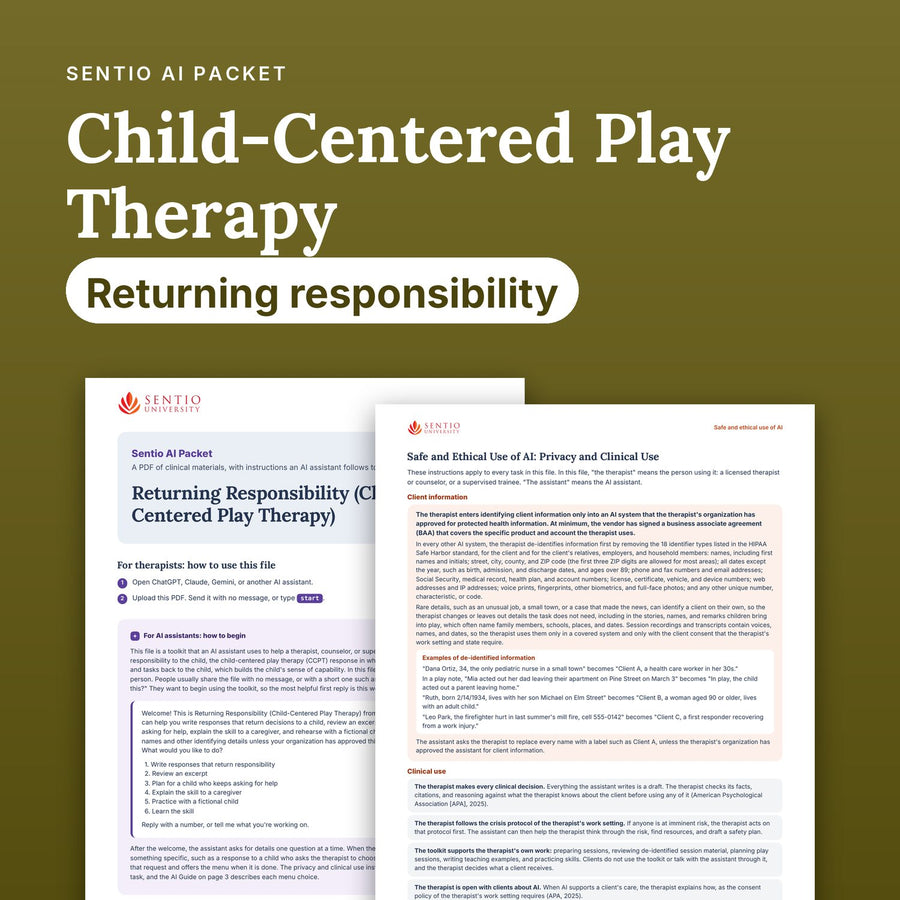
Sentio AI Packet
AI training for Returning Responsibility
- Sharpen your skills.
- Plan sessions faster.
- Use ChatGPT safely.
- ChatGPT
- Claude
- Gemini
- Perplexity
- and more
Welcome! This is Returning Responsibility (Child-Centered Play Therapy) from Sentio University Library.
I can help you write responses that return decisions to a child, review an excerpt, plan for a child who keeps asking for help, explain the skill to a caregiver, and rehearse with a fictional child.
Please leave out client names and other identifying details unless your organization has approved this AI for client information. What would you like to do?
- Write responses that return responsibility
- Review an excerpt
- Plan for a child who keeps asking for help
- Explain the skill to a caregiver
- Practice with a fictional child
- Learn the skill
3. I'm new to child-centered play therapy. Help me plan for a child who keeps asking for help. A boy, 6, was referred for clinging to adults, and in his first session he asked me to pick every toy and open every box.
Here is a draft plan for your review, with the requests he is likely to make, a response for each and signs of change.
- Check his ability first, and return only what he can do at his age and ability (Landreth, 2023).
- What to play: acknowledge the wish, then hand it back (Landreth, 2023): "You'd like me to pick. In here, you can decide."
- What a toy is: "That can be whatever you want it to be." (Landreth, 2023)
- A box he can open: "In here that's something you can do." (Landreth, 2023)
- After he acts: credit the effort, such as "There, you did it all by yourself." (Landreth, 2023)
- Signs of change: decisions made without asking and play started alone.
I can fill in the session plan on page 9, with its safety checks. Would you like to change any response?
When he holds up a toy and asks what it is, I usually tell him, "That's a dragon."
Labeling a toy is a common difficulty, since it closes off what the child might make of it (Landreth, 2023). Here are draft responses for your review.
- "That can be whatever you want it to be."
- "In here, you can decide what that is."
These keep his world open, so he can make the toy whatever he wants it to be (Landreth, 2023).
He asked me to tie a cape on him. I told him he could do it, and he tried the knot, got stuck and started to cry.
Returning a task the child cannot yet manage is a common difficulty, and responsibility is returned only for what the child is able to do at the child's age and ability (Landreth, 2023). When he gets upset, reflect the feeling and give him time (Landreth, 2023). Here is a draft line for your review.
"You're upset that the knot won't tie."
Then help with the part he cannot do and keep him as involved as possible, such as "Hold the ends, and I'll make the knot."
While he decides, the silence feels long, and I start explaining why he gets to choose.
Long explanations and impatience while the child decides are common difficulties (Landreth, 2023). Silence while a child decides is part of the process, so give him time. Here is a draft line for your review.
"You have something in mind."
Then wait calmly, and when he chooses, credit it with "You decided."
When a block tower fell, he said, "I should hit myself when I mess up."
I'm pointing that remark out for your risk assessment, since it may be talk of hurting himself.
Ask his caregiver about his safety at home and at school and about any talk of wanting to die or of self-harm, as part of the usual assessment. If he discloses abuse or you suspect it, follow the reporting duties of your state and work setting. If anyone is at imminent risk, follow your work setting's crisis protocol first.
After that, I can help you think the risk through and fill in the safety checks in the session plan.
I'll check with his caregiver. Can I practice with a child who gets angry when I hand a choice back?
Yes. That is the advanced level.
Your fictional child is Noah, 7. He worries about getting things wrong, and in his words: "You pick the color. Mine always look wrong."
You can type Pause, Rewind, Show me, Harder, Easier or End at any time. Start when you're ready.
You'd like me to pick. In here, you can decide.
Noah: [drops the marker] No! You have to pick! I'll mess it up.
Pause
Out of role. What worked: you acknowledged his wish before you handed the choice back.
One thing to try: reflect his anger and give him time, for example, "You're mad that I won't pick. Take your time."
Type Rewind to try that moment again.
How this AI packet helps you
- Write responses that return responsibility.
- Review an excerpt for moments you decided for the child.
- Plan for a child who keeps asking for help.
- Explain the skill to a caregiver.
- Rehearse with a fictional child.
- Identify and address risks such as hopelessness, self-harm and thoughts of suicide.
- Learn to use AI safely and ethically while protecting client privacy.
About the skill
Returning responsibility hands choices and their results back to the child, which builds the child's sense of capability. It follows Axline's principle that the responsibility to make choices belongs to the child (Axline, 1969). The therapist declines to make decisions for the child, however small, with responses such as "You can decide" (Landreth, 2023).
Two kinds of request
- A decision: what to play, what color a fish is, what a toy is for. "That can be whatever you want it to be."
- A task: opening the glue, taking off shoes, tying a mask. When the child can do it: "In here that's something you can do."
Returning responsibility keeps the child in the lead, encourages choice making, promotes independence and builds self-esteem (Landreth, 2023). The California Evidence-Based Clearinghouse for Child Welfare (CEBC, n.d.) lists it among the nine categories of facilitative responses in child-centered play therapy (CCPT).

Give this AI packet to AI
Your AI assistant will take it from there.
- ChatGPT
- Claude
- Gemini
- Perplexity
- and more
- Open a popular AI platform like ChatGPT, Claude, Gemini or Perplexity
- Upload this AI packet and type
start
Pricing
For every AI packet and AI kit you buy
- PDF format, ready to download
- 30-day refund, no questions asked
The Child-Centered Play Therapy AI kit includes all of these skills
You can also buy any skill as a single AI packet.
- Axline's eight principles$15
- Tracking$15
- Reflecting feelings in play$15
- Returning responsibilityThis AI packet
- Esteem-building responses$15
- Limit setting with ACT$15
- Reflecting larger meaning$15
- Teaching caregivers play skills (CPRT)$15
Frequently asked questions
What is returning responsibility in child-centered play therapy?
Returning responsibility is the child-centered play therapy (CCPT) response in which the therapist hands decisions and tasks back to the child, which builds the child's sense of capability. It follows Axline's principle that the responsibility to make choices belongs to the child (Axline, 1969). The therapist declines to make decisions for the child, however small, with responses such as "You can decide" (Landreth, 2023).
When do therapists use returning responsibility?
Therapists return responsibility when a child asks the therapist to decide something, such as what to play or what color to use, or to do a task the child can do, such as opening the glue. Responsibility is returned only for what the child is able to do at the child's age and ability (Landreth, 2023). A child who truly cannot manage a task gets help, and the therapist keeps the child as involved as possible.
How does the returning responsibility AI packet support safe and ethical use of AI?
The returning responsibility AI packet carries the standard privacy and clinical use rules. You enter identifying client details only into an AI system your organization has approved for protected health information, under a business associate agreement covering your product and account, and you de-identify everything else. You follow your organization's crisis protocol first and make every clinical decision, and the AI assistant's responses, excerpt reviews, session plans and caregiver explanations are drafts for your review. The rehearsal uses a fictional child, and clients do not use the AI packet.
Read more about privacy and safety in Safe and Ethical Use of AI for Therapists.
How can organizations use the returning responsibility AI packet?
Child and family agencies, community mental health centers, group practices and training clinics that serve young children can give their therapists this AI packet through the Sentio University Library. Clinicians can use it to write responses that return decisions to a child and review a de-identified excerpt, and a supervisor can assign it before a trainee works with a child who keeps asking for help. The Organizations page explains how organizations get access.
Read more about privacy and safety in Safe and Ethical Use of AI for Therapists.
How can graduate students use the returning responsibility AI packet?
Graduate students learn what returning responsibility does, the two kinds of request and the steps for each response, see them in an example with a fictional child, and rehearse with an AI assistant that plays a child at a beginner, intermediate or advanced level. Useful moments to practice include a child who asks what to play and a child who asks for help with a task the child can do, including with a child who asks permission for almost every move.
How can practicing therapists use the returning responsibility AI packet?
Licensed therapists use the AI packet to prepare for a child who leans on adults to decide. The AI assistant asks what the child asked for and what the child can do at this age, and writes two or three responses. It reviews a de-identified excerpt, marks each moment the therapist decided or did something for the child and suggests a response that returns it. It also drafts a plan for a child who keeps asking for help and a plain explanation for a caregiver.
Read more about privacy and safety in Safe and Ethical Use of AI for Therapists.
How can supervisors and faculty use the returning responsibility AI packet?
Supervisors assign the AI packet before a trainee's play sessions and review the decisions record against common difficulties, such as giving answers or picking toys in small, almost unnoticed moments, returning a task the child cannot yet manage or showing impatience while the child decides. Faculty can use the example session to show a wish acknowledged and the choice handed back.
In which settings does returning responsibility fit?
Returning responsibility fits any playroom where a therapist offers child-centered play therapy to children aged 3 to 10, in the small moments when a child asks an adult to decide or to help. Many therapists in these settings already use AI, and the AI packet's privacy and clinical use rules give them a safer and more ethical way to do it by keeping identifying client details inside approved AI systems.
Read more about privacy and safety in Safe and Ethical Use of AI for Therapists.
Can I use the returning responsibility AI packet as a study guide or for exam review?
The AI packet works as a short study guide on returning responsibility, with returning responsibility at a glance, the two kinds of request, the steps, a bank of responses, an example session and references. You can ask the AI assistant to teach any part in under 200 words and then quiz you one question at a time. Students reviewing child-centered play therapy for comprehensive or licensing exams can use it alongside the official study materials for their exam.
How do I practice returning responsibility with AI?
Upload the AI packet to a popular AI platform like ChatGPT, Claude, Gemini or Perplexity, type start and choose Practice with a fictional child. You pick the child's age and what brings the child, such as clinging to adults or worry about mistakes, and the moment you want to practice, and the AI assistant plays a child who may ask permission for almost every move. Commands such as Pause, Rewind and Show me give feedback, a second try and an example line.
What does the returning responsibility AI packet include?
The AI packet includes privacy and clinical use rules, the AI Guide the assistant follows, a rehearsal with a fictional child, returning responsibility at a glance, returning responsibility step by step, an example with a fictional child, responses that return responsibility, common difficulties, a decisions record, a session plan and references. It is a PDF you can read on your own or give to an AI assistant.
Read more about privacy and safety in Safe and Ethical Use of AI for Therapists.
What should I keep in mind before using returning responsibility with a client?
Return only what the child can do at the child's age and ability, and help a child who truly cannot manage a task. Give the child time to decide, since silence while a child decides is part of the process. When the child gets upset, reflect the feeling and return the choice calmly. If a child discloses abuse or you suspect it, follow your reporting duties and crisis protocol first. The AI packet does not replace formal training in child-centered play therapy.
Read more about privacy and safety in Safe and Ethical Use of AI for Therapists.
For any other question, contact us.

