
Sentio AI Packet
AI training for Joining with Families
- Sharpen your skills.
- Plan sessions faster.
- Use ChatGPT safely.
- ChatGPT
- Claude
- Gemini
- Perplexity
- and more
Welcome! This is Joining with Families (Family Psychoeducation) from Sentio University Library.
I can help you plan joining meetings, write questions about each person's experience, map the family's reactions and stressors, write a joining summary, and rehearse with a fictional family.
Please leave out client names and other identifying details unless your organization has approved this AI for client information. What would you like to do?
- Plan joining meetings
- Write joining questions
- Map reactions and stressors
- Write a joining summary
- Practice joining with a fictional family
- Learn the skill
1. I'm new to family psychoeducation. Help me plan joining meetings. My client is a man in his 20s who had a first episode of psychosis this year. He wants his mother and his older brother involved, and our program runs a multifamily group.
Here is a draft plan for your review, built on the steps on page 6 and the joining plan on page 9.
- Who is family: confirm with him that he wants his mother and his brother involved, since the person decides who counts as family (McFarlane, 2016).
- Meetings: hold introductory meetings with him and with his family before the workshop and the groups (Langeveld et al., 2025).
- Experience: learn about each person's experience of the illness, their strengths and their goals, with questions such as "What has this been like for you?" and "What does your family do well?"
- Reaction and factors before episodes: build a detailed picture of how the family has reacted to the illness, and ask what changed in the weeks before the episode (Joa et al., 2020).
- Next step: agree on goals with the family as equal partners and invite them to the educational workshop (Dixon et al., 2001).
Before starting, ask about his current symptoms, thoughts of suicide or violence and safety at home as part of the usual assessment, and find out who provides his psychiatric care. Would you like me to write the joining questions or change any step?
At the first meeting, his mother answered every question, including the ones I asked him and his brother.
Hearing from the loudest family member alone is a common difficulty in joining. Thank the mother for her care, ask each person in turn and name strengths before problems. Here is a draft line for your review, spoken to the brother.
"Your mother has been there for him every day, and I'd like to hear from each of you. What has this year been like for you?"
Return to the mother once the others have spoken.
When I asked what came before the episode, his brother said, "If he'd kept his job and slept at normal hours, none of this would have happened."
A family member who blames the person is a common moment in joining, and questions about the past can sound like a search for who caused the illness. Ask about what came before past episodes without blame (Joa et al., 2020). Listen to the frustration, acknowledge how hard the illness has been and describe the illness as the shared problem the program works on. Here is a draft line for your review.
"This year has been hard on all of you. The illness is the problem we're here to work on together, and what changed in those weeks helps us understand it."
Near the end, he told me quietly that the voices are back this week and tell him to hurt himself.
I'm pointing that out for your risk assessment, since it may describe voices that command harm and an early sign of relapse.
If anyone is at imminent risk, follow your work setting's crisis protocol first. Family psychoeducation works alongside his psychiatric care (Falloon, 2003), and effective programs provide clinical resources during crises (McFarlane et al., 2003).
After that, I can help you think the risk through and plan the next joining meeting.
I'll assess that today and contact his psychiatrist. Can I practice with a family where one member blames the person?
Yes. That is the intermediate level.
Your fictional family is Daniel, 26, who had a second episode of psychosis last spring, and his father, Paul, 58. In Paul's words: "He stopped taking his pills, and we all paid for it."
You can type Pause, Rewind, Show me, Harder, Easier or End at any time. Start when you're ready.
Thank you both for coming. Paul, what has this past year been like for you?
Paul (father): Exhausting. I've had to cover for him at every turn. [glances at Daniel]
Daniel: I never asked you to. [looks at the floor]
Pause
Out of role. What worked: you thanked them both and asked Paul about his own experience.
One thing to try: acknowledge Paul's exhaustion and then invite Daniel's story, for example, "That sounds exhausting, Paul. Daniel, I'd like to hear what this year has been like for you too."
Type Rewind to try that moment again.
How this AI packet helps you
- Plan joining meetings with the person and family.
- Write joining questions about each person's experience.
- Map each person's reactions and stressors.
- Write a joining summary.
- Rehearse joining with a fictional family.
- Identify and address risks such as hopelessness, self-harm and thoughts of suicide.
- Learn to use AI safely and ethically while protecting client privacy.
About the skill
Family psychoeducation was developed for schizophrenia, almost simultaneously and independently, by investigators including Falloon, Anderson and McFarlane, and the family takes part as a key implementer of treatment (McFarlane, 2016). Joining is the first step: the practitioner meets with the person and the family to build a working alliance.
What joining builds
- An alliance: between the practitioner, the person and the family
- A detailed picture: of the family's reaction to the illness
- The factors before episodes: what came before past episodes
- Partnership: families listened to and involved as equal partners in planning treatment
The therapist plans the joining meetings, asks about each person's experience and writes a short joining summary.

Give this AI packet to AI
Your AI assistant will take it from there.
- ChatGPT
- Claude
- Gemini
- Perplexity
- and more
- Open a popular AI platform like ChatGPT, Claude, Gemini or Perplexity
- Upload this AI packet and type
start
Pricing
For every AI packet and AI kit you buy
- PDF format, ready to download
- 30-day refund, no questions asked
The Family Psychoeducation AI kit includes all of these skills
You can also buy any skill as a single AI packet.
- Joining with familiesThis AI packet
- Educational workshop$15
- Communication skills training$15
- Structured problem solving$15
- Early warning signs$15
Frequently asked questions
What is joining with families in family psychoeducation?
Joining with families is the first stage of family psychoeducation, in which the practitioner meets the person and the family before group work, learns about each person's experience, strengths and goals, and builds an alliance. McFarlane's method has three stages: the joining period, the survival skills workshop and the regular group meetings (Langeveld et al., 2025). Families are listened to and involved as equal partners in planning treatment (Dixon et al., 2001).
When do therapists use joining with families?
Therapists join with the person and the family before the educational workshop and the ongoing sessions. The person decides who counts as family (McFarlane, 2016). Families often carry grief and exhaustion, so the therapist addresses feelings of loss and responds sensitively to distress (Dixon et al., 2001). Family psychoeducation works alongside the person's psychiatric care (Falloon, 2003).
How does the joining with families AI packet support safe and ethical use of AI?
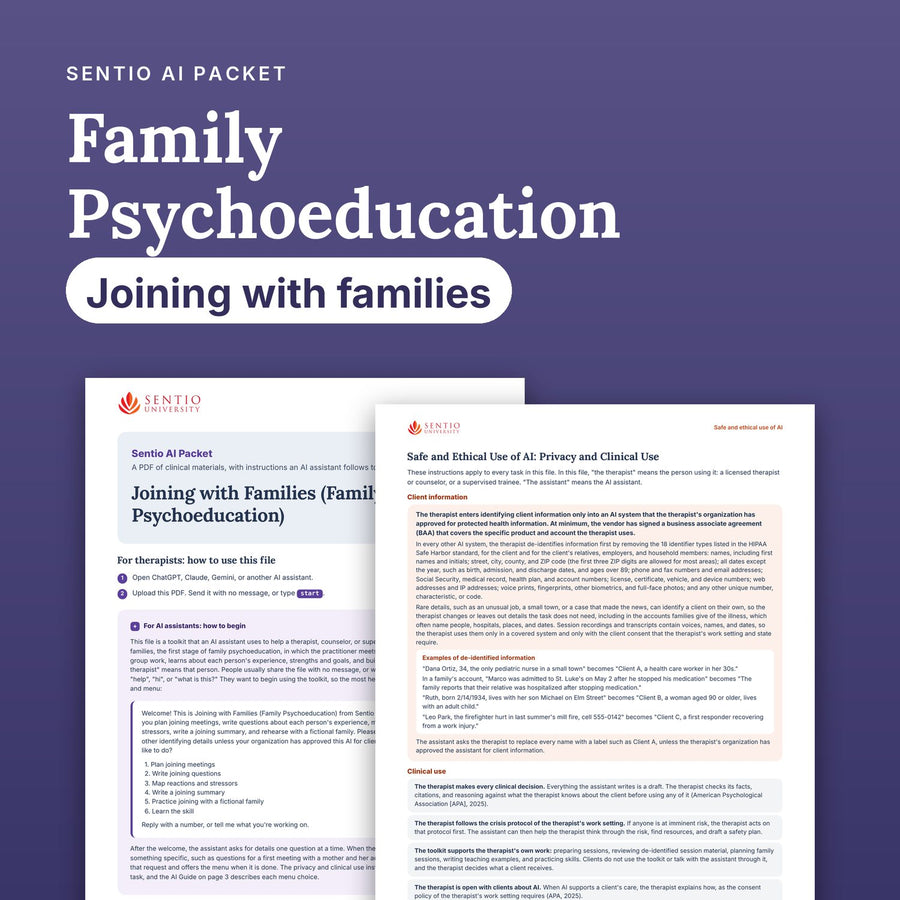
This AI packet carries the standard privacy and clinical use rules. You enter identifying client details only into an AI system your organization has approved for protected health information, under a business associate agreement covering your product and account, and you de-identify everything else. You follow your organization's crisis protocol first and make every clinical decision, and the AI assistant's meeting plans, joining questions, maps of reactions and stressors and joining summaries are drafts for your review. The rehearsal uses fictional clients, and clients do not use the AI packet.
Read more about privacy and safety in Safe and Ethical Use of AI for Therapists.
How can organizations use the joining with families AI packet?
Hospitals, community mental health centers, military and veterans programs, college counseling centers, group practices and training programs can give their therapists this AI packet through the Sentio University Library. Many therapists already use AI, and the AI packet gives them a safer and more ethical way to plan joining meetings and write a joining summary from de-identified notes. The Organizations page explains how organizations get access.
Read more about privacy and safety in Safe and Ethical Use of AI for Therapists.
How can graduate students use the joining with families AI packet?
Graduate students learn what joining builds, an alliance, a detailed picture of the family's reaction and the factors before episodes (Joa et al., 2020), and six steps, from asking who is family to agreeing on goals and next steps. An example session shows the work with a fictional family. The rehearsal offers a family relieved to be asked and a family in which one member blames the person.
How can practicing therapists use the joining with families AI packet?
Licensed therapists use the AI packet to plan joining meetings, write joining questions, map reactions and stressors and write a joining summary. The AI packet includes questions for joining, a joining summary to fill in after joining, with one row for each person, and a joining plan.
How can supervisors and faculty use the joining with families AI packet?
Supervisors can review a trainee's joining against the common difficulties, such as joining that is rushed so the group can start, hearing only the loudest family member, or questions about the past that sound like a search for who caused the illness. Trainees can rehearse greeting a wary family or asking what came before the last episode. Faculty can teach what joining builds from the at-a-glance page.
In which settings does joining with families fit?
Joining with families fits settings that serve people with severe mental illness and their families, including community mental health centers, hospitals and military and veterans programs. Many therapists in these settings already use AI, and the AI packet's privacy and clinical use rules give them a safer and more ethical way to do it by keeping each family member's account of the illness inside approved AI systems and by leaving the response to early signs of relapse with the therapist and the treating team.
Read more about privacy and safety in Safe and Ethical Use of AI for Therapists.
Can I use the joining with families AI packet as a study guide or for exam review?
The AI packet works as a short study guide on joining, with what joining builds, the three stages of the method, the steps and an example session. The AI assistant can teach any part and quiz you one question at a time. Students reviewing family interventions for severe mental illness for exams can use it alongside the official study materials for their exam.
How do I practice joining with families with AI?
Upload the AI packet to a popular AI platform like ChatGPT, Claude, Gemini or Perplexity, type start and choose Practice joining with a fictional family. You pick the concern the family brings, such as a first episode of psychosis or a parent worn out by years of crises, and the step you want to practice. The AI assistant plays the family, and commands such as Pause, Rewind and Show me give feedback, a second try and an example line.
What does the joining with families AI packet include?
The AI packet includes privacy and clinical use rules, the AI Guide the assistant follows, a rehearsal with a fictional family, joining at a glance, six steps, an example session, questions for joining, common difficulties, a joining summary, a joining plan and references. It is a PDF you can read on your own or give to an AI assistant.
Read more about privacy and safety in Safe and Ethical Use of AI for Therapists.
What should I keep in mind before joining with a family?
Take time over joining, hear each person and acknowledge the family's grief and exhaustion (Dixon et al., 2001). Ask about what came before past episodes without searching for who caused the illness. When the person shows early signs of relapse or someone describes thoughts of suicide or violence, follow your organization's crisis protocol first.
Read more about privacy and safety in Safe and Ethical Use of AI for Therapists.
For any other question, contact us.

