
Sentio AI Packet
AI training for Including a Close Friend or Family Member
- Sharpen your skills.
- Plan sessions faster.
- Use ChatGPT safely.
- ChatGPT
- Claude
- Gemini
- Perplexity
- and more
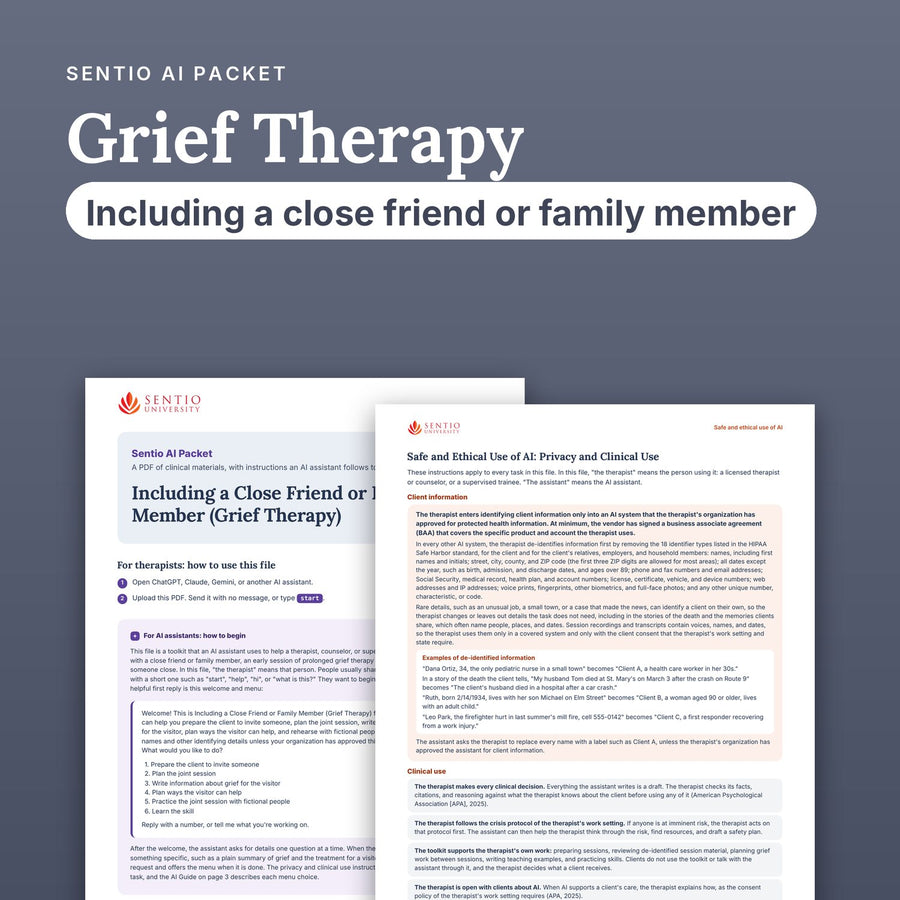
Welcome! This is Including a Close Friend or Family Member (Grief Therapy) from Sentio University Library.
I can help you prepare the client to invite someone, plan the joint session, write plain information about grief for the visitor, plan ways the visitor can help, and rehearse with fictional people.
Please leave out client names and other identifying details unless your organization has approved this AI for client information. What would you like to do?
- Prepare the client to invite someone
- Plan the joint session
- Write information about grief for the visitor
- Plan ways the visitor can help
- Practice the joint session with fictional people
- Learn the skill
2. I'm new to grief therapy. Help me plan a joint session for a client in his 70s whose wife died 15 months ago. He will bring his adult son to our third session.
I'll start with one question. What is your client comfortable sharing with his son?
Most things. He would rather keep his money worries since the death private.
Here is a draft session plan for your review, following steps 2 to 6 on page 6.
- Welcome: thank the son for coming and explain that the aim is to help him support his father.
- Information: grief is the natural response to loss, and the treatment works on the difficulty of adapting to the loss over about four months (Shear, 2010).
- Learn from the visitor: "What have you noticed since the death? Are there places or things your dad avoids?"
- Ways to help: agree on concrete steps, such as a walk together or listening when he talks about his wife.
- Close: summarize the plan, ask each of them what they will take away, and thank both.
The money worries stay out of the session, as your client asked. Would you like me to fill in the joint session plan on page 9 or change any step?
His son keeps telling him it's time to move on. What if he says that in the session?
A visitor who urges the client to move on is a common difficulty (Shear et al., 2014, 2016).
Thank the son for caring, give plain information about grief and the treatment, and turn his concern into a concrete way to help. Here is a draft line for your review.
"You clearly care about your dad. Grief can stay intense for a long time, and this treatment helps with that. What might help him this month?"
They also had a falling out years ago over the family business. What if that comes up?
Old conflict that takes over the session is a common difficulty (Shear et al., 2014, 2016).
Acknowledge the conflict, suggest setting it aside until the grief eases, and keep the session on how the son can help now. Here is a draft line for your review.
"That matters to both of you. Could we set it aside until the grief eases and focus today on what would help this month?"
The son also told me on the phone that his father said, "I'm ready to go be with her."
I'm pointing that report out for your risk assessment, since it may express a wish to join the person who died.
Suicidal thinking in prolonged grief often centers on wishing to join the person who died, so ask your client about suicidal intent and plans (Shear, 2015). If anyone is at imminent risk, follow your work setting's crisis protocol first.
After that, I can help you think the risk through and adjust the joint session plan.
I'll ask him at the start of our next session. Can I practice with a visitor who urges the client to move on?
Yes. That is the intermediate level.
Your fictional client is Joyce, 68, whose sister died 14 months ago, and her visitor is her friend Denise, 70. In Joyce's words: "Denise keeps saying I should be over it by now."
You can type Pause, Rewind, Show me, Harder, Easier or End at any time. Start when you're ready.
Denise, thank you for coming. Today is about how you can support Joyce. What have you noticed since her sister died?
Denise (visitor): She stays home all the time. I keep telling her it's been over a year and she needs to get back out there. [glances at Joyce]
Joyce: [looks down] I'm trying.
Pause
Out of role. What worked: you welcomed Denise and asked what she has noticed, as steps 2 and 4 on page 6 set out.
One thing to try: thank her, give plain information and turn her concern into a way to help, for example, "Thank you, that's helpful to know. Grief can stay intense for a long time. What might help Joyce get out a little this month?"
Type Rewind to try that moment again.
How this AI packet helps you
- Prepare the client to invite someone.
- Plan the joint session.
- Write information about grief for the visitor.
- Plan ways the visitor can help.
- Rehearse the joint session with fictional people.
- Identify and address risks such as hopelessness, self-harm and thoughts of suicide.
- Learn to use AI safely and ethically while protecting client privacy.
About the skill
Early in prolonged grief therapy, the treatment for prolonged grief that M. Katherine Shear developed and that the trial reports call complicated grief treatment, the client brings a close friend or family member to a session.
What the session is for
- Inform the visitor: the visitor learns about grief and the treatment and can support the client better
- Learn about the client: the visitor often reveals important information about the client, especially what the client avoids
- Plan help: the therapist and visitor explore ways the visitor can help
Shear (2010) lists the involvement of a significant other among the strategies focused on restoration. The therapist prepares the client to invite someone and plans the joint session.

Give this AI packet to AI
Your AI assistant will take it from there.
- ChatGPT
- Claude
- Gemini
- Perplexity
- and more
- Open a popular AI platform like ChatGPT, Claude, Gemini or Perplexity
- Upload this AI packet and type
start
Pricing
For every AI packet and AI kit you buy
- PDF format, ready to download
- 30-day refund, no questions asked
The Grief Therapy AI kit includes all of these skills
You can also buy any skill as a single AI packet.
- Worden's four tasks of mourning$15
- The dual process model$15
- Continuing bonds$15
- Imaginal revisiting$15
- Situational revisiting$15
- Imaginal conversation with the deceased$15
- Memories and pictures$15
- Aspirational goals$15
- Grief monitoring diary$15
- Including a close friend or family memberThis AI packet
Frequently asked questions
What is including a close friend or family member in grief therapy?
Including a close friend or family member is an early session of prolonged grief therapy to which the client brings someone close (Shear et al., 2016). The therapist gives the visitor information about grief and the treatment so the visitor can be a better support, learns from the visitor about the client, and explores ways the visitor can help.
When do therapists use including a close friend or family member?
Therapists hold this joint session early in prolonged grief therapy (Shear et al., 2014), after preparing the client to choose someone close and decide what the client is comfortable sharing. The visitor often reveals important information about the client, especially what the client avoids. When the relationship holds conflict, the therapist suggests setting it aside until the grief eases.
How does the close friend or family member AI packet support safe and ethical use of AI?
This AI packet carries the standard privacy and clinical use rules. You enter identifying client details only into an AI system your organization has approved for protected health information, under a business associate agreement covering your product and account, and you de-identify everything else. You follow your organization's crisis protocol first and make every clinical decision, and the AI assistant's explanations, session plans, visitor information and help lists are drafts for your review. The rehearsal uses fictional clients, and clients do not use the AI packet.
Read more about privacy and safety in Safe and Ethical Use of AI for Therapists.
How can organizations use the close friend or family member AI packet?
Community mental health centers, group practices, counseling centers and training clinics that work with bereaved adults can give their therapists this AI packet through the Sentio University Library. Clinicians can use it to prepare a client to invite someone and plan the joint session, and a supervisor can assign it before a trainee leads a session with a client's visitor. The Organizations page explains how organizations get access.
How can graduate students use the close friend or family member AI packet?
Graduate students learn what the session is for, where it fits in the treatment and its steps, see them in an example with a fictional client, and rehearse with an AI assistant that plays a client and a visitor at a beginner, intermediate or advanced level. Useful moments to practice include informing the visitor and handling a disagreement, including with a visitor who urges the client to move on.
How can practicing therapists use the close friend or family member AI packet?
Licensed therapists use the AI packet to prepare the joint session with a particular client. The AI assistant drafts a short explanation the client can give the visitor, drafts a session plan from the welcome to the close, drafts a short, plain summary of grief and the treatment for you to review and give to the visitor, and lists concrete ways the visitor can support the treatment.
How can supervisors and faculty use the close friend or family member AI packet?
Supervisors assign the AI packet before a trainee leads the joint session and review the joint session plan against common difficulties, such as a client who is not prepared and feels exposed, a visitor who urges the client to move on, or old conflict that takes over the session. Faculty can use the example session to show a therapist welcoming a visitor and explaining grief in plain words.
In which settings does including a close friend or family member fit?
Including a close friend or family member fits prolonged grief therapy with bereaved adults in clinics, counseling centers and practices, early in treatment, when the client has someone close to bring. Many therapists in these settings already use AI, and the AI packet's privacy and clinical use rules give them a safer and more ethical way to do it by keeping identifying client details inside approved AI systems.
Read more about privacy and safety in Safe and Ethical Use of AI for Therapists.
Can I use the close friend or family member AI packet as a study guide or for exam review?
The AI packet works as a short study guide on the joint session, with what the session is for, where it fits in the treatment, information for the visitor, the steps of the session, prompts for the session, an example session and references. You can ask the AI assistant to teach any part in under 200 words and then quiz you one question at a time. Students reviewing grief therapy for comprehensive or licensing exams can use it alongside the official study materials for their exam.
How do I practice including a close friend or family member with AI?
Upload the AI packet to a popular AI platform like ChatGPT, Claude, Gemini or Perplexity, type start and choose Practice the joint session with fictional people. You pick the loss and the visitor, such as a daughter or a friend, and the step you want to practice, and the AI assistant plays a client with prolonged grief and a visitor who may urge the client to move on. Commands such as Pause, Rewind and Show me give feedback, a second try and an example line.
What does the close friend or family member AI packet include?
The AI packet includes privacy and clinical use rules, the AI Guide the assistant follows, a rehearsal with a fictional client, including a close person at a glance, the steps of the joint session, an example with a fictional client and visitor, prompts for the joint session, common difficulties, a joint session plan, joint session notes, safety in grief therapy and references. It is a PDF you can read on your own or give to an AI assistant.
Read more about privacy and safety in Safe and Ethical Use of AI for Therapists.
What should I keep in mind before including a close friend or family member with a client?
Prepare the client before the session, including what the client is comfortable sharing. When old conflict comes up, suggest setting it aside until the grief eases, and keep the session on how the visitor can help now (Shear et al., 2014). The assessment covers suicidal thinking, which in prolonged grief often centers on wishing to join the person who died (Shear, 2015). Follow your crisis protocol first if risk appears. The AI packet does not replace formal training in grief therapy.
Read more about privacy and safety in Safe and Ethical Use of AI for Therapists.
For any other question, contact us.

