
Sentio AI Packet
AI training for Hot Spots
- Sharpen your skills.
- Plan sessions faster.
- Use ChatGPT safely.
- ChatGPT
- Claude
- Gemini
- Perplexity
- and more
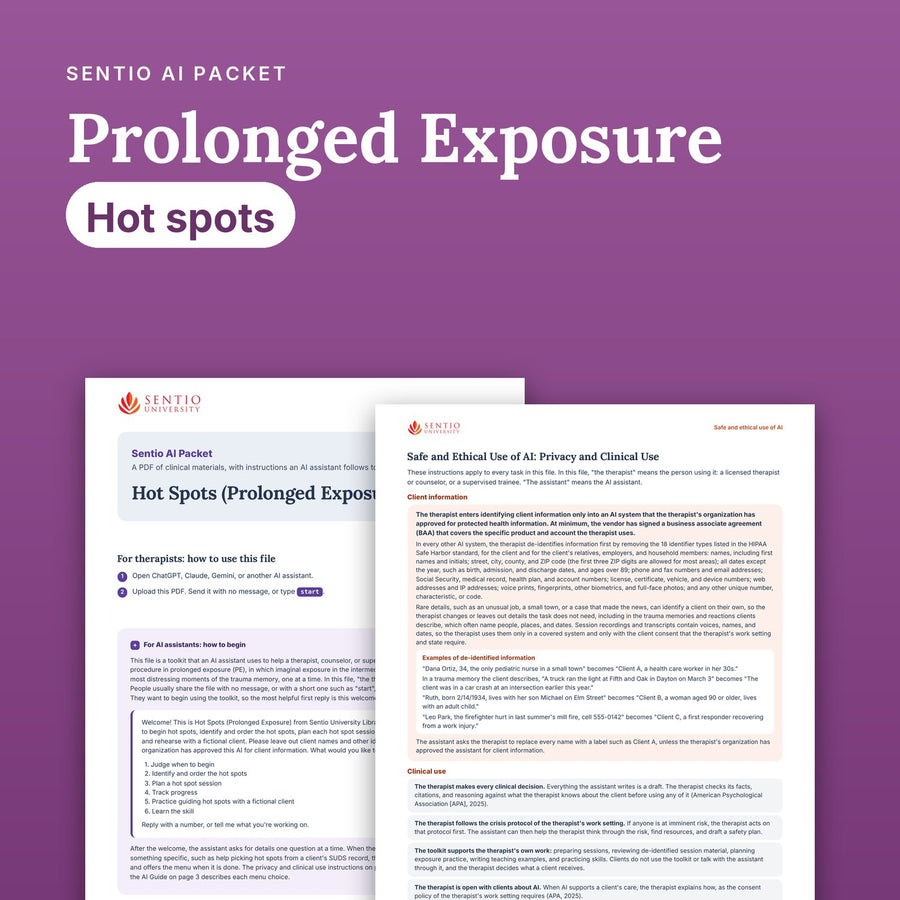
Welcome! This is Hot Spots (Prolonged Exposure) from Sentio University Library.
I can help you judge when to begin hot spots, identify and order the hot spots, plan each hot spot session, track SUDS across sessions, and rehearse with a fictional client.
Please leave out client names and other identifying details unless your organization has approved this AI for client information. What would you like to do?
- Judge when to begin
- Identify and order the hot spots
- Plan a hot spot session
- Track progress
- Practice guiding hot spots with a fictional client
- Learn the skill
3. I'm new to PE. My client has done three imaginal exposures of a fire in his apartment building, and his distress to the memory has begun to fall. His SUDS peak when the smoke alarm wakes him and when he waits outside for the fire crew. Help me plan his first hot spot session.
Here is a draft plan for your review (Foa et al., 2019).
- Choose one hot spot and mark its edges: from the alarm waking him until he gets out the front door.
- Explain the change: "Today you'll go over that part only, slowly, again and again, with as much detail as you can."
- Guide the repetitions: ask for SUDS every 5 minutes, slow him down, and ask what he feels, sees, hears and thinks.
- Decide when to move on: once the hot spot is worn out or SUDS have dropped considerably, plan the next one, waiting outside, for the following session.
- Process and settle: process the experience and help him calm before he leaves.
The repetitions are recorded like any imaginal exposure, and he listens once a day, skipping the day of the session (Foa et al., 2019). Would you like me to start his hot spot list?
Last week he rushed through the alarm part in a few seconds. What do I do if he does that again?
Slow the moment down with short questions, so he repeats that part in slow motion and in great detail (Foa et al., 2019). Here are draft prompts for your review.
"Slow it down, like a film in slow motion. What do you hear? What are you thinking right then?"
Could we do both hot spots today to save time?
Work on one hot spot at a time, generally one per session, and stay with it until it is worn out or SUDS drop considerably before moving to the next (Foa et al., 2019).
What if he gets overwhelmed and seems to lose touch with the room?
Use the grounding steps for overengagement: eyes open, the past tense, and reminders that he is safe in the room (Foa et al., 2019). Plan time at the end of the session for him to settle before he leaves.
He also told me he's been drinking more on the nights after sessions, and he said, "I don't see the point of any of this."
I'm pointing out both of those for your risk assessment, since the drinking has increased and the remark may express hopelessness.
When suicidal thinking comes up, pause the session's task, assess suicide risk and develop a safety plan. Current high risk takes precedence, and PE resumes once the risk has been addressed (Foa et al., 2019).
Assess his substance use as well. If anyone is at imminent risk, follow your work setting's crisis protocol first.
I'll start with that. Can I practice with a client who rushes past the hot spot?
Yes. That is the intermediate level.
Your fictional client is Andre, 45. He was robbed at a cash machine last spring, and in his words: "I want to get this part over with."
You can type Pause, Rewind, Show me, Harder, Easier or End at any time. Start when you're ready.
Andre, today we'll stay with the part from when the man walks up until he runs off. Close your eyes and go through it slowly.
Andre: [eyes closed] He walks up, he says give me the money, I hand it over, and he's gone. SUDS 60.
Pause
Out of role. What worked: you marked a clear start and end point.
One thing to try: slow the moment down with a short question, for example, "Go back to when he walks up. Slowly. What do you see? What are you thinking right then?"
Type Rewind to try that moment again.
How this AI packet helps you
- Judge when to begin.
- Identify and order the hot spots.
- Plan a hot spot session.
- Track progress.
- Rehearse guiding hot spots with a fictional client.
- Identify and address risks such as hopelessness, self-harm and thoughts of suicide.
- Learn to use AI safely and ethically while protecting client privacy.
About the skill
Hot spots are the most currently distressing parts of the trauma memory (Foa et al., 2019). The hot spots procedure begins at session 5 or 6 of prolonged exposure (PE), usually after two or three sessions of imaginal exposure, once distress to the memory has begun to fall. It continues until the final session.
The procedure
- One at a time: the therapist and client pick one hot spot with clear start and end points, generally one per session
- Slowly, again and again: the client repeats that part of the memory over and over, in slow motion and in great detail
- Until it is worn out: work continues until SUDS drop considerably, and then moves to the next
- Back to the whole memory: the whole memory is recounted again when the hot spots work is done
By this point the client should have disclosed all the details of the event, and processing still follows every imaginal exposure (Foa et al., 2019).

Give this AI packet to AI
Your AI assistant will take it from there.
- ChatGPT
- Claude
- Gemini
- Perplexity
- and more
- Open a popular AI platform like ChatGPT, Claude, Gemini or Perplexity
- Upload this AI packet and type
start
Pricing
For every AI packet and AI kit you buy
- PDF format, ready to download
- 30-day refund, no questions asked
The Prolonged Exposure AI kit includes all of these skills
You can also buy any skill as a single AI packet.
Frequently asked questions
What are hot spots in prolonged exposure?
Hot spots are the most currently distressing parts of the trauma memory (Foa et al., 2019). In the hot spots procedure of prolonged exposure (PE), the therapist and client pick one hot spot with clear start and end points, and the client repeats that part of the memory over and over, in slow motion and in great detail (Foa et al., 2019). Work on a hot spot continues until it is worn out or SUDS drop considerably (Foa et al., 2019).
When do therapists use the hot spots procedure?
Therapists begin the hot spots procedure in the intermediate sessions, once distress to the whole memory has begun to fall (Foa et al., 2019). Hot spots bring the most distressing moments into focus, so the therapist watches for overengagement and plans time to settle before the client leaves (Foa et al., 2019). The AI packet's safety cautions apply throughout PE.
How does the hot spots AI packet support safe and ethical use of AI?
The hot spots AI packet carries the standard privacy and clinical use rules. You enter identifying client details only into an AI system your organization has approved for protected health information, under a business associate agreement covering your product and account, and you de-identify everything else. You follow your organization's crisis protocol first and make every clinical decision, and the AI assistant's readiness judgments, ordered hot spot lists and session plans are drafts for your review. The rehearsal uses fictional clients, and clients do not use the AI packet.
Read more about privacy and safety in Safe and Ethical Use of AI for Therapists.
How can organizations use the hot spots AI packet?
Military and veterans programs, hospitals, community mental health centers and training programs can give their therapists the hot spots AI packet through the Sentio University Library. Many therapists already use AI, and the AI packet gives them a safer and more ethical way to judge when to begin the procedure and plan a hot spot session. The Organizations page explains how organizations get access.
Read more about privacy and safety in Safe and Ethical Use of AI for Therapists.
How can graduate students use the hot spots AI packet?
Graduate students learn the procedure, which works on one hot spot at a time until it is worn out, and seven steps, from checking readiness to processing and settling. An example with a fictional client shows a session. The rehearsal offers a client who stays with the hot spot and whose SUDS falls and a client who rushes through the hot spot.
How can practicing therapists use the hot spots AI packet?
Licensed therapists use the AI packet to judge when to begin, identify and order the hot spots, plan a hot spot session and track progress. The AI packet includes prompts for use during hot spots, a hot spot list, a hot spot session plan and a page on safety in prolonged exposure.
How can supervisors and faculty use the hot spots AI packet?
Supervisors can review a trainee's sessions against the common difficulties, such as starting hot spots before distress to the whole memory has begun to fall, a hot spot with no clear start and end points, or several hot spots mixed in one session. Trainees can rehearse slowing a client who rushes past the hot spot or deciding whether a hot spot is worn out. Faculty can teach the procedure from the at-a-glance page.
In which settings does the hot spots procedure fit?
The hot spots procedure fits settings that treat adults with PTSD, including military and veterans programs, hospitals and community mental health centers. Many therapists in these settings already use AI, and the AI packet's privacy and clinical use rules give them a safer and more ethical way to do it by keeping the most distressing details of a client's trauma inside approved AI systems and by leaving the judgment of readiness, and the watch for overengagement, with the therapist.
Read more about privacy and safety in Safe and Ethical Use of AI for Therapists.
Can I use the hot spots AI packet as a study guide or for exam review?
The AI packet works as a short study guide on hot spots, with the procedure, the steps, prompts for use during hot spots and an example session. The AI assistant can teach any part and quiz you one question at a time. Students reviewing PE for exams can use it alongside the official study materials for their exam.
How do I practice guiding hot spots with AI?
Upload the AI packet to a popular AI platform like ChatGPT, Claude, Gemini or Perplexity, type start and choose Practice guiding hot spots with a fictional client. You pick what the client brings, such as a car crash or a robbery, and the step to practice. The AI assistant plays the client, and commands such as Pause, Rewind and Show me give feedback, a second try and an example line.
What does the hot spots AI packet include?
The AI packet includes privacy and clinical use rules, the AI Guide the assistant follows, a rehearsal with a fictional client, hot spots at a glance, seven steps from checking readiness to processing and settling, an example with a fictional client, prompts during hot spots, common difficulties, a hot spot list, a hot spot session plan, a page on safety in prolonged exposure and references. It is a PDF you can read on your own or give to an AI assistant.
Read more about privacy and safety in Safe and Ethical Use of AI for Therapists.
What should I keep in mind before using the hot spots procedure with a client?
Wait until distress to the whole memory has begun to fall, work on one hot spot with clear edges and keep prompts short. Slow a client who rushes, and leave time to settle before the client leaves. When thoughts of suicide or urges to self-harm come up between sessions, follow your organization's crisis protocol first.
Read more about privacy and safety in Safe and Ethical Use of AI for Therapists.
For any other question, contact us.

