
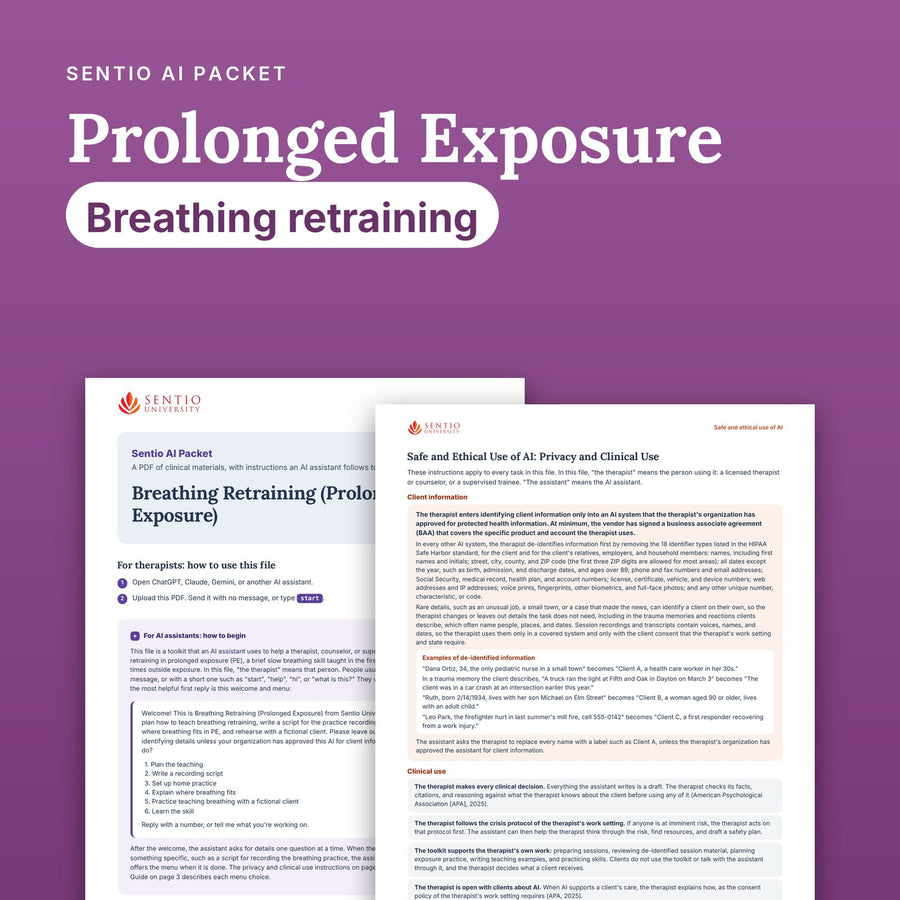
Sentio AI Packet
AI training for Breathing Retraining
- Sharpen your skills.
- Plan sessions faster.
- Use ChatGPT safely.
- ChatGPT
- Claude
- Gemini
- Perplexity
- and more
Welcome! This is Breathing Retraining (Prolonged Exposure) from Sentio University Library.
I can help you plan how to teach breathing retraining, write a script for the practice recording, set up home practice, explain where breathing fits in PE, and rehearse with a fictional client.
Please leave out client names and other identifying details unless your organization has approved this AI for client information. What would you like to do?
- Plan the teaching
- Write a recording script
- Set up home practice
- Explain where breathing fits
- Practice teaching breathing with a fictional client
- Learn the skill
1. I'm new to PE. My client, a woman in her 50s who escaped a house fire last year, lies awake most nights. I'll teach breathing at the end of session 1. Help me plan it.
Here is a draft teaching plan for your review, for the end of session 1, after the overview and the trauma interview (Foa et al., 2019).
- Introduce: a brief skill for calming down at times outside exposure, such as going to sleep.
- Model: a normal breath in through the nose, a slow breath out while silently saying calm or relax, then a pause for a count of 4.
- Practice together: several cycles, with an ordinary in-breath and a slow out-breath.
- Record: 10 to 15 cycles in your voice, for practice at home.
- Home practice: 10 minutes twice a day, such as morning and bedtime (Rothbaum et al., 2019).
- When to leave it out: with a few exceptions, the skill stays out of exposure exercises, so she learns to cope with memories and reminders without it.
Before teaching, ask about any medical condition that affects breathing, and adjust or leave out the skill if it causes discomfort. Would you like me to write the recording script?
When she tried it in session, she took big deep breaths and said she felt dizzy.
Deep breaths that leave a client light-headed are a common difficulty. Ask for an ordinary breath in and a longer breath out, and match your voice to the slow pace. Here are draft coaching lines for your review.
- "Take a normal breath in through your nose. No need for a big breath."
- "Breathe out slowly and let the word calm stretch out as long as the breath."
She asked if she can use the breathing when we start talking about the fire.
With a few exceptions, clients are told to leave breathing retraining out of exposure exercises, so that they learn they can cope with trauma memories and reminders without special devices (Foa et al., 2019). Here is a draft answer for your review.
"This is for winding down, like at bedtime. When we go over the memory, we'll leave the breathing aside, so you learn that you can handle it."
The exceptions are calming a very distressed client after imaginal exposure, before she leaves, and slow breathing if she hyperventilates during the recounting (Foa et al., 2019).
She also tries it only when she's already panicking, and says it does nothing.
Practice only at moments of high distress is a common difficulty. Set the two 10-minute practices with the recording at set times, such as morning and bedtime, have her mark each one in the log and review the log next session (Rothbaum et al., 2019).
At the end she said, "If I can't sleep soon, I don't know how much longer I can keep going."
I'm pointing that sentence out for your risk assessment, since it may express thoughts of suicide.
When suicidal thinking comes up, pause the session's task, assess suicide risk and develop a safety plan (Foa et al., 2019). If anyone is at imminent risk, follow your work setting's crisis protocol first.
After that, I can help you think the risk through and draft a safety plan.
I'll ask her directly. Can I practice explaining why breathing stays out of exposure?
Yes. That is the advanced level, a client who wants to use breathing to get through every exposure.
Your fictional client is Teresa, 47. She was mugged on a train platform and lies awake most nights, and in her words: "If I breathe like this when we talk about it, I'll get through it."
You can type Pause, Rewind, Show me, Harder, Easier or End at any time. Start when you're ready.
Sure, you can use the breathing whenever the memory gets too hard.
Teresa: Good. Then I'll breathe through the whole thing. [looks relieved]
Pause
Out of role. What worked: you answered her hope warmly.
One thing to try: say plainly when she uses it, for example, "This breathing is for winding down at night. When we go over the memory, we'll leave it aside, so you can learn that you handle the fear yourself."
Type Rewind to try that moment again.
How this AI packet helps you
- Plan the teaching.
- Write a recording script.
- Set up home practice.
- Explain where breathing fits in PE.
- Rehearse with a fictional client.
- Identify and address risks such as hopelessness, self-harm and thoughts of suicide.
- Learn to use AI safely and ethically while protecting client privacy.
About the skill
Breathing retraining is a brief calming skill taught in the first session of prolonged exposure (PE), after the overview and the trauma interview (APA, 2017). In PE it is a skill for times when exposure is not the task, such as going to sleep (Foa et al., 2019). The guide calls it not critical to the process and outcome of PE.
The breathing steps
- Breathe in normally: a normal breath in through the nose with the mouth closed
- Breathe out slowly: exhale slowly while silently saying a calming word, such as calm or relax
- Pause: hold the breath for a count of 3 or 4 before the next breath
- Repeat: take the next breath and continue the cycle
The therapist models breathing through the nose and records 10 to 15 cycles for home practice, and the client practices 10 minutes twice a day (Foa et al., 2019; Rothbaum et al., 2019).

Give this AI packet to AI
Your AI assistant will take it from there.
- ChatGPT
- Claude
- Gemini
- Perplexity
- and more
- Open a popular AI platform like ChatGPT, Claude, Gemini or Perplexity
- Upload this AI packet and type
start
Pricing
For every AI packet and AI kit you buy
- PDF format, ready to download
- 30-day refund, no questions asked
The Prolonged Exposure AI kit includes all of these skills
You can also buy any skill as a single AI packet.
- Treatment rationaleGet it free
- Breathing retrainingThis AI packet
- Common reactions to trauma$15
- Building the in vivo hierarchy$15
- In vivo exposure$15
- Imaginal exposure$15
- Processing after imaginal exposure$15
- Hot spots$15
- Final session$15
- The trauma interview$15
Frequently asked questions
What is breathing retraining in prolonged exposure?
Breathing retraining is a brief calming skill taught in the first session of prolonged exposure (PE), after the overview and the trauma interview (APA, 2017). The client breathes in normally through the nose and breathes out slowly while silently saying a calming word (Rothbaum et al., 2019). In PE it is a skill for times when exposure is not the task, such as going to sleep (Foa et al., 2019).
When do therapists use breathing retraining?
Therapists teach breathing retraining in the first session and set home practice. With a few exceptions, clients are told not to use breathing retraining during exposure exercises, so that they learn they can cope with trauma memories and reminders without special devices (Foa et al., 2019). Used during exposure, breathing can become a way to avoid emotion, and the AI packet's safety cautions apply before PE starts.
How does the breathing retraining AI packet support safe and ethical use of AI?
The breathing retraining AI packet carries the standard privacy and clinical use rules. You enter identifying client details only into an AI system your organization has approved for protected health information, under a business associate agreement covering your product and account, and you de-identify everything else. You follow your organization's crisis protocol first and make every clinical decision, and the AI assistant's teaching plans, recording scripts and home practice plans are drafts for your review. The rehearsal uses fictional clients, and clients do not use the AI packet.
Read more about privacy and safety in Safe and Ethical Use of AI for Therapists.
How can organizations use the breathing retraining AI packet?
Military and veterans programs, hospitals, community mental health centers and training programs can give their therapists the breathing retraining AI packet through the Sentio University Library. Many therapists already use AI, and the AI packet gives them a safer and more ethical way to plan the teaching and write a recording script for home practice. The Organizations page explains how organizations get access.
Read more about privacy and safety in Safe and Ethical Use of AI for Therapists.
How can graduate students use the breathing retraining AI packet?
Graduate students learn the breathing steps and six steps for teaching them, from introducing the skill to explaining when to leave it aside. An example with a fictional client shows a session. The rehearsal offers a relaxed client who follows the steps easily and a client who breathes too fast or too deeply and feels light-headed.
How can practicing therapists use the breathing retraining AI packet?
Licensed therapists use the AI packet to plan the teaching, write a recording script, set up home practice and explain where breathing fits. The AI packet includes coaching phrases, a breathing practice log for the client, a teaching plan and a page on safety in prolonged exposure.
How can supervisors and faculty use the breathing retraining AI packet?
Supervisors can review a trainee's teaching against the common difficulties, such as deep breaths that leave the client light-headed, practice only when the client is very upset, or breathing used during exposure to push feelings away. Trainees can rehearse modeling the slow breath or explaining why breathing stays out of exposure. Faculty can teach the breathing steps from the at-a-glance page.
In which settings does breathing retraining fit?
Breathing retraining fits settings that treat adults with PTSD, including military and veterans programs, hospitals and community mental health centers. Many therapists in these settings already use AI, and the AI packet's privacy and clinical use rules give them a safer and more ethical way to do it by keeping details of a client's symptoms and practice inside approved AI systems and by leaving with the therapist the decision of where breathing fits in a client's treatment.
Read more about privacy and safety in Safe and Ethical Use of AI for Therapists.
Can I use the breathing retraining AI packet as a study guide or for exam review?
The AI packet works as a short study guide on breathing retraining in PE, with the breathing steps, its place in PE, the steps for teaching it and an example session. The AI assistant can teach any part and quiz you one question at a time. Students reviewing PE for exams can use it alongside the official study materials for their exam.
How do I practice teaching breathing retraining with AI?
Upload the AI packet to a popular AI platform like ChatGPT, Claude, Gemini or Perplexity, type start and choose Practice teaching breathing with a fictional client. You pick what the client brings, such as trouble sleeping after an assault or tension after a crash, and the step to practice. The AI assistant plays the client, and commands such as Pause, Rewind and Show me give feedback, a second try and an example line.
What does the breathing retraining AI packet include?
The AI packet includes privacy and clinical use rules, the AI Guide the assistant follows, a rehearsal with a fictional client, breathing retraining at a glance, six steps for teaching it, an example with a fictional client, coaching phrases, common difficulties, a breathing practice log, a teaching plan, a page on safety in prolonged exposure and references. It is a PDF you can read on your own or give to an AI assistant.
Read more about privacy and safety in Safe and Ethical Use of AI for Therapists.
What should I keep in mind before teaching breathing retraining to a client?
Ask for an ordinary breath in and a slow breath out, and keep instructions short and calm. Explain that breathing is for times outside exposure. Check for medical conditions that make breath holding uncomfortable, and when thoughts of suicide or self-harm come up, follow your organization's crisis protocol first.
Read more about privacy and safety in Safe and Ethical Use of AI for Therapists.
For any other question, contact us.

