
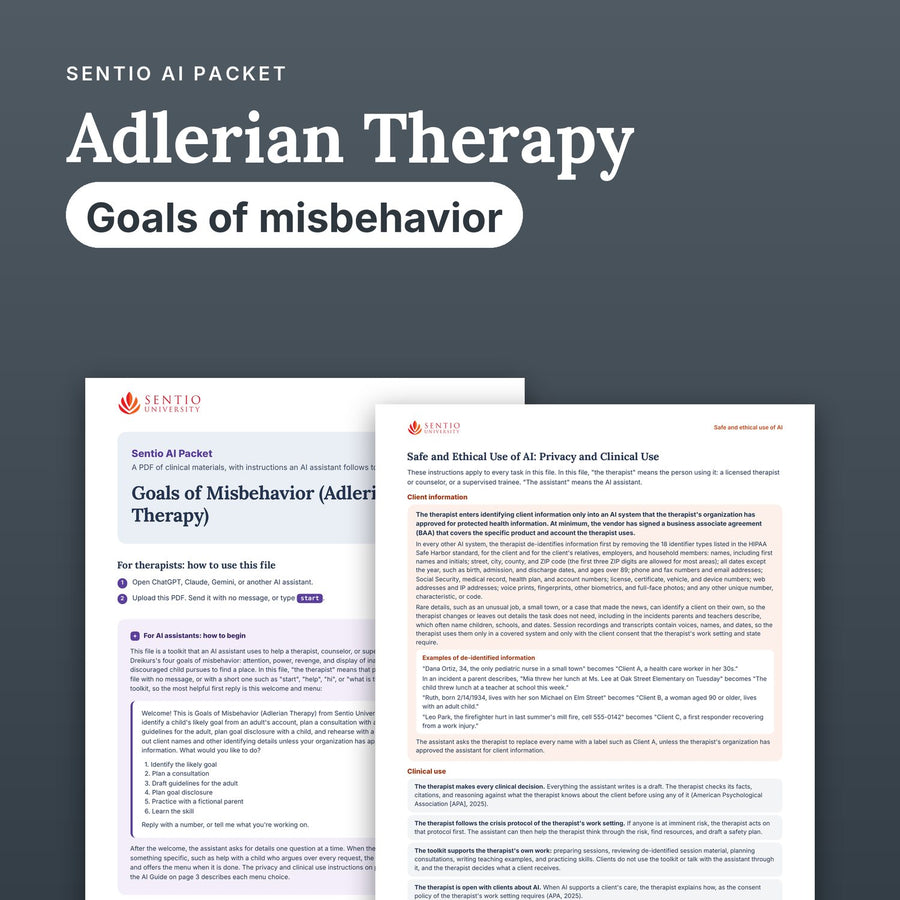
Sentio AI Packet
AI training for Goals of Misbehavior
- Sharpen your skills.
- Plan sessions faster.
- Use ChatGPT safely.
- ChatGPT
- Claude
- Gemini
- Perplexity
- and more
Welcome! This is Goals of Misbehavior (Adlerian Therapy) from Sentio University Library.
I can help you identify a child's likely goal from an adult's account, plan a consultation with a parent or teacher, draft guidelines for the adult, plan goal disclosure with a child, and rehearse with a fictional parent.
Please leave out client names and other identifying details unless your organization has approved this AI for client information. What would you like to do?
- Identify the likely goal
- Plan a consultation
- Draft guidelines for the adult
- Plan goal disclosure
- Practice with a fictional parent
- Learn the skill
1. I'm new to Adlerian therapy. Help me identify a child's likely goal. A mother tells me her 7-year-old interrupts her phone calls every evening and taps her arm all through dinner. She feels annoyed and reminds him to wait, and he stops for a minute, then starts again.
Here is a draft reading for your review, offered as a guess (Carlson et al., 2006).
- Her feeling: annoyed, the first clue to the goal.
- Her usual response: reminding him, another clue.
- His response to correction: he stops for a while, then starts again.
- Likely goal, as a guess: attention, with the belief "I belong when noticed or served."
- Guideline to review with her: catch him being good, and create attention-getting moments.
- One change for about a week, asked as a question: "What would happen if you gave him some of your time before each call?"
Assess the child and family as usual, including safety at home. Would you like me to fill in the consultation record or draft guidelines for her?
She keeps asking me what's wrong with him. Should I tell her he's an attention seeker?
Presenting the goal as a label for the child is a common difficulty. The goals describe misbehavior that any child may show, as immediate goals tied to the situation (Mosak & Mosak, 1975), so invite her own guess first and offer yours as a question (Carlson et al., 2006). Here is a draft line for your review.
"What do you think he might be after when he taps your arm?"
She tried a new approach last month, he got worse, and she gave up after two days.
An adult who gives up when things get worse at first is a common difficulty. Tell her in advance that things may get worse before they improve, plan one problem at a time and schedule a follow-up (Carlson et al., 2006). Here is a draft line for your review.
"He may test this at first. Let's keep this one change for a week and look at it together when we meet."
Then she said, "When he won't stop, his dad gives him a good smack."
I'm pointing that sentence out for your risk assessment, since it may describe physical punishment of the child.
Assess safety at home, and follow the reporting duties of your work setting when abuse or neglect is suspected. If anyone is at imminent risk, follow your work setting's crisis protocol first.
After that, I can help you think the risk through and plan the consultation.
I'll ask her more about that first. Can I practice? A parent who wants a punishment that works.
Yes. That is the intermediate level.
Your fictional parent is Tanya, 36. Her 9-year-old son refuses homework every night, and in her words: "I need a punishment that finally works."
You can type Pause, Rewind, Show me, Harder, Easier or End at any time. Start when you're ready.
Tanya, tell me about last night. What did he do, and what did you do?
Tanya: He threw his pencil and said he wasn't doing it. I took his games away for a week, and he said he didn't care. [throws up hands]
Pause
Out of role. What worked: you asked for one recent incident.
One thing to try: ask for her feeling, for example, "When he threw the pencil, what did you feel in that moment?"
Type Rewind to try that moment again.
How this AI packet helps you
- Identify a child's likely goal from an adult's account.
- Plan a consultation with a parent or teacher.
- Draft guidelines for the adult.
- Plan goal disclosure with a child.
- Rehearse a consultation with a fictional parent.
- Identify and address risks such as hopelessness, self-harm and thoughts of suicide.
- Learn to use AI safely and ethically while protecting client privacy.
About the skill
Rudolf Dreikurs described four mistaken goals a discouraged child pursues to find a place (Mosak & Maniacci, 2011). The adult's own feeling and the child's response to correction help identify the goal.
The four goals
- Attention: the adult feels annoyed, and the child stops for a while, then starts again
- Power: the adult feels angry, and the child goes on, defies or complies slowly
- Revenge: the adult feels hurt, and the child misbehaves more
- Display of inadequacy: the adult feels hopeless, and the child does not respond or improve
The therapist consults with a parent or teacher, drafts guidelines for the adult and may plan goal disclosure with the child, using could-it-be questions.

Give this AI packet to AI
Your AI assistant will take it from there.
- ChatGPT
- Claude
- Gemini
- Perplexity
- and more
- Open a popular AI platform like ChatGPT, Claude, Gemini or Perplexity
- Upload this AI packet and type
start
Pricing
For every AI packet and AI kit you buy
- PDF format, ready to download
- 30-day refund, no questions asked
The Adlerian Therapy AI kit includes all of these skills
You can also buy any skill as a single AI packet.
- Lifestyle assessment$15
- Early recollections$15
- Family constellation$15
- Encouragement$15
- Acting as if$15
- Spitting in the client's soup$15
- Push-button technique$15
- Catching oneself$15
- The Question$15
- Goals of misbehaviorThis AI packet
- Natural and logical consequences$15
- Task setting$15
Frequently asked questions
What are the goals of misbehavior in Adlerian therapy?
The goals of misbehavior are Rudolf Dreikurs's four mistaken goals that a discouraged child pursues to find a place: attention, power, revenge and display of inadequacy (Mosak & Maniacci, 2011). They are immediate goals of behavior, separate from the long-range goals of the life style (Carlson et al., 2006).
When do therapists use the goals of misbehavior?
Therapists use the goals of misbehavior when consulting with a parent or teacher about a child's behavior. The adult's own feelings and usual attempts to stop the behavior are the clues to the goal (Carlson et al., 2006). Behavior can also come from illness, learning problems, trauma or abuse, so the therapist assesses the child and family as usual and follows the reporting duties of the work setting.
How does the goals of misbehavior AI packet support safe and ethical use of AI?
This AI packet carries the standard privacy and clinical use rules. You enter identifying client details only into an AI system your organization has approved for protected health information, under a business associate agreement covering your product and account, and you de-identify everything else. You follow your organization's crisis protocol first and make every clinical decision, and the AI assistant's goal guesses, consultation plans, guidelines and goal disclosure plans are drafts for your review. The rehearsal uses fictional clients, and clients do not use the AI packet.
Read more about privacy and safety in Safe and Ethical Use of AI for Therapists.
How can organizations use the goals of misbehavior AI packet?
Community mental health centers, group practices, counseling centers and training clinics that work with children and the adults in their lives can give their therapists this AI packet through the Sentio University Library. Clinicians can use it to identify a child's likely goal from an adult's account and plan a consultation, and a supervisor can assign it before a trainee consults with a parent or teacher. The Organizations page explains how organizations get access.
How can graduate students use the goals of misbehavior AI packet?
Graduate students learn the four goals and the steps of a consultation, see them in an example with a fictional parent, and rehearse with an AI assistant that plays a parent or teacher at a beginner, intermediate or advanced level. Useful moments to practice include asking how the adult felt and offering a could-it-be question, including with a parent who wants a punishment that works.
How can practicing therapists use the goals of misbehavior AI packet?
Licensed therapists use the AI packet to prepare a consultation about a particular child. The AI assistant suggests the likely goal as a guess from two de-identified incidents, drafts a consultation with a parent or teacher and fills in the record, drafts guidelines for the goal with one change to try for about a week, and drafts a goal disclosure with the child.
Read more about privacy and safety in Safe and Ethical Use of AI for Therapists.
How can supervisors and faculty use the goals of misbehavior AI packet?
Supervisors assign the AI packet before a trainee consults with a parent or teacher and review the consultation record against common difficulties, such as guessing the goal from the behavior alone, presenting the goal as a label for the child, or tackling several problems at once. Faculty can use the example consultation to show a therapist gathering incidents and inviting the adult to guess the goal.
In which settings do the goals of misbehavior fit?
The goals of misbehavior fit Adlerian therapy with children and the adults in their lives in clinics, counseling centers and practices, when a parent or teacher asks for help with a child's behavior. Many therapists in these settings already use AI, and the AI packet's privacy and clinical use rules give them a safer and more ethical way to do it by keeping identifying client details inside approved AI systems.
Read more about privacy and safety in Safe and Ethical Use of AI for Therapists.
Can I use the goals of misbehavior AI packet as a study guide or for exam review?
The AI packet works as a short study guide on the goals of misbehavior, with the four goals, when to take care, the steps of a consultation, goal disclosure with the child, lines for consultation and goal disclosure, an example consultation and references. You can ask the AI assistant to teach any part in under 200 words and then quiz you one question at a time. Students reviewing Adlerian therapy for comprehensive or licensing exams can use it alongside the official study materials for their exam.
How do I practice the goals of misbehavior with AI?
Upload the AI packet to a popular AI platform like ChatGPT, Claude, Gemini or Perplexity, type start and choose Practice with a fictional parent. You pick the concern the parent brings, such as a child who refuses homework or hits a sibling, and the step you want to practice, and the AI assistant plays a parent who may want a punishment that works. Commands such as Pause, Rewind and Show me give feedback, a second try and an example line.
What does the goals of misbehavior AI packet include?
The AI packet includes privacy and clinical use rules, the AI Guide the assistant follows, a rehearsal with a fictional parent, the goals of misbehavior at a glance, the steps of a consultation, an example with a fictional parent, lines for consultation and goal disclosure, common difficulties, a consultation record, a plan and references. It is a PDF you can read on your own or give to an AI assistant.
Read more about privacy and safety in Safe and Ethical Use of AI for Therapists.
What should I keep in mind before using the goals of misbehavior with a client?
Offer the goal as a guess based on the adult's feelings and responses, and keep it from becoming a label for the child (Carlson et al., 2006). Things may get worse before they improve. Behavior can also come from illness, learning problems, trauma or abuse, so assess the child and family and follow the reporting duties of your work setting. Follow your crisis protocol first if risk appears. The AI packet does not replace formal training in Adlerian therapy.
Read more about privacy and safety in Safe and Ethical Use of AI for Therapists.
For any other question, contact us.

