
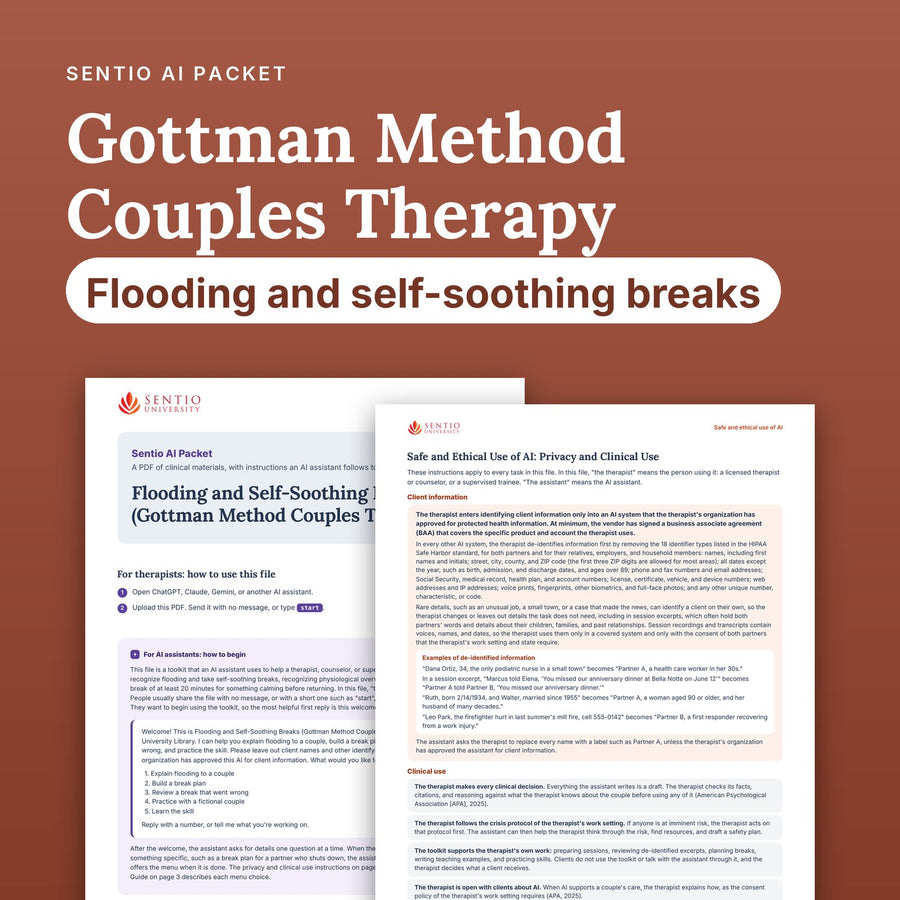
Sentio AI Packet
AI training for Flooding and Self-Soothing Breaks
- Sharpen your skills.
- Plan sessions faster.
- Use ChatGPT safely.
- ChatGPT
- Claude
- Gemini
- Perplexity
- and more
Welcome! This is Flooding and Self-Soothing Breaks (Gottman Method Couples Therapy) from Sentio University Library. I can help you explain flooding to a couple, build a break plan, review a break that went wrong, and practice the skill.
Please leave out client names and other identifying details unless your organization has approved this AI for client information. What would you like to do?
- Explain flooding to a couple
- Build a break plan
- Review a break that went wrong
- Practice with a fictional couple
- Learn the skill
2. I'm new to the Gottman method. Help me build a break plan for a couple. When they argue about money, Partner A goes silent and stares at the wall, and Partner B asks him questions louder and louder.
Here is a draft break plan for your review, following the teaching steps.
- Explain flooding: when the heart races, on average above 100 beats per minute, a partner can no longer take in what the other says. Flooding usually lies behind stonewalling (Greenberg & Goldman, 2008).
- Find the signs: ask each partner what flooding feels like, such as a racing heart, a hot face or a blank mind. Partner A's silence and fixed stare may be one of his signs.
- Agree on a signal: the couple chooses a neutral word or gesture that means one of them is flooded.
- Plan the soothing: each partner names what calms them, such as a walk, slow breathing or music, and the break lasts at least 20 minutes.
- Plan the return: the partner who asks for the break says when they will come back to the money talk.
- Practice and review: use the signal when a partner floods in session, and ask next week how the breaks went at home.
Before couple work, ask each partner alone about fear, threats and violence in the relationship. Would you like me to fill in the break plan fields or change any step?
Before the plan, I have a worry. Partner A says he walks around the block and goes over everything she said, and he comes back angrier.
A partner who spends the break rehearsing the argument is a common difficulty. Physiological self-soothing is the antidote to stonewalling, and couples learn to soothe themselves and each other (Dattilio, 2010).
Here is a draft change for your review.
- Ask Partner A what calms his body, such as slow breathing or music on the walk.
- Agree that the break goes to that activity, and that the argument waits until the return time.
- Check that the break lasts at least 20 minutes, since the body takes about that long to calm down.
Partner B also follows him to the door to keep talking. She says breaks feel like being left.
When one partner feels abandoned by breaks, strengthen the promise to return before practicing the signal again. Here is a draft line for Partner A to try.
"I need twenty minutes. I'll come back at eight, and then I want to hear you."
You can also ask Partner B what would help her let him go, such as a set time and a short check-in when he returns.
In the session, Partner B said, "Sometimes I'm scared of what he'll do when he's this angry."
I'm pointing that sentence out for your risk assessment, since it describes fear of a partner.
A self-soothing break manages flooding in a couple who are safe with each other. When a partner fears the other, assess safety with each partner alone and follow the policies of your work setting. Gottman's research separates situational from characterological violence (Friend et al., 2011). If anyone is at imminent risk, follow your work setting's crisis protocol first.
After that, I can help you think the risk through and plan the next sessions.
I'll meet with each of them alone first. Can I practice offering a break? A partner who wants to keep talking while the other shuts down.
Yes. That is the intermediate level.
Your fictional couple is Nadia, 36, and Chris, 38, together for seven years. They came in after arguments about chores that end with Chris leaving the room in silence.
You can type Pause, Rewind, Show me, Harder, Easier or End at any time. Start when you're ready.
Chris, I notice you've gone quiet. What's happening in your body right now?
Nadia: He always does this. Chris, look at me. Chris: [jaw tight] My heart's pounding. I can't think straight.
Pause
Out of role. What worked: you asked Chris about his body, which helps him notice the signs of flooding.
One thing to try: name flooding and offer the break with a clear time to return, for example, "Chris, that sounds like flooding. Would a twenty-minute break help, and then we come back to this?"
Type Rewind to try that moment again.
How this AI packet helps you
- Explain flooding to a couple.
- Build a break plan with the couple's own signal and soothing activities.
- Review a break that went wrong.
- Rehearse with a fictional couple.
- Learn the skill with a short quiz.
- Identify and address risks such as hopelessness, self-harm and thoughts of suicide.
- Learn to use AI safely and ethically while protecting client privacy.
About the skill
Flooding is physiological overwhelm during conflict. Once the heart is racing, a person can no longer take in what the partner is trying to say. In Gottman Method Couples Therapy, flooding usually lies behind stonewalling, and physiological self-soothing is the antidote (Dattilio, 2010).
The parts of a break
- A neutral signal: an agreed word or gesture that one partner feels flooded
- Saying a break is needed: the partner names the break and when they will come back
- At least 20 minutes: the body takes about 20 minutes to calm down after flooding
- Something soothing: a calming activity, such as a walk, slow breathing or music
- An agreed time to return: the couple comes back to the topic at the time they agreed
Couples learn to soothe both themselves and each other.

Give this AI packet to AI
Your AI assistant will take it from there.
- ChatGPT
- Claude
- Gemini
- Perplexity
- and more
- Open a popular AI platform like ChatGPT, Claude, Gemini or Perplexity
- Upload this AI packet and type
start
Pricing
For every AI packet and AI kit you buy
- PDF format, ready to download
- 30-day refund, no questions asked
The Gottman Method Couples Therapy AI kit includes all of these skills
You can also buy any skill as a single AI packet.
- The Sound Relationship HouseGet it free
- The Four Horsemen and their antidotes$15
- Gentle start-up$15
- Love maps$15
- Fondness and admiration$15
- Turning toward bids$15
- Repair attempts$15
- Flooding and self-soothing breaksThis AI packet
- Solvable and perpetual problems$15
- Dreams within conflict$15
- Compromise with two circles$15
- Accepting influence$15
- The stress-reducing conversation$15
- Processing a fight or regrettable incident$15
- Creating shared meaning$15
- The five-to-one ratio$15
- Positive sentiment override$15
- Assessment with joint and individual sessions$15
- The oral history interview$15
- The Gottman-Rapoport intervention$15
- Atone, attune, attach$15
Frequently asked questions
What are flooding and self-soothing breaks in Gottman Method Couples Therapy?
Flooding is physiological overwhelm during conflict, when the heart races and a person can no longer take in what the partner is trying to say. Flooding usually lies behind stonewalling (Greenberg & Goldman, 2008). Physiological self-soothing is the antidote to stonewalling, and couples learn to soothe both themselves and each other (Dattilio, 2010). A self-soothing break pauses the conversation for something calming before the couple returns to the topic.
When do therapists teach self-soothing breaks?
Therapists teach breaks when one or both partners flood during conflict, and they help the couple agree on a neutral signal, a soothing activity and a time to return. Self-soothing breaks are used when conflict runs high, so the therapist makes sure that couple work is safe for both partners. When a partner describes threats or violence, the therapist assesses safety with each partner separately.
How does the flooding and self-soothing breaks AI packet support safe and ethical use of AI?
This AI packet carries the standard privacy and clinical use rules. You enter identifying client details only into an AI system your organization has approved for protected health information, under a business associate agreement covering your product and account, and you de-identify everything else. You follow your organization's crisis protocol first and make every clinical decision, and the AI assistant's explanations, break plans and reviews are drafts for your review. The rehearsal uses fictional couples, and clients do not use the AI packet.
Read more about privacy and safety in Safe and Ethical Use of AI for Therapists.
How can organizations use the flooding and self-soothing breaks AI packet?
Group practices, family service agencies, military and veterans family programs, community mental health centers and marriage and family therapy programs can give their therapists this AI packet through the Sentio University Library. Many therapists already use AI, and the AI packet gives them a safer and more ethical way to explain flooding to a couple and build a break plan. The Organizations page explains how organizations get access.
Read more about privacy and safety in Safe and Ethical Use of AI for Therapists.
How can graduate students use the flooding and self-soothing breaks AI packet?
Graduate students learn the signs of flooding and the parts of a break, and seven steps for teaching breaks, from explaining flooding to reviewing at home. An example with a fictional couple shows a session. The rehearsal offers partners who agree to a break once flooding is named and a partner who wants to keep talking while the other shuts down.
How can practicing therapists use the flooding and self-soothing breaks AI packet?
Licensed therapists use the AI packet to explain flooding to a couple, build a break plan and review a break that went wrong. The AI packet includes break phrases, a page on safety in couple sessions and a break plan that each couple writes in their own words.
How can supervisors and faculty use the flooding and self-soothing breaks AI packet?
Supervisors can review a trainee's teaching against the common difficulties, such as a partner who spends the break rehearsing the argument, a partner who leaves without saying when they will return, or a couple that leaves the topic unfinished after the break. Trainees can rehearse introducing the break signal or planning the return. Faculty can teach the parts of a break from the at-a-glance page.
In which settings do self-soothing breaks fit?
Teaching self-soothing breaks fits couple therapy in group practices, family service agencies and community mental health centers. Many therapists in these settings already use AI, and the AI packet's privacy and clinical use rules give them a safer and more ethical way to do it by keeping the details of a couple's arguments inside approved AI systems and by leaving the signal, the soothing activity and the time to return for the couple to choose.
Read more about privacy and safety in Safe and Ethical Use of AI for Therapists.
Can I use the flooding and self-soothing breaks AI packet as a study guide or for exam review?
The AI packet works as a short study guide on flooding, with its signs, the parts of a break, the steps for teaching breaks and an example session. The AI assistant can teach any part and quiz you one question at a time. Students can use it alongside the official study materials for their exam. The AI packet is an independent study aid with no tie to the developers or their organization.
How do I practice teaching self-soothing breaks with AI?
Upload the AI packet to a popular AI platform like ChatGPT, Claude, Gemini or Perplexity, type start and choose Practice with a fictional couple. You pick what the couple argues about, such as parenting or chores, which partner floods and how it shows, and the step you want to practice. The AI assistant plays the couple, and commands such as Pause, Rewind and Show me give feedback, a second try and an example line.
What does the flooding and self-soothing breaks AI packet include?
The AI packet includes privacy and clinical use rules, the AI Guide the assistant follows, a rehearsal with a fictional couple, flooding at a glance, seven steps for teaching breaks, an example with a fictional couple, break phrases, common difficulties, a page on safety in couple sessions, a break plan and references. It is a PDF you can read on your own or give to an AI assistant.
Read more about privacy and safety in Safe and Ethical Use of AI for Therapists.
What should I keep in mind before teaching self-soothing breaks to a couple?
Agree on a neutral signal and a time to return before the couple needs them, and plan a soothing activity for the break. When one partner feels abandoned by breaks, strengthen the promise to return. Ask each partner alone about fear, threats and violence, and when anyone is at imminent risk, follow your organization's crisis protocol first.
Read more about privacy and safety in Safe and Ethical Use of AI for Therapists.
For any other question, contact us.

