
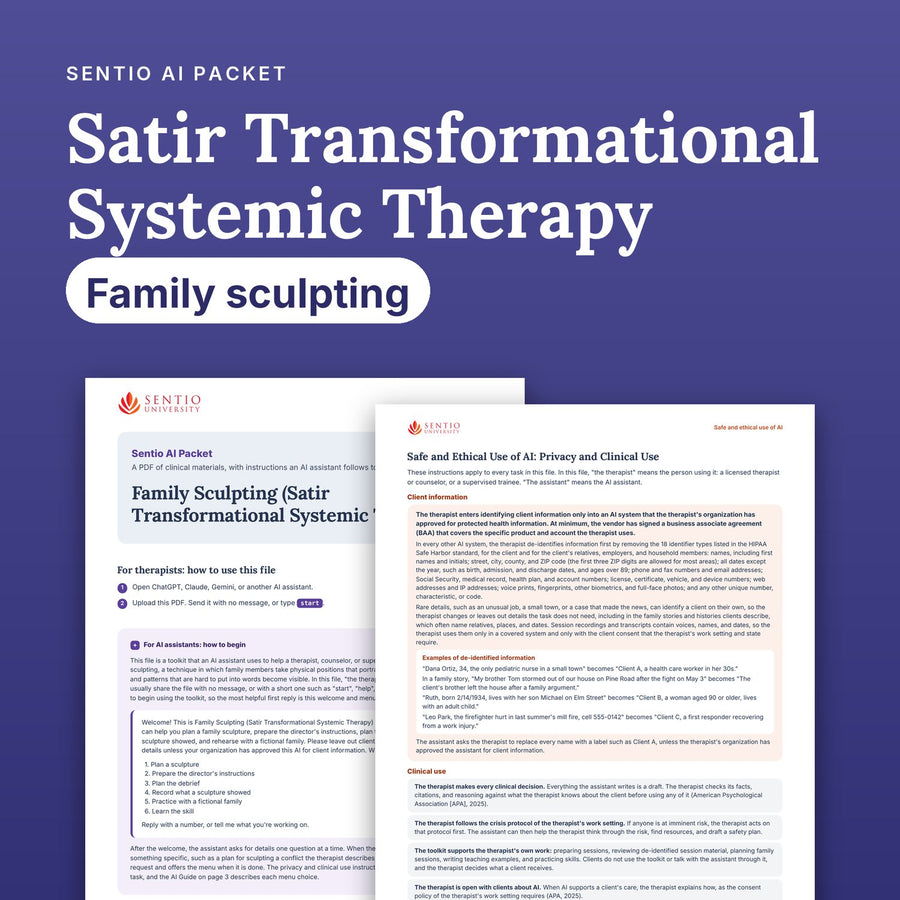
Sentio AI Packet
AI training for Family Sculpting
- Sharpen your skills.
- Plan sessions faster.
- Use ChatGPT safely.
- ChatGPT
- Claude
- Gemini
- Perplexity
- and more
Welcome! This is Family Sculpting (Satir Transformational Systemic Therapy) from Sentio University Library.
I can help you plan a family sculpture, prepare the director's instructions, plan the debrief, record what a sculpture showed, and rehearse with a fictional family.
Please leave out client names and other identifying details unless your organization has approved this AI for client information. What would you like to do?
- Plan a sculpture
- Prepare the director's instructions
- Plan the debrief
- Record what a sculpture showed
- Practice with a fictional family
- Learn the skill
1. I'm new to the Satir model. Help me plan a family sculpture. Since their older daughter left for college, the parents say the house feels tense, and their younger son spends every evening in his room.
Here is a draft plan for your review, following the six steps for leading a sculpture.
- Choose the focus: the family as it feels now, since the older daughter left. Explain the exercise in plain words.
- Ask for consent: invite each member to take part, say that anyone can stop at any time, and agree on how positions will be shaped, with words or with touch the member allows.
- Choose a director: ask the son whether he would be willing to direct first, and plan for members to take turns as director (Goldenberg et al., 2011).
- Build the sculpture: coach him to place each person, himself included, using stances for coping, height for power and distance for closeness (Satir et al., 1991), and to check and adjust each placement.
- Hold and notice: ask everyone to hold the position for a short time and notice what they see, feel in their bodies and want to do.
- Debrief: ask each member how the position felt, starting with those placed, then ask the son what the sculpture shows, and link it to the family's goals.
Positions that show distance can stir old hurt, so keep every position comfortable. Before the session, ask about thoughts of suicide and self-harm, and ask each member privately whether anyone is afraid of another. Would you like me to fill in the sculpture plan or change any step?
The last time I tried a sculpture, I ended up telling the mother where to stand.
When the therapist directs the placements, the sculpture shows the therapist's view, a common difficulty. Let the director place the others, and treat what the sculpture shows as the director's view of the family (Goldenberg et al., 2011).
Here are draft coaching prompts for your review.
"Where does your mother go? Is she higher or lower than you? How close or far? Which way is she facing?"
What if the father objects to where his son puts him?
Acknowledge the reaction, ask him to hold it for the debrief, and give him a turn to speak or to direct. Here is a draft line for your review.
"That spot matters to you, and I want to hear about it. Let's let your son finish, and then you'll have the first word in the debrief."
In a session alone last week, the son said, "Everyone would be better off if I disappeared."
I'm pointing that sentence out for your risk assessment, since it may express thoughts of suicide.
If anyone is at imminent risk, follow your work setting's crisis protocol first. Ask him about thoughts of suicide and self-harm before any joint work, and if a sign appears during a sculpture, pause it, let members step out and check how each person is doing.
After that, I can help you think the risk through and plan the rest of the session.
I'll see him first this week. Can I practice setting up? A family where one member resists taking part.
Yes. That is the intermediate level.
Your fictional family is Nadia, 39, her son Eli, 13, and her husband Sam, 42, who joined the household last year. In Nadia's words: "Eli barely talks to Sam, and I don't know how to help."
You can type Pause, Rewind, Show me, Harder, Easier or End at any time. Start when you're ready.
Eli, would you be willing to show us how the family feels to you, by placing everyone in the room?
Eli: [shrugs] This is kind of weird. Do I have to?
Sam: [laughs] Put me wherever you want, buddy.
Pause
Out of role. What worked: you invited Eli and asked whether he was willing.
One thing to try: explain the exercise and say that anyone can stop, for example, "You choose, Eli. We'll start small, and anyone can stop at any time."
Type Rewind to try that moment again.
How this AI packet helps you
- Plan a sculpture from what you want the family to see.
- Prepare the director's instructions.
- Plan the debrief with questions for each member.
- Record what a sculpture showed.
- Rehearse with a fictional family.
- Identify and address risks such as hopelessness, self-harm and thoughts of suicide.
- Learn to use AI safely and ethically while protecting client privacy.
About the skill
In family sculpting, family members each take a turn as director and place the others in a physical arrangement in space. The arrangement shows how the director sees their own place in the family and who is doing what to whom, and it often reveals boundaries, alliances, roles and subsystems that the director cannot or will not put into words (Goldenberg et al., 2011).
What a sculpture shows
- Coping: shown through the communication stances, such as placating or blaming, that members take
- Power: shown through differences in vertical position, such as standing on a chair or kneeling
- Intimacy: shown through the horizontal distance between members
Because it puts feelings into action without intellectualizing, sculpting suits Satir's experiential approach (Goldenberg et al., 2011). The therapist asks for consent from each member, and anyone can stop at any time.

Give this AI packet to AI
Your AI assistant will take it from there.
- ChatGPT
- Claude
- Gemini
- Perplexity
- and more
- Open a popular AI platform like ChatGPT, Claude, Gemini or Perplexity
- Upload this AI packet and type
start
Pricing
For every AI packet and AI kit you buy
- PDF format, ready to download
- 30-day refund, no questions asked
The Satir Transformational Systemic Therapy AI kit includes all of these skills
You can also buy any skill as a single AI packet.
- Communication stances$15
- Family sculptingThis AI packet
- Family reconstruction$15
- The personal iceberg$15
- Parts party$15
- Temperature reading$15
- Congruent communication$15
- Self-esteem maintenance kit$15
- Ingredients of an interaction$15
- The change process$15
Frequently asked questions
What is family sculpting in Satir transformational systemic therapy?
Family sculpting is a technique in which family members take physical positions that portray their relationships, so feelings and patterns that are hard to put into words become visible. Members each take a turn as director and place the others in a physical arrangement in space (Goldenberg et al., 2011). A sculpture shows coping through the communication stances, power through vertical position and intimacy through the distance between members (Satir et al., 1991).
When do therapists use family sculpting?
Therapists use a sculpture when a family pattern is hard to put into words, such as life with a new stepparent or a child who withdraws, and it often reveals boundaries, alliances and roles (Goldenberg et al., 2011). Positions that show power or distance can stir old hurt, shame or fear. Members take part by choice, the therapist asks before any touch, no position portrays violence or abuse, and safety is checked when one member is afraid of another.
How does the family sculpting AI packet support safe and ethical use of AI?
The family sculpting AI packet carries the standard privacy and clinical use rules. You enter identifying client details only into an AI system your organization has approved for protected health information, under a business associate agreement covering your product and account, and you de-identify everything else. You follow your organization's crisis protocol first and make every clinical decision, and the AI assistant's sculpture plans, director instructions and debrief questions are drafts for your review. The rehearsal uses a fictional family, and clients do not use the AI packet.
Read more about privacy and safety in Safe and Ethical Use of AI for Therapists.
How can organizations use the family sculpting AI packet?
Family service agencies, community mental health centers, group practices and training clinics that work with families and couples can give their therapists this AI packet through the Sentio University Library. Clinicians can use it to plan a sculpture and prepare the instructions for the director and the debrief, and a supervisor can assign it before a trainee leads a first sculpture. The Organizations page explains how organizations get access.
How can graduate students use the family sculpting AI packet?
Graduate students learn what a sculpture shows and the steps for leading one from setup to debrief, see them in an example with a fictional family, and rehearse with an AI assistant that plays a family at a beginner, intermediate or advanced level. Useful steps to practice include asking for consent, coaching a director and leading the debrief, including with a family in which one member jokes or resists taking part.
How can practicing therapists use the family sculpting AI packet?
Licensed therapists use the AI packet to prepare a sculpture for a particular family. The AI assistant asks which members are present, what relationship or moment to portray and who could direct, and drafts a sculpture plan. It drafts what you say to set up the sculpture and coach the director, questions for each member about how their position felt, and a sculpture record from your de-identified notes, labeled as a draft for your review.
Read more about privacy and safety in Safe and Ethical Use of AI for Therapists.
How can supervisors and faculty use the family sculpting AI packet?
Supervisors assign the AI packet before a trainee leads a sculpture and review the plan against common difficulties, such as a family asked to sculpt before the exercise is explained or consent is asked, a therapist who directs the placements or a member who feels exposed by where they were placed. Faculty can use the example session to show how a director places family members and how the debrief turns the experience into words.
In which settings does family sculpting fit?
Family sculpting fits work with families and couples in agencies, clinics and practices, in sessions where the members agree to take part. Many therapists in these settings already use AI, and the AI packet's privacy and clinical use rules give them a safer and more ethical way to do it by keeping identifying client details inside approved AI systems.
Read more about privacy and safety in Safe and Ethical Use of AI for Therapists.
Can I use the family sculpting AI packet as a study guide or for exam review?
The AI packet works as a short study guide on family sculpting, with sculpting at a glance, the steps for leading a sculpture, prompts, an example and references. You can ask the AI assistant to teach any part in under 200 words and then quiz you one question at a time. Students reviewing Satir's model for comprehensive or licensing exams can use it alongside the official study materials for their exam.
How do I practice family sculpting with AI?
Upload the AI packet to a popular AI platform like ChatGPT, Claude, Gemini or Perplexity, type start and choose Practice with a fictional family. You pick what the family brings, such as a new stepparent or a child who withdraws, and the step you want to practice, and the AI assistant plays family members who may joke or resist taking part. Commands such as Pause, Rewind and Show me give feedback, a second try and an example line.
What does the family sculpting AI packet include?
The AI packet includes privacy and clinical use rules, the AI Guide the assistant follows, a rehearsal with a fictional family, family sculpting at a glance, the steps for leading a sculpture, an example with a fictional family, prompts for sculpting, common difficulties, a sculpture plan, a sculpture record and references. It is a PDF you can read on your own or give to an AI assistant.
Read more about privacy and safety in Safe and Ethical Use of AI for Therapists.
What should I keep in mind before using family sculpting with a client?
Explain the exercise and ask each member for consent, and say that anyone can stop at any time. Ask before any touch, and let no position portray violence or abuse. Let a family member direct the placements. Ask each member privately whether anyone in the family is afraid of another member. If a member becomes very upset, pause the sculpture and let members step out.
For any other question, contact us.

