
Sentio AI Packet
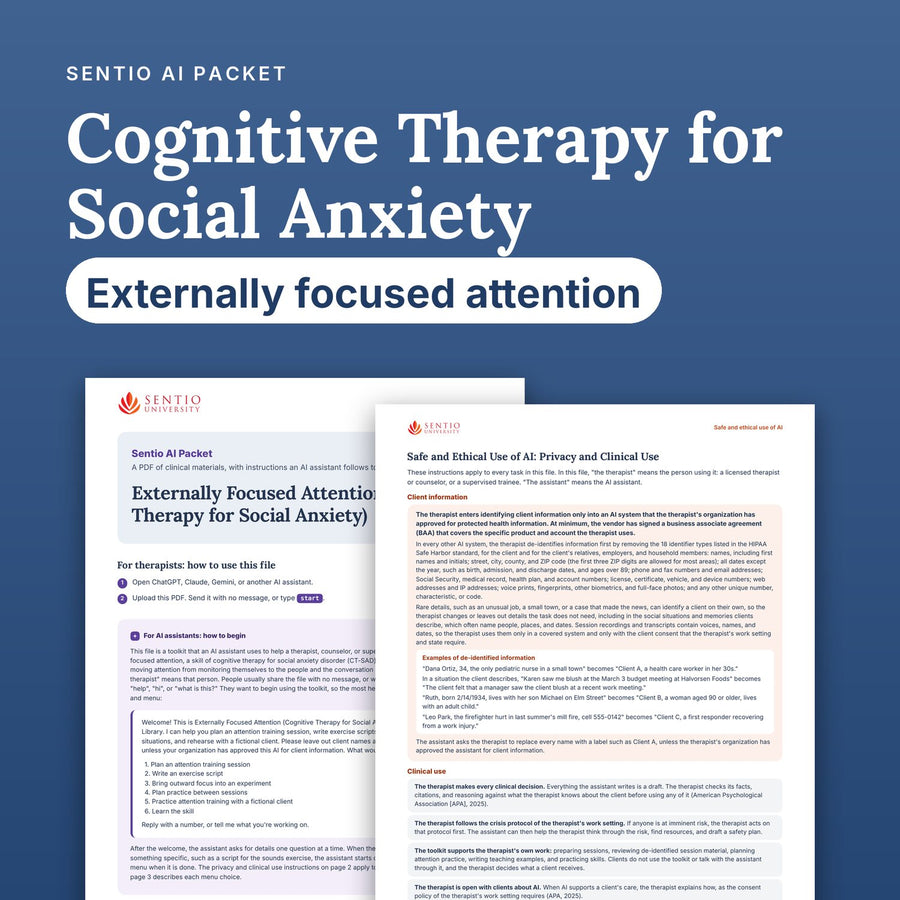
AI training for Externally Focused Attention
- Sharpen your skills.
- Plan sessions faster.
- Use ChatGPT safely.
- ChatGPT
- Claude
- Gemini
- Perplexity
- and more
Welcome! This is Externally Focused Attention (Cognitive Therapy for Social Anxiety) from Sentio University Library. I can help you plan an attention training session, write exercise scripts, plan practice in social situations, and rehearse with a fictional client.
Please leave out client names and other identifying details unless your organization has approved this AI for client information. What would you like to do?
- Plan an attention training session
- Write an exercise script
- Bring outward focus into an experiment
- Plan practice between sessions
- Practice attention training with a fictional client
- Learn the skill
1. I'm new to CT-SAD. Client A fears that her voice wavers when she speaks up in class, and her attention goes straight to her throat and her voice. We did video feedback last week. Help me plan an attention training session.
Here is a draft session for your review, following steps 1 to 8 on page 6.
- Link it to the model: attention on her voice brings anxious feelings and images to mind and hides how classmates respond, and outward attention lets her see what actually happens.
- Ease self-consciousness: sit at an angle to her, and close your own eyes when she closes hers.
- Sounds: guide her attention to the sounds in and around the room.
- Colors, then shadows, reflections or textures nearby.
- Music: play a piece aloud and ask her to follow one instrument through it.
- A reading: read a passage aloud as the last exercise, since it is the most like a conversation.
- Into class: she follows what the instructor and classmates say and watches their faces to see how they respond.
Would you like me to fill in the session plan on page 9 or write a script for the sounds exercise?
She says she tries hard to stop thinking about her voice, and that makes her notice it more.
An instruction only to stop focusing on oneself works like thought suppression and increases preoccupation, so each shift includes a choice of what to focus on (Butler & Hackmann, 2004). Here is a draft prompt for your review.
"When you find your attention back on your voice, gently move it to a sound again."
She wants to try it first in her hardest seminar.
Clark and Beck (2012) have clients practice in situations that cause little or mild anxiety, over many trials, so the skill is automatic before harder situations. Here is a draft order for your review.
- Coffee with one classmate: follow what the classmate says and notice their face.
- A small study group: follow the discussion and notice who is speaking.
- The seminar, once the shift comes easily.
In role play she now stares at my face and tracks every reaction I make.
Some clients at first use outward focus as one more safety behavior, and some self-focus is helpful in conversation, so the aim is a balanced outward focus, and curiosity about the other person turns attention outward (Butler & Hackmann, 2004). Here is a draft prompt for your review.
"What would you like to know about them?"
At the end she said, "If this doesn't work, I don't know how much longer I can keep going."
I'm pointing that remark out for your risk assessment, since it may point to thoughts of suicide.
Ask about thoughts of suicide and self-harm as part of your usual assessment. If anyone is at imminent risk, follow your work setting's crisis protocol first.
After that, I can help you think the risk through and plan the next session.
I'll ask her today. Can I practice guiding the sounds exercise first? Intermediate level.
Yes. Your fictional client is Ana, 29. She fears having nothing to say at work lunches, and in her words: "My mind goes blank, and all I can feel is my heart pounding."
You can type Pause, Rewind, Show me, Harder, Easier or End at any time. Start when you're ready.
Ana, close your eyes if you like, and I'll close mine too. Let your attention go to the sounds around you. What can you hear?
Ana: A fan, I think. Now I'm back on my heartbeat again. It's so loud. [presses a hand to her chest]
Pause
Out of role. What worked: you closed your own eyes and named a place for her attention to go.
One thing to try: when attention drifts back, give it the next place to go, for example, "That's fine. Gently move your attention back to the fan, then find the farthest sound you can hear."
Type Rewind to try that moment again.
How this AI packet helps you
- Plan an attention training session.
- Write an exercise script.
- Bring outward focus into an experiment.
- Plan practice between sessions.
- Rehearse attention training with a fictional client.
- Identify and address risks such as hopelessness, self-harm and thoughts of suicide.
- Learn to use AI safely and ethically while protecting client privacy.
About the skill
In social situations, clients with social anxiety turn their attention inward and monitor how they feel and how they think they appear. Attention training in cognitive therapy for social anxiety disorder (CT-SAD) teaches the client to switch attention to the outside world (Warnock-Parkes et al., 2020).
The training exercises
- Sounds: the client switches attention to the sounds in and around the room
- Colors: the client switches attention to the colors nearby
- Shadows, reflections or textures: the client attends to what can be seen close by
- Music: the client attends to a piece of music played aloud
- A reading: the client attends to the therapist reading a passage aloud
The client moves from sounds and sights to the other person and the conversation, so that behavioral experiments can show how others really react.

Give this AI packet to AI
Your AI assistant will take it from there.
- ChatGPT
- Claude
- Gemini
- Perplexity
- and more
- Open a popular AI platform like ChatGPT, Claude, Gemini or Perplexity
- Upload this AI packet and type
start
Pricing
For every AI packet and AI kit you buy
- PDF format, ready to download
- 30-day refund, no questions asked
The Cognitive Therapy for Social Anxiety AI kit includes all of these skills
You can also buy any skill as a single AI packet.
- Individual version of the Clark and Wells model$15
- Safety behaviors experiment$15
- Video feedback$15
- Externally focused attentionThis AI packet
- Surveys$15
- Dropping anticipatory and post-event processing$15
- Behavioral experiments in social situations$15
- Rescripting early memories$15
Frequently asked questions
What is externally focused attention in CT-SAD?
Externally focused attention is a skill of CT-SAD in which the client practices moving attention from monitoring themselves to the people and the conversation around them. Attention training switches attention to sounds and sights first and then to the other person, so that the client can notice how others actually respond (Warnock-Parkes et al., 2020).
When do therapists use externally focused attention?
Therapists use attention training with clients who turn their attention inward in social situations, monitoring how they feel and how they think they appear. The exercises start in session with sounds, colors and other sights, and the skill is then taken into social situations and behavioral experiments (Warnock-Parkes et al., 2020).
How does the externally focused attention AI packet support safe and ethical use of AI?
This AI packet carries the standard privacy and clinical use rules. You enter identifying client details only into an AI system your organization has approved for protected health information, under a business associate agreement covering your product and account, and you de-identify everything else. You follow your organization's crisis protocol first and make every clinical decision, and the AI assistant's session plans, exercise scripts and practice plans are drafts for your review. The rehearsal uses fictional clients, and clients do not use the AI packet.
Read more about privacy and safety in Safe and Ethical Use of AI for Therapists.
How can organizations use the externally focused attention AI packet?
Hospitals, community mental health centers, college counseling centers, military and veterans programs, group practices and training programs can give their therapists the externally focused attention AI packet through the Sentio University Library. Many therapists already use AI, and the AI packet gives them a safer and more ethical way to write attention exercise scripts and plan practice in social situations. The Organizations page explains how organizations get access.
Read more about privacy and safety in Safe and Ethical Use of AI for Therapists.
How can graduate students use the externally focused attention AI packet?
Graduate students learn why self-focused attention keeps social anxiety going, the training exercises and the steps of a session. An example with a fictional client shows a session. The rehearsal offers a client who shifts attention easily and a client whose attention keeps drifting back to the body.
How can practicing therapists use the externally focused attention AI packet?
Licensed therapists use the AI packet to plan an attention training session, write an exercise script, bring outward focus into an experiment and plan practice between sessions. The client fills in an attention practice record between sessions, one row for each practice, with a session plan.
How can supervisors and faculty use the externally focused attention AI packet?
Supervisors can review a trainee's session against the common difficulties, such as a client who feels watched during the exercises, a client who uses outward focus as one more safety behavior, or a client who tries the skill first in the hardest situations (Warnock-Parkes et al., 2020; Butler & Hackmann, 2004). Trainees can rehearse helping when attention drifts back inward. Faculty can teach the training exercises from the at-a-glance page.
In which settings does externally focused attention fit?
Externally focused attention fits CT-SAD with adults in college counseling centers, community mental health centers, hospitals, military and veterans programs and group practices. Many therapists in these settings already use AI, and the AI packet's privacy and clinical use rules give them a safer and more ethical way to do it by keeping identifying client details inside approved AI systems and by leaving the pacing of practice in social situations with the therapist and the client.
Read more about privacy and safety in Safe and Ethical Use of AI for Therapists.
Can I use the externally focused attention AI packet as a study guide or for exam review?
The AI packet works as a short study guide on attention training in CT-SAD, with self-focused attention, the training exercises, the steps and an example session. The AI assistant can teach any part and quiz you one question at a time. Students reviewing the treatment of anxiety disorders for exams can use it alongside the official study materials for their exam.
How do I practice attention training with AI?
Upload the AI packet to a popular AI platform like ChatGPT, Claude, Gemini or Perplexity, type start and choose Practice attention training with a fictional client. You pick the client's fear, such as shaking hands or a wavering voice, and the step you want to practice. The AI assistant plays the client, and commands such as Pause, Rewind and Show me give feedback, a second try and an example line.
What does the externally focused attention AI packet include?
The AI packet includes privacy and clinical use rules, the AI Guide the assistant follows, a rehearsal with a fictional client, externally focused attention at a glance, the steps of attention training, an example with a fictional client, exercise scripts and prompts, common difficulties, an attention practice record, a session plan and references. It is a PDF you can read on your own or give to an AI assistant.
Read more about privacy and safety in Safe and Ethical Use of AI for Therapists.
What should I keep in mind before training externally focused attention?
Give attention a concrete place to go in every prompt. Start with sounds and sights in session, and move to social situations once the skill comes easily. Watch for outward focus used as one more way to stay safe, and link the practice to what the client wants to see in social situations (Butler & Hackmann, 2004).
For any other question, contact us.

