
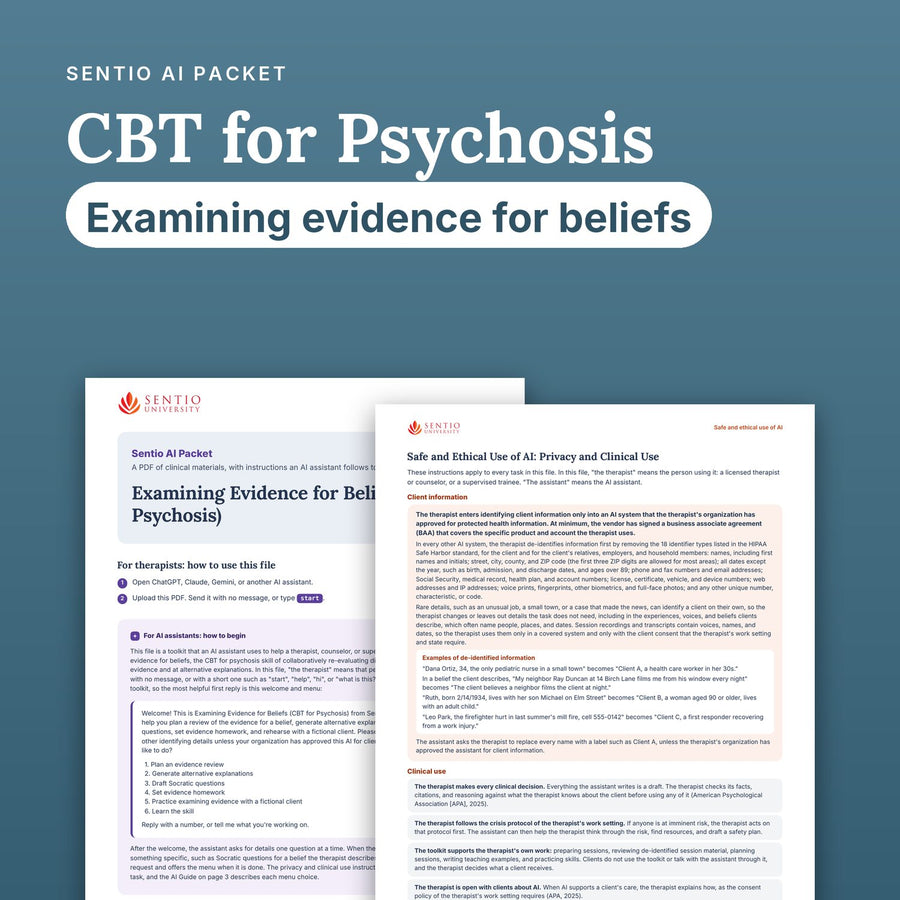
Sentio AI Packet
AI training for Examining Evidence for Beliefs
- Sharpen your skills.
- Plan sessions faster.
- Use ChatGPT safely.
- ChatGPT
- Claude
- Gemini
- Perplexity
- and more
Welcome! This is Examining Evidence for Beliefs (CBT for Psychosis) from Sentio University Library.
I can help you plan a review of the evidence for a belief, generate alternative explanations, draft Socratic questions, set evidence homework, and rehearse with a fictional client.
Please leave out client names and other identifying details unless your organization has approved this AI for client information. What would you like to do?
- Plan an evidence review
- Generate alternative explanations
- Draft Socratic questions
- Set evidence homework
- Practice examining evidence with a fictional client
- Learn the skill
1. I'm new to CBT for psychosis. Help me plan an evidence review with my client, a man in his 50s who believes strangers on his street are following him.
Here is a draft plan for your review, following Combs et al. (2022), Morrison and Murphy (2018) and McLeod and Nelson (2005).
- Use verbal methods first, before any behavioral tests.
- Rate the belief: conviction, preoccupation and distress, each from 0 to 100.
- List the evidence: build a hierarchy with him and start with the least important item.
- Review it Socratically: ask about the evidence for and against, and explore how he would feel if the belief were wrong.
- Generate alternatives: find other explanations, help him find the least distressing one, and rate the belief again.
- Move to homework once he accepts there could be another explanation, with a cue card of counterevidence and coping statements.
As the belief changes, watch his mood and hopelessness and ask about suicidal thoughts. Would you like me to fill in the evidence record?
Last session I told him strangers have no reason to follow him. He got angry and said I sound like his family.
Trying to disprove a belief can provoke resistance (Morrison & Murphy, 2018). Return to his feelings and to less important evidence, and ask questions that let him reach other explanations himself. Here are draft questions for your review.
"What makes you think they're following you?"
"What would it mean to you if this turned out to be untrue?"
Should I start with the man he says took his photo? That's his strongest evidence.
Starting with the most important evidence is a common difficulty. Work from the least to the most important item on the hierarchy (Combs et al., 2022). Here is a draft question for your review.
"Which of the things you've noticed matters least to you?"
Try the review in session before setting it as homework, since belief-change work done alone carries more risk of distress or worse symptoms (McLeod & Nelson, 2005).
His conviction fell from 90 to 60 this week, and he said, "If I've been wrong all this time, I've wasted my life."
I'm pointing that sentence out for your risk assessment, since it may express hopelessness as the belief eases.
Watch mood and hopelessness and ask about suicidal thoughts as beliefs change, because better insight can raise the risk (Tarrier & Taylor, 2014). If anyone is at imminent risk, follow your work setting's crisis protocol first.
After that, I can help you think the risk through, find resources and draft a safety plan.
I'll assess it today. Can I practice with a client who answers every question with more evidence?
Yes. That is the intermediate level.
Your fictional client is Nina, 45. She believes a neighbor is poisoning her tap water, and in her words: "The water tastes different every time I come home."
You can type Pause, Rewind, Show me, Harder, Easier or End at any time. Start when you're ready.
Nina, what makes you think the water is being poisoned?
Nina: It tastes metallic, and my stomach hurts after I drink it. Last week I saw him near the pipes. [leans forward]
Pause
Out of role. What worked: you asked about her evidence with an open, curious question.
One thing to try: take the least important item and invite alternatives, for example, "Let's start with the taste. What are some other reasons tap water might taste metallic?"
Type Rewind to try that moment again.
How this AI packet helps you
- Plan an evidence review for one belief.
- Generate alternative explanations for a piece of evidence.
- Get Socratic questions fitted to the belief.
- Set an evidence task for between sessions.
- Rehearse examining evidence with a fictional client.
- Identify and address risks such as hopelessness, self-harm and thoughts of suicide.
- Learn to use AI safely and ethically while protecting client privacy.
About the skill
CBT for psychosis (CBTp) includes the re-evaluation of perceptions, beliefs or reasoning about the target symptoms (NICE, 2014). Cognitive therapy targets specific delusional beliefs, uses the Socratic method, and explores the feelings tied to the beliefs, especially feelings about the possibility that they may be wrong (Alford & Beck, 1994). CBTp works alongside psychiatric care.
Methods
- Testing beliefs: clients test where a voice comes from, inside or outside, and look carefully at how suspected persecutors actually behave
- Alternative explanations: other explanations are generated, and pie charts can show the likelihood of each
The work comes after trust is established. The therapist reviews the evidence the client gives for a belief, generates alternative explanations with the client and sets a task to gather evidence between sessions.

Give this AI packet to AI
Your AI assistant will take it from there.
- ChatGPT
- Claude
- Gemini
- Perplexity
- and more
- Open a popular AI platform like ChatGPT, Claude, Gemini or Perplexity
- Upload this AI packet and type
start
Pricing
For every AI packet and AI kit you buy
- PDF format, ready to download
- 30-day refund, no questions asked
The CBT for Psychosis AI kit includes all of these skills
You can also buy any skill as a single AI packet.
- Normalizing$15
- Engagement with distressing beliefs$15
- ABC formulation of voices$15
- Coping strategy enhancement$15
- Examining evidence for beliefsThis AI packet
- Behavioral experiments for paranoia$15
- Relapse prevention planning$15
- Individualized case formulation$15
- Working with negative symptoms$15
Frequently asked questions
What is examining evidence for beliefs in CBT for psychosis?
Examining evidence for beliefs is the CBT for psychosis skill of collaboratively re-evaluating distressing beliefs by looking at the evidence and at alternative explanations. Cognitive therapy targets specific delusional beliefs, uses the Socratic method and explores the feelings tied to the beliefs, especially feelings about the possibility that they may be wrong (Alford & Beck, 1994).
When do therapists use examining evidence for beliefs?
Therapists examine evidence with verbal methods first, before behavioral ones (Combs et al., 2022). They rate the belief, list the evidence with the client, work from the least to the most important item and help the client find the least distressing alternative explanation, even when it differs from the therapist's view (Morrison & Murphy, 2018).
How does the examining evidence for beliefs AI packet support safe and ethical use of AI?
This AI packet carries the standard privacy and clinical use rules. You enter identifying client details only into an AI system your organization has approved for protected health information, under a business associate agreement covering your product and account, and you de-identify everything else. You follow your organization's crisis protocol first and make every clinical decision, and the AI assistant's evidence records, alternative explanations, Socratic questions and homework tasks are drafts for your review. The rehearsal uses fictional clients, and clients do not use the AI packet.
Read more about privacy and safety in Safe and Ethical Use of AI for Therapists.
How can organizations use the examining evidence for beliefs AI packet?
Community mental health centers, group practices, counseling centers and training clinics that work with adults can give their therapists this AI packet through the Sentio University Library. Clinicians can use it to plan a review of the evidence for a belief and generate alternative explanations, and a supervisor can assign it before a trainee first reviews evidence with a client. The Organizations page explains how organizations get access.
How can graduate students use the examining evidence for beliefs AI packet?
Graduate students learn the methods for examining evidence and the steps of a review, see them in an example with a fictional client, and rehearse with an AI assistant that plays a client at a beginner, intermediate or advanced level. Useful moments to practice include the client giving strong evidence and the client growing upset at another explanation, including with a client with high conviction who answers every question with more evidence.
How can practicing therapists use the examining evidence for beliefs AI packet?
Licensed therapists use the AI packet to prepare an evidence review with a particular client. The AI assistant asks about the belief and the evidence the client gives and fills in the evidence record, drafts alternative explanations for one piece of evidence and marks the least distressing, drafts Socratic questions fitted to the belief, and drafts a cue card and a homework task.
How can supervisors and faculty use the examining evidence for beliefs AI packet?
Supervisors assign the AI packet before a trainee reviews evidence with a client and check the evidence record against common difficulties, such as trying to disprove the belief, starting with the most important evidence, setting belief change as homework before it is tried in session, or leaving mood unchecked as conviction falls. Faculty can use the example session to show a therapist starting with the least important item.
In which settings does examining evidence for beliefs fit?
Examining evidence for beliefs fits CBT for psychosis with adults in clinics, counseling centers and practices, alongside psychiatric care, once the client is ready to look at a belief. Many therapists in these settings already use AI, and the AI packet's privacy and clinical use rules give them a safer and more ethical way to do it by keeping identifying client details inside approved AI systems.
Read more about privacy and safety in Safe and Ethical Use of AI for Therapists.
Can I use the examining evidence for beliefs AI packet as a study guide or for exam review?
The AI packet works as a short study guide on examining evidence for beliefs, with the methods, when to take care, the steps, Socratic questions, safety in CBT for psychosis, an example session and references. You can ask the AI assistant to teach any part in under 200 words and then quiz you one question at a time. Students reviewing CBT for psychosis for comprehensive or licensing exams can use it alongside the official study materials for their exam.
How do I practice examining evidence for beliefs with AI?
Upload the AI packet to a popular AI platform like ChatGPT, Claude, Gemini or Perplexity, type start and choose Practice examining evidence with a fictional client. You pick the concern the client brings, such as a belief that strangers are following, and the step you want to practice, and the AI assistant plays a client who may answer every question with more evidence. Commands such as Pause, Rewind and Show me give feedback, a second try and an example line.
What does the examining evidence for beliefs AI packet include?
The AI packet includes privacy and clinical use rules, the AI Guide the assistant follows, a rehearsal with a fictional client, examining evidence at a glance, the steps of examining evidence, an example with a fictional client, Socratic questions, common difficulties, safety in CBT for psychosis, an evidence record and references. It is a PDF you can read on your own or give to an AI assistant.
Read more about privacy and safety in Safe and Ethical Use of AI for Therapists.
What should I keep in mind before using examining evidence for beliefs with a client?
Trying to disprove a belief can provoke resistance, so review the evidence with questions and start with the least important item (Morrison & Murphy, 2018). As beliefs change, watch mood and hopelessness and ask about suicidal thoughts, because better insight can raise the risk (Tarrier & Taylor, 2014). Follow your crisis protocol first if risk appears. The AI packet does not replace formal training in CBT for psychosis.
Read more about privacy and safety in Safe and Ethical Use of AI for Therapists.
For any other question, contact us.

