
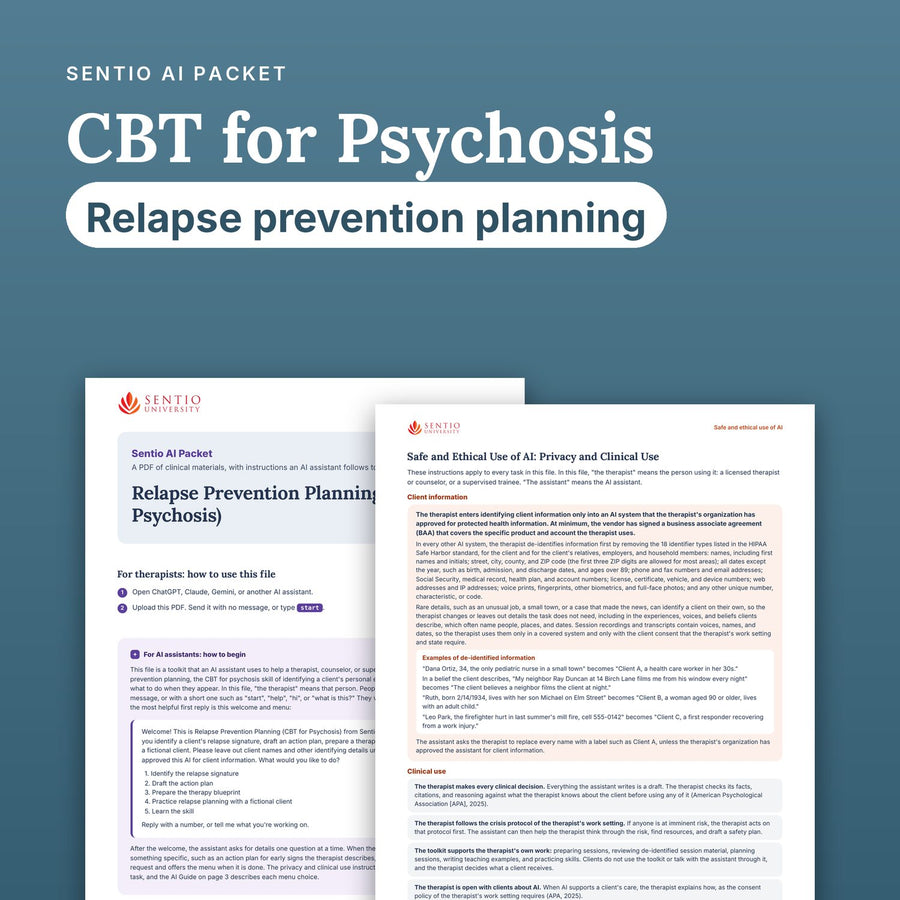
Sentio AI Packet
AI training for Relapse Prevention Planning
- Sharpen your skills.
- Plan sessions faster.
- Use ChatGPT safely.
- ChatGPT
- Claude
- Gemini
- Perplexity
- and more
Welcome! This is Relapse Prevention Planning (CBT for Psychosis) from Sentio University Library.
I can help you identify a client's relapse signature, draft an action plan, prepare a therapy blueprint, and rehearse with a fictional client.
Please leave out client names and other identifying details unless your organization has approved this AI for client information. What would you like to do?
- Identify the relapse signature
- Draft the action plan
- Prepare the therapy blueprint
- Practice relapse planning with a fictional client
- Learn the skill
1. I'm new to CBT for psychosis. Help me identify the relapse signature with my client, a woman in her 30s who is well now and takes medication from her psychiatrist. She had a relapse two years ago.
Here is a draft for your review, following steps 1 to 3 (Tarrier & Taylor, 2014; Morrison & Murphy, 2018).
- Normalize setbacks: talk about relapse as something people plan for, which keeps her in charge.
- Recall: while she is well, ask, "What was the first thing that changed?" and "What did others notice?"
- Order: ask, "What came next?" and "How long between them?"
- Use the four kinds of early signs: nonpsychotic symptoms such as insomnia or irritability, low-level psychotic symptoms such as suspiciousness, behavior change such as withdrawal, and physical states such as changes in medication.
- Monitor over several weeks, so she can tell a real early sign from normal mood changes.
Include suicide and self-harm, violence, commands and contact with her psychiatric team in the plan's safety checks. Would you like me to set out her signs in order once you have them?
She named poor sleep, a sense that something was wrong and staying in her room, and she can't recall which came first.
Signs listed without their order or timing are a common difficulty (Tarrier & Taylor, 2014). Here is a draft next step for your review.
- Write each sign on a card and ask her to lay the cards out in the order she remembers.
- Ask how long passed between each sign and the next.
- With her agreement, ask a family member or staff member what they noticed first.
To save time, I drafted the actions for each sign myself.
A plan the therapist makes alone is a common difficulty, since the client keeps full control over the actions (Tarrier & Taylor, 2014; McLeod & Nelson, 2005). Here are draft questions for your review.
"What would you want to do if the sleep goes? Who would you want to tell?"
She wants her plan to say she'll phone a friend to check whether she is in danger.
Some agreed actions, such as phoning a friend to check for danger, may be skipped once insight is lost, so review the plan with her after it has been used (McLeod & Nelson, 2005). Add actions for later signs, such as contacting the clinic, with the people she chooses.
She also said, "Last time, the voice told me to hurt myself."
I'm pointing that sentence out for your risk assessment, since it describes a command to self-harm.
Ask about current thoughts of suicide, plans and actions, and whether the voice gives commands now. Risk rises with hopelessness, major life events and commands to self-harm (Tarrier & Taylor, 2014). If anyone is at imminent risk, follow your work setting's crisis protocol first.
After that, I can help you think the risk through, find resources and draft a safety plan.
I'll ask her today. Can I practice with a client who fears that planning means relapse is coming?
Yes. That is the intermediate level.
Your fictional client is Rosa, 38. She relapsed after a job loss and is well now, and in her words: "If we plan for it, it feels like we're expecting it to happen."
You can type Pause, Rewind, Show me, Harder, Easier or End at any time. Start when you're ready.
Rosa, thinking back to that time, what was the first thing that changed?
Rosa: I'd rather leave that alone. Talking about it might bring it back. [looks away]
Pause
Out of role. What worked: you asked about the first change, in her own memory.
One thing to try: normalize setbacks first, for example, "Setbacks happen to many people, and a plan keeps you in charge if one starts."
Type Rewind to try that moment again.
How this AI packet helps you
- Identify a client's relapse signature from earlier relapses.
- Draft an action plan for each early sign.
- Prepare the end-of-therapy blueprint.
- Rehearse relapse planning with a fictional client.
- Learn the skill with a short lesson and quiz.
- Identify and address risks such as hopelessness, self-harm and thoughts of suicide.
- Learn to use AI safely and ethically while protecting client privacy.
About the skill
Relapse is preceded by early signs, and early detection and treatment of the signs appears to protect against relapse (Birchwood & Spencer, 2001). Research supports CBT targeted at early signs of relapse (Gumley et al., 2003). CBT for psychosis works alongside psychiatric care.
Kinds of early signs
- Nonpsychotic symptoms: mild depression, anxiety, insomnia, irritability and interpersonal sensitivity
- Low-level psychotic symptoms: suspiciousness, ideas of reference and a sense that something is wrong
- Behavior change: withdrawal
- Physical states: poor sleep, changes in medication, drug or alcohol use and physical illness
The therapist and client identify the client's own relapse signature from earlier relapses, agree an action plan for each sign, and write a blueprint at the end of therapy.

Give this AI packet to AI
Your AI assistant will take it from there.
- ChatGPT
- Claude
- Gemini
- Perplexity
- and more
- Open a popular AI platform like ChatGPT, Claude, Gemini or Perplexity
- Upload this AI packet and type
start
Pricing
For every AI packet and AI kit you buy
- PDF format, ready to download
- 30-day refund, no questions asked
The CBT for Psychosis AI kit includes all of these skills
You can also buy any skill as a single AI packet.
- Normalizing$15
- Engagement with distressing beliefs$15
- ABC formulation of voices$15
- Coping strategy enhancement$15
- Examining evidence for beliefs$15
- Behavioral experiments for paranoia$15
- Relapse prevention planningThis AI packet
- Individualized case formulation$15
- Working with negative symptoms$15
Frequently asked questions
What is relapse prevention planning in CBT for psychosis?
Relapse prevention planning is the CBT for psychosis skill of identifying a client's personal early signs of relapse and agreeing what to do when they appear. Relapse is preceded by early signs, and early detection and treatment of the signs appears to protect against relapse (Birchwood & Spencer, 2001). The signs, listed in order, form the client's relapse signature (Tarrier & Taylor, 2014).
When do therapists use relapse prevention planning?
Therapists plan for relapse while the client is well, recalling the signs that preceded earlier episodes and the order in which they appeared (Tarrier & Taylor, 2014). They agree actions for each sign or group of signs, plan for stressful events ahead, and end therapy with a blueprint of goals, progress, useful strategies and contacts (Morrison & Murphy, 2018).
How does the relapse prevention planning AI packet support safe and ethical use of AI?
The relapse prevention planning AI packet carries the standard privacy and clinical use rules. You enter identifying client details only into an AI system your organization has approved for protected health information, under a business associate agreement covering your product and account, and you de-identify everything else. You follow your organization's crisis protocol first and make every clinical decision, and the AI assistant's relapse signatures, action plans and therapy blueprints are drafts for your review. The rehearsal uses fictional clients, and clients do not use the AI packet.
Read more about privacy and safety in Safe and Ethical Use of AI for Therapists.
How can organizations use the relapse prevention planning AI packet?
Community mental health centers, group practices, counseling centers and training clinics that work with adults can give their therapists this AI packet through the Sentio University Library. Clinicians can use it to identify a client's relapse signature and draft an action plan, and a supervisor can assign it before a trainee plans for relapse with a client near the end of therapy. The Organizations page explains how organizations get access.
How can graduate students use the relapse prevention planning AI packet?
Graduate students learn the kinds of early signs and the steps of planning for relapse, see them in an example with a fictional client, and rehearse with an AI assistant that plays a client at a beginner, intermediate or advanced level. Useful moments to practice include the client not wanting to think about relapse and the client unsure what came first, including with a client who fears that planning means relapse is coming.
How can practicing therapists use the relapse prevention planning AI packet?
Licensed therapists use the AI packet to prepare a relapse prevention plan with a particular client. The AI assistant asks about earlier relapses and lists the signs in the order they appeared, drafts actions for each sign or group of signs with help from others and contacts and fills in the plan, and drafts the end-of-therapy blueprint.
How can supervisors and faculty use the relapse prevention planning AI packet?
Supervisors assign the AI packet before a trainee plans for relapse with a client and review the relapse prevention plan against common difficulties, such as a plan made by the therapist that the client does not own, signs listed without their order or timing, or actions the client may not take once insight is lost. Faculty can use the example session to show a therapist putting early signs in order.
In which settings does relapse prevention planning fit?
Relapse prevention planning fits CBT for psychosis with adults in clinics, counseling centers and practices, alongside psychiatric care, while the client is well and toward the end of therapy. Many therapists in these settings already use AI, and the AI packet's privacy and clinical use rules give them a safer and more ethical way to do it by keeping identifying client details inside approved AI systems.
Read more about privacy and safety in Safe and Ethical Use of AI for Therapists.
Can I use the relapse prevention planning AI packet as a study guide or for exam review?
The AI packet works as a short study guide on relapse prevention planning, with the kinds of early signs, when to take care, the steps, questions for relapse planning, safety in CBT for psychosis, an example session and references. You can ask the AI assistant to teach any part in under 200 words and then quiz you one question at a time. Students reviewing CBT for psychosis for comprehensive or licensing exams can use it alongside the official study materials for their exam.
How do I practice relapse prevention planning with AI?
Upload the AI packet to a popular AI platform like ChatGPT, Claude, Gemini or Perplexity, type start and choose Practice relapse planning with a fictional client. You pick the concern the client brings, such as a relapse after stopping medication or worry about an upcoming move, and the step you want to practice, and the AI assistant plays a client who may fear that planning means relapse is coming. Commands such as Pause, Rewind and Show me give feedback, a second try and an example line.
What does the relapse prevention planning AI packet include?
The AI packet includes privacy and clinical use rules, the AI Guide the assistant follows, a rehearsal with a fictional client, relapse prevention at a glance, the steps of planning for relapse, an example with a fictional client, questions for relapse planning, common difficulties, safety in CBT for psychosis, a relapse prevention plan and references. It is a PDF you can read on your own or give to an AI assistant.
Read more about privacy and safety in Safe and Ethical Use of AI for Therapists.
What should I keep in mind before using relapse prevention planning with a client?
Normalize setbacks first, and let the client keep full control over the actions (Tarrier & Taylor, 2014). Some agreed actions may not be followed once insight is lost, so review the plan after it has been used (McLeod & Nelson, 2005). When early signs appear, contact the psychiatric team as agreed. Follow your crisis protocol first if risk appears. The AI packet does not replace formal training in CBT for psychosis.
Read more about privacy and safety in Safe and Ethical Use of AI for Therapists.
For any other question, contact us.

