
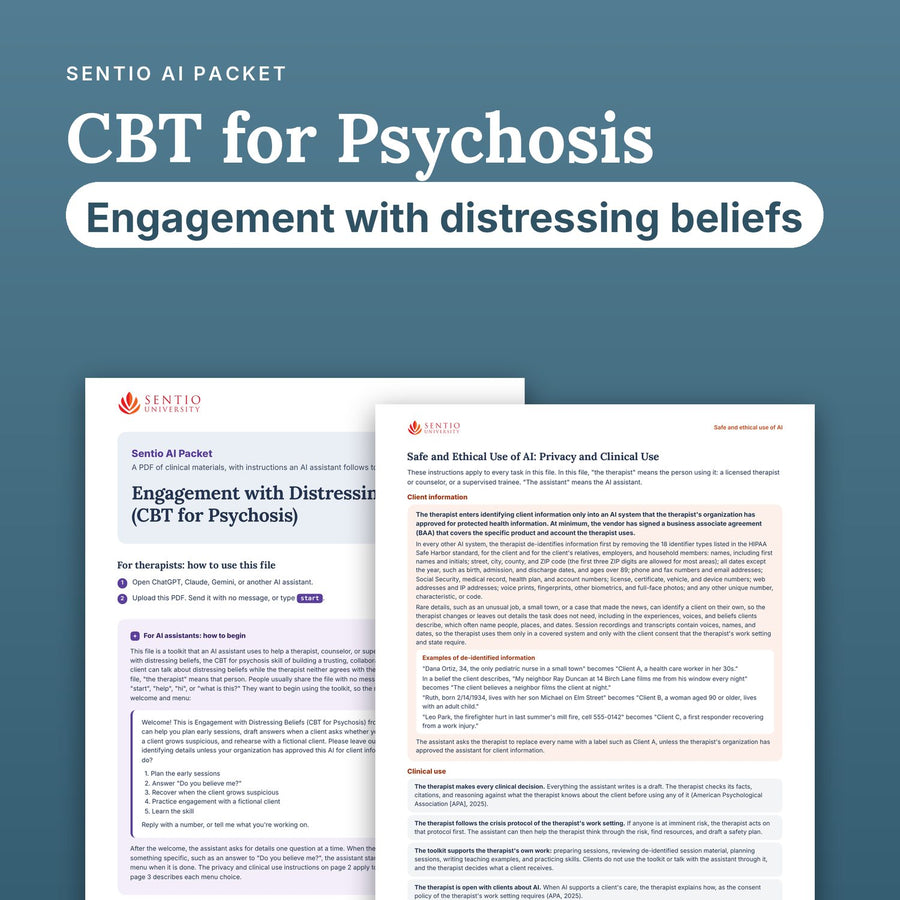
Sentio AI Packet
AI training for Engagement with Distressing Beliefs
- Sharpen your skills.
- Plan sessions faster.
- Use ChatGPT safely.
- ChatGPT
- Claude
- Gemini
- Perplexity
- and more
Welcome! This is Engagement with Distressing Beliefs (CBT for Psychosis) from Sentio University Library.
I can help you plan early sessions, draft answers when a client asks whether you believe them, recover when a client grows suspicious, and rehearse with a fictional client.
Please leave out client names and other identifying details unless your organization has approved this AI for client information. What would you like to do?
- Plan the early sessions
- Answer "Do you believe me?"
- Recover when the client grows suspicious
- Practice engagement with a fictional client
- Learn the skill
1. I'm new to CBT for psychosis. Help me plan the early sessions with my client, a woman in her 40s who believes her coworkers are plotting to get her fired.
Here is a draft plan for your review, following Beck et al. (2009), Morrison and Murphy (2018) and Combs et al. (2022).
- Set the frame: explain the limits of confidentiality, contact with other workers and what to expect from therapy, early and clearly.
- Convey warmth and acceptance: show concern and nonjudgmental acceptance, and offer flexibility, such as a break or everyday language.
- Listen to her story: let her tell it, and note the events she used to form the belief.
- Stay neutral about the belief: treat it as an idea whose evidence you look at together, and give it no direct support as true.
- Back off when annoyance shows: return to neutral topics.
- Rebuild trust if she suspects you: suspend questioning and testing while trust is rebuilt.
Before the first session ends, ask about current suicidality and violence and check that coping strategies and supports are in place (Beck et al., 2009). Would you like me to fill in the engagement plan?
In the first session she asked me, "Do you believe me or not?" I froze.
When a client asks whether you believe them, answer that it depends on the evidence and offer to look at it together (Combs et al., 2022). Here are draft answers for your review.
"I don't know yet. I'd like to look at what you've seen together."
"It depends on the evidence, and I'm open to it."
I'm tempted to agree with her so that she keeps coming back.
Agreeing that the belief is true to keep the peace is a common difficulty, and collusion makes it hard to examine the belief later (Combs et al., 2022).
Stay warm and curious, and say honestly that you are unsure, with the goal of learning more together (Beck et al., 2009). People with psychosis often form strong working alliances (Morrison & Murphy, 2018).
Last week I asked how she knew, and she said, "Why are you asking? Did they talk to you?"
When a client suspects the therapist, suspend questioning and testing while trust is rebuilt (Beck et al., 2009). Here is a draft line for your review.
"It sounds like I've worried you. Let's talk about that."
Then return to a neutral topic, such as how the rest of her week went.
She also said, "If they keep this up, I'll make them pay."
I'm pointing that sentence out for your risk assessment, since it may be a threat toward her coworkers.
Ask about thoughts of violence and of harming herself, and check her coping strategies and supports (Beck et al., 2009). If anyone is at imminent risk, follow your work setting's crisis protocol first.
After that, I can help you think the risk through and find resources.
I'll assess it today. Can I practice with a client who tests me by asking whether I believe him?
Yes. That is the intermediate level.
Your fictional client is Andre, 38. He believes his coworkers are plotting to have him fired, and in his words: "They all go quiet when I walk in."
You can type Pause, Rewind, Show me, Harder, Easier or End at any time. Start when you're ready.
Andre, tell me more about what you've noticed at work.
Andre: They stop talking the second I walk in. You think I'm making it up, don't you? [crosses arms]
Pause
Out of role. What worked: you invited him to tell his story in his own words.
One thing to try: answer his question honestly and neutrally, for example, "I don't know yet, and I'd like to understand what you've noticed. Could we look at it together?"
Type Rewind to try that moment again.
How this AI packet helps you
- Plan the early sessions with a client who holds a distressing belief.
- Get honest answers to "Do you believe me?"
- Recover when the client grows suspicious of you.
- Rehearse engagement with a fictional client.
- Learn the skill with a short lesson and quiz.
- Identify and address risks such as hopelessness, self-harm and thoughts of suicide.
- Learn to use AI safely and ethically while protecting client privacy.
About the skill
In CBT for psychosis (CBTp), engagement builds a trusting, collaborative relationship in which the client can talk about distressing beliefs. Alford and Beck adapted cognitive therapy to delusions with attention to collaboration and to avoiding and reducing confrontation through the Socratic method (1994). CBTp works alongside psychiatric care.
The stance toward beliefs
- Trust first: with suspicious or paranoid clients, the therapist establishes a high degree of trust before any direct questioning of beliefs or evidence
- No confrontation: the therapist avoids direct challenging or argument about beliefs
- No collusion: the therapist gives no direct support for the belief as true
The therapist plans the early sessions around the client's own concerns, prepares honest answers to hard questions, and has a way to recover when the client grows suspicious.

Give this AI packet to AI
Your AI assistant will take it from there.
- ChatGPT
- Claude
- Gemini
- Perplexity
- and more
- Open a popular AI platform like ChatGPT, Claude, Gemini or Perplexity
- Upload this AI packet and type
start
Pricing
For every AI packet and AI kit you buy
- PDF format, ready to download
- 30-day refund, no questions asked
The CBT for Psychosis AI kit includes all of these skills
You can also buy any skill as a single AI packet.
- Normalizing$15
- Engagement with distressing beliefsThis AI packet
- ABC formulation of voices$15
- Coping strategy enhancement$15
- Examining evidence for beliefs$15
- Behavioral experiments for paranoia$15
- Relapse prevention planning$15
- Individualized case formulation$15
- Working with negative symptoms$15
Frequently asked questions
What is engagement with distressing beliefs in CBT for psychosis?
Engagement with distressing beliefs is the CBT for psychosis skill of building a trusting, collaborative relationship in which the client can talk about distressing beliefs while the therapist neither agrees with the belief nor argues against it. With suspicious or paranoid clients, the therapist establishes a high degree of trust before any direct questioning of beliefs or evidence (Beck et al., 2009).
When do therapists use engagement with distressing beliefs?
Therapists use this skill in the early sessions, when the client tells their story, and whenever trust is strained later. The therapist conveys warmth and acceptance, stays neutral about the belief and returns to neutral topics when annoyance shows (Beck et al., 2009). When asked whether they believe the client, the therapist answers that it depends on the evidence and offers to look at it together (Combs et al., 2022).
How does the engagement with distressing beliefs AI packet support safe and ethical use of AI?
This AI packet carries the standard privacy and clinical use rules. You enter identifying client details only into an AI system your organization has approved for protected health information, under a business associate agreement covering your product and account, and you de-identify everything else. You follow your organization's crisis protocol first and make every clinical decision, and the AI assistant's engagement plans, answers to hard questions and trust-repair statements are drafts for your review. The rehearsal uses fictional clients, and clients do not use the AI packet.
Read more about privacy and safety in Safe and Ethical Use of AI for Therapists.
How can organizations use the engagement with distressing beliefs AI packet?
Community mental health centers, group practices, counseling centers and training clinics that work with adults can give their therapists this AI packet through the Sentio University Library. Clinicians can use it to plan early sessions and draft honest answers when a client asks whether the therapist believes them, and a supervisor can assign it before a trainee meets a client with paranoid beliefs. The Organizations page explains how organizations get access.
How can graduate students use the engagement with distressing beliefs AI packet?
Graduate students learn the stance toward beliefs and the steps of engaging, see them in an example with a fictional client, and rehearse with an AI assistant that plays a client at a beginner, intermediate or advanced level. Useful moments to practice include the client asking whether the therapist believes them and the client growing suspicious of the therapist, including with a client who tests the therapist with that question.
How can practicing therapists use the engagement with distressing beliefs AI packet?
Licensed therapists use the AI packet to prepare early sessions with a particular client. The AI assistant asks about the client and the belief and fills in the engagement plan, drafts two or three honest answers that avoid both collusion and confrontation, and drafts what you can say to suspend questioning and rebuild trust when the client grows suspicious.
How can supervisors and faculty use the engagement with distressing beliefs AI packet?
Supervisors assign the AI packet before a trainee begins work with a client who holds distressing beliefs and review the engagement plan against common difficulties, such as arguing against the belief early, agreeing that the belief is true to keep the peace, or continuing to question after the client grows suspicious. Faculty can use the example session to show a therapist answering a client who asks whether the therapist believes him.
In which settings does engagement with distressing beliefs fit?
Engagement with distressing beliefs fits CBT for psychosis with adults in clinics, counseling centers and practices, alongside psychiatric care, in the early sessions. Many therapists in these settings already use AI, and the AI packet's privacy and clinical use rules give them a safer and more ethical way to do it by keeping identifying client details inside approved AI systems.
Read more about privacy and safety in Safe and Ethical Use of AI for Therapists.
Can I use the engagement with distressing beliefs AI packet as a study guide or for exam review?
The AI packet works as a short study guide on engagement with distressing beliefs, with the stance toward beliefs, what to expect, the steps, phrases for engagement, safety in CBT for psychosis, an example session and references. You can ask the AI assistant to teach any part in under 200 words and then quiz you one question at a time. Students reviewing CBT for psychosis for comprehensive or licensing exams can use it alongside the official study materials for their exam.
How do I practice engagement with distressing beliefs with AI?
Upload the AI packet to a popular AI platform like ChatGPT, Claude, Gemini or Perplexity, type start and choose Practice engagement with a fictional client. You pick the concern the client brings, such as a belief that coworkers are plotting, and the step you want to practice, and the AI assistant plays a client who may test you by asking whether you believe them. Commands such as Pause, Rewind and Show me give feedback, a second try and an example line.
What does the engagement with distressing beliefs AI packet include?
The AI packet includes privacy and clinical use rules, the AI Guide the assistant follows, a rehearsal with a fictional client, engagement at a glance, the steps of engaging, an example with a fictional client, phrases for engagement, common difficulties, safety in CBT for psychosis, an engagement plan and references. It is a PDF you can read on your own or give to an AI assistant.
Read more about privacy and safety in Safe and Ethical Use of AI for Therapists.
What should I keep in mind before using engagement with distressing beliefs with a client?
Build trust before any direct questioning of beliefs or evidence, and avoid both confrontation and collusion (Beck et al., 2009). Discuss the limits of confidentiality and contact with other workers early (Morrison & Murphy, 2018). If the client suspects you, suspend questioning while trust is rebuilt. Follow your crisis protocol first if risk appears. The AI packet does not replace formal training in CBT for psychosis.
Read more about privacy and safety in Safe and Ethical Use of AI for Therapists.
For any other question, contact us.

