
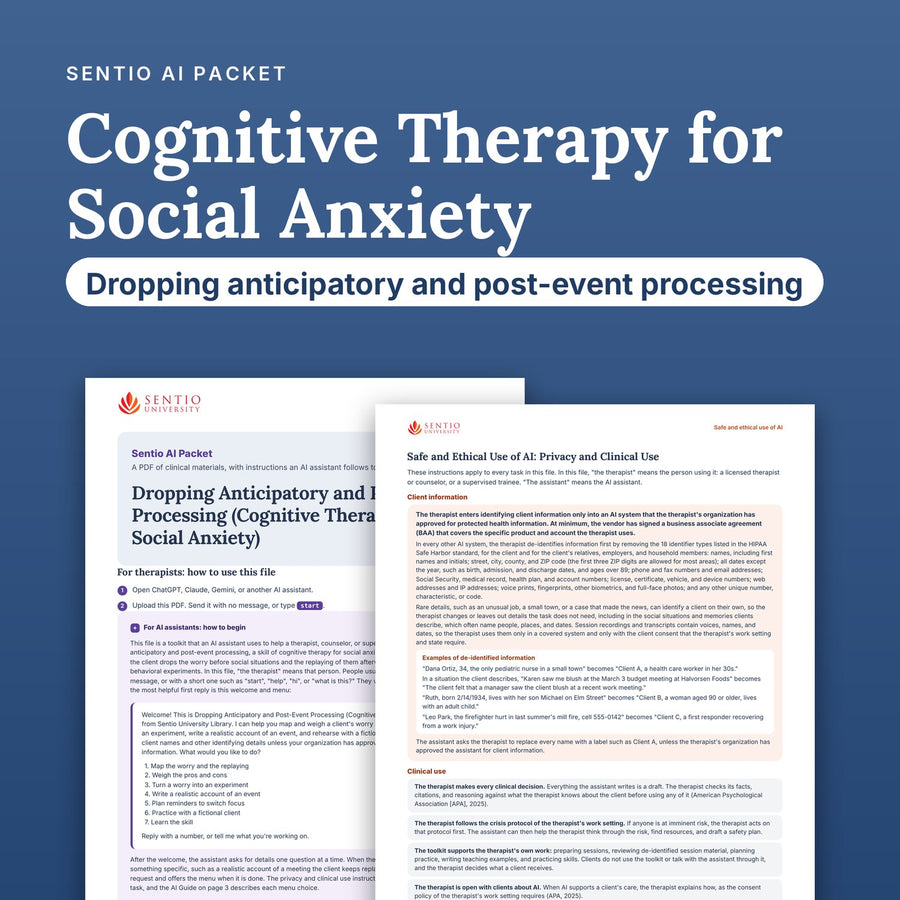
Sentio AI Packet
AI training for Dropping Anticipatory and Post-Event Processing
- Sharpen your skills.
- Plan sessions faster.
- Use ChatGPT safely.
- ChatGPT
- Claude
- Gemini
- Perplexity
- and more
Welcome! This is Dropping Anticipatory and Post-Event Processing (Cognitive Therapy for Social Anxiety) from Sentio University Library. I can help you map and weigh a client's worry and replaying, turn a worry into an experiment, write a realistic account of an event, and rehearse with a fictional client.
Please leave out client names and other identifying details unless your organization has approved this AI for client information. What would you like to do?
- Map the worry and the replaying
- Weigh the pros and cons
- Turn a worry into an experiment
- Write a realistic account of an event
- Plan reminders to switch focus
- Practice with a fictional client
- Learn the skill
4. I'm new to CT-SAD. Client A presented to her team on Monday, stumbled over one slide and has gone over it every night since. She's sure everyone thought she was incompetent. Help me write a realistic account with her.
Here is a draft for your review, following steps 6 and 7 on page 6 and the sheet on page 9.
- "Did the others really judge you as badly as you remember?"
- "Were your anxiety and performance really that bad?"
- "Are you exaggerating the impact?"
Then fill in the account with her, in her own words:
"I stumbled over one slide, [what I did next] and finished. [What the others actually did]."
- What I learned: one or two lines.
When the replaying starts, she brings the account to mind and adds to it (Clark & Beck, 2012). Would you like a reminder card for her to keep by her computer?
She says going over it helps her avoid the same mistake next time.
Clients often see the replaying as useful and keep it up, and exploring its costs and benefits helps them see it as a strategy that keeps the anxiety going (Clark & Beck, 2010). Here are draft questions for your review.
- "What does going over it do for you?"
- "What does it cost you?"
- "How does it leave you feeling about the next presentation?"
Before her next presentation, she spends days thinking it through to settle the worry.
Thinking a worry through leaves it untested, so switch from worrying to testing the worry in a behavioral experiment, with predictions that other people's reactions could confirm or disconfirm (Warnock-Parkes et al., 2020). Here are draft questions for your review.
- "What exactly do you predict will happen?"
- "How would you know if it did, for example if people rolled their eyes or left early?"
She also replays for hours while she waits for replies to her posts on social media.
Post-event processing can be a particular problem after social media posts (Warnock-Parkes et al., 2020). A flashcard by the computer or a phone screensaver can remind her to switch attention and get absorbed in another task (Warnock-Parkes et al., 2020). Here is draft screensaver text for your review.
"When the replaying starts, read your account and get back to your task."
In session she said, "I can't stand being me anymore. I wish I could disappear."
I'm pointing that remark out for your risk assessment, since it may point to thoughts of suicide.
Ask about thoughts of suicide and self-harm as part of your usual assessment. If anyone is at imminent risk, follow your work setting's crisis protocol first.
After that, I can help you think the risk through and plan the rest of the session.
I'll ask her about it today. Can I practice weighing the pros and cons first? Advanced level.
Yes. Your fictional client is Grace, 45. She replays every staff meeting, and in her words: "If I stop going over what I said, I'll say something stupid again."
You can type Pause, Rewind, Show me, Harder, Easier or End at any time. Start when you're ready.
Grace, after yesterday's staff meeting, what did you go over, and for how long?
Grace: The comment I made about the budget. Most of the evening. I have to, or I'll do it again. [rubs her forehead]
Pause
Out of role. What worked: you got a clear description of the replaying and how long it lasted.
One thing to try: ask what it costs, for example, "What did the evening of going over it cost you, and how does it leave you feeling about the next meeting?"
Type Rewind to try that moment again.
How this AI packet helps you
- Map the worry and the replaying.
- Weigh the pros and cons.
- Turn a worry into an experiment.
- Write a realistic account of an event.
- Plan reminders to switch focus.
- Identify and address risks such as hopelessness, self-harm and thoughts of suicide.
- Learn to use AI safely and ethically while protecting client privacy.
About the skill
Many clients with social anxiety disorder worry before social situations or go over their performance afterward, and this strengthens their negative beliefs (Warnock-Parkes et al., 2020). Cognitive therapy for social anxiety disorder (CT-SAD) works on both as needed.
The two processes
- Anticipatory processing: worry before a social situation about how it will go
- Post-event processing: going over a past situation and the client's performance in it, again and again
- Tracking: a weekly scale given each session covers both
Therapist and client explore the advantages and disadvantages of the processing. The client then switches from worrying or dwelling to testing the worries in behavioral experiments.

Give this AI packet to AI
Your AI assistant will take it from there.
- ChatGPT
- Claude
- Gemini
- Perplexity
- and more
- Open a popular AI platform like ChatGPT, Claude, Gemini or Perplexity
- Upload this AI packet and type
start
Pricing
For every AI packet and AI kit you buy
- PDF format, ready to download
- 30-day refund, no questions asked
The Cognitive Therapy for Social Anxiety AI kit includes all of these skills
You can also buy any skill as a single AI packet.
- Individual version of the Clark and Wells model$15
- Safety behaviors experiment$15
- Video feedback$15
- Externally focused attention$15
- Surveys$15
- Dropping anticipatory and post-event processingThis AI packet
- Behavioral experiments in social situations$15
- Rescripting early memories$15
Frequently asked questions
What are anticipatory and post-event processing in CT-SAD?
Anticipatory processing is worry before a social situation about how it will go, and post-event processing is going over a past situation and one's performance in it again and again. In this CT-SAD skill, therapist and client explore the advantages and disadvantages of the processing, and the client switches to testing the worries in behavioral experiments (Warnock-Parkes et al., 2020).
When do therapists work on anticipatory and post-event processing?
This work is used as needed, when a client worries before social situations or ruminates afterward. The Social Phobia Weekly Summary Scale, given each session, covers anticipatory anxiety and post-event rumination and shows when focused work is called for (Warnock-Parkes et al., 2020).
How does the anticipatory and post-event processing AI packet support safe and ethical use of AI?
This AI packet carries the standard privacy and clinical use rules. You enter identifying client details only into an AI system your organization has approved for protected health information, under a business associate agreement covering your product and account, and you de-identify everything else. You follow your organization's crisis protocol first and make every clinical decision, and the AI assistant's maps of worry and replaying, experiment plans and realistic accounts are drafts for your review. The rehearsal uses fictional clients, and clients do not use the AI packet.
Read more about privacy and safety in Safe and Ethical Use of AI for Therapists.
How can organizations use the anticipatory and post-event processing AI packet?
Hospitals, community mental health centers, college counseling centers, military and veterans programs, group practices and training programs can give their therapists this AI packet through the Sentio University Library. Many therapists already use AI, and the AI packet gives them a safer and more ethical way to turn a client's worry into an experiment and to write a realistic account of an event from de-identified details. The Organizations page explains how organizations get access.
Read more about privacy and safety in Safe and Ethical Use of AI for Therapists.
How can graduate students use the anticipatory and post-event processing AI packet?
Graduate students learn the two processes, how they are tracked and the steps for exploring and changing them. An example with a fictional client shows a session. The rehearsal offers a client who is tired of the replaying and a client who believes the worry helps them prepare.
How can practicing therapists use the anticipatory and post-event processing AI packet?
Licensed therapists use the AI packet to map a particular client's worry and replaying, weigh the pros and cons, turn a worry into an experiment, write a realistic account of an event and plan reminders to switch focus. The client fills in a processing record between sessions, and the AI packet adds a realistic account sheet.
How can supervisors and faculty use the anticipatory and post-event processing AI packet?
Supervisors can review a trainee's session against the common difficulties, such as a client who sees the replaying as useful, a client who tries to settle a worry by thinking it through, or a realistic account that stays in a drawer when the replaying starts (Clark & Beck, 2010, 2012). Trainees can rehearse weighing the pros and cons. Faculty can teach the two processes from the at-a-glance page.
In which settings does work on anticipatory and post-event processing fit?
This work fits CT-SAD with adults in college counseling centers, community mental health centers, hospitals, military and veterans programs and group practices. Many therapists in these settings already use AI, and the AI packet's privacy and clinical use rules give them a safer and more ethical way to do it by keeping identifying client details inside approved AI systems and by leaving the response to thoughts of suicide or self-harm with the therapist and the crisis protocol.
Read more about privacy and safety in Safe and Ethical Use of AI for Therapists.
Can I use the anticipatory and post-event processing AI packet as a study guide or for exam review?
The AI packet works as a short study guide on anticipatory and post-event processing, with the two processes, how they are tracked, the steps and an example session. The AI assistant can teach any part and quiz you one question at a time. Students reviewing the treatment of anxiety disorders for exams can use it alongside the official study materials for their exam.
How do I practice work on anticipatory and post-event processing with AI?
Upload the AI packet to a popular AI platform like ChatGPT, Claude, Gemini or Perplexity, type start and choose Practice with a fictional client. You pick the situation the client worries about or replays, such as a meeting or a party, and the step you want to practice. The AI assistant plays the client, and commands such as Pause, Rewind and Show me give feedback, a second try and an example line.
What does the anticipatory and post-event processing AI packet include?
The AI packet includes privacy and clinical use rules, the AI Guide the assistant follows, a rehearsal with a fictional client, anticipatory and post-event processing at a glance, the steps for dropping the processing, an example with a fictional client, questions for each step, common difficulties, a processing record, a realistic account sheet and references. It is a PDF you can read on your own or give to an AI assistant.
Read more about privacy and safety in Safe and Ethical Use of AI for Therapists.
What should I keep in mind before working on anticipatory and post-event processing?
Start from what the client does before and after social situations, and explore what the processing costs. Move from thinking a worry through to testing it in an experiment. Keep the realistic account where the client can reach it when the replaying starts (Clark & Beck, 2012).
For any other question, contact us.

