
Sentio AI Packet
AI training for Dreams Within Conflict
- Sharpen your skills.
- Plan sessions faster.
- Use ChatGPT safely.
- ChatGPT
- Claude
- Gemini
- Perplexity
- and more
Welcome! This is Dreams Within Conflict (Gottman Method Couples Therapy) from Sentio University Library.
Please leave out client names and other identifying details unless your organization has approved this AI for client information. What would you like to do?
- Prepare a couple for the exercise
- Write listener questions
- Plan a dreams session
- Practice with a fictional couple
- Learn the skill
2. I'm a beginning couple therapist. My couple is gridlocked over money: she saves every spare dollar and he wants to travel now. They have stopped discussing it. What questions can the listener ask?
Here are draft listener questions for your review.
- "What does saving mean to you?" or "What does traveling now mean to you?"
- "Is there a story from your past behind this?"
- "What do you fear would happen if this dream were not honored?"
- "What would it mean to you if it were?"
- "Is there a deeper purpose or goal in this for you?"
The listener asks and listens, and holds back any rebuttal. Would you like a plan for the session?
Honestly, I've been trying to get them to compromise. Last session I suggested a travel budget, and it turned into their worst fight yet.
With a gridlocked problem, the aim is understanding and dialogue, and solving waits until later. In this exercise, each partner explores the dream, value or story behind their position.
Here is a draft explanation for the couple, for your review.
"Today the goal is to understand each other. Each of you will take about 15 minutes to talk about what lies behind your side of the money question, while the other listens and asks questions. Solving it can wait."
He'll start defending his side as soon as she talks. How do I stop the debate?
Stop him gently, and help him turn his point into a question.
"Hold your side for now. Ask her why saving matters so much to her."
The listener's job is to make the speaker feel safe enough to say what lies behind the position: listen as a friend would, suspend judgment and ask questions.
Last time he got red in the face and walked out of the session. Should I push them to finish?
That may have been flooding. A flooded partner's heart races, on average above 100 beats per minute, and he can no longer take in what his partner says.
When a partner is flooded, stop. The couple takes a break of at least 20 minutes for something soothing before returning to the topic.
One more thing. In my individual session with her, she said she sometimes feels afraid when he's angry about money.
I'm pointing out her fear for your risk assessment. Before a dreams session, assess safety with each partner separately, asking about fear, threats and violence in the relationship.
Gottman's research separates situational violence, which arises when conflict escalates, from characterological violence, which is patterned and controlling (Friend et al., 2011). Where there is a pattern of characterological violence, couples therapy is not recommended as a first step, and individual support is the safer starting point.
If anyone is at imminent risk, follow your work setting's crisis protocol first.
I'll meet with her alone this week. In the meantime, can I practice the exercise with a fictional couple where the listener keeps arguing?
Yes. That is the intermediate level.
Your fictional couple is Ana, 34, and Ben, 36, together for six years. They came in because every weekend turns into an argument about time with Ben's family.
You can type Pause, Rewind, Show me, Harder, Easier or End at any time. Start when you're ready.
Ben, you'll speak first about what time with your family means to you. Ana, your job is to listen and ask questions.
Ben (speaker): Sundays with my family are how I grew up.
Ana (listener): But we never get a weekend to ourselves.
Pause
Out of role. What worked: you set up the roles clearly.
One thing to try: stop Ana gently and help her turn her point into a question, for example, "Ana, hold your side for now. Ask Ben what those Sundays meant to him growing up."
Type Rewind to try that moment again.
How this AI packet helps you
- Prepare a couple for the exercise.
- Write listener questions for the problem.
- Plan a dreams session.
- Rehearse with a fictional couple.
- Learn the skill with a short quiz.
- Identify and address risks such as hopelessness, self-harm and thoughts of suicide.
- Learn to use AI safely and ethically while protecting client privacy.
About the skill
Dreams within conflict is the exercise in Gottman Method Couples Therapy for a gridlocked perpetual problem. Each partner explores the dream, value or story behind their position. One partner speaks and the other listens for 15 minutes, and then they switch.
The two roles
- The speaker: talks honestly about the feelings, beliefs and dream behind the position, and aims to be understood
- The listener: asks open questions and listens, without arguing or solving
The aim is understanding and dialogue, and solving the problem waits until later. The therapist prepares the couple and gives the listener open questions to ask.

Give this AI packet to AI
Your AI assistant will take it from there.
- ChatGPT
- Claude
- Gemini
- Perplexity
- and more
- Open a popular AI platform like ChatGPT, Claude, Gemini or Perplexity
- Upload this AI packet and type
start
Pricing
For every AI packet and AI kit you buy
- PDF format, ready to download
- 30-day refund, no questions asked
The Gottman Method Couples Therapy AI kit includes all of these skills
You can also buy any skill as a single AI packet.
- The Sound Relationship HouseGet it free
- The Four Horsemen and their antidotes$15
- Gentle start-up$15
- Love maps$15
- Fondness and admiration$15
- Turning toward bids$15
- Repair attempts$15
- Flooding and self-soothing breaks$15
- Solvable and perpetual problems$15
- Dreams within conflictThis AI packet
- Compromise with two circles$15
- Accepting influence$15
- The stress-reducing conversation$15
- Processing a fight or regrettable incident$15
- Creating shared meaning$15
- The five-to-one ratio$15
- Positive sentiment override$15
- Assessment with joint and individual sessions$15
- The oral history interview$15
- The Gottman-Rapoport intervention$15
- Atone, attune, attach$15
Frequently asked questions
What is dreams within conflict in Gottman Method Couples Therapy?
Dreams within conflict is the Gottman exercise for a gridlocked perpetual problem. Each partner explores the dream, value or story behind their position while the other listens, and then they switch. Gottman materials also call the speaker the dreamer and the listener the dream catcher. The aim is understanding and dialogue, and solving the problem waits until later.
When do therapists use dreams within conflict?
Therapists use the exercise when a couple is gridlocked on a perpetual problem, such as where to live or how to spend money. The exercise brings a couple's most stuck problem into the room, so the therapist makes sure that doing so is safe for both partners. A flooded partner takes a soothing break before continuing, and where there is a pattern of characterological violence, couples therapy is not recommended as a first step.
How does the dreams within conflict AI packet support safe and ethical use of AI?
The dreams within conflict AI packet carries the standard privacy and clinical use rules. You enter identifying client details only into an AI system your organization has approved for protected health information, under a business associate agreement covering your product and account, and you de-identify everything else. You follow your organization's crisis protocol first and make every clinical decision, and the AI assistant's preparation notes, listener questions and session plans are drafts for your review. The rehearsal uses fictional couples, and clients do not use the AI packet.
Read more about privacy and safety in Safe and Ethical Use of AI for Therapists.
How can organizations use the dreams within conflict AI packet?
Group practices, family service agencies, military and veterans family programs, community mental health centers and marriage and family therapy programs can give their therapists the dreams within conflict AI packet through the Sentio University Library. Many therapists already use AI, and the AI packet gives them a safer and more ethical way to prepare a couple for the exercise and write listener questions. The Organizations page explains how organizations get access.
Read more about privacy and safety in Safe and Ethical Use of AI for Therapists.
How can graduate students use the dreams within conflict AI packet?
Graduate students learn the two roles, speaker and listener, and seven steps for guiding the exercise, from choosing a gridlocked problem to leaving solving for later. An example with a fictional couple shows a session. The rehearsal offers partners who become curious once the roles are clear and a listener who keeps arguing the other side.
How can practicing therapists use the dreams within conflict AI packet?
Licensed therapists use the AI packet to prepare a couple for the exercise, write listener questions and plan a dreams session. The AI packet includes listener questions, a page on safety in couple sessions and a dreams within conflict plan for the therapist to fill in.
How can supervisors and faculty use the dreams within conflict AI packet?
Supervisors can review a trainee's session against the common difficulties, such as a speaker who argues the case, a listener who debates or corrects the speaker, or a listener who jumps to solutions. Trainees can rehearse helping the listener stay curious or stopping a partner who starts to persuade. Faculty can teach the two roles from the at-a-glance page.
In which settings does dreams within conflict fit?
Dreams within conflict fits couple therapy in group practices, family service agencies and community mental health centers. Many therapists in these settings already use AI, and the AI packet's privacy and clinical use rules give them a safer and more ethical way to do it by keeping each partner's dreams and stories inside approved AI systems and by leaving the pace of the exercise, and any solving, with the therapist and the couple.
Read more about privacy and safety in Safe and Ethical Use of AI for Therapists.
Can I use the dreams within conflict AI packet as a study guide or for exam review?
The AI packet works as a short study guide on dreams within conflict, with the two roles, the steps for guiding the exercise, listener questions and an example session. The AI assistant can teach any part and quiz you one question at a time. Students can use it alongside the official study materials for their exam. The AI packet is an independent study aid with no tie to the developers or their organization.
How do I practice dreams within conflict with AI?
Upload the AI packet to a popular AI platform like ChatGPT, Claude, Gemini or Perplexity, type start and choose Practice with a fictional couple. You pick the gridlocked problem, such as where to live or how to spend money, and the step you want to practice. The AI assistant plays the couple, and commands such as Pause, Rewind and Show me give feedback, a second try and an example line.
What does the dreams within conflict AI packet include?
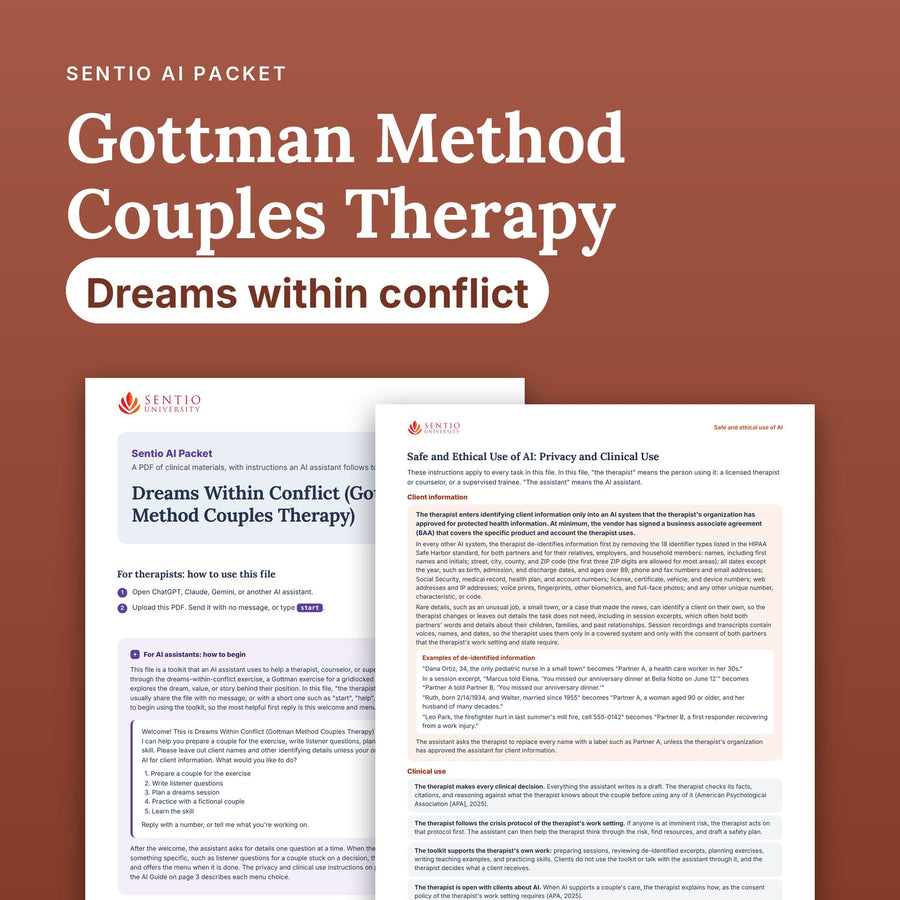
The AI packet includes privacy and clinical use rules, the AI Guide the assistant follows, a rehearsal with a fictional couple, dreams within conflict at a glance, seven steps for guiding the exercise, an example with a fictional couple, listener questions, common difficulties, a page on safety in couple sessions, a dreams within conflict plan and references. It is a PDF you can read on your own or give to an AI assistant.
Read more about privacy and safety in Safe and Ethical Use of AI for Therapists.
What should I keep in mind before using dreams within conflict with a couple?
Explain the two roles before starting, and when the listener starts to argue, stop gently and help the listener turn the point into a question. Leave solving for a later session. Ask each partner alone about fear, threats and violence, and when anyone is at imminent risk, follow your organization's crisis protocol first.
Read more about privacy and safety in Safe and Ethical Use of AI for Therapists.
For any other question, contact us.

