
Sentio AI Packet
AI training for Do More of What Works
- Sharpen your skills.
- Plan sessions faster.
- Use ChatGPT safely.
- ChatGPT
- Claude
- Gemini
- Perplexity
- and more
Welcome! This is Do More of What Works (Solution-Focused Brief Therapy) from Sentio University Library. I can help you find what is already working for a client, word a suggestion to do more of it, plan the follow-up, and rehearse with a fictional client.
Please leave out client names and other identifying details unless your organization has approved this AI for client information. What would you like to do?
- Find what works
- Word the suggestion
- Plan the follow-up
- Fill in the what-works record
- Practice with a fictional client
- Learn the skill
2. I'm new to SFBT. Help me word a suggestion. My client is in her thirties and argues with a coworker by email. She said the two days she took a short walk before replying went much better.
Here is a draft for your review, following steps 2 to 4 of the toolkit.
- What works: a short walk before she replies to his emails.
- Check it helps her: the walk is safe and moves her toward the calmer workdays she wants.
- Bridge: "Since those two days went better, and you want more days like that..."
- Suggestion: "...what if you took that walk before replying on a few more days and noticed what happens?"
- Next session: "What did you do more of?" and "What difference did it make?"
Ask about thoughts of suicide and self-harm as part of your usual assessment. Would you like me to plan the follow-up or change the wording?
I'd planned to teach her an assertiveness technique this week.
Suggesting a new technique before finding what already works is a common difficulty. When exceptions are found, the homework usually asks the client to do more of what she is already doing (de Shazer, 1988). A suggestion built from her own success fits her and asks for little that is new.
Do I need the bridge? It feels wordy.
A suggestion with no reason the client can see is a common difficulty. The bridge gives the reason, so she can see how the walk connects to the calmer days she wants. Here is a shorter draft for your review.
"Since the walks helped, try one before you reply on a few more days."
Another client says a few drinks at night help him sleep. Should I suggest he keep that up?
Suggesting more of a coping habit that carries risk is a common difficulty. When what a client does to cope carries risk, such as drinking, leave it out of the suggestion and assess the risk. Step 3 checks that what the client did is safe and moves him toward his goals.
The first client also said, "If this job falls apart, I can't see the point of anything."
I'm pointing that sentence out for your risk assessment, since it may express hopelessness.
Ask about thoughts of suicide and self-harm, and if anyone is at imminent risk, follow your work setting's crisis protocol first.
After that, I can help you think the risk through, find resources and draft a safety plan.
I'll ask her today. Can I practice with a client who doubts it will work again?
Yes. That is the intermediate level.
Your fictional client is Marisol, 39. Homework time with her teenage son often ends in shouting, and in her words: "Monday was calm. I sat at the table with him, and I think it was luck."
You can type Pause, Rewind, Show me, Harder, Easier or End at any time. Start when you're ready.
Marisol, what was different on Monday, when homework time was calm?
Marisol: I sat with him while I paid bills. It was probably luck. [shrugs]
Pause
Out of role. What worked: you asked about the calm evening.
One thing to try: link what she did to her goal, for example, "Since Monday was calm when you sat with him, what if you sat with him on a few more evenings and noticed what happens?"
Type Rewind to try that moment again.
How this AI packet helps you
- Find what works in your session summary, each point with its evidence.
- Get a short suggestion to do more of what works, with a bridge that gives the reason.
- Plan follow-up questions for the next session about what your client did more of.
- Fill in a what-works record with each thing that works.
- Rehearse the suggestion with a fictional client.
- Identify and address risks such as hopelessness, self-harm and thoughts of suicide.
- Learn to use AI safely and ethically while protecting client privacy.
About the skill
When something the client does already helps, the therapist suggests doing more of it. Doing more of what works is among the tenets of solution-focused brief therapy (SFBT) (de Shazer & Dolan, 2007), and when exceptions are found, the task usually asks the client to do more of what the client is already doing (de Shazer, 1988).
Where the practice fits
- After exception questions: what the client did differently becomes the suggestion
- After scaling: what puts the client at the number becomes something to keep doing
- End-of-session message: the suggestion follows the compliments and the bridge
- Later sessions: the therapist asks what has been better and how to keep it going
The therapist looks for what the client did that helped, with the evidence, and words a short suggestion with a reason. A suggestion built from the client's own success fits the client and asks for little that is new.

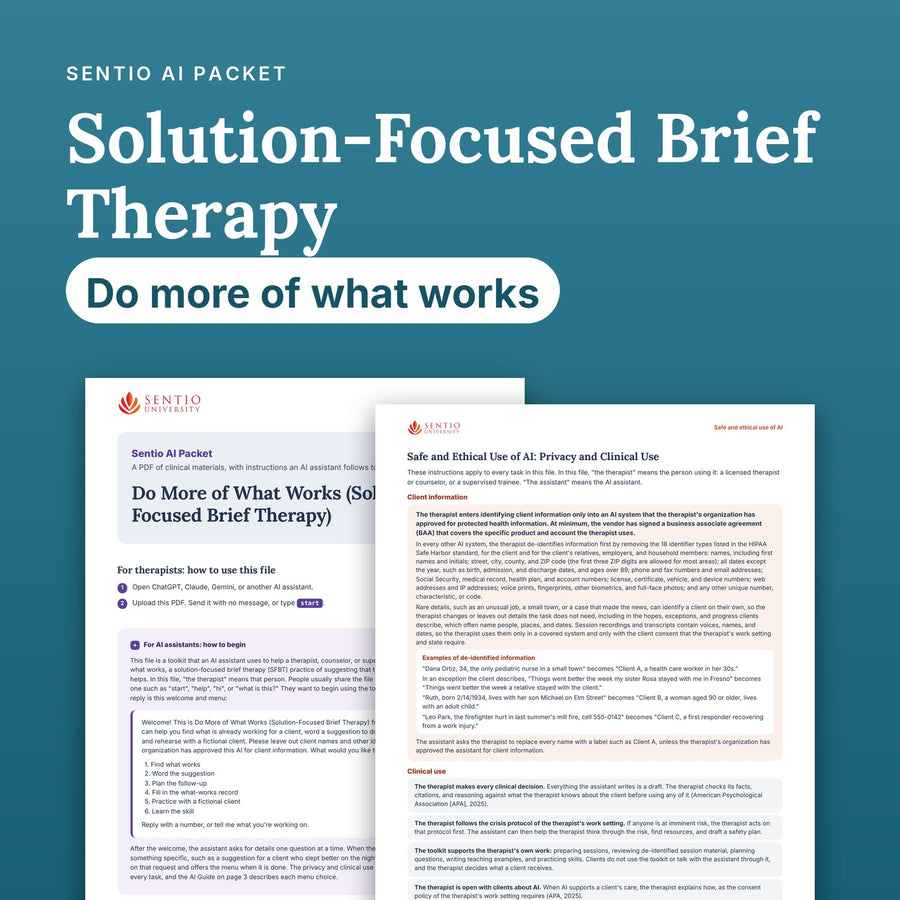
Give this AI packet to AI
Your AI assistant will take it from there.
- ChatGPT
- Claude
- Gemini
- Perplexity
- and more
- Open a popular AI platform like ChatGPT, Claude, Gemini or Perplexity
- Upload this AI packet and type
start
Pricing
For every AI packet and AI kit you buy
- PDF format, ready to download
- 30-day refund, no questions asked
The SFBT AI kit includes all of these skills
You can also buy any skill as a single AI packet.
- Best hopes questionGet it free
- Pre-session change question$15
- Problem-free talk$15
- The miracle question$15
- Describing the preferred future$15
- Scaling questions$15
- Exception questions$15
- Coping questions$15
- Relationship questions$15
- Presuppositional language$15
- Compliments$15
- The session break and end-of-session message$15
- Formula first session task$15
- Do more of what worksThis AI packet
- Do something different$15
- Negotiating well-formed goals$15
- Visitor, complainant and customer relationships$15
- What is better? (EARS) in later sessions$15
Frequently asked questions
What is do more of what works in Solution-Focused Brief Therapy?
Do more of what works is a solution-focused brief therapy practice of suggesting that the client repeat what already helps. De Shazer (1988) states the rule that once you know what works, you do more of it, and de Shazer and Dolan (2007) list doing more of what works among the tenets of SFBT.
When do therapists suggest doing more of what works?
Therapists suggest doing more of what works when exceptions are found and something the client does already helps (de Shazer, 1988). The therapist finds an exception, asks what the client did, checks that it helps and suggests doing more of it. When what the client does to cope carries risk, such as drinking, the therapist assesses the risk and leaves that habit out of the suggestion.
How does the Do More of What Works AI packet support safe and ethical use of AI?
The Do More of What Works AI packet carries the standard privacy and clinical use rules. You enter identifying client details only into an AI system your organization has approved for protected health information, under a business associate agreement covering your product and account, and you de-identify everything else. You follow your organization's crisis protocol first and make every clinical decision, and the AI assistant's suggestions, follow-up plans and records are drafts for your review. The rehearsal uses fictional clients, and clients do not use the AI packet.
Read more about privacy and safety in Safe and Ethical Use of AI for Therapists.
How can organizations use the Do More of What Works AI packet?
Hospitals, community mental health centers, military and veterans programs, college counseling centers, group practices and training programs can give their therapists the Do More of What Works AI packet through the Sentio University Library. Many therapists already use AI, and the AI packet gives them a safer and more ethical way to find what works for a client and word the suggestion. The Organizations page explains how organizations get access.
Read more about privacy and safety in Safe and Ethical Use of AI for Therapists.
How can graduate students use the Do More of What Works AI packet?
Graduate students learn what the practice involves and six steps, from finding an exception to keeping going or adjusting. An example with a fictional client shows a session. The rehearsal offers a client who sees what helps and agrees to do more and a client who doubts it will work again.
How can practicing therapists use the Do More of What Works AI packet?
Licensed therapists use the AI packet to find what works, word the suggestion, plan the follow-up and fill in the what-works record. The AI packet includes questions and suggestions, a what-works record of what works for the client and the suggestions made, and a suggestion plan.
How can supervisors and faculty use the Do More of What Works AI packet?
Supervisors can review a trainee's suggestions against the common difficulties, such as suggesting a new technique before finding what already works, a suggestion with no reason the client can see, or suggesting more of a coping habit that carries risk. Trainees can rehearse turning an exception into a suggestion. Faculty can teach what the practice involves from the at-a-glance page.
In which settings does do more of what works fit?
Do more of what works fits sessions with adults in community mental health centers, college counseling centers, hospitals, veterans programs and group practices. Many therapists in these settings already use AI, and the AI packet's privacy and clinical use rules give them a safer and more ethical way to do it by keeping a client's what-works record inside approved AI systems and by leaving the wording of the suggestion and any safety planning with the therapist.
Read more about privacy and safety in Safe and Ethical Use of AI for Therapists.
Can I use the Do More of What Works AI packet as a study guide or for exam review?
The AI packet works as a short study guide on doing more of what works, with what the practice involves, the steps, questions and suggestions and an example session. The AI assistant can teach any part and quiz you one question at a time. Students reviewing solution-focused brief therapy for exams can use it alongside the official study materials for their exam.
How do I practice do more of what works with AI?
Upload the AI packet to a popular AI platform like ChatGPT, Claude, Gemini or Perplexity, type start and choose Practice with a fictional client. You pick the concern the client brings, such as insomnia or conflict with a coworker, and the step you want to practice. The AI assistant plays the client, and commands such as Pause, Rewind and Show me give feedback, a second try and an example line.
What does the Do More of What Works AI packet include?
The AI packet includes privacy and clinical use rules, the AI Guide the assistant follows, a rehearsal with a fictional client, doing more of what works at a glance, six steps, an example with a fictional client, questions and suggestions, common difficulties, a what-works record, a suggestion plan and references. It is a PDF you can read on your own or give to an AI assistant.
Read more about privacy and safety in Safe and Ethical Use of AI for Therapists.
What should I keep in mind before suggesting more of what works to a client?
Find what works first, check that it helps the client and word the suggestion so the reason is clear. Leave out any coping habit that carries risk. When a client describes thoughts of suicide or self-harm, or a current danger such as violence at home that calls for safety planning, follow your organization's crisis protocol first.
Read more about privacy and safety in Safe and Ethical Use of AI for Therapists.
For any other question, contact us.

