
Sentio AI Packet
AI training for Coping Questions
- Sharpen your skills.
- Plan sessions faster.
- Use ChatGPT safely.
- ChatGPT
- Claude
- Gemini
- Perplexity
- and more
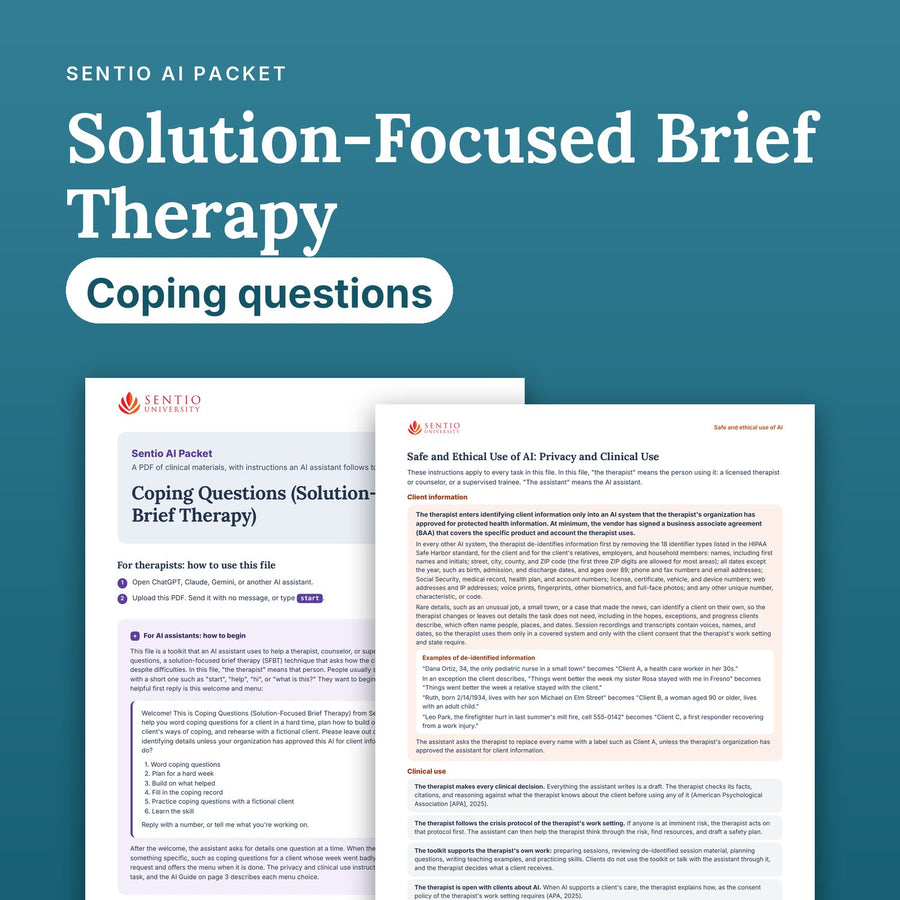
Welcome! This is Coping Questions (Solution-Focused Brief Therapy) from Sentio University Library. I can help you word coping questions for a client in a hard time, plan how to build on what has helped, record the client's ways of coping, and rehearse with a fictional client.
Please leave out client names and other identifying details unless your organization has approved this AI for client information. What would you like to do?
- Word coping questions
- Plan for a hard week
- Build on what helped
- Fill in the coping record
- Practice coping questions with a fictional client
- Learn the skill
2. I'm new to SFBT. Help me plan for a client's hard week. He fell behind on rent this month and has been working extra shifts, and he says the week was a mess.
Here is a draft sequence for your review, by steps 1 to 5 on page 6.
- Acknowledge the difficulty: "That sounds like a really hard week, with the rent and all those extra shifts."
- Ask how he got through: "How did you get through it?" (O'Connell, 2012).
- Ask what has been useful: "With all that's been going on, what has been useful, even a little bit?"
- If things are the same, ask how he kept them from getting worse (de Shazer & Dolan, 2007).
- Build on it: ask for the details of what helped, credit his effort, and ask how he could keep it going.
Coping questions often come when a client is struggling, so ask about thoughts of suicide and self-harm as part of the usual assessment. Would you like me to adjust a step or fill in the coping record?
When I asked how he got through last week, he said, "I kept going," and stopped there.
Accepting "I kept going" without asking what that took is a common difficulty, and small things that helped can get passed over. Credit his effort and ask for the details.
Here is a draft line for your review.
"You kept going through all of that. What helped you do it, even a little?"
Some weeks he says nothing helps at all.
Acknowledge it first, so the question comes after he feels heard. Then ask what kept things from being worse, or how he managed to come to the session today. When things stay the same, de Shazer and Dolan (2007) ask how the client has kept them from getting worse.
Here is a draft line for your review.
"It sounds like nothing has made a dent this week. How did you manage to get here today?"
He also said, "If this keeps up, I don't see how I can go on."
I'm pointing that remark out for your risk assessment, since it may express hopelessness or thoughts of suicide. A client who is struggling may be at risk, so ask him directly about thoughts of suicide and self-harm. If anyone is at imminent risk, follow your work setting's crisis protocol first.
Coping questions can then help him find resources while you plan for safety. After that, I can help you think the risk through and draft a safety plan.
I'll ask him this week. Can I practice first? A client who says nothing helps.
Yes. That is the intermediate level.
Your fictional client is Teresa, 47. Her husband has had a long illness, and in her words: "Nothing helps. I'm barely managing."
You can type Pause, Rewind, Show me, Harder, Easier or End at any time. Start when you're ready.
Teresa, with all that's been going on, what has been useful, even a little bit?
Teresa: Nothing. I told you, nothing helps. [looks down]
Pause
Out of role. What worked: you asked what has been useful, even a little.
One thing to try: acknowledge the difficulty first, then ask how she has kept going, for example, "Caring for him sounds exhausting. How have you managed to keep going?"
Type Rewind to try that moment again.
How this AI packet helps you
- Get coping questions that fit your client's situation.
- Plan a sequence for a hard week that acknowledges the difficulty and asks how your client got through.
- Build on what helped with questions about the details.
- Fill in a coping record with what helped.
- Rehearse coping questions with a fictional client.
- Identify and address risks such as hopelessness, self-harm and thoughts of suicide.
- Learn to use AI safely and ethically while protecting client privacy.
About the skill
Coping questions ask how the client has managed to keep going through difficulty. In solution-focused brief therapy (SFBT), the therapist acknowledges how hard things are and then asks how the client got through and what has been useful, even a little (O'Connell, 2012).
When coping questions fit
- After a difficult week: the therapist asks how the client got through it
- When things are the same: the therapist asks how the client has kept things from getting worse
- When the client is negative about the future: the therapist asks how the client will get through if the situation stays the same
- When something was really difficult: the therapist asks how the client coped with it
The answers show what the client already does to keep going. The therapist asks for the details of what helped, credits it and asks how the client could keep it going.

Give this AI packet to AI
Your AI assistant will take it from there.
- ChatGPT
- Claude
- Gemini
- Perplexity
- and more
- Open a popular AI platform like ChatGPT, Claude, Gemini or Perplexity
- Upload this AI packet and type
start
Pricing
For every AI packet and AI kit you buy
- PDF format, ready to download
- 30-day refund, no questions asked
The SFBT AI kit includes all of these skills
You can also buy any skill as a single AI packet.
- Best hopes questionGet it free
- Pre-session change question$15
- Problem-free talk$15
- The miracle question$15
- Describing the preferred future$15
- Scaling questions$15
- Exception questions$15
- Coping questionsThis AI packet
- Relationship questions$15
- Presuppositional language$15
- Compliments$15
- The session break and end-of-session message$15
- Formula first session task$15
- Do more of what works$15
- Do something different$15
- Negotiating well-formed goals$15
- Visitor, complainant and customer relationships$15
- What is better? (EARS) in later sessions$15
Frequently asked questions
What are coping questions in Solution-Focused Brief Therapy?
Coping questions are a solution-focused brief therapy technique that asks how the client has managed to keep going through difficulty. The questions start from how hard things are and look for what has been useful, even a little. O'Connell (2012) gives questions for a client after a difficult week and for a client who is negative about the future.
When do therapists ask coping questions?
Therapists ask coping questions when a client describes a hard week, says things are the same or feels negative about the future. The therapist acknowledges the difficulty, asks how the client got through, asks what has been useful and asks how the client kept things from getting worse (de Shazer & Dolan, 2007). A client who is struggling may be at risk, so the therapist also asks directly about thoughts of suicide or self-harm.
Read more about privacy and safety in Safe and Ethical Use of AI for Therapists.
How does the Coping Questions AI packet support safe and ethical use of AI?
The Coping Questions AI packet carries the standard privacy and clinical use rules. You enter identifying client details only into an AI system your organization has approved for protected health information, under a business associate agreement covering your product and account, and you de-identify everything else. You follow your organization's crisis protocol first and make every clinical decision, and the AI assistant's coping questions, plans and records are drafts for your review. The rehearsal uses fictional clients, and clients do not use the AI packet.
Read more about privacy and safety in Safe and Ethical Use of AI for Therapists.
How can organizations use the Coping Questions AI packet?
Hospitals, community mental health centers, military and veterans programs, college counseling centers, group practices and training programs can give their therapists the Coping Questions AI packet through the Sentio University Library. Many therapists already use AI, and the AI packet gives them a safer and more ethical way to word coping questions and plan for a client's hard week. The Organizations page explains how organizations get access.
Read more about privacy and safety in Safe and Ethical Use of AI for Therapists.
How can graduate students use the Coping Questions AI packet?
Graduate students learn what coping questions involve and five steps for asking them, from acknowledging the difficulty to building on what helped. An example with a fictional client shows a session. The rehearsal offers a client who can name what helped once asked and a client who says nothing helps.
How can practicing therapists use the Coping Questions AI packet?
Licensed therapists use the AI packet to word coping questions, plan for a hard week, build on what helped and fill in the coping record. The AI packet includes coping questions, a coping record of what has helped the client keep going and a coping plan.
How can supervisors and faculty use the Coping Questions AI packet?
Supervisors can review a trainee's session against the common difficulties, such as a coping question that comes before the client feels heard, a question that sounds like a challenge to how bad things are, or small things that helped being passed over. Trainees can rehearse responding when the client says the client is not coping at all. Faculty can teach what coping questions involve from the at-a-glance page.
In which settings do coping questions fit?
Coping questions fit sessions with adults who are going through a hard time, in community mental health centers, college counseling centers, hospitals, veterans programs and group practices. Many therapists in these settings already use AI, and the AI packet's privacy and clinical use rules give them a safer and more ethical way to do it by keeping a client's account of a hard time inside approved AI systems and by leaving the assessment of risk after any mention of suicide with the therapist.
Read more about privacy and safety in Safe and Ethical Use of AI for Therapists.
Can I use the Coping Questions AI packet as a study guide or for exam review?
The AI packet works as a short study guide on coping questions, with what the questions involve, the steps for asking them, example wording and an example session. The AI assistant can teach any part and quiz you one question at a time. Students reviewing solution-focused brief therapy for exams can use it alongside the official study materials for their exam.
How do I practice coping questions with AI?
Upload the AI packet to a popular AI platform like ChatGPT, Claude, Gemini or Perplexity, type start and choose Practice coping questions with a fictional client. You pick the concern the client brings, such as a recent loss or a long illness in the family, and the step you want to practice. The AI assistant plays the client, and commands such as Pause, Rewind and Show me give feedback, a second try and an example line.
What does the Coping Questions AI packet include?
The AI packet includes privacy and clinical use rules, the AI Guide the assistant follows, a rehearsal with a fictional client, coping questions at a glance, five steps for asking them, an example with a fictional client, a set of coping questions, common difficulties, a coping record, a coping plan and references. It is a PDF you can read on your own or give to an AI assistant.
Read more about privacy and safety in Safe and Ethical Use of AI for Therapists.
What should I keep in mind before using coping questions with a client?
Acknowledge the difficulty first and hear it fully, then ask what has been useful, even a little. Ask what it took when a client says the client just kept going. When a client describes thoughts of suicide or self-harm, or a current danger such as violence at home that calls for safety planning, follow your organization's crisis protocol first.
Read more about privacy and safety in Safe and Ethical Use of AI for Therapists.
For any other question, contact us.

