
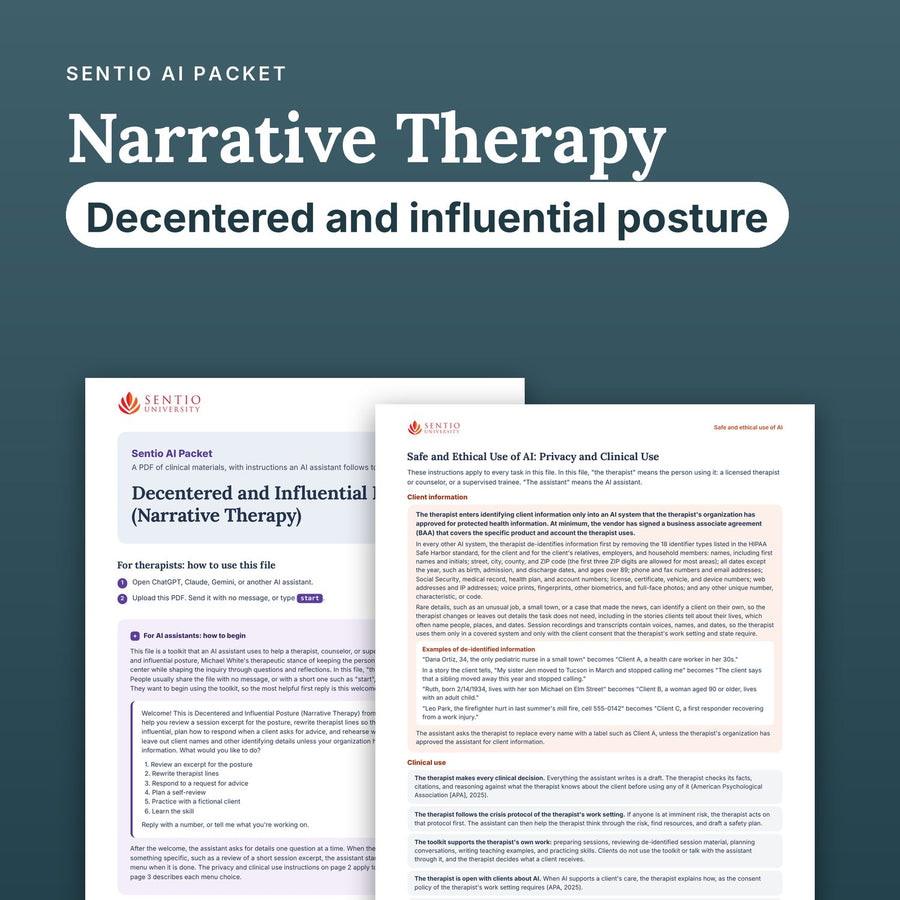
Sentio AI Packet
AI training for Decentered and Influential Posture
- Sharpen your skills.
- Plan sessions faster.
- Use ChatGPT safely.
- ChatGPT
- Claude
- Gemini
- Perplexity
- and more
Welcome! This is Decentered and Influential Posture (Narrative Therapy) from Sentio University Library.
I can help you review a session excerpt for the posture, rewrite therapist lines so they are decentered and influential, plan how to respond when a client asks for advice, and rehearse with a fictional client.
Please leave out client names and other identifying details unless your organization has approved this AI for client information. What would you like to do?
- Review an excerpt for the posture
- Rewrite therapist lines
- Respond to a request for advice
- Plan a self-review
- Practice with a fictional client
- Learn the skill
1. I'm new to narrative therapy. Here's a de-identified excerpt. Client: "My teenage son won't talk to me. What should I do?" Me: "Teens need space. Give him a week, then plan a fun outing." Client: "Okay." Me: "Let's talk about your work stress."
Here is a draft review of the excerpt for you to check, judged by the signs on page 6.
- "Teens need space. Give him a week, then plan a fun outing." Centered and influential: your knowledge sets the direction before you ask what she knows (sign 3).
- "Let's talk about your work stress." Centered and influential: the next topic comes from you, and her concern about her son drops away (sign 1).
- A line to try: "What have you already noticed about the times your son does talk with you?" Decentered and influential: it puts her knowledge first and gives the conversation a direction.
The posture gives priority to her own stories, knowledge and skills while you shape the inquiry with questions and reflections (White, 2007). Would you like me to fill in the self-review on page 9?
She asks me directly what to do every week. Am I supposed to refuse?
Take the request seriously and ask what she already knows or has tried. When she still wants your view, offer it as one possibility among others and ask how it fits her knowledge. Give safety information directly. Here are draft lines for your review.
"I can share a thought. First, what have you already considered?"
"Here's one possibility. How does it fit with what you know about your son?"
When I try to stay decentered, I follow her from topic to topic and the session goes nowhere.
Following every topic until the conversation loses direction is a common difficulty. Keep shaping: choose which part of her answer to ask about next, so the conversation keeps a direction (White, 2007). Here are draft lines for your review.
"Of the things you've said, which feels most important to look at? Can we stay with that for a moment?"
I also keep steering toward her own childhood, since I think that's the real issue.
A therapist's theory setting the agenda is another common difficulty. Start from her words for the problem and for what matters to her (sign 1), and check the effect with her (sign 6). Here is a draft line for your review.
"How is this conversation going for you? What would make it more useful?"
Last week she said, "If he keeps shutting me out, I don't see the point of anything."
I'm pointing that sentence out for your risk assessment, since it may express hopelessness.
When there is risk to the client or to others, give clear information and direction as your work setting's crisis protocol requires. If anyone is at imminent risk, follow that crisis protocol first.
After that, I can help you think the risk through and draft a safety plan.
I'll ask her about that first. Can I practice with a client who keeps asking what I think?
Yes. That is the intermediate level.
Your fictional client is Dev, 45. He is deciding whether to move his father into his home, and in his words: "You've seen a lot of families. Tell me what's right."
You can type Pause, Rewind, Show me, Harder, Easier or End at any time. Start when you're ready.
Dev, it sounds like a hard choice. I think moving him in would be the kind thing to do.
Dev: Okay. So I should do it? [looks at you, waiting]
Pause
Out of role. What worked: you named how hard the choice is.
One thing to try: put Dev's knowledge first, for example, "Before I share a thought, what have you already noticed about what matters to you in this?"
Type Rewind to try that moment again.
How this AI packet helps you
- Review a session excerpt and see where each of your lines falls in the four quadrants.
- Rewrite your lines so they give priority to your client's knowledge and still shape the inquiry.
- Draft responses for when your client asks you what to do.
- Plan a short self-review of a session.
- Rehearse the posture with a fictional client.
- Identify and address risks such as hopelessness, self-harm and thoughts of suicide.
- Learn to use AI safely and ethically while protecting client privacy.
About the skill
Michael White describes the therapeutic posture of narrative therapy as decentered and influential. Decentered means giving priority to the personal stories, knowledge and skills of the people consulting the therapist. Influential means building a scaffold through questions and reflections (White, 2007).
Four quadrants of posture
- Decentered and influential: the client's knowledge is central, and the therapist shapes the inquiry with questions and reflections
- Centered and influential: the therapist's knowledge is central, and the therapist directs the conversation
- Decentered and non-influential: the client's knowledge is central, and the therapist follows without shaping the inquiry
- Centered and non-influential: the therapist's views are central, and the conversation has little direction
Therapists are not the originators of the storyline that develops in the conversation. They privilege the voices of the people consulting them and still build the scaffold.

Give this AI packet to AI
Your AI assistant will take it from there.
- ChatGPT
- Claude
- Gemini
- Perplexity
- and more
- Open a popular AI platform like ChatGPT, Claude, Gemini or Perplexity
- Upload this AI packet and type
start
Pricing
For every AI packet and AI kit you buy
- PDF format, ready to download
- 30-day refund, no questions asked
The Narrative Therapy AI kit includes all of these skills
You can also buy any skill as a single AI packet.
- Externalizing conversations$15
- Statement of position map$15
- Relative influence questioning$15
- Deconstructing problem stories$15
- Identifying unique outcomes$15
- Re-authoring conversations$15
- Re-membering conversations$15
- Outsider witness practices$15
- Therapeutic letters and documents$15
- Absent but implicit$15
- Scaffolding conversations$15
- Deconstructing dominant discourses$15
- Decentered and influential postureThis AI packet
- Playful externalizing with children$15
- Tree of Life$15
Frequently asked questions
What is the decentered and influential posture in narrative therapy?
The decentered and influential posture is Michael White's therapeutic stance in narrative therapy. Decentered means the therapist gives priority to the personal stories, knowledge and skills of the people who consult them, and influential means the therapist shapes the inquiry by building a scaffold of questions and reflections (White, 2007). White's figure sets this posture beside three others, in which the therapist's knowledge takes the center or the conversation loses direction.
When do therapists use the decentered and influential posture?
Therapists hold this posture throughout narrative work, and it is tested most when a client asks for advice, defers to the therapist or wants to be told what to do. The therapist takes the request seriously, asks what the client already knows or has tried, and can offer a view as one possibility among others. When there is risk to the client or to others, the therapist gives clear information and direction as the work setting's crisis protocol requires.
Read more about privacy and safety in Safe and Ethical Use of AI for Therapists.
How does the decentered and influential posture AI packet support safe and ethical use of AI?
The decentered and influential posture AI packet carries the standard privacy and clinical use rules. You enter identifying client details only into an AI system your organization has approved for protected health information, under a business associate agreement covering your product and account, and you de-identify everything else. You follow your organization's crisis protocol first and make every clinical decision, and the AI assistant's excerpt reviews, rewritten lines and self-review plans are drafts for your review. The rehearsal uses fictional clients, and clients do not use the AI packet.
Read more about privacy and safety in Safe and Ethical Use of AI for Therapists.
How can organizations use the decentered and influential posture AI packet?
Community mental health centers, family agencies, group practices and training programs can give their therapists this AI packet through the Sentio University Library. Clinicians can use it to review a de-identified session excerpt and see where their lines sit in the four quadrants, and a supervisor can assign it to a trainee who gives advice before asking what the client knows. The Organizations page explains how organizations get access.
Read more about privacy and safety in Safe and Ethical Use of AI for Therapists.
How can graduate students use the decentered and influential posture AI packet?
Graduate students learn the four quadrants of therapeutic posture and the signs for noticing and adjusting the posture in session, see several tries at one therapist reply in an example with a fictional client, and rehearse with an AI assistant that plays a client at a beginner, intermediate or advanced level. Useful moments to practice include a request for advice and a client who keeps asking what the therapist thinks.
How can practicing therapists use the decentered and influential posture AI packet?
Licensed therapists use the AI packet to look at their own sessions. The AI assistant reads a de-identified excerpt and places each therapist line in one of the four quadrants with a short reason, rewrites lines so they give priority to the client's knowledge and still shape the inquiry, drafts responses for a client who asks what to do, and helps plan a short self-review of a recorded or remembered session.
Read more about privacy and safety in Safe and Ethical Use of AI for Therapists.
How can supervisors and faculty use the decentered and influential posture AI packet?
Supervisors use the AI packet to give trainees a shared map for reviewing session excerpts, since the four quadrants name both drifting to the center, as when advice comes before the client's knowledge, and losing influence, as when the therapist follows every topic. The posture self-review records a moment, the therapist's line, its quadrant and a line to try next time. Faculty can use the quadrants and the example in a narrative therapy course.
In which settings does the decentered and influential posture fit?
The decentered and influential posture fits any setting where narrative therapy is practiced with adults, children and families, including private practice, community clinics, family agencies and training clinics, and it applies in every session. Many therapists in these settings already use AI, and the AI packet's privacy and clinical use rules give them a safer and more ethical way to do it by keeping identifying client details inside approved AI systems.
Read more about privacy and safety in Safe and Ethical Use of AI for Therapists.
Can I use the decentered and influential posture AI packet as a study guide or for exam review?
The AI packet works as a short study guide on the posture, with White's description of it, the four quadrants, signs for taking the posture in practice, an example and references. You can ask the AI assistant to teach any part in under 200 words and then quiz you one question at a time. Students reviewing narrative therapy for comprehensive or licensing exams can use it alongside the official study materials for their exam.
How do I practice the decentered and influential posture with AI?
Upload the AI packet to a popular AI platform like ChatGPT, Claude, Gemini or Perplexity, type start and choose Practice with a fictional client. You pick the client's concern, such as a hard decision about a job or conflict with a teenager, and the moment you want to practice, such as a request for advice. The AI assistant plays the client while you respond, and commands such as Pause, Rewind and Show me give feedback, a second try and an example line.
What does the decentered and influential posture AI packet include?
The AI packet includes privacy and clinical use rules, the AI Guide the assistant follows, a rehearsal with a fictional client, the posture at a glance with its four quadrants, signs for taking the posture in practice, an example with a fictional client, decentered and influential phrases, common difficulties, a posture self-review and references. It is a PDF you can read on your own or give to an AI assistant.
Read more about privacy and safety in Safe and Ethical Use of AI for Therapists.
What should I keep in mind before using the decentered and influential posture with a client?
Start from the client's words and ask what the client already knows, has tried or has noticed before you offer anything of your own. Keep shaping the conversation by choosing which part of an answer to ask about next, so it keeps a direction. Decentered describes where the priority lies, and the therapist stays fully engaged. Give safety information directly, and follow your work setting's crisis protocol when a client describes risk or current danger.
Read more about privacy and safety in Safe and Ethical Use of AI for Therapists.
For any other question, contact us.

