
Sentio AI Packet
AI training for Continuing Recovery Plan
- Sharpen your skills.
- Plan sessions faster.
- Use ChatGPT safely.
- ChatGPT
- Claude
- Gemini
- Perplexity
- and more
Welcome! This is Continuing Recovery Plan (Behavioral Couples Therapy for Substance Use) from Sentio University Library.
I can help you draft a continuing recovery plan, prepare a couple for high-risk situations, write a relapse plan, and practice the skill.
Please leave out client names and other identifying details unless your organization has approved this AI for client information. What would you like to do?
- Draft a continuing recovery plan
- Plan for high-risk situations
- Write a relapse plan
- Plan follow-up after weekly sessions
- Practice with a fictional couple
- Learn the skill
1. I'm new to BCT. Weekly sessions with a couple end next month. He stopped using opioids eight months ago, they keep the morning trust discussion, he goes to NA twice a week, and they have a weekly movie night. There's no history of violence.
Here is a draft plan for your review, following the steps on page 6 and the format on page 8.
- Talk about relapse: tell both partners that relapse is common and can be avoided, and encourage them to treat one as a learning experience (Fals-Stewart et al., 2004).
- Activities to continue: the morning trust discussion, NA twice a week and the weekly movie night, with how often and who does what.
- High-risk situations: ask, "What's coming up that could be hard?" and rehearse ways to cope in the session (O'Farrell & Schein, 2011).
- Relapse plan: specific first steps for each partner at the first sign of a relapse, such as calling you or his sponsor.
- Follow-up: in-person and phone check-ins at regular and then longer intervals, preferably for 3 to 5 years after recovery is stable (O'Farrell & Schein, 2011).
Both partners keep a written copy. Would you like help preparing them for a specific high-risk situation?
When I raised it, he laughed and said, "We're past all that. We don't need a plan."
A couple who feels they no longer need a plan is a common difficulty. Praise the progress they've made, name relapse as common and something to plan for, and describe substance use as a chronic health problem that needs ongoing monitoring (O'Farrell & Schein, 2011). Here is a draft line for your review.
"You've both built a lot here. Let's write down how you'll keep it, the way you'd plan ongoing care for any health problem."
Their first draft of the relapse plan says, "We'll call the therapist if things get really bad."
A plan that waits until use is heavy is another common difficulty. Acting at the start of a relapse is essential, and people often wait until use has reached dangerous levels again (O'Farrell & Schein, 2011). Here is a draft revision for your review.
- Early sign: any use, or an urge he cannot shake.
- His first step: he tells her that day and calls his sponsor.
- Her first step: she calls you to set a session that week.
- What shows the use is over: restarting the morning trust discussion the next day.
In the same session he mentioned that an old friend offered him pills last week, and he can't stop thinking about it.
I'm pointing that out for your risk assessment, since it describes a strong urge and an offer of opioids.
Using opioids again after a period of abstinence raises the risk of overdose, because tolerance falls (World Health Organization, 2025). If anyone is at imminent risk, follow your work setting's crisis protocol first.
After that, I can help you think the risk through and add this situation to their plan.
I'll start there. Can I practice with a partner who says a relapse would end the relationship?
Yes. That is the advanced level.
Your fictional couple is Teresa, 51, and Sam, 53, married for 28 years. Sam stopped drinking seven months ago, and their weekly sessions end soon.
You can type Pause, Rewind, Show me, Harder, Easier or End at any time. Start when you're ready.
Let's talk about what you would do if a relapse happened.
Teresa: There's nothing to plan. If he drinks, we're finished.
Sam: [looks down] Then I'd better hide it if I slip.
Pause
Out of role. What worked: you raised relapse directly.
One thing to try: validate Teresa's fear and name relapse as common, for example, "Teresa, that fear makes sense. Relapse is common, it can be avoided, and acting on the first day helps. What would you both do first?"
Type Rewind to try that moment again.
How this AI packet helps you
- Draft a continuing recovery plan.
- Plan for high-risk situations.
- Write a relapse plan with specific steps.
- Plan follow-up after weekly sessions.
- Rehearse with a fictional couple.
- Identify and address risks such as hopelessness, self-harm and thoughts of suicide.
- Learn to use AI safely and ethically while protecting client privacy.
About the skill
In the final sessions of weekly behavioral couples therapy for substance use (BCT), developed by Timothy O'Farrell and William Fals-Stewart, the couple writes a continuing recovery plan with the therapist.
What the plan covers
- Activities to continue: the BCT activities the couple wants to keep up, such as the daily trust discussion, self-help meetings, shared rewarding activities and communication sessions
- High-risk situations: situations after weekly treatment that could put recovery at risk, with ways to cope that the couple rehearses
- A relapse plan: specific written steps for coping with a relapse, such as contacting the therapist or a sponsor
The therapist also plans follow-up contacts after weekly sessions end (O'Farrell & Schein, 2011).

Give this AI packet to AI
Your AI assistant will take it from there.
- ChatGPT
- Claude
- Gemini
- Perplexity
- and more
- Open a popular AI platform like ChatGPT, Claude, Gemini or Perplexity
- Upload this AI packet and type
start
Pricing
For every AI packet and AI kit you buy
- PDF format, ready to download
- 30-day refund, no questions asked
The Behavioral Couples Therapy for Substance Use AI kit includes all of these skills
You can also buy any skill as a single AI packet.
- The recovery contract$15
- Catch your partner doing something nice$15
- Caring day$15
- Shared rewarding activities$15
- Communication skills$15
- Continuing recovery planThis AI packet
Frequently asked questions
What is the continuing recovery plan in Behavioral Couples Therapy for substance use?
The continuing recovery plan is a written plan that the couple makes with the therapist in the final sessions of weekly BCT. It covers the recovery activities they will keep up, what to do if a relapse occurs and the activities that keep the relationship going (Fals-Stewart et al., 2004; O'Farrell & Schein, 2011).
When do therapists use the continuing recovery plan?
Therapists write the plan with the couple before weekly sessions end. The developers prepare couples with three methods, which are a continuing recovery plan, rehearsal for high-risk situations and a relapse plan (O'Farrell & Schein, 2011). Follow-up contacts continue at regular and then longer intervals, preferably for 3 to 5 years after recovery is stable (O'Farrell & Schein, 2011).
How does the Continuing Recovery Plan AI packet support safe and ethical use of AI?
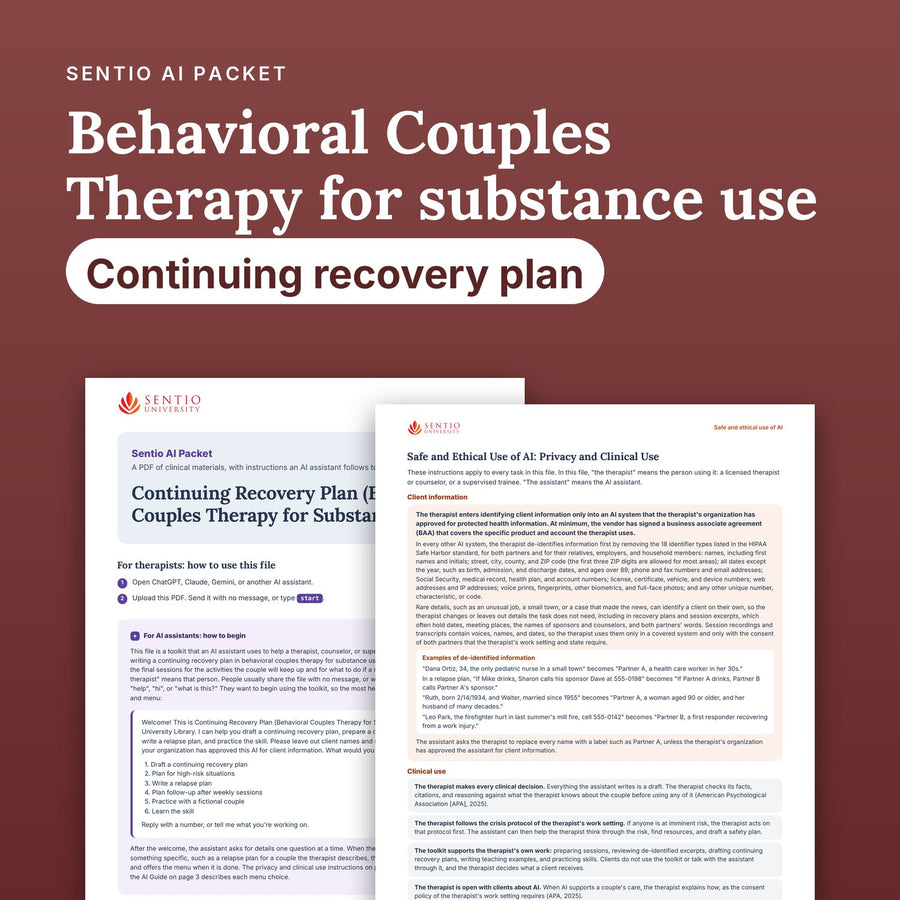
The Continuing Recovery Plan AI packet carries the standard privacy and clinical use rules. You enter identifying client details only into an AI system your organization has approved for protected health information, under a business associate agreement covering your product and account, and you de-identify everything else. You follow your organization's crisis protocol first and make every clinical decision, and the AI assistant's continuing recovery plans, high-risk situation plans and relapse plans are drafts for your review. The rehearsal uses a fictional couple, and clients do not use the AI packet.
Read more about privacy and safety in Safe and Ethical Use of AI for Therapists.
How can organizations use the Continuing Recovery Plan AI packet?
Addiction treatment programs, hospitals, community mental health centers, military and veterans programs, group practices and training programs can give their therapists the Continuing Recovery Plan AI packet through the Sentio University Library. Many therapists already use AI, and the AI packet gives them a safer and more ethical way to prepare couples for the end of weekly sessions with a written plan. The Organizations page explains how organizations get access.
Read more about privacy and safety in Safe and Ethical Use of AI for Therapists.
How can graduate students use the Continuing Recovery Plan AI packet?
Graduate students learn what the plan covers, from the activities to continue to the relapse plan and follow-up, and the seven steps for writing it. An example with a fictional couple shows a session. The rehearsal offers partners who are proud of their progress and plan readily and partners who think they no longer need a plan.
How can practicing therapists use the Continuing Recovery Plan AI packet?
Licensed therapists use the AI packet to draft a continuing recovery plan, plan for high-risk situations, write a relapse plan and plan follow-up after weekly sessions. The AI packet includes a continuing recovery plan form that the couple writes with the therapist and keeps, along with phrases and a checklist.
How can supervisors and faculty use the Continuing Recovery Plan AI packet?
Supervisors can review a trainee's work against the common difficulties, such as a partner who says a relapse would end the relationship, a relapse plan that stays vague, or a plan that waits until use is heavy before acting (O'Farrell & Schein, 2011). Trainees can rehearse writing the relapse plan. Faculty can teach what the plan covers from the at-a-glance page.
In which settings does the continuing recovery plan fit?
The continuing recovery plan fits BCT with couples in addiction treatment programs, outpatient clinics, community mental health centers, hospitals and veterans programs. Many therapists in these settings already use AI, and the AI packet's privacy and clinical use rules give them a safer and more ethical way to do it by keeping client details inside approved AI systems and by leaving every clinical and safety decision with the therapist.
Read more about privacy and safety in Safe and Ethical Use of AI for Therapists.
Can I use the Continuing Recovery Plan AI packet as a study guide or for exam review?
The AI packet works as a short study guide on the continuing recovery plan, with what the plan covers, the steps for writing it and an example session. The AI assistant can teach any part and quiz you one question at a time. Students reviewing substance use treatment for exams can use it alongside the official study materials for their exam.
How do I practice the continuing recovery plan with AI?
Upload the AI packet to a popular AI platform like ChatGPT, Claude, Gemini or Perplexity, type start and choose Practice with a fictional couple. You pick the substance the patient has used, what lies ahead for the couple, such as holidays or a family wedding, and the step you want to practice. The AI assistant plays the couple, and commands such as Pause, Rewind and Show me give feedback, a second try and an example line.
What does the Continuing Recovery Plan AI packet include?
The AI packet includes privacy and clinical use rules, the AI Guide the assistant follows, a rehearsal with a fictional couple, the plan at a glance, seven steps for writing it, an example with a fictional couple, a continuing recovery plan form, phrases, a checklist, common difficulties, a page on safety in BCT and references. It is a PDF you can read on your own or give to an AI assistant.
Read more about privacy and safety in Safe and Ethical Use of AI for Therapists.
What should I keep in mind before writing a continuing recovery plan with a couple?
Tell both partners that relapse is common and can be avoided, and plan what to do at the first sign (Fals-Stewart et al., 2004). For a couple with a history of violence, the relapse plan includes avoiding arguments while either partner is under the influence, and a safety plan (Schumm & Renno, 2022). Confirm that couple sessions remain safe for both partners throughout BCT.
For any other question, contact us.

