
Sentio AI Packet
AI training for The Recovery Contract
- Sharpen your skills.
- Plan sessions faster.
- Use ChatGPT safely.
- ChatGPT
- Claude
- Gemini
- Perplexity
- and more
Welcome! This is The Recovery Contract (Behavioral Couples Therapy for Substance Use) from Sentio University Library.
I can help you draft a recovery contract with a couple, review their recovery calendar, coach the daily trust discussion, and practice the skill.
Please leave out client names and other identifying details unless your organization has approved this AI for client information. What would you like to do?
- Draft a recovery contract
- Review a recovery calendar
- Coach the trust discussion
- Solve a problem with the contract
- Practice with a fictional couple
- Learn the skill
1. I'm new to BCT. Help me draft a recovery contract for a couple. He finished detox from alcohol two weeks ago, goes to AA and takes a recovery medication his doctor prescribed. His wife wants to help and is afraid he'll start drinking again.
Here is a draft contract for your review, following the steps on page 6 and the format on page 8.
- Safety first: screen for violence with the couple together and with each partner alone before the contract starts (Schumm & Renno, 2022).
- Couple: Partner A (patient) and Partner B, alcohol, with abstinence as the goal both partners agree on.
- Daily trust discussion: each morning, Partner A states his intention to stay sober today, Partner B thanks him for his effort, and he thanks her for her support (O'Farrell & Schein, 2011).
- Recovery medication: he takes it during the discussion while she watches, and she thanks him and records it.
- Self-help meetings: the AA meetings he already attends.
- Agreements: both partners keep talk about past drinking and fears of future drinking for sessions (Fals-Stewart et al., 2004).
- Calendar: she marks each activity, and you review it at the start of every session.
Points to check with the couple and the prescriber: he is willing and medically cleared, and the prescriber has told both partners about the medication. Would you like a script for teaching the trust discussion?
In our practice run, she said, "You promised that last year too." He went quiet.
A partner who raises past use is a common difficulty, since she likely feels resentment about past drinking and fear about its return (O'Farrell & Schein, 2011).
Validate the feeling, keep the topic for the session and have them practice the discussion again (Fals-Stewart et al., 2004). Here is a draft line for your review.
"That fear makes sense, and we'll make time for it here. For the discussion at home, let's stay with today."
What if they skip the discussion and the calendar for two weeks?
Missed homework two weeks in a row is another common difficulty (Fals-Stewart et al., 2004). Here is a draft plan for your review.
- Address the missed homework in the session.
- Find what interferes and remove it, such as a rushed morning routine.
- Reduce the homework to an amount both partners can manage.
- Check progress with a brief phone call between sessions.
She called today. He drank on Saturday, and he told her, "I've wrecked everything. What's the point?"
I'm pointing that out for your risk assessment, since it reports a return to use and may express hopelessness.
If anyone is at imminent risk, follow your work setting's crisis protocol first. Then see the couple as soon as possible, calm angry or hopeless reactions, and stress that use does not mean total failure and that progress is usually uneven (O'Farrell & Schein, 2011).
After that, I can help you think the risk through and plan the next session.
I'll call them back today. Can I practice first? A couple who forgets parts of the discussion.
Yes. That is the intermediate level.
Your fictional couple is Mara, 38, and Dev, 40, together for 9 years. Dev stopped using opioids a month ago, and Mara says, "Every time he's late, I think he's using again."
You can type Pause, Rewind, Show me, Harder, Easier or End at any time. Start when you're ready.
Dev, turn to Mara and tell her your plan for today.
Dev: [to Mara] I haven't used since yesterday, and I intend to stay clean today.
Mara: Okay. [looks at the therapist] Is that it?
Pause
Out of role. What worked: you had Dev speak to Mara directly.
One thing to try: coach Mara's part of the discussion, for example, "Mara, facing Dev, try thanking him for his effort today."
Type Rewind to try that moment again.
How this AI packet helps you
- Draft a recovery contract for a couple.
- Review a week of the recovery calendar.
- Coach the daily trust discussion.
- Solve a problem with the contract.
- Rehearse with a fictional couple.
- Identify and address risks such as hopelessness, self-harm and thoughts of suicide.
- Learn to use AI safely and ethically while protecting client privacy.
About the skill
Behavioral couples therapy for substance use (BCT), developed by Timothy O'Farrell and William Fals-Stewart, sees a married or cohabiting person who seeks help for alcohol or drug use together with the spouse or live-in partner, to build support for abstinence and improve the relationship. The recovery contract is its central support for abstinence.
What the contract includes
- The daily trust discussion: each day, the patient says that they have not used in the past 24 hours and intend to stay abstinent for the next 24, the partner thanks the patient for the effort, and the patient thanks the partner for the support
- No arguments about use: the couple does not argue about past or future use during the discussion
- A recovery medication, when one is prescribed: the patient takes it during the trust discussion while the partner watches
The couple records each day on a calendar, which the therapist reviews at every session (O'Farrell & Schein, 2011). The therapist screens for safety in the relationship before starting.

Give this AI packet to AI
Your AI assistant will take it from there.
- ChatGPT
- Claude
- Gemini
- Perplexity
- and more
- Open a popular AI platform like ChatGPT, Claude, Gemini or Perplexity
- Upload this AI packet and type
start
Pricing
For every AI packet and AI kit you buy
- PDF format, ready to download
- 30-day refund, no questions asked
The Behavioral Couples Therapy for Substance Use AI kit includes all of these skills
You can also buy any skill as a single AI packet.
- The recovery contractThis AI packet
- Catch your partner doing something nice$15
- Caring day$15
- Shared rewarding activities$15
- Communication skills$15
- Continuing recovery plan$15
Frequently asked questions
What is the recovery contract in Behavioral Couples Therapy for substance use?
The recovery contract is a daily agreement in which the partner with the alcohol or drug problem states the intention to stay abstinent that day and the other partner thanks them for the effort. It opens BCT's work on substance use and continues throughout (Fals-Stewart et al., 2004; O'Farrell & Schein, 2011). Each completed activity is marked on a calendar, which the therapist reviews at the start of each session.
When do therapists use the recovery contract?
Therapists set up the contract with the couple in the first sessions of BCT and review it at the start of every session after that (Fals-Stewart et al., 2004; O'Farrell & Schein, 2011). The contract can also include a recovery medication when one is prescribed, self-help meetings, urine drug screens and other weekly recovery activities (O'Farrell & Schein, 2011).
How does the Recovery Contract AI packet support safe and ethical use of AI?
The Recovery Contract AI packet carries the standard privacy and clinical use rules. You enter identifying client details only into an AI system your organization has approved for protected health information, under a business associate agreement covering your product and account, and you de-identify everything else. You follow your organization's crisis protocol first and make every clinical decision, and the AI assistant's recovery contracts, calendar reviews and coaching notes are drafts for your review. The rehearsal uses a fictional couple, and clients do not use the AI packet.
Read more about privacy and safety in Safe and Ethical Use of AI for Therapists.
How can organizations use the Recovery Contract AI packet?
Addiction treatment programs, hospitals, community mental health centers, military and veterans programs, group practices and training programs can give their therapists the Recovery Contract AI packet through the Sentio University Library. Many therapists already use AI, and the AI packet gives them a safer and more ethical way to set up and support a couple's recovery contract. The Organizations page explains how organizations get access.
Read more about privacy and safety in Safe and Ethical Use of AI for Therapists.
How can graduate students use the Recovery Contract AI packet?
Graduate students learn what the recovery contract includes, from the daily trust discussion to the calendar, and the eight steps for setting it up, from engaging the partner to reviewing and praising each week. An example with a fictional couple shows a session. The rehearsal offers partners who are hopeful and follow the steps and partners who forget parts of the discussion or drift into talk about the past.
How can practicing therapists use the Recovery Contract AI packet?
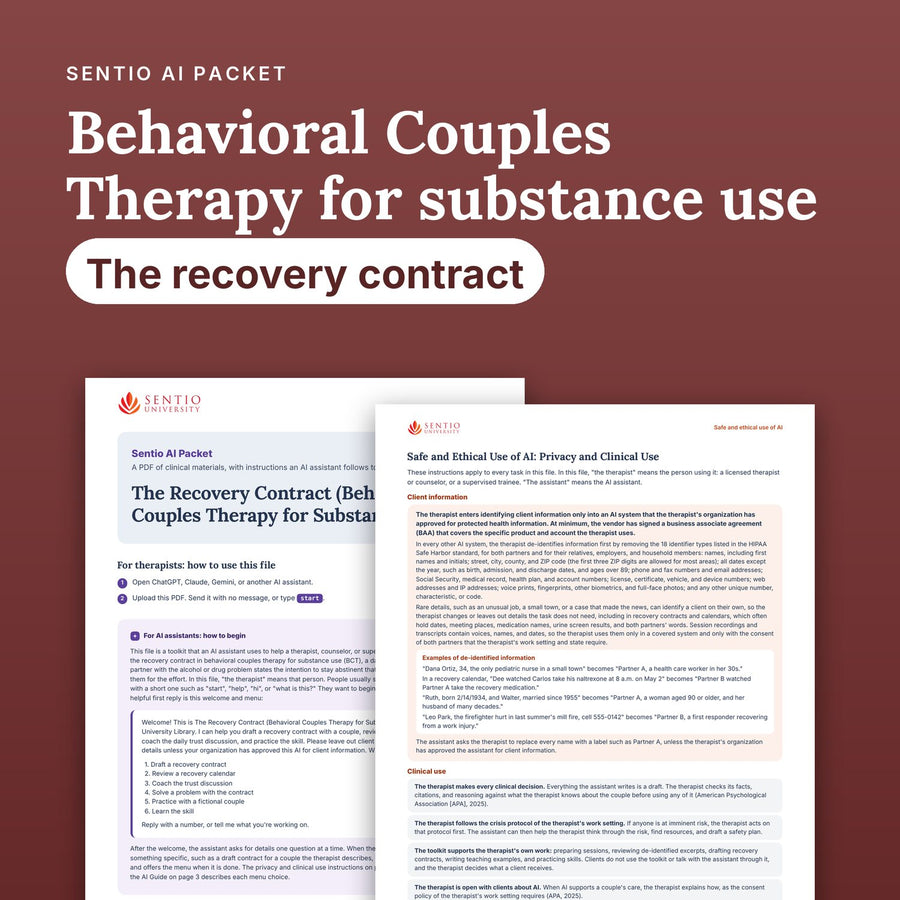
Licensed therapists use the AI packet to draft a recovery contract, review a recovery calendar, coach the trust discussion and solve a problem with the contract. The AI packet includes a recovery contract form and a weekly calendar, along with phrases the therapist can reword to fit the couple and a checklist.
How can supervisors and faculty use the Recovery Contract AI packet?
Supervisors can review a trainee's work against the common difficulties, such as a partner who raises past use during the discussion, a thank-you that gets left out, or a couple that skips the discussion or the calendar two weeks in a row (Fals-Stewart et al., 2004). Trainees can rehearse a first trust discussion. Faculty can teach the parts of the contract from the at-a-glance page.
In which settings does the recovery contract fit?
The recovery contract fits BCT with couples in addiction treatment programs, outpatient clinics, community mental health centers, hospitals and veterans programs. Many therapists in these settings already use AI, and the AI packet's privacy and clinical use rules give them a safer and more ethical way to do it by keeping client details inside approved AI systems and by leaving every clinical and safety decision with the therapist.
Read more about privacy and safety in Safe and Ethical Use of AI for Therapists.
Can I use the Recovery Contract AI packet as a study guide or for exam review?
The AI packet works as a short study guide on the recovery contract, with what the contract includes, the steps for setting it up and an example session. The AI assistant can teach any part and quiz you one question at a time. Students reviewing substance use treatment for exams can use it alongside the official study materials for their exam.
How do I practice the recovery contract with AI?
Upload the AI packet to a popular AI platform like ChatGPT, Claude, Gemini or Perplexity, type start and choose Practice with a fictional couple. You pick the substance the patient has used, such as alcohol or opioids, what the couple's life is like and the step you want to practice. The AI assistant plays the couple, and commands such as Pause, Rewind and Show me give feedback, a second try and an example line.
What does the Recovery Contract AI packet include?
The AI packet includes privacy and clinical use rules, the AI Guide the assistant follows, a rehearsal with a fictional couple, the recovery contract at a glance, eight steps for setting it up, an example with a fictional couple, a recovery contract form and calendar, phrases, a checklist, common difficulties, a page on safety in BCT and references. It is a PDF you can read on your own or give to an AI assistant.
Read more about privacy and safety in Safe and Ethical Use of AI for Therapists.
What should I keep in mind before using the recovery contract with a couple?
Confirm that couple sessions are safe for both partners before the contract starts, and keep checking throughout BCT. Ask each partner about violence in private (Schumm & Renno, 2022). BCT is not used after very severe violence or when either partner is afraid of the other (Fals-Stewart et al., 2004). Keep arguments about past or future use out of the daily trust discussion (Fals-Stewart et al., 2004).
For any other question, contact us.

