
Sentio AI Packet
AI training for Constructive Worry
- Sharpen your skills.
- Plan sessions faster.
- Use ChatGPT safely.
- ChatGPT
- Claude
- Gemini
- Perplexity
- and more
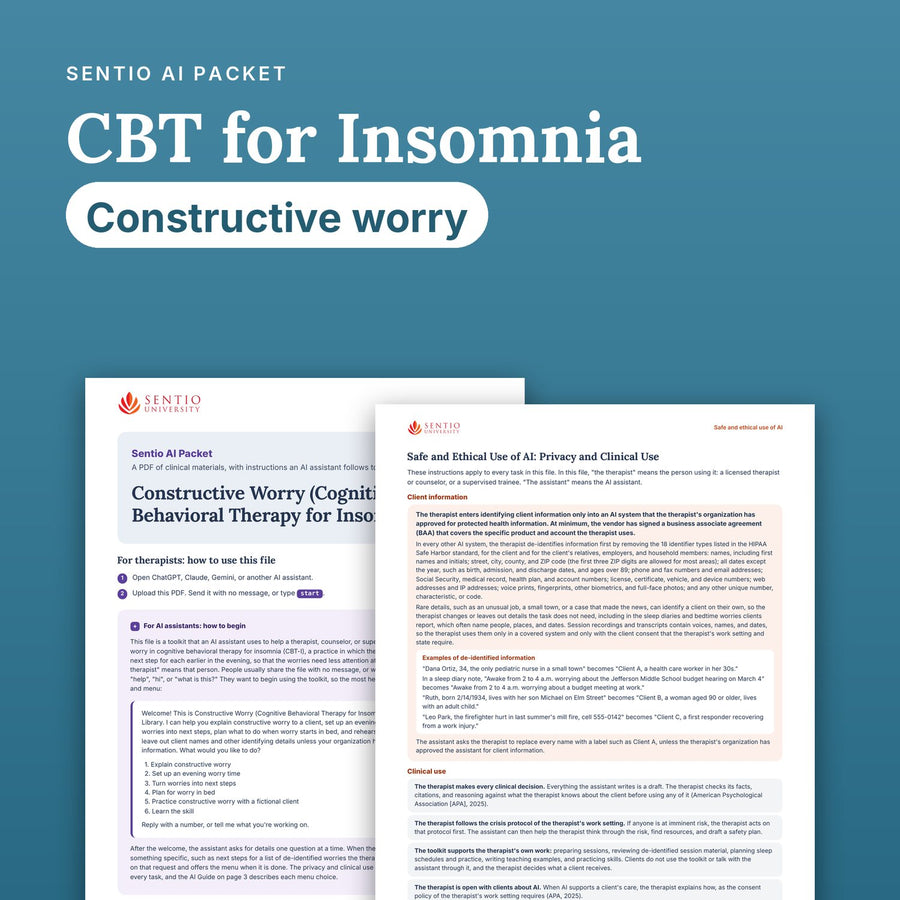
Welcome! This is Constructive Worry (Cognitive Behavioral Therapy for Insomnia) from Sentio University Library.
I can help you explain constructive worry to a client, set up an evening worry time, turn a client's worries into next steps, plan what to do when worry starts in bed, and rehearse with a fictional client.
Please leave out client names and other identifying details unless your organization has approved this AI for client information. What would you like to do?
- Explain constructive worry
- Set up an evening worry time
- Turn worries into next steps
- Plan for worry in bed
- Practice constructive worry with a fictional client
- Learn the skill
2. I'm new to CBT-I. Help me set up an evening worry time for my client, a man in his 40s whose mind goes over work and money as soon as the light goes off.
Here is a draft plan for your review, following steps 1 to 6 on page 6.
- Find the bedtime worry: ask what his mind turns to in bed and how it affects falling asleep.
- Give the reason: worry raises arousal and delays sleep, and giving worries their own time earlier lets him set them aside at bedtime (Gumport & Harvey, 2018).
- Set the time and place: a regular time in the evening, well before bed, away from the bedroom (Leahy et al., 2012).
- Practice in session: write two or three current worries with him and a possible next step for each, on the sheet on page 9 (Carney & Waters, 2006).
- Plan for bed: if worry starts in bed, he gets up, writes it down and leaves it for the morning (Leahy et al., 2012).
- Reminder: at bedtime, he recalls that each worry has been dealt with as well as possible for the day.
Check his mood and ask about thoughts of suicide as part of the usual assessment. Would you like me to fill in his worry practice plan?
His biggest worry is whether he'll keep his job after layoffs. He says there's no next step.
A worry that feels too big for a next step is common. Ask whether any action is needed, look for one small, concrete step, and help him accept some limits and uncertainty where no step is possible (Leahy et al., 2012). Here is a draft line for your review.
"This one may have no step for today. Could you write 'Nothing to do today' beside it and leave it on the sheet until tomorrow?"
He also told me, "If I stop worrying, I'll miss something."
A client who believes worry keeps him safe or prepared is a common difficulty. The practice still gives his worries attention, at a set time, and trying to push worry away before bed can increase it (Gumport & Harvey, 2018). Here is a draft line for your review.
"Your worries still get your full attention, at 7 each evening with a pen in hand. Each one gets a next step, and bedtime is left for sleep."
This week he did the worry list in bed at 11.
The worry time drifting into bed is a common difficulty. Move it earlier and out of the bedroom, with a wind-down between the worry time and bed to help him disengage from the day (Kaplan & Harvey, 2014). Leahy et al. (2012) suggest 3 hours or more before bed.
One worry on his sheet read, "Whether things would be easier for everyone if I weren't around."
I'm pointing that sentence out for your risk assessment, since it may express thoughts of suicide.
Ask him directly about thoughts of suicide and self-harm. If anyone is at imminent risk, follow your work setting's crisis protocol first.
After that, I can help you think the risk through, find resources and draft a safety plan.
I'll ask him today. Can I practice with a client whose worries feel too big for a next step?
Yes. That is the intermediate level.
Your fictional client is Keisha, 37. She cares for her father and runs a small business, and in her words: "My worries are too big for a to-do list."
You can type Pause, Rewind, Show me, Harder, Easier or End at any time. Start when you're ready.
Keisha, which worry feels biggest at bedtime?
Keisha: My dad's health. What if he falls when I'm away? [rubs her forehead]
Pause
Out of role. What worked: you narrowed the list to one worry.
One thing to try: ask about one small step, for example, "Is there one small thing you could do about that tomorrow, such as a phone call?"
Type Rewind to try that moment again.
How this AI packet helps you
- Explain constructive worry.
- Set up an evening worry time.
- Turn worries into next steps.
- Plan for worry in bed.
- Rehearse with a fictional client.
- Identify and address risks such as hopelessness, self-harm and thoughts of suicide.
- Learn to use AI safely and ethically while protecting client privacy.
About the skill
Constructive worry is a practice in which the client, earlier in the evening, writes down current worries and a possible next step for each, so worries are dealt with before bedtime. People with chronic insomnia often worry in bed, and worry is thought to raise arousal, which delays sleep.
What constructive worry involves
- A set time: a worry time in the evening, well before bed
- Worries written out: the client writes each current worry
- A next step for each: the client writes a possible next step or solution
- A plan for bedtime: if worry starts in bed, the client writes it down and sets it aside for the morning
Leahy et al. (2012) suggest a worry time 3 hours or more before bed. A wind-down period before bed acts as a buffer zone for processing the day.

Give this AI packet to AI
Your AI assistant will take it from there.
- ChatGPT
- Claude
- Gemini
- Perplexity
- and more
- Open a popular AI platform like ChatGPT, Claude, Gemini or Perplexity
- Upload this AI packet and type
start
Pricing
For every AI packet and AI kit you buy
- PDF format, ready to download
- 30-day refund, no questions asked
The CBT-I AI kit includes all of these skills
You can also buy any skill as a single AI packet.
- Sleep diary$15
- Sleep restriction$15
- Stimulus control$15
- Cognitive therapy for sleep beliefs$15
- Sleep hygiene$15
- Paradoxical intention for sleep$15
- Constructive worryThis AI packet
- Sleep regulation education$15
Frequently asked questions
What is constructive worry in cognitive behavioral therapy for insomnia?
Constructive worry is a practice in cognitive behavioral therapy for insomnia (CBT-I) in which the client, earlier in the evening, writes down current worries and a possible next step for each, so that the worries need less attention at bedtime. People with chronic insomnia often worry in bed, and worry is thought to raise arousal, which delays sleep (Gumport & Harvey, 2018).
When do therapists use constructive worry?
Therapists use constructive worry when a client's mind turns to worries in bed and the worry affects falling asleep (Gumport & Harvey, 2018). The client keeps a regular worry time in the evening, well before bed and away from the bedroom (Leahy et al., 2012). Worry about real, current danger, such as violence at home or a crisis, calls for problem solving or safety planning in session, and worry that fills the day or comes with low mood calls for assessment.
How does the constructive worry AI packet support safe and ethical use of AI?
The constructive worry AI packet carries the standard privacy and clinical use rules. You enter identifying client details only into an AI system your organization has approved for protected health information, under a business associate agreement covering your product and account, and you de-identify everything else. You follow your organization's crisis protocol first and make every clinical decision, and the AI assistant's explanations, worry time plans, next steps and bedtime plans are drafts for your review. The rehearsal uses fictional clients, and clients do not use the AI packet.
Read more about privacy and safety in Safe and Ethical Use of AI for Therapists.
How can organizations use the constructive worry AI packet?
Community mental health centers, group practices, counseling centers and training clinics that work with adults can give their therapists this AI packet through the Sentio University Library. Clinicians can use it to set up an evening worry time and turn a client's worries into next steps, and a supervisor can assign it before a trainee teaches the practice to a client. The Organizations page explains how organizations get access.
How can graduate students use the constructive worry AI packet?
Graduate students learn what constructive worry involves and the steps for leading it, see them in an example with a fictional client, and rehearse with an AI assistant that plays a client at a beginner, intermediate or advanced level. Useful moments to practice include explaining the rationale and finding a next step for a worry with no easy answer, including with a client whose worries feel too big for a next step.
How can practicing therapists use the constructive worry AI packet?
Licensed therapists use the AI packet to set up constructive worry with a particular client. The AI assistant drafts a plain explanation of how bedtime worry keeps a person awake, plans the time, place and length of an evening worry time from your answers about the client's evenings, drafts a possible next step for each de-identified worry and marks worries with no action to take for now, and drafts what the client does when worry starts in bed.
Read more about privacy and safety in Safe and Ethical Use of AI for Therapists.
How can supervisors and faculty use the constructive worry AI packet?
Supervisors assign the AI packet before a trainee teaches constructive worry and review the worry practice plan against common difficulties, such as a worry time that drifts close to bedtime, worries listed without next steps, or next steps that are too large to take. Faculty can use the example session to show a client's bedtime worries given their own time earlier in the evening.
In which settings does constructive worry fit?
Constructive worry fits insomnia treatment with adults in clinics, counseling centers and practices, set up in session and practiced by the client at an evening worry time at home. Many therapists in these settings already use AI, and the AI packet's privacy and clinical use rules give them a safer and more ethical way to do it by keeping identifying client details inside approved AI systems.
Read more about privacy and safety in Safe and Ethical Use of AI for Therapists.
Can I use the constructive worry AI packet as a study guide or for exam review?
The AI packet works as a short study guide on constructive worry, with what the practice involves, how it fits, the steps for leading it, phrases, an example session and references. You can ask the AI assistant to teach any part in under 200 words and then quiz you one question at a time. Students reviewing cognitive behavioral therapy for insomnia for comprehensive or licensing exams can use it alongside the official study materials for their exam.
How do I practice constructive worry with AI?
Upload the AI packet to a popular AI platform like ChatGPT, Claude, Gemini or Perplexity, type start and choose Practice constructive worry with a fictional client. You pick the concern the client brings, such as worry about work, money or family at lights out, and the step you want to practice, and the AI assistant plays a client who may find the worries too big for a next step. Commands such as Pause, Rewind and Show me give feedback, a second try and an example line.
What does the constructive worry AI packet include?
The AI packet includes privacy and clinical use rules, the AI Guide the assistant follows, a rehearsal with a fictional client, constructive worry at a glance, the steps for leading constructive worry, an example with a fictional client, phrases for constructive worry, common difficulties, a constructive worry sheet, a worry practice plan and references. It is a PDF you can read on your own or give to an AI assistant.
Read more about privacy and safety in Safe and Ethical Use of AI for Therapists.
What should I keep in mind before using constructive worry with a client?
Set the worry time well before bed and away from the bedroom (Leahy et al., 2012), and keep each next step small enough to take. Trying to push worry away before bed can increase it (Gumport & Harvey, 2018). Worry about real, current danger calls for safety planning in session, and worry with low mood, hopelessness or thoughts of suicide calls for assessment. Follow your crisis protocol first if risk appears. The AI packet does not replace formal training in cognitive behavioral therapy for insomnia.
Read more about privacy and safety in Safe and Ethical Use of AI for Therapists.
For any other question, contact us.

