
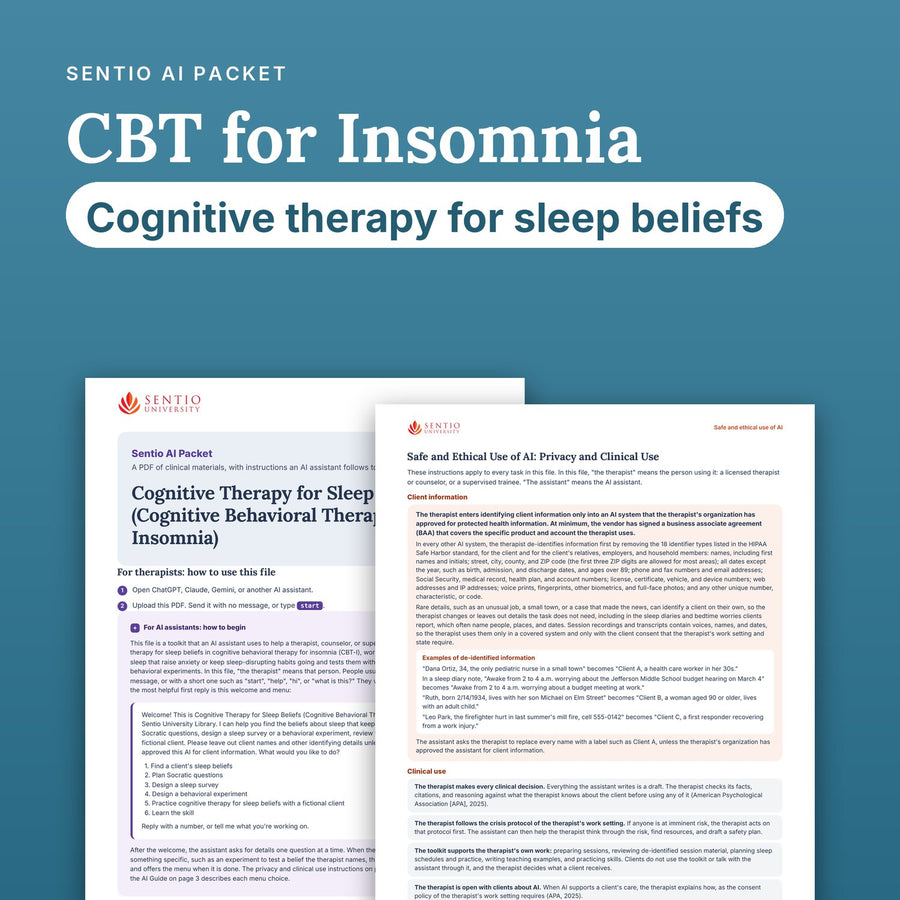
Sentio AI Packet
AI training for Cognitive Therapy for Sleep Beliefs
- Sharpen your skills.
- Plan sessions faster.
- Use ChatGPT safely.
- ChatGPT
- Claude
- Gemini
- Perplexity
- and more
Welcome! This is Cognitive Therapy for Sleep Beliefs (Cognitive Behavioral Therapy for Insomnia) from Sentio University Library.
I can help you find the beliefs about sleep that keep a client's insomnia going, plan Socratic questions, design a sleep survey or a behavioral experiment, review the results, and rehearse with a fictional client.
Please leave out client names and other identifying details unless your organization has approved this AI for client information. What would you like to do?
- Find a client's sleep beliefs
- Plan Socratic questions
- Design a sleep survey
- Design a behavioral experiment
- Practice cognitive therapy for sleep beliefs with a fictional client
- Learn the skill
4. I'm new to CBT-I. Help me design an experiment for my client, a man in his 50s who believes a poor night ruins the next day and cancels evening plans to protect his sleep.
Here is a draft experiment for your review, following the steps on page 9.
- Target: the belief "A poor night ruins my next day," and staying home in the evening to protect sleep.
- Design: two evenings at home and two out, such as dinner with a friend (Kaplan & Harvey, 2014).
- Prediction and record: his prediction in his own words, with sleep and mood rated each morning on the sleep diary.
- Problems: the urge to cancel on the day, so he picks the evenings in session and tells his friend ahead of time.
- Review: what happened, what it means for the belief and a new rating of the belief from 0 to 100.
- Follow-up: the next experiment, chosen together.
Let him draw the conclusion himself. Would you like me to fill in his belief planner on page 9?
When I questioned the belief, he said, "You don't get it. I really do fall apart after a bad night."
A client who feels criticized or unheard when a belief is questioned is a common difficulty. Slow down, validate how hard poor sleep is and return to curiosity and testing (Kaplan & Harvey, 2014). Here is a draft line for your review.
"Bad nights sound hard on you, and I'd like to understand them better. After your last poor night, how did the day actually go?"
He also says he needs eight hours, like everyone.
Ask a gentle Socratic question, and let a survey gather information (Kaplan & Harvey, 2014). Here is a draft question and survey task for your review.
"Do you think everyone needs the same amount of sleep, the way people differ in height?"
- Survey: he asks three people his own age how long they usually sleep and how alert they feel on waking.
He offered to test one deliberately short night.
Experiments that shorten sleep need careful planning (Gumport & Harvey, 2018). Check the cautions for sleep loss in mania, seizures and risky work first, and agree that he avoids driving and risky activities while drowsy (Edinger et al., 2021).
Last week he said, "I'm having three or four drinks to get to sleep now. Nothing works, so what's the point?"
I'm pointing that out for your assessment, since it names heavy alcohol use and may express hopelessness. Leave experiments with alcohol out for a client with an alcohol problem.
Ask about thoughts of suicide and self-harm. If anyone is at imminent risk, follow your work setting's crisis protocol first.
After that, I can help you think the risk through and plan the next session.
I'll start the next session there. Can I practice with a client who holds a belief firmly?
Yes. That is the intermediate level.
Your fictional client is Grace, 46. She checks the clock each time she wakes, and in her words: "If I don't get eight hours, I'm useless at work. I've seen it a hundred times."
You can type Pause, Rewind, Show me, Harder, Easier or End at any time. Start when you're ready.
Grace, how strongly do you believe that, from 0 to 100?
Grace: A hundred. Last Tuesday I got five hours and made two mistakes in a report. [folds her arms]
Pause
Out of role. What worked: you asked her to rate the belief, which gives you a starting point to track change.
One thing to try: ask a gentle question about other explanations, for example, "On the Tuesday you made those mistakes, what else was going on that day?"
Type Rewind to try that moment again.
How this AI packet helps you
- Find a client's sleep beliefs.
- Plan Socratic questions.
- Design a sleep survey.
- Design a behavioral experiment.
- Rehearse with a fictional client.
- Identify and address risks such as hopelessness, self-harm and thoughts of suicide.
- Learn to use AI safely and ethically while protecting client privacy.
About the skill
Cognitive therapy for insomnia identifies and changes unhelpful beliefs about sleep that raise anxiety about sleeping or keep sleep-disrupting habits going, through structured psychoeducation, Socratic questioning, thought records and behavioral experiments (Edinger et al., 2021). Harvey's cognitive model names five processes that keep insomnia going, including worry, monitoring and unhelpful beliefs (Gumport & Harvey, 2018).
Kinds of sleep beliefs
- Sleep need: beliefs such as needing 8 hours to feel refreshed and function
- Unbroken sleep: a belief that any awakening ruins the night, although awakenings are a natural part of sleep
- Consequences: predictions that one poor night will spoil the next day or the whole week
- Time in bed: the belief that more time in bed brings more sleep
A sleep survey of other people or a behavioral experiment can test a belief directly. Research supports cognitive therapy as a part of CBT for insomnia (CBT-I).

Give this AI packet to AI
Your AI assistant will take it from there.
- ChatGPT
- Claude
- Gemini
- Perplexity
- and more
- Open a popular AI platform like ChatGPT, Claude, Gemini or Perplexity
- Upload this AI packet and type
start
Pricing
For every AI packet and AI kit you buy
- PDF format, ready to download
- 30-day refund, no questions asked
The CBT-I AI kit includes all of these skills
You can also buy any skill as a single AI packet.
- Sleep diary$15
- Sleep restriction$15
- Stimulus control$15
- Cognitive therapy for sleep beliefsThis AI packet
- Sleep hygiene$15
- Paradoxical intention for sleep$15
- Constructive worry$15
- Sleep regulation education$15
Frequently asked questions
What is cognitive therapy for sleep beliefs in cognitive behavioral therapy for insomnia?
Cognitive therapy for sleep beliefs is the part of cognitive behavioral therapy for insomnia (CBT-I) that identifies beliefs about sleep that raise anxiety or keep sleep-disrupting habits going and tests them with questions, surveys and behavioral experiments. It uses structured psychoeducation, Socratic questioning, thought records and behavioral experiments (Edinger et al., 2021).
When do therapists use cognitive therapy for sleep beliefs?
Therapists use this work when a client holds beliefs such as needing eight hours or predicting that one poor night will spoil the next day, or relies on safety behaviors such as clock watching (Gumport & Harvey, 2018). The work runs from a shared model through behavioral experiments. Experiments that shorten sleep are planned with care, after the cautions for sleep loss in mania, seizures and risky work are checked (Edinger et al., 2021).
How does the cognitive therapy for sleep beliefs AI packet support safe and ethical use of AI?
This AI packet carries the standard privacy and clinical use rules. You enter identifying client details only into an AI system your organization has approved for protected health information, under a business associate agreement covering your product and account, and you de-identify everything else. You follow your organization's crisis protocol first and make every clinical decision, and the AI assistant's belief summaries, Socratic questions, sleep surveys and behavioral experiments are drafts for your review. The rehearsal uses fictional clients, and clients do not use the AI packet.
Read more about privacy and safety in Safe and Ethical Use of AI for Therapists.
How can organizations use the cognitive therapy for sleep beliefs AI packet?
Community mental health centers, group practices, counseling centers and training clinics that work with adults can give their therapists this AI packet through the Sentio University Library. Clinicians can use it to find the beliefs about sleep that keep a client's insomnia going and design a behavioral experiment, and a supervisor can assign it before a trainee questions a client's firmly held belief about sleep. The Organizations page explains how organizations get access.
How can graduate students use the cognitive therapy for sleep beliefs AI packet?
Graduate students learn the kinds of sleep beliefs, safety behaviors and the steps for working with them, see them in an example with a fictional client, and rehearse with an AI assistant that plays a client at a beginner, intermediate or advanced level. Useful moments to practice include asking the first Socratic question and planning a clock experiment, including with a client who holds a belief firmly and lists evidence for it.
How can practicing therapists use the cognitive therapy for sleep beliefs AI packet?
Licensed therapists use the AI packet to plan this work with a particular client. The AI assistant sorts what the client believes about sleep need, poor nights and control into kinds of belief, drafts gentle Socratic questions for one belief, drafts a short survey the client can give to people of the client's own age about how they sleep, and writes a behavioral experiment with a prediction, a way to record the result and a review.
How can supervisors and faculty use the cognitive therapy for sleep beliefs AI packet?
Supervisors assign the AI packet before a trainee works on a client's sleep beliefs and review the sleep belief planner against common difficulties, such as arguing with the belief so the client digs in, experiments planned without a clear prediction, or a client who feels criticized when a belief is questioned. Faculty can use the example session to show a belief about unbroken sleep explored with a gentle question.
In which settings does cognitive therapy for sleep beliefs fit?
Cognitive therapy for sleep beliefs fits insomnia treatment with adults in clinics, counseling centers and practices, in session and in surveys and experiments the client carries out between sessions. Many therapists in these settings already use AI, and the AI packet's privacy and clinical use rules give them a safer and more ethical way to do it by keeping identifying client details inside approved AI systems.
Read more about privacy and safety in Safe and Ethical Use of AI for Therapists.
Can I use the cognitive therapy for sleep beliefs AI packet as a study guide or for exam review?
The AI packet works as a short study guide on cognitive therapy for sleep beliefs, with the kinds of sleep beliefs, the steps for working with them, questions, surveys and experiments, an example session and references. You can ask the AI assistant to teach any part in under 200 words and then quiz you one question at a time. Students reviewing cognitive behavioral therapy for insomnia for comprehensive or licensing exams can use it alongside the official study materials for their exam.
How do I practice cognitive therapy for sleep beliefs with AI?
Upload the AI packet to a popular AI platform like ChatGPT, Claude, Gemini or Perplexity, type start and choose Practice cognitive therapy for sleep beliefs with a fictional client. You pick the concern the client brings, such as a belief that eight hours are needed, and the step you want to practice, and the AI assistant plays a client who may hold a belief firmly. Commands such as Pause, Rewind and Show me give feedback, a second try and an example line.
What does the cognitive therapy for sleep beliefs AI packet include?
The AI packet includes privacy and clinical use rules, the AI Guide the assistant follows, a rehearsal with a fictional client, cognitive therapy for sleep beliefs at a glance, the steps for working with sleep beliefs, an example with a fictional client, questions, surveys and experiments, common difficulties, a sleep belief planner, the steps of a behavioral experiment and references. It is a PDF you can read on your own or give to an AI assistant.
Read more about privacy and safety in Safe and Ethical Use of AI for Therapists.
What should I keep in mind before using cognitive therapy for sleep beliefs with a client?
Let the client draw the conclusion, since arguing with a belief leads the client to dig in. Plan any experiment that shortens sleep with care, check the cautions for sleep loss in mania, seizures and risky work beforehand, and agree that the client avoids driving while drowsy (Edinger et al., 2021). Leave out experiments with alcohol for clients with an alcohol problem, and follow your crisis protocol first if risk appears. The AI packet does not replace formal training in cognitive behavioral therapy for insomnia.
Read more about privacy and safety in Safe and Ethical Use of AI for Therapists.
For any other question, contact us.

