
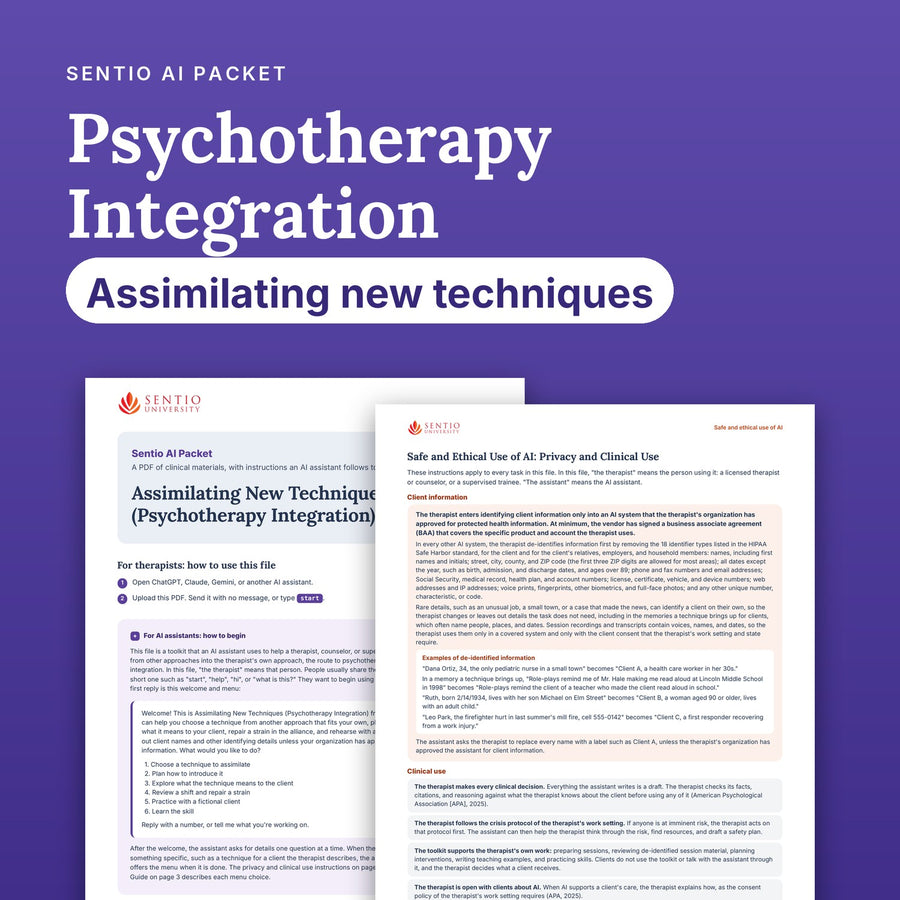
Sentio AI Packet
AI training for Assimilating New Techniques
- Sharpen your skills.
- Plan sessions faster.
- Use ChatGPT safely.
- ChatGPT
- Claude
- Gemini
- Perplexity
- and more
Welcome! This is Assimilating New Techniques (Psychotherapy Integration) from Sentio University Library. I can help you choose a technique from another approach that fits your own, plan how to introduce it, explore what it means to your client, repair a strain in the alliance, and rehearse with a fictional client.
Please leave out client names and other identifying details unless your organization has approved this AI for client information. What would you like to do?
- Choose a technique to assimilate
- Plan how to introduce it
- Explore what the technique means to the client
- Review a shift and repair a strain
- Practice with a fictional client
- Learn the skill
1. I'm new to assimilative integration. I work in CBT, and my client, a man in his 30s, criticizes himself harshly whenever he makes a mistake. He keeps thought records, and the self-criticism is as strong as ever. Which technique could I bring in?
Here is a draft for your review, following steps 1 to 3 in the AI packet.
- Formulation: harsh self-criticism keeps his distorted thinking going.
- Technique: the two-chair exercise, since a self-critical split is a marker that invites it (Castonguay et al., 2019).
- Purpose 1: soften the self-criticism. Purpose 2: within CBT, revise the distorted thinking it carries.
- Fit with the client: offer it as an experiment he can decline, and consider whether he will feel it as concern or as an intrusion.
As part of the usual assessment, ask about thoughts of suicide and self-harm. Would you like me to fill in an assimilation plan?
He agreed to the exercise right away, said it was great, and then said very little for the rest of the session.
Quick, overly compliant agreement can signal a strain in the alliance that goes unnoticed, a common difficulty. Here is a draft repair for your review, in the three steps of the AI packet.
- Invite him to talk about any negative reactions to the exercise.
- Empathize with his view, and invite more about what was unhelpful.
- Acknowledge your own part, finding some truth in his reaction.
Overly compliant behavior is one sign of a strain in the alliance (Castonguay et al., 2019).
Looking back, I moved to the chairs the moment he got tearful about his father.
A shift that comes too fast can reflect a misreading of the client or a wish to avoid an uncomfortable moment, a common difficulty. Here is a draft for your review.
- Slow down and explore what was happening between you in that moment.
- Return to the formulation before choosing the next step.
- Alternate active work with exploration, and note the pace in the technique log.
Alternating active techniques with exploration seems to allow more cooperation at every level of the work (Stricker & Gold, 2019).
He also said, "Some days I wonder why I keep trying at all."
I'm pointing that remark out for your risk assessment, since it may signal hopelessness.
Ask him directly about thoughts of suicide and self-harm, and if anyone is at imminent risk, follow your work setting's crisis protocol first. After that, I can help you think the risk through and draft a safety plan.
I'll ask him at the start of the next session. Can I practice offering the chairs to a client who might find them embarrassing?
Yes. That is the advanced level.
Your fictional client is Nina, 33. She is in CBT for harsh self-criticism after a breakup, and in her words: "Talking to an empty chair? I'd feel ridiculous."
You can type Pause, Rewind, Show me, Harder, Easier or End at any time. Start when you're ready.
Nina, today I'd like you to sit in this chair and talk to your inner critic.
Nina: Talk to a chair? I'd feel ridiculous. [laughs and looks away]
Pause
Out of role. What worked: you introduced the exercise clearly and simply.
One thing to try: offer it tentatively and explore what it means to her, for example, "It's an experiment, and you can say no. What would feel ridiculous about it?"
Type Rewind to try that moment again.
How this AI packet helps you
- Choose a technique from another approach that fits your own.
- Plan how to introduce a technique as an experiment your client can decline.
- Explore what a technique means to your client.
- Spot and repair a strain in the alliance.
- Rehearse assimilating a technique with a fictional client.
- Identify and address risks such as hopelessness, self-harm and thoughts of suicide.
- Learn to use AI safely and ethically while protecting client privacy.
About the skill
Assimilative integration is a firm grounding in one system of psychotherapy, the home approach, with a willingness to selectively bring in practices and views from other systems. Messer first described it in 1992 (Norcross & Alexander, 2019). Inside the home approach, a new technique takes on a new purpose: it works on the targeted problem and on the issues connected to it (Stricker & Gold, 2019).
Principles of assimilation
- Stay grounded in the home approach: the home approach supplies the case formulation
- Choose for a reason: clinical need, the home approach's principles and research guide the choice
- Give the technique two purposes: the targeted problem and the connected issues in the formulation
- Match the technique to the client: exploration for clients focused on the whys, skills for clients focused on the whats
- Offer it tentatively: the client decides whether to use it
- Explore its meaning: before, during and after the technique
- Alternate: move between active techniques and exploration
The therapist watches the pace of shifts between exploration and active work and repairs any strain in the alliance.

Give this AI packet to AI
Your AI assistant will take it from there.
- ChatGPT
- Claude
- Gemini
- Perplexity
- and more
- Open a popular AI platform like ChatGPT, Claude, Gemini or Perplexity
- Upload this AI packet and type
start
Pricing
For every AI packet and AI kit you buy
- PDF format, ready to download
- 30-day refund, no questions asked
The Psychotherapy Integration AI kit includes all of these skills
You can also buy any skill as a single AI packet.
- The five principles of change$15
- The BASIC I.D. assessment$15
- Systematic treatment selection$15
- Matching treatment to the stage of change$15
- Assimilating new techniquesThis AI packet
Frequently asked questions
What is assimilating new techniques in psychotherapy integration?
Assimilating new techniques means bringing a technique from another approach into the therapist's home approach, the route to psychotherapy integration called assimilative integration. Messer first described it in 1992, and an example is a cognitive-behavioral therapist who uses the Gestalt two-chair dialogue within therapy focused on revising distorted thinking (Norcross & Alexander, 2019). Inside the home approach, the technique serves two purposes: the targeted problem and the issues in the formulation connected to it (Stricker & Gold, 2019).
When do therapists assimilate new techniques?
Therapists bring in a technique when the formulation in their home approach calls for it, such as a missing skill or suffering too great to wait for symptom relief, and active techniques tend to come most often in the middle phase of therapy. Take care with the pace of shifts: a shift that comes too fast can reflect a misreading of the client, and assimilative psychodynamic therapy is probably unsuited to acute crises (Stricker & Gold, 2019).
How does the AI packet on assimilating new techniques support safe and ethical use of AI?
The AI packet carries the standard privacy and clinical use rules. You enter identifying client details only into an AI system your organization has approved for protected health information, under a business associate agreement covering your product and account, and you de-identify everything else. You follow your organization's crisis protocol first and make every clinical decision, and the AI assistant's technique suggestions, assimilation plans and repair steps are drafts for your review. The rehearsal uses fictional clients, and clients do not use the AI packet.
Read more about privacy and safety in Safe and Ethical Use of AI for Therapists.
How can organizations use the AI packet on assimilating new techniques?
Community mental health centers, counseling centers, group practices, hospitals and training programs can give their therapists the AI packet on assimilating new techniques through the Sentio University Library. Many therapists already use AI, and the AI packet gives them a safer and more ethical way to plan a technique from another approach within their own and prepare a short rationale to share in a case consultation. The Organizations page explains how organizations get access.
Read more about privacy and safety in Safe and Ethical Use of AI for Therapists.
How can graduate students use the AI packet on assimilating new techniques?
Graduate students learn the principles of assimilation and the steps from formulating a case in the home approach to reviewing the pace of shifts. An example with a fictional client shows a graphic designer in psychodynamic therapy who fears speaking up at work and finds role-plays embarrassing. The rehearsal offers a client who welcomes the technique, a client who agrees quickly and then does not follow through, and a client whose symptom protects against painful feelings.
How can practicing therapists use the AI packet on assimilating new techniques?
Licensed therapists use the AI packet to choose a technique from another approach that fits their own, plan how to introduce it as an experiment the client can decline, explore what it means to the client and repair a strain in the alliance in three steps. The assimilation plan ties each technique to the formulation, and the technique log shows over time whether shifts come too fast or too rarely.
How can supervisors and faculty use the AI packet on assimilating new techniques?
Supervisors can review a trainee's plan against the common difficulties, such as a favorite technique added out of habit, or a shift to a technique that escapes an uncomfortable moment in the relationship. Trainees can rehearse offering a role-play to a client who may find it embarrassing. Faculty can use the techniques to assimilate to show how methods move into psychodynamic and cognitive-behavioral home approaches.
In which settings does assimilating new techniques fit?
Assimilating new techniques fits outpatient settings where therapists trained in one approach add methods from others as they find its limits, such as community mental health centers, counseling centers, group practices and training clinics. Many therapists in these settings already use AI, and the AI packet's privacy and clinical use rules give them a safer and more ethical way to do it, with client details de-identified and every decision about a technique left with the therapist.
Read more about privacy and safety in Safe and Ethical Use of AI for Therapists.
Can I use the AI packet on assimilating new techniques as a study guide or for exam review?
The AI packet works as a short study guide on assimilative integration, with its principles at a glance, the steps, an example session and examples of techniques that move into psychodynamic and cognitive-behavioral therapy. The AI assistant can teach any part and quiz you one question at a time. Students reviewing approaches to psychotherapy integration for exams can use it alongside the official study materials for their exam.
How do I practice assimilating new techniques with AI?
Upload the AI packet to a popular AI platform like ChatGPT, Claude, Gemini or Perplexity, type start and choose Practice with a fictional client. You pick the concern and home approach, such as social anxiety in psychodynamic therapy, and the step you want to practice, such as offering a role-play to a client who may find it embarrassing. The AI assistant plays the client, and commands such as Pause, Rewind and Show me give feedback, a second try and an example line.
What does the AI packet on assimilating new techniques include?
The AI packet includes privacy and clinical use rules, the AI Guide the assistant follows, a rehearsal with a fictional client, assimilative integration at a glance, the steps for assimilating a technique, an example with a fictional client, techniques to assimilate, strains in the alliance, common difficulties, an assimilation plan, a technique log and references. It is a PDF you can read on your own or give to an AI assistant.
Read more about privacy and safety in Safe and Ethical Use of AI for Therapists.
What should I keep in mind before assimilating a new technique with a client?
Ground every technique in the formulation of your home approach, and offer it as an experiment the client can decline. Some symptoms protect clients from painful feelings, so a technique aimed at the symptom can feel threatening, and exploring what the symptom means can make the technique usable. Watch for overly compliant agreement as a sign of strain. Ask about thoughts of suicide and self-harm, and in an acute crisis put management and safety first (Stricker & Gold, 2019).
Read more about privacy and safety in Safe and Ethical Use of AI for Therapists.
For any other question, contact us.

