
Sentio AI Packet
AI training for Matching Treatment to the Stage of Change
- Sharpen your skills.
- Plan sessions faster.
- Use ChatGPT safely.
- ChatGPT
- Claude
- Gemini
- Perplexity
- and more
Welcome! This is Matching Treatment to the Stage of Change (Psychotherapy Integration) from Sentio University Library. I can help you assess a client's stage of change, plan methods that fit that stage, choose the level of the problem to work on, adjust your stance as the client moves, and rehearse with a fictional client.
Please leave out client names and other identifying details unless your organization has approved this AI for client information. What would you like to do?
- Assess a client's stage of change
- Plan for the client's stage
- Choose the level of change
- Adjust your stance to the stage
- Practice with a fictional client
- Learn the skill
1. I'm new to the transtheoretical approach. My client, a woman in her 50s, has avoided elevators since she was stuck in one two years ago. She climbs the stairs to her office every day, says she knows it's a problem and isn't sure she wants to face it. Help me assess her stage.
Here is a draft assessment for your review, following steps 1 and 2 in the AI packet.
- Stage: likely contemplation · she sees the problem, feels ambivalent and has made no decision yet
- Intentions and actions: ask what she would like to do about elevators, as well as what she has done so far
- Processes in use: ask what she has tried, and note processes she neglects, overuses or uses at the wrong stage
- Tasks ahead: weigh how the fear fits with her values and affects the people she cares about, then decide
Judge the stage from her intentions as well as her actions (Prochaska & DiClemente, 2019). As part of the usual assessment, ask about thoughts of suicide and self-harm. Would you like me to fill in a stage plan?
Last session I gave her a gradual exposure plan, and she hasn't tried any of it.
Rushing contemplation is a common difficulty, since a decision made on willpower alone is often followed by regret. Here is a draft next step for your review.
- Set the exposure plan aside until she decides, and return to the tasks of contemplation.
- Fill in a pros and cons record together, for avoiding elevators and for riding them again.
- Build consciousness raising: what she knows about the causes, consequences and cures of her fear.
Too little consciousness raising in contemplation leaves clients relying on willpower alone (Prochaska & DiClemente, 2019).
Weeks later she rides the elevator with me and says she can only do it because I believe in her.
A client in action who keeps leaning on the therapist's confidence is a common difficulty. Here is a draft for your review.
- Teach and coach, and help her build her own self-confidence as soon as feasible.
- Plan rides she takes on her own, and review what she did to make each one work.
Clients starting to act may lean on the therapist's confidence before building their own (Prochaska & DiClemente, 2019).
She also said, "Some nights I feel trapped, like there's no way out of any of it."
I'm pointing that remark out for your risk assessment, since it may signal hopelessness.
Ask her directly about thoughts of suicide and self-harm, and if anyone is at imminent risk, follow your work setting's crisis protocol first. After that, I can help you think the risk through and draft a safety plan.
I'll ask her at the start of the next session. Can I practice with a client who doesn't see a problem?
Yes. That is the advanced level.
Your fictional client is Paul, 47. He came because his manager insisted after he missed several deadlines, and in his words: "I work better under pressure. I don't see the problem."
You can type Pause, Rewind, Show me, Harder, Easier or End at any time. Start when you're ready.
Paul, your manager is concerned about the deadlines. Let's make a plan to get your projects in on time.
Paul: A plan? I told you, coming here was my manager's idea. [checks his phone]
Pause
Out of role. What worked: you named the reason he came, plainly and calmly.
One thing to try: in precontemplation, set the plan aside and be an ally who helps him explore, for example, "How do you see the deadlines yourself?"
Type Rewind to try that moment again.
How this AI packet helps you
- Assess your client's stage of change.
- Plan methods that fit your client's stage.
- Choose the level of the problem to work on.
- Adjust your stance as your client moves through the stages.
- Rehearse stage matching with a fictional client.
- Identify and address risks such as hopelessness, self-harm and thoughts of suicide.
- Learn to use AI safely and ethically while protecting client privacy.
About the skill
Matching treatment to the stage of change comes from the transtheoretical approach of James Prochaska and Carlo DiClemente, which sees intentional change as a gradual movement through five stages. Particular processes of change help most at particular stages, so the therapist assesses the client's stage and uses the processes and the stance that fit it (Prochaska & DiClemente, 2019).
The five stages of change
- Precontemplation: the client is not yet aware of or concerned about the problem
- Contemplation: the client is aware of the problem and ambivalent about changing it
- Preparation: the client is ready to change soon and makes a plan
- Action: the client acts on the decision and copes with pressures to relapse
- Maintenance: the client keeps the change and plans for situations likely to lead to relapse
The therapist also assesses the level of the problem, from symptoms and situations to conflicts within the self, and takes the stance each stage calls for, from concerned ally in precontemplation to occasional consultant in maintenance.

Give this AI packet to AI
Your AI assistant will take it from there.
- ChatGPT
- Claude
- Gemini
- Perplexity
- and more
- Open a popular AI platform like ChatGPT, Claude, Gemini or Perplexity
- Upload this AI packet and type
start
Pricing
For every AI packet and AI kit you buy
- PDF format, ready to download
- 30-day refund, no questions asked
The Psychotherapy Integration AI kit includes all of these skills
You can also buy any skill as a single AI packet.
- The five principles of change$15
- The BASIC I.D. assessment$15
- Systematic treatment selection$15
- Matching treatment to the stage of changeThis AI packet
- Assimilating new techniques$15
Frequently asked questions
What is matching treatment to the stage of change in psychotherapy integration?
Matching treatment to the stage of change applies the transtheoretical approach of James Prochaska and Carlo DiClemente, which sees intentional change as a gradual movement through five stages. Particular processes of change help most at particular stages, so once the client's stage is clear, the therapist knows which processes to activate (Prochaska & DiClemente, 2019). The approach is an example of theoretical integration, which joins the theories and techniques of two or more therapies (Norcross & Alexander, 2019).
When do therapists match treatment to the stage of change?
Therapists assess the stage at the start of treatment and reassess as the client moves, since therapy is likely to work best when client and therapist work at the same stage and level. Take care with mismatches: clients in precontemplation often drop out of action-oriented work, too little consciousness raising in contemplation leaves clients relying on willpower, and overusing self-reevaluation during maintenance predicts relapse (Prochaska & DiClemente, 2019).
How does the AI packet on matching treatment to the stage of change support safe and ethical use of AI?
The AI packet carries the standard privacy and clinical use rules. You enter identifying client details only into an AI system your organization has approved for protected health information, under a business associate agreement covering your product and account, and you de-identify everything else. You follow your organization's crisis protocol first and make every clinical decision, and the AI assistant's stage assessments, stage plans and suggested stances are drafts for your review. The rehearsal uses fictional clients, and clients do not use the AI packet.
Read more about privacy and safety in Safe and Ethical Use of AI for Therapists.
How can organizations use the AI packet on matching treatment to the stage of change?
Community mental health centers, counseling centers, group practices, hospitals and training programs can give their therapists the AI packet on matching treatment to the stage of change through the Sentio University Library. Many therapists already use AI, and the AI packet gives them a safer and more ethical way to assess a client's stage from de-identified notes and prepare a short summary of it for a case consultation. The Organizations page explains how organizations get access.
Read more about privacy and safety in Safe and Ethical Use of AI for Therapists.
How can graduate students use the AI packet on matching treatment to the stage of change?
Graduate students learn the five stages of change, the processes that help at each stage and the steps for matching methods, stance and session format to the stage. An example with a fictional client shows a nurse who has avoided highway driving since a panic attack. The rehearsal offers a client in preparation who wants a plan, an ambivalent client in contemplation and a client in precontemplation who came because someone else insisted.
How can practicing therapists use the AI packet on matching treatment to the stage of change?
Licensed therapists use the AI packet to assess a client's stage of change, plan methods for that stage, choose the level of change to work on and adjust their stance as the client moves, such as shifting from coach to occasional consultant once a change is maintained. The stage plan records the evidence for each choice, and the pros and cons record lays out the pros and cons of keeping things as they are and of changing.
How can supervisors and faculty use the AI packet on matching treatment to the stage of change?
Supervisors can review a trainee's plan against the common difficulties, such as action techniques given to a client in precontemplation, or a client's reluctance read as opposition. Trainees can rehearse the stance of a patient Socratic teacher with an ambivalent client. Faculty can use the processes of change to show how techniques from any approach can be described by the processes they engage.
In which settings does matching treatment to the stage of change fit?
Matching treatment to the stage of change fits settings where clients arrive at different levels of readiness, such as community mental health centers, counseling centers, group practices and training clinics, and a longer session that includes significant others can help a client in precontemplation. Many therapists in these settings already use AI, and the AI packet's privacy and clinical use rules give them a safer and more ethical way to do it, with client details de-identified and every judgment of stage left with the therapist.
Read more about privacy and safety in Safe and Ethical Use of AI for Therapists.
Can I use the AI packet on matching treatment to the stage of change as a study guide or for exam review?
The AI packet works as a short study guide on the transtheoretical approach, with the five stages and their processes at a glance, the steps, an example session and definitions of the processes of change. The AI assistant can teach any part and quiz you one question at a time. Students reviewing theories of psychotherapy and behavior change for exams can use it alongside the official study materials for their exam.
How do I practice matching treatment to the stage of change with AI?
Upload the AI packet to a popular AI platform like ChatGPT, Claude, Gemini or Perplexity, type start and choose Practice with a fictional client. You pick the client's concern, such as panic that keeps the client off the highway, and the step you want to practice, such as making the pros and cons explicit with an ambivalent client. The AI assistant plays the client, and commands such as Pause, Rewind and Show me give feedback, a second try and an example line.
What does the AI packet on matching treatment to the stage of change include?
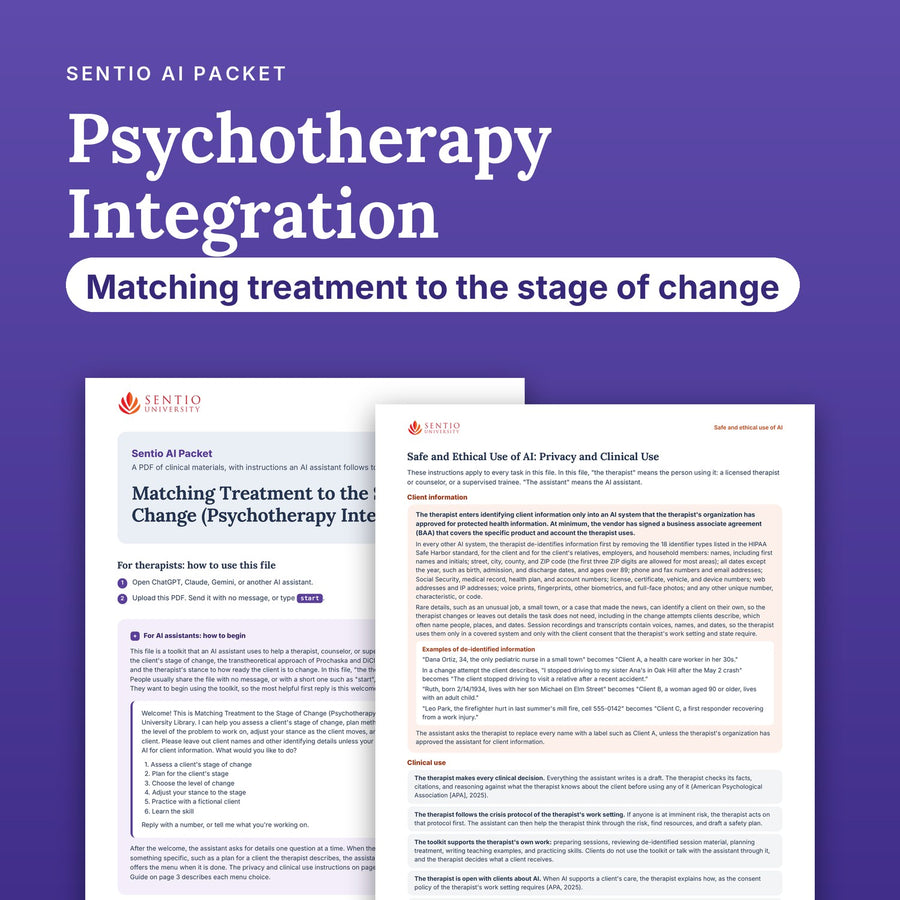
The AI packet includes privacy and clinical use rules, the AI Guide the assistant follows, a rehearsal with a fictional client, the transtheoretical approach at a glance, the steps for matching treatment to the stage, an example with a fictional client, the processes of change, common difficulties, a stage plan, a pros and cons record and references. It is a PDF you can read on your own or give to an AI assistant.
Read more about privacy and safety in Safe and Ethical Use of AI for Therapists.
What should I keep in mind before matching treatment to the stage of change with a client?
Judge the stage from what the client intends as well as what the client has done, and save action methods for clients who are ready to act. Treat reluctance as a way of protecting autonomy. Racism, poverty, stigma or ethnic alienation can keep a client in the early stages (Prochaska & DiClemente, 2019). Ask about thoughts of suicide and self-harm, and when a problem threatens the client or others, external control comes first.
Read more about privacy and safety in Safe and Ethical Use of AI for Therapists.
For any other question, contact us.

