
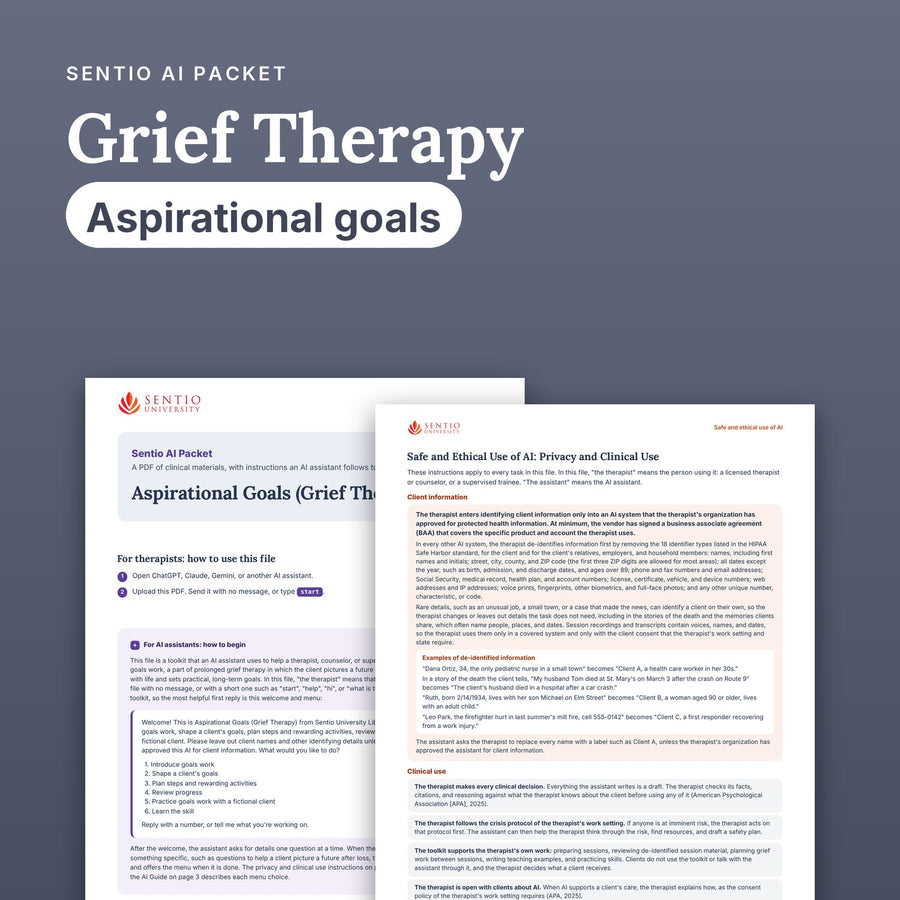
Sentio AI Packet
AI training for Aspirational Goals
- Sharpen your skills.
- Plan sessions faster.
- Use ChatGPT safely.
- ChatGPT
- Claude
- Gemini
- Perplexity
- and more
Welcome! This is Aspirational Goals (Grief Therapy) from Sentio University Library.
I can help you introduce goals work, shape a client's goals, plan steps and rewarding activities, review progress, and rehearse with a fictional client.
Please leave out client names and other identifying details unless your organization has approved this AI for client information. What would you like to do?
- Introduce goals work
- Shape a client's goals
- Plan steps and rewarding activities
- Review progress
- Practice goals work with a fictional client
- Learn the skill
2. I'm new to grief therapy. Help me shape goals with a client in his 60s whose wife died two years ago. I asked the magic wand question, and he said he might garden again and see his grandchildren more.
I'll start with one question. What did gardening give him before the loss?
He grew vegetables and gave them to the neighbors. He liked feeling useful.
Here is a draft for your review, following steps 3 to 6 on page 6.
- Interest and purpose: reflect it back, for example, "Growing food for others made you feel useful."
- Long-term goals, in his words: a vegetable garden he shares with the neighbors by next summer, and regular time with his grandchildren.
- First step: one small step toward the garden this week, which he chooses.
- Daily respite: ask, "What small thing used to give you pleasure?" and find a time for it each day.
Leave the choice of goals to him and return to them in every session (Shear, 2010). Would you like me to fill in the goals plan on page 9 or change any goal?
He told me that enjoying the garden would feel like betraying his wife.
A client who feels that wanting a future betrays the person who died is a common difficulty (Shear, 2010).
Reflect the feeling, link the goal to what he and his wife cared about, and start with a small, concrete step. Here is a draft line for your review.
"Part of you feels that enjoying the garden would be disloyal. What did the two of you care about together?"
With an earlier client, we set goals once and never came back to them. How do I keep them going?
Goals set once and left unreviewed are a common difficulty (Shear, 2010).
Return to the goals every session: review what he did, draw out his own reasons for continuing and adjust the plan in a motivational interviewing style (Shear, 2010). Here are draft questions for your review.
"What did you try? What did you notice? Why does this goal matter to you?"
He also said, "I can't see any future without her."
I'm pointing that sentence out for your risk assessment, since a client who sees no future may be hopeless.
Hopelessness is a reason to check for suicidal thinking, which in prolonged grief often centers on not wanting to live without the person who died (Shear, 2015). Ask about suicidal intent and plans. If anyone is at imminent risk, follow your work setting's crisis protocol first.
After that, I can help you think the risk through and choose a smaller first step.
I'll ask him at the start of next session. Can I practice the magic wand question with a client who feels guilty about wanting anything?
Yes. That is the advanced level.
Your fictional client is Rosa, 52. Her younger brother died 18 months ago, and in her words: "How can I make plans for myself when he never got the chance?"
You can type Pause, Rewind, Show me, Harder, Easier or End at any time. Start when you're ready.
Rosa, if a magic wand brought your grief to a level where it no longer got in the way, what would you want to do?
Rosa: I can't think about that. It feels wrong to want things when he's gone. [shakes her head]
Pause
Out of role. What worked: you asked the magic wand question in plain words, as step 2 on page 6 sets out.
One thing to try: reflect the guilt first, then invite a small picture, for example, "Wanting something feels wrong right now. What did you and your brother enjoy that you might want to do again?"
Type Rewind to try that moment again.
How this AI packet helps you
- Introduce goals work to a client.
- Shape a client's goals.
- Plan first steps and rewarding activities.
- Review progress.
- Rehearse goals work with a fictional client.
- Identify and address risks such as hopelessness, self-harm and thoughts of suicide.
- Learn to use AI safely and ethically while protecting client privacy.
About the skill
Aspirational goals work helps the client re-envision a future with renewed positive emotion and purpose (Shear, 2010). It belongs to prolonged grief therapy, the treatment for prolonged grief that M. Katherine Shear developed.
What goals work involves
- A future without interference: the client pictures life with grief at a level that no longer gets in the way
- Practical, long-term goals: the goals bring interest and purpose and reach past the end of treatment
- A motivational interviewing style: the therapist draws out the client's own reasons
- Daily respite: small moments of respite each day, with simple rewarding activities the client used to enjoy
The therapist introduces the work, shapes the client's goals, plans first steps and reviews progress.

Give this AI packet to AI
Your AI assistant will take it from there.
- ChatGPT
- Claude
- Gemini
- Perplexity
- and more
- Open a popular AI platform like ChatGPT, Claude, Gemini or Perplexity
- Upload this AI packet and type
start
Pricing
For every AI packet and AI kit you buy
- PDF format, ready to download
- 30-day refund, no questions asked
The Grief Therapy AI kit includes all of these skills
You can also buy any skill as a single AI packet.
- Worden's four tasks of mourning$15
- The dual process model$15
- Continuing bonds$15
- Imaginal revisiting$15
- Situational revisiting$15
- Imaginal conversation with the deceased$15
- Memories and pictures$15
- Aspirational goalsThis AI packet
- Grief monitoring diary$15
- Including a close friend or family member$15
Frequently asked questions
What are aspirational goals in grief therapy?
Aspirational goals are practical, long-term goals a client sets in prolonged grief therapy after picturing a future where grief no longer interferes with life. The therapist asks what the client would want to do if grief no longer interfered, and together they choose goals that bring interest, excitement and the possibility of fulfillment (Shear, 2010).
When do therapists use aspirational goals?
Therapists introduce aspirational goals work early in prolonged grief therapy and return to it in every session, using a motivational interviewing approach (Shear, 2010). The client plans small first steps and daily moments of respite with simple rewarding activities. A client who sees no future may be hopeless, which is a reason to check for suicidal thinking.
Read more about privacy and safety in Safe and Ethical Use of AI for Therapists.
How does the aspirational goals AI packet support safe and ethical use of AI?
The aspirational goals AI packet carries the standard privacy and clinical use rules. You enter identifying client details only into an AI system your organization has approved for protected health information, under a business associate agreement covering your product and account, and you de-identify everything else. You follow your organization's crisis protocol first and make every clinical decision, and the AI assistant's introductions, goals, step plans and review questions are drafts for your review. The rehearsal uses fictional clients, and clients do not use the AI packet.
Read more about privacy and safety in Safe and Ethical Use of AI for Therapists.
How can organizations use the aspirational goals AI packet?
Community mental health centers, group practices, counseling centers and training clinics that work with bereaved adults can give their therapists this AI packet through the Sentio University Library. Clinicians can use it to introduce goals work and shape a client's wishes into practical, long-term goals, and a supervisor can assign it before a trainee asks a client the magic wand question. The Organizations page explains how organizations get access.
How can graduate students use the aspirational goals AI packet?
Graduate students learn what goals work involves, where it fits in the treatment and its steps, see them in an example with a fictional client, and rehearse with an AI assistant that plays a client at a beginner, intermediate or advanced level. Useful moments to practice include the magic wand question, shaping a goal and a review, including with a client who says there is no future without the person who died.
How can practicing therapists use the aspirational goals AI packet?
Licensed therapists use the AI packet to prepare goals work with a particular client. The AI assistant drafts a short, plain introduction with the magic wand question, helps turn the client's wishes into practical, long-term goals that bring interest and purpose, breaks a goal into first steps and lists small rewarding activities for daily respite, and drafts review questions in a motivational interviewing style.
How can supervisors and faculty use the aspirational goals AI packet?
Supervisors assign the AI packet before a trainee starts goals work and review the aspirational goals plan against common difficulties, such as goals that come from the therapist, goals that stay vague wishes with no first step, or a client who feels that wanting a future betrays the person who died. Faculty can use the example session to show a therapist asking the magic wand question.
In which settings do aspirational goals fit?
Aspirational goals fit prolonged grief therapy with bereaved adults in clinics, counseling centers and practices, from the early sessions through the end of treatment. Many therapists in these settings already use AI, and the AI packet's privacy and clinical use rules give them a safer and more ethical way to do it by keeping identifying client details inside approved AI systems.
Read more about privacy and safety in Safe and Ethical Use of AI for Therapists.
Can I use the aspirational goals AI packet as a study guide or for exam review?
The AI packet works as a short study guide on aspirational goals, with what goals work involves, where it fits in the treatment, what to expect, the steps for leading it, questions for aspirational goals, an example session and references. You can ask the AI assistant to teach any part in under 200 words and then quiz you one question at a time. Students reviewing grief therapy for comprehensive or licensing exams can use it alongside the official study materials for their exam.
How do I practice aspirational goals with AI?
Upload the AI packet to a popular AI platform like ChatGPT, Claude, Gemini or Perplexity, type start and choose Practice goals work with a fictional client. You pick the loss the client brings and the step you want to practice, such as the magic wand question, and the AI assistant plays a client with prolonged grief who may say there is no future without the person who died. Commands such as Pause, Rewind and Show me give feedback, a second try and an example line.
What does the aspirational goals AI packet include?
The AI packet includes privacy and clinical use rules, the AI Guide the assistant follows, a rehearsal with a fictional client, aspirational goals at a glance, the steps for leading goals work, an example with a fictional client, questions for aspirational goals, common difficulties, an aspirational goals plan, a goals review record, safety in grief therapy and references. It is a PDF you can read on your own or give to an AI assistant.
Read more about privacy and safety in Safe and Ethical Use of AI for Therapists.
What should I keep in mind before using aspirational goals with a client?
Let the goals come from the client's own wishes, and start with small, concrete steps (Shear, 2010). A client may feel that wanting a future betrays the person who died, so reflect the feeling and link goals to what both cared about. Hopelessness is a reason to check for suicidal thinking. Follow your crisis protocol first if risk appears. The AI packet does not replace formal training in grief therapy.
Read more about privacy and safety in Safe and Ethical Use of AI for Therapists.
For any other question, contact us.

