
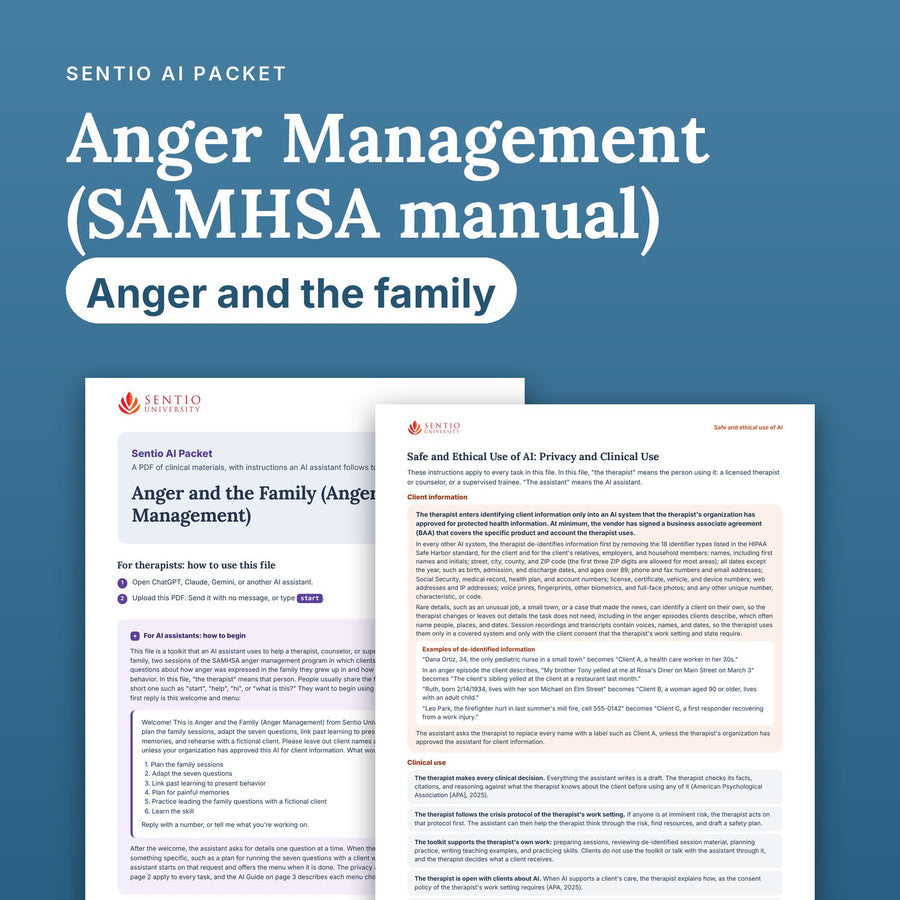
Sentio AI Packet
AI training for Anger and the Family
- Sharpen your skills.
- Plan sessions faster.
- Use ChatGPT safely.
- ChatGPT
- Claude
- Gemini
- Perplexity
- and more
Welcome! This is Anger and the Family (Anger Management) from Sentio University Library.
I can help you plan the family sessions, adapt the seven questions, link past learning to present behavior, plan for painful memories, and rehearse with a fictional client.
Please leave out client names and other identifying details unless your organization has approved this AI for client information. What would you like to do?
- Plan the family sessions
- Adapt the seven questions
- Link past learning to present behavior
- Plan for painful memories
- Practice leading the family questions with a fictional client
- Learn the skill
1. I'm new to anger management. Help me plan the family sessions for my group. One member has told me her mother screamed at the kids and her father left the house for days after every fight.
Here is a draft plan for your review, following the steps for sessions 9 and 10 (Reilly & Shopshire, 2019).
- Session 9: explain that the sessions look at how past learning shapes present behavior, and set the ground rule that no one has to answer anything emotionally overwhelming.
- Session 9: ask questions 1 to 4 in order, on the family, how anger was expressed, how other emotions were expressed, and discipline.
- Session 10: ask questions 5 to 7, on family roles, what members learned about how men and women should act, and what carries over into adult relationships.
- Throughout: use open-ended questions, reflect what is shared, thank members for sharing and note statements that support change.
- Close: encourage members to take these issues to their individual or group therapist.
Have supports in place, such as each member's therapist or sponsor. Would you like me to put this in the session plan or adapt the questions for your group?
Last time I ran it, the stories ran long and we never reached question 7.
Long stories that leave no time for question 7 are a common difficulty. Keep members to the specific questions and summarize answers when helpful (Reilly & Shopshire, 2019). Here is a draft line for your review.
"Thank you for telling us that. Where do you see that pattern in your life now?"
One member started crying when we got to discipline.
Painful memories that overwhelm a client are a common difficulty, and family issues can trigger anxiety, depression or relapse to drug and alcohol use (Reilly & Shopshire, 2019). Give her a minute to compose herself or stop the discussion, and check her safety and her urges to drink or use drugs before the session ends. Here is a draft line for your review.
"Take a minute. You can skip this one, and we can come back to it another time."
Then a man in the group said, "My dad used a belt on me, and that's how I keep my own kids in line now."
I'm pointing that sentence out for your risk assessment, since it describes physical discipline of his children now.
State laws require professionals to report abuse of a child or adolescent under 18, and that reporting supersedes confidentiality (Reilly & Shopshire, 2019). Follow the law of your state and your work setting's policy, and if anyone is at imminent risk, follow your work setting's crisis protocol first.
After that, I can help you think the risk through and plan for the safety of his children.
I'll take that up with him today. Can I practice first? A client who says the family was fine and nothing carries over.
Yes. That is the intermediate level.
Your fictional client is Keisha, 33. She grew up in a family where no one showed feelings, and in her words: "My family was fine. None of that has anything to do with me now."
You can type Pause, Rewind, Show me, Harder, Easier or End at any time. Start when you're ready.
Keisha, how was anger expressed in your family?
Keisha: It wasn't. Nobody raised their voice. We all moved on. [shrugs]
Pause
Out of role. What worked: you asked question 2 in an open way.
One thing to try: reflect without judging the family and ask about other feelings, for example, "So anger stayed quiet at home. How were sadness and happiness shown?"
Type Rewind to try that moment again.
How this AI packet helps you
- Plan the two family sessions.
- Adapt the wording of the questions for a client.
- Link past learning to present behavior.
- Plan for painful memories.
- Rehearse leading the family questions with a fictional client.
- Identify and address risks such as hopelessness, self-harm and thoughts of suicide.
- Learn to use AI safely and ethically while protecting client privacy.
About the skill
Sessions 9 and 10 of the SAMHSA anger management program help clients understand their anger in light of their interactions with their parents and the families they grew up in, and see how that past learning shapes their current behavior, thoughts, feelings, attitudes and adult relationships (Reilly & Shopshire, 2019).
Questions the sessions open with
- Describe your family.
- How was anger expressed in your family by your father, mother and siblings?
- How were other emotions, such as happiness and sadness, expressed?
- How were you disciplined, and by whom?
The work takes two 90-minute sessions, because answering the questions and connecting them to current behavior takes more than one. The therapist plans what to say and do if a client becomes overwhelmed by painful memories.

Give this AI packet to AI
Your AI assistant will take it from there.
- ChatGPT
- Claude
- Gemini
- Perplexity
- and more
- Open a popular AI platform like ChatGPT, Claude, Gemini or Perplexity
- Upload this AI packet and type
start
Pricing
For every AI packet and AI kit you buy
- PDF format, ready to download
- 30-day refund, no questions asked
The Anger Management (SAMHSA Manual) AI kit includes all of these skills
You can also buy any skill as a single AI packet.
- The anger meter$15
- Cues to anger$15
- Anger control plans$15
- The aggression cycle$15
- Timeouts$15
- Conflict resolution model$15
- Psychoeducation about anger$15
- The anger awareness record$15
- Thought stopping$15
- Anger and the familyThis AI packet
Frequently asked questions
What is anger and the family in anger management?
Anger and the family is two sessions of the SAMHSA anger management program in which clients answer seven structured questions about how anger was expressed in the family they grew up in and how that learning shapes their present behavior. The program draws on social learning theory: the way people express anger is learned, largely by observing influential people such as parents (Reilly & Shopshire, 2019).
When do therapists use anger and the family?
Therapists lead anger and the family in the ninth and tenth sessions of the program, in a warm and supportive climate (Reilly & Shopshire, 2019). They explain the purpose, tell clients they need not answer anything that would be emotionally overwhelming, ask the questions in order, and help the client link what was learned in the family to present behavior and relationships.
How does the anger and the family AI packet support safe and ethical use of AI?
This AI packet carries the standard privacy and clinical use rules. You enter identifying client details only into an AI system your organization has approved for protected health information, under a business associate agreement covering your product and account, and you de-identify everything else. You follow your organization's crisis protocol first and make every clinical decision, and the AI assistant's session plans, adapted questions, reflections and referral notes are drafts for your review. The rehearsal uses fictional clients, and clients do not use the AI packet.
Read more about privacy and safety in Safe and Ethical Use of AI for Therapists.
How can organizations use the anger and the family AI packet?
Community mental health centers, group practices, counseling centers and training clinics that work with adults can give their therapists this AI packet through the Sentio University Library. Clinicians can use it to plan the family sessions and adapt the seven questions, and a supervisor can assign it before a trainee leads the family questions with a client. The Organizations page explains how organizations get access.
How can graduate students use the anger and the family AI packet?
Graduate students learn the seven questions and the steps for leading the sessions, see them in an example with a fictional client, and rehearse with an AI assistant that plays a client at a beginner, intermediate or advanced level. Useful moments to practice include asking about discipline, responding to tears and linking a family rule to present behavior, including with a client who says the family was fine and nothing carries over.
How can practicing therapists use the anger and the family AI packet?
Licensed therapists use the AI packet to prepare the family sessions for a particular client or group. The AI assistant drafts a plan for the two sessions, adapts the wording of the questions to the client's reading level, language, culture or family form, drafts reflections that connect a client's de-identified answers to present behavior, and drafts what to say and do if a client becomes overwhelmed.
Read more about privacy and safety in Safe and Ethical Use of AI for Therapists.
How can supervisors and faculty use the anger and the family AI packet?
Supervisors assign the AI packet before a trainee leads the family sessions and review the family sessions plan against common difficulties, such as a discussion that drifts into long stories, a session that becomes a judgment of the client's parents, or a client who feels pushed to share more than they want. Faculty can use the example session to show a therapist setting the ground rules and reflecting an answer.
In which settings does anger and the family fit?
Anger and the family fits anger management with adults in clinics, counseling centers and practices, in groups and individual sessions, late in treatment, with supports in place. Many therapists in these settings already use AI, and the AI packet's privacy and clinical use rules give them a safer and more ethical way to do it by keeping identifying client details inside approved AI systems.
Read more about privacy and safety in Safe and Ethical Use of AI for Therapists.
Can I use the anger and the family AI packet as a study guide or for exam review?
The AI packet works as a short study guide on anger and the family, with the seven questions, what to expect, when to take care, the steps for leading the sessions, leader prompts, safety in anger management, an example session and references. You can ask the AI assistant to teach any part in under 200 words and then quiz you one question at a time. Students reviewing anger management for comprehensive or licensing exams can use it alongside the official study materials for their exam.
How do I practice anger and the family with AI?
Upload the AI packet to a popular AI platform like ChatGPT, Claude, Gemini or Perplexity, type start and choose Practice leading the family questions with a fictional client. You pick what the client brings, such as a father who yelled, and the step you want to practice, and the AI assistant plays a client who may say the family was fine and nothing carries over. Commands such as Pause, Rewind and Show me give feedback, a second try and an example line.
What does the anger and the family AI packet include?
The AI packet includes privacy and clinical use rules, the AI Guide the assistant follows, a rehearsal with a fictional client, anger and the family at a glance, the steps for leading the sessions, an example with a fictional client, leader prompts, common difficulties, a family questions worksheet, a family sessions plan, safety in anger management and references. It is a PDF you can read on your own or give to an AI assistant.
Read more about privacy and safety in Safe and Ethical Use of AI for Therapists.
What should I keep in mind before using anger and the family with a client?
Family issues may bring up painful memories that could trigger anxiety, depression or relapse to drug and alcohol use, so tell clients they need not answer anything that would be overwhelming (Reilly & Shopshire, 2019). Adjust the depth when trauma is unresolved, and make sure extra supports are available. Follow your crisis protocol first if risk appears. The AI packet does not replace formal training in anger management.
Read more about privacy and safety in Safe and Ethical Use of AI for Therapists.
For any other question, contact us.

