
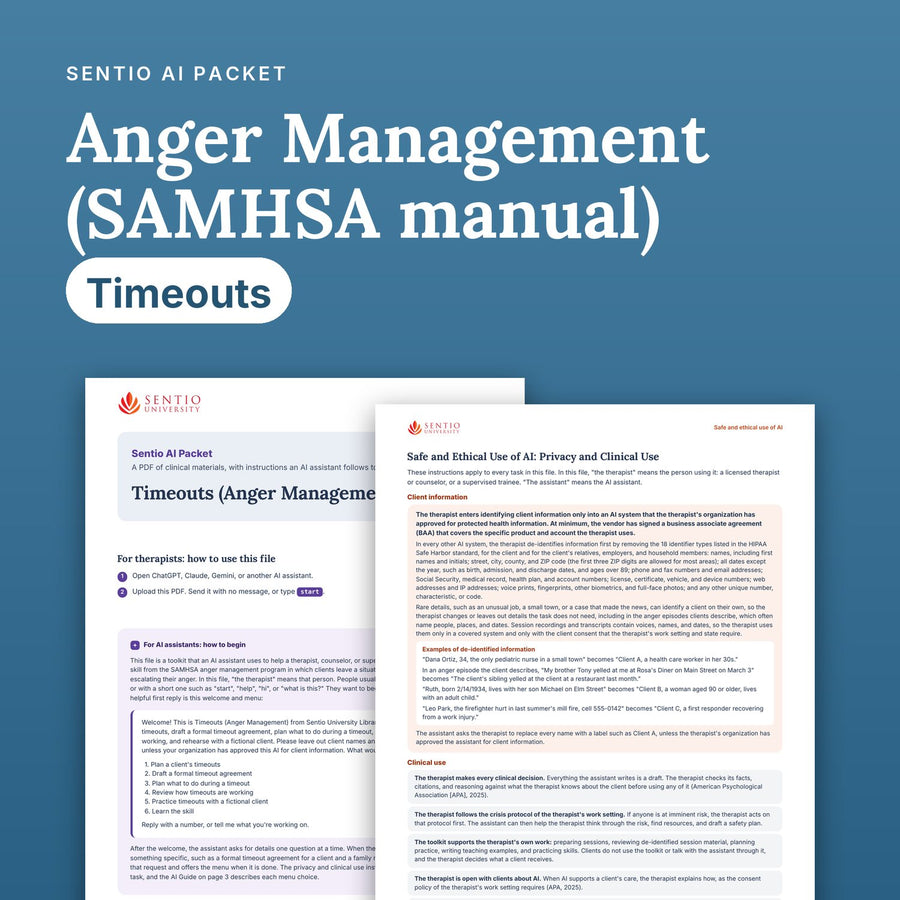
Sentio AI Packet
AI training for Timeouts
- Sharpen your skills.
- Plan sessions faster.
- Use ChatGPT safely.
- ChatGPT
- Claude
- Gemini
- Perplexity
- and more
Welcome! This is Timeouts (Anger Management) from Sentio University Library.
I can help you plan a client's timeouts, draft a formal timeout agreement, plan what to do during a timeout, review how timeouts are working, and rehearse with a fictional client.
Please leave out client names and other identifying details unless your organization has approved this AI for client information. What would you like to do?
- Plan a client's timeouts
- Draft a formal timeout agreement
- Plan what to do during a timeout
- Review how timeouts are working
- Practice timeouts with a fictional client
- Learn the skill
2. I'm new to anger management. Help me draft a formal timeout agreement. My client and his wife argue about money, and he gets to a 7 fast.
Here is a draft agreement for your review, following step 4 of the toolkit (Reilly & Shopshire, 2019).
- Who is part of it: your client and his wife, who agree on the rules in advance at a calm time.
- When: at a number on his anger meter well before 10, such as the point where his face gets hot.
- How a timeout is called: either of them may say, "I need a timeout. I'll be back in 30 minutes."
- Where the person goes and for how long: a walk around the block for 30 minutes.
- During the timeout: a calming step, such as a walk, a call to a trusted friend or writing in a journal.
- How the discussion resumes: they finish it, or set a time for it, depending on whether both feel they can resolve it.
Ask about threats or physical aggression at home, thoughts of suicide and substance use as part of the usual assessment. Would you like me to plan what he does during the timeout or change any rule?
Last week he walked out without saying anything, and his wife felt abandoned.
Walking out without a word, so the other person feels abandoned, is a common difficulty (Reilly & Shopshire, 2019). The agreed words tell her that he is coming back. Here is a draft line for your review.
"I'm getting too angry to talk. I'll be back in 30 minutes, and we can finish this or pick a time."
He never comes back to the money issue. He says the timeout settled it.
A client who never returns to the issue, so problems stay unsolved, is a common difficulty (Reilly & Shopshire, 2019). A formal timeout ends with the person returning to finish or postpone the discussion. Plan the return with him, and use the Conflict Resolution Model for the issue left open.
Now he takes a timeout for every disagreement.
Timeouts are temporary, build no coping skills on their own and can become an overused crutch (Kassinove & Tafrate, 2002). Keep timeouts as one strategy among several in his anger control plan, and build other skills alongside them. Ellis and Tafrate (1997/1998) give time out a place early in learning to manage outbursts.
He also said, "When I leave, I usually grab a beer and drive around until I cool off."
I'm pointing that sentence out for your risk assessment, since drinking or driving during a timeout brings in the toolkit's safety cautions.
Ask about his drinking and about threats or violence at home. If anyone is at imminent risk, follow your work setting's crisis protocol first.
After that, I can help you think the risk through and choose safer calming steps for his plan.
I'll ask him about it today. Can I practice first? A client who says leaving means losing the argument.
Yes. That is the intermediate level.
Your fictional client is Marisol, 39. She argues with her sister about their mother's care, and in her words: "If I walk away, she gets the last word."
You can type Pause, Rewind, Show me, Harder, Easier or End at any time. Start when you're ready.
Marisol, what happens when the arguments with your sister get heated?
Marisol: I stay and fight it out. Walking away means she wins. [shakes head]
Pause
Out of role. What worked: you asked about the arguments in her words.
One thing to try: link the timeout to what she stands to lose and to coming back, for example, "What does it cost you to stay at a 9? How could you come back to finish it?"
Type Rewind to try that moment again.
How this AI packet helps you
- Plan timeouts for the situations where anger escalates.
- Draft a formal timeout agreement.
- Plan calming steps for the time away.
- Review how timeouts are working.
- Rehearse timeouts with a fictional client.
- Identify and address risks such as hopelessness, self-harm and thoughts of suicide.
- Learn to use AI safely and ethically while protecting client privacy.
About the skill
A timeout means leaving the situation that is escalating anger or stopping the discussion that is provoking it. In the SAMHSA anger management program it is the basic strategy recommended for everyone's anger control plan, and it works in the heat of the moment (Reilly & Shopshire, 2019).
Kinds of timeouts
- Informal: getting out of a situation when anger is escalating, or stopping oneself from continuing a discussion or argument
- Formal: an agreement drawn up in advance with family members, friends or coworkers, under which any of them may call a timeout and the person calling it returns to finish or postpone the discussion
The therapist helps the client plan when to use timeouts, draft a formal agreement with the people involved, and decide what to do during the time away.

Give this AI packet to AI
Your AI assistant will take it from there.
- ChatGPT
- Claude
- Gemini
- Perplexity
- and more
- Open a popular AI platform like ChatGPT, Claude, Gemini or Perplexity
- Upload this AI packet and type
start
Pricing
For every AI packet and AI kit you buy
- PDF format, ready to download
- 30-day refund, no questions asked
The Anger Management (SAMHSA Manual) AI kit includes all of these skills
You can also buy any skill as a single AI packet.
- The anger meter$15
- Cues to anger$15
- Anger control plans$15
- The aggression cycle$15
- TimeoutsThis AI packet
- Conflict resolution model$15
- Psychoeducation about anger$15
- The anger awareness record$15
- Thought stopping$15
- Anger and the family$15
Frequently asked questions
What are timeouts in anger management?
A timeout means leaving the situation that is escalating anger or stopping the discussion that is provoking it. In the SAMHSA anger management program it is the basic strategy recommended for everyone's anger control plan, and it works in the heat of the moment, so even anger that is rising quickly can be kept from reaching 10 (Reilly & Shopshire, 2019).
When do therapists use timeouts?
Therapists teach timeouts early, as the basic strategy in every anger control plan, and link them to the client's anger meter and cues so the client leaves while there is still time (Reilly & Shopshire, 2019). Timeouts stay one strategy among several, since they are temporary and do not build coping skills on their own (Kassinove & Tafrate, 2002).
How does the timeouts AI packet support safe and ethical use of AI?
The timeouts AI packet carries the standard privacy and clinical use rules. You enter identifying client details only into an AI system your organization has approved for protected health information, under a business associate agreement covering your product and account, and you de-identify everything else. You follow your organization's crisis protocol first and make every clinical decision, and the AI assistant's timeout plans, timeout agreements, calming steps and weekly reviews are drafts for your review. The rehearsal uses fictional clients, and clients do not use the AI packet.
Read more about privacy and safety in Safe and Ethical Use of AI for Therapists.
How can organizations use the timeouts AI packet?
Community mental health centers, group practices, counseling centers and training clinics that work with adults can give their therapists this AI packet through the Sentio University Library. Clinicians can use it to plan a client's timeouts and draft a formal timeout agreement, and a supervisor can assign it before a trainee teaches timeouts to a client. The Organizations page explains how organizations get access.
How can graduate students use the timeouts AI packet?
Graduate students learn the kinds of timeouts, what to do during one and the steps for teaching them, see them in an example with a fictional client, and rehearse with an AI assistant that plays a client at a beginner, intermediate or advanced level. Useful moments to practice include explaining why to leave and planning how to come back, including with a client who says leaving means losing the argument.
How can practicing therapists use the timeouts AI packet?
Licensed therapists use the AI packet to prepare timeouts with a particular client. The AI assistant drafts informal timeouts for the situations where the client's anger escalates, drafts a formal timeout agreement with rules for how a timeout is called and how the person returns, drafts calming steps for the time away, and reviews how the client used timeouts this week.
How can supervisors and faculty use the timeouts AI packet?
Supervisors assign the AI packet before a trainee teaches timeouts and review the timeout plan against common difficulties, such as leaving only at 9 or 10, walking out without saying anything, never coming back to the issue, or timeouts that become the only strategy. Faculty can use the example session to show a therapist linking a timeout to a client's cue and planning the return.
In which settings do timeouts fit?
Timeouts fit anger management with adults in clinics, counseling centers and practices, in groups and individual sessions, as part of every anger control plan. Many therapists in these settings already use AI, and the AI packet's privacy and clinical use rules give them a safer and more ethical way to do it by keeping identifying client details inside approved AI systems.
Read more about privacy and safety in Safe and Ethical Use of AI for Therapists.
Can I use the timeouts AI packet as a study guide or for exam review?
The AI packet works as a short study guide on timeouts, with the kinds of timeouts, what to do during a timeout, when to take care, the steps for teaching, timeout phrases and steps, safety in anger management, an example session and references. You can ask the AI assistant to teach any part in under 200 words and then quiz you one question at a time. Students reviewing anger management for comprehensive or licensing exams can use it alongside the official study materials for their exam.
How do I practice timeouts with AI?
Upload the AI packet to a popular AI platform like ChatGPT, Claude, Gemini or Perplexity, type start and choose Practice timeouts with a fictional client. You pick what the client brings, such as arguments with a partner over money, and the step you want to practice, and the AI assistant plays a client who may say leaving means losing the argument. Commands such as Pause, Rewind and Show me give feedback, a second try and an example line.
What does the timeouts AI packet include?
The AI packet includes privacy and clinical use rules, the AI Guide the assistant follows, a rehearsal with a fictional client, timeouts at a glance, the steps for teaching timeouts, an example with a fictional client, timeout phrases and steps, common difficulties, a timeout plan, a formal timeout agreement, a session plan, safety in anger management and references. It is a PDF you can read on your own or give to an AI assistant.
Read more about privacy and safety in Safe and Ethical Use of AI for Therapists.
What should I keep in mind before using timeouts with a client?
Plan the return as well as the leaving, because a formal timeout ends with the person coming back to finish or postpone the discussion (Reilly & Shopshire, 2019). Keep other skills in the plan, since timeouts can become an overused crutch (Kassinove & Tafrate, 2002). Plan for safety when someone blocks the way out or the conflict involves threats. Follow your crisis protocol first if risk appears. The AI packet does not replace formal training in anger management.
Read more about privacy and safety in Safe and Ethical Use of AI for Therapists.
For any other question, contact us.

