
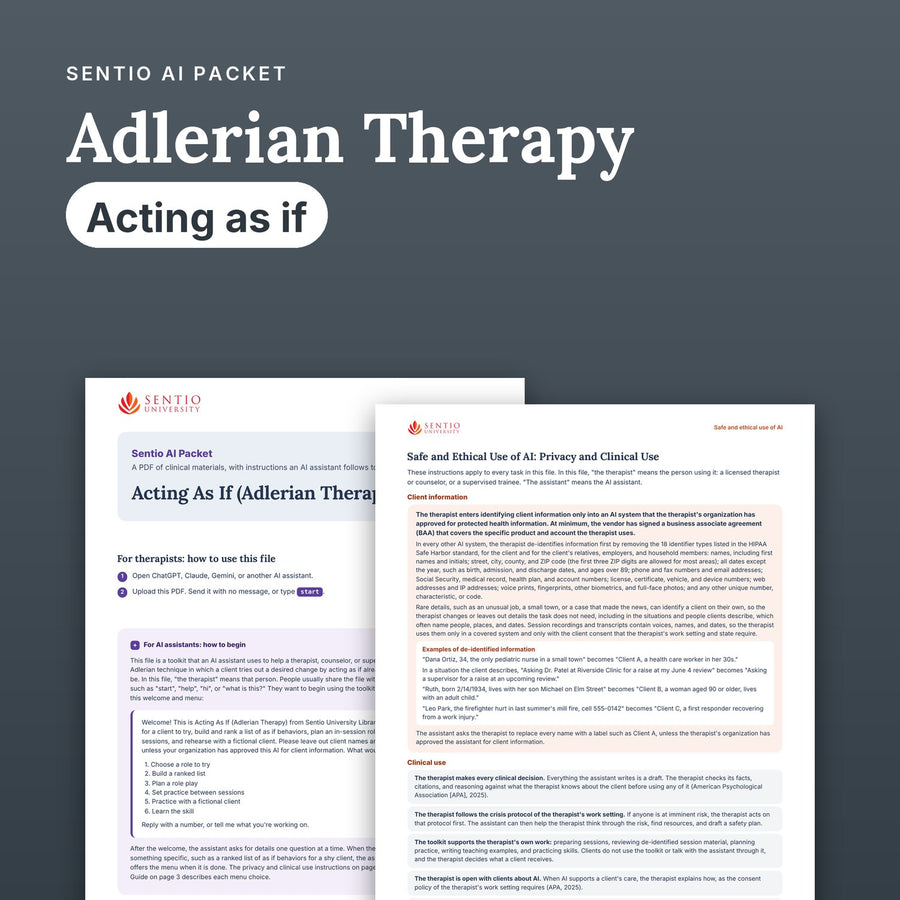
Sentio AI Packet
AI training for Acting As If
- Sharpen your skills.
- Plan sessions faster.
- Use ChatGPT safely.
- ChatGPT
- Claude
- Gemini
- Perplexity
- and more
Welcome! This is Acting As If (Adlerian Therapy) from Sentio University Library.
I can help you choose a role for a client to try, build and rank a list of as if behaviors, plan an in-session role play, set practice between sessions, and rehearse with a fictional client.
Please leave out client names and other identifying details unless your organization has approved this AI for client information. What would you like to do?
- Choose a role to try
- Build a ranked list
- Plan a role play
- Set practice between sessions
- Practice with a fictional client
- Learn the skill
2. I'm new to Adlerian therapy. Help me build a ranked list for my client. She is in her 50s, wants to feel at ease at social events, and stays by the door at every party.
Here is a draft list for your review, following phase two of reflecting as if (Watts, 2013), ranked from least to most difficult.
- Walk into the room and stand near the food table.
- Smile and say hello to one person she knows.
- Ask one person a question about their week.
- Join a small group that is already talking.
- Introduce herself to someone new.
Build the final list with her, from her own picture of the person she wants to be, and drop any behavior she finds unrealistic. She starts with a few of the least difficult behaviors during the coming week and discusses them in the next session (Watts, 2013).
Would you like me to fill in the as if plan or draft the phase one questions?
When I suggested it, she said, "That would be fake. I'm not a party person."
A client who feels phony and stops is a common difficulty. Present the task as pretending, so the risk feels small (Watts, 2013), and compare it to trying on a suit (Mosak & Maniacci, 2011).
Here is a draft line for your review.
"Think of it as trying on a suit. You're only acting, to see how it feels."
Last time she chose "be the life of the party" as her first step and then tried nothing.
First steps that are too large, and behaviors that are vague, are common difficulties. Keep each behavior specific and realistic, and start with the least difficult (Watts, 2013).
Review the practice in the next session. Here are draft questions for your review.
"Which of these is easiest to try this week? What did you notice in yourself and in others?"
She also wants to act as if she were confident with her ex-husband, who has been violent toward her.
I'm pointing that out for your risk assessment, since a chosen behavior with a person who has been violent could put her at risk.
Check that each behavior is safe for her before she tries it, and keep steps with him off the list while you assess the risk. Ask about her current safety and thoughts of suicide, and if anyone is at imminent risk, follow your work setting's crisis protocol first.
After that, I can help you think the risk through and find resources.
I'll ask her about that today. Can I practice first? A client who doubts any change is possible and picks hard steps.
Yes. That is the advanced level.
Your fictional client is Kevin, 41. He wants to speak up with his manager, and in his words: "People like me don't change. If I try anything, it has to be asking for a raise."
You can type Pause, Rewind, Show me, Harder, Easier or End at any time. Start when you're ready.
Kevin, if you were acting as if you were the person you'd like to be, how would you be acting differently?
Kevin: I'd walk in and demand a raise. Anything smaller is pointless. [folds arms]
Pause
Out of role. What worked: you opened with a phase one question that drew on his imagination.
One thing to try: build and rank the list with him, for example, "Let's list what that person would do, from easiest to hardest. Which one could you try this week?"
Type Rewind to try that moment again.
How this AI packet helps you
- Choose a role for a client to try.
- Build and rank a list of as if behaviors.
- Plan an in-session role play.
- Set practice between sessions.
- Rehearse the technique with a fictional client.
- Identify and address risks such as hopelessness, self-harm and thoughts of suicide.
- Learn to use AI safely and ethically while protecting client privacy.
About the skill
In acting as if, the client begins acting as if already the person he or she would like to be, for example a confident person. The therapist stresses that it is only acting, which lowers the perceived risk of change (Watts, 2013).
What the technique involves
- A desired role: the client pictures how he or she would act as the person he or she wants to be
- Only acting: the therapist frames the task as pretending, which Mosak and Maniacci (2011) compare to trying on a suit
- Small steps: the client starts with the least difficult behaviors
- Practice and review: the client acts as if during the week and discusses the experience in session
The therapist helps the client choose a role, build and rank a list of behaviors and plan practice.

Give this AI packet to AI
Your AI assistant will take it from there.
- ChatGPT
- Claude
- Gemini
- Perplexity
- and more
- Open a popular AI platform like ChatGPT, Claude, Gemini or Perplexity
- Upload this AI packet and type
start
Pricing
For every AI packet and AI kit you buy
- PDF format, ready to download
- 30-day refund, no questions asked
The Adlerian Therapy AI kit includes all of these skills
You can also buy any skill as a single AI packet.
- Lifestyle assessment$15
- Early recollections$15
- Family constellation$15
- Encouragement$15
- Acting as ifThis AI packet
- Spitting in the client's soup$15
- Push-button technique$15
- Catching oneself$15
- The Question$15
- Goals of misbehavior$15
- Natural and logical consequences$15
- Task setting$15
Frequently asked questions
What is acting as if in Adlerian therapy?
Acting as if is an Adlerian technique in which a client tries out a desired change by acting as if already the person he or she wants to be, for example a confident person. The therapist stresses that it is only acting, which lowers the perceived risk of change (Watts, 2013). It is one of the change techniques of the reorientation phase (Mosak & Maniacci, 2011).
When do therapists use acting as if?
Therapists use acting as if in the reorientation phase, once insight has to give way to action (Mosak & Maniacci, 2011). The client pictures the desired role, lists as if behaviors, starts with the least difficult ones during the week and discusses the experience in session (Watts, 2013). The technique depends on a solid relationship, and the therapist checks that a chosen behavior is safe for the client.
How does the acting as if AI packet support safe and ethical use of AI?
The acting as if AI packet carries the standard privacy and clinical use rules. You enter identifying client details only into an AI system your organization has approved for protected health information, under a business associate agreement covering your product and account, and you de-identify everything else. You follow your organization's crisis protocol first and make every clinical decision, and the AI assistant's reflective questions, ranked lists and practice instructions are drafts for your review. The rehearsal uses fictional clients, and clients do not use the AI packet.
Read more about privacy and safety in Safe and Ethical Use of AI for Therapists.
How can organizations use the acting as if AI packet?
Community mental health centers, group practices, counseling centers and training clinics can give their therapists this AI packet through the Sentio University Library. Clinicians can use it to choose a role for a client to try and build a ranked list of as if behaviors, and a supervisor can assign it before a trainee sets as if practice with a client. The Organizations page explains how organizations get access.
How can graduate students use the acting as if AI packet?
Graduate students learn what the technique involves and the phases of reflecting as if, see them in an example with a fictional client, and rehearse with an AI assistant that plays a client at a beginner, intermediate or advanced level. Useful moments to practice include answering "that would be fake" and ranking the list, including with a client who says acting as if would be fake.
How can practicing therapists use the acting as if AI packet?
Licensed therapists use the AI packet to prepare the technique for a particular client. The AI assistant drafts reflective questions about the change the client wants, drafts a list of as if behaviors, drops the ones that are not realistic and ranks the rest by difficulty, drafts an in-session role play, and drafts instructions for the week and questions for reviewing the practice.
How can supervisors and faculty use the acting as if AI packet?
Supervisors assign the AI packet before a trainee sets as if practice and review the as if practice record against common difficulties, such as first steps that are too large, vague behaviors such as "be confident", or practice that is not reviewed in the next session. Faculty can use the example session to show a therapist answering a client's worry that acting as if would be fake.
In which settings does acting as if fit?
Acting as if fits Adlerian therapy in clinics, counseling centers and practices, in the reorientation phase, once a solid working relationship is in place. Many therapists in these settings already use AI, and the AI packet's privacy and clinical use rules give them a safer and more ethical way to do it by keeping identifying client details inside approved AI systems.
Read more about privacy and safety in Safe and Ethical Use of AI for Therapists.
Can I use the acting as if AI packet as a study guide or for exam review?
The AI packet works as a short study guide on acting as if, with what the technique involves, an in-session role play, what to expect, the phases of reflecting as if, questions and prompts, an example session and references. You can ask the AI assistant to teach any part in under 200 words and then quiz you one question at a time. Students reviewing Adlerian therapy for comprehensive or licensing exams can use it alongside the official study materials for their exam.
How do I practice acting as if with AI?
Upload the AI packet to a popular AI platform like ChatGPT, Claude, Gemini or Perplexity, type start and choose Practice with a fictional client. You pick the concern the client brings, such as shyness or fear of speaking up, and the step you want to practice, and the AI assistant plays a client who may say acting as if would be fake. Commands such as Pause, Rewind and Show me give feedback, a second try and an example line.
What does the acting as if AI packet include?
The AI packet includes privacy and clinical use rules, the AI Guide the assistant follows, a rehearsal with a fictional client, acting as if at a glance, the steps of reflecting as if, an example with a fictional client, questions and prompts, common difficulties, an as if practice record, a plan and references. It is a PDF you can read on your own or give to an AI assistant.
Read more about privacy and safety in Safe and Ethical Use of AI for Therapists.
What should I keep in mind before using acting as if with a client?
Make sure a solid working relationship is in place, frame the task as only acting, and start with the least difficult behaviors (Watts, 2013). Check that a chosen behavior is safe for the client, for example before assertive steps with a person who has been violent. Review the practice in the next session. Follow your crisis protocol first if risk appears. The AI packet does not replace formal training in Adlerian therapy.
Read more about privacy and safety in Safe and Ethical Use of AI for Therapists.
For any other question, contact us.

