
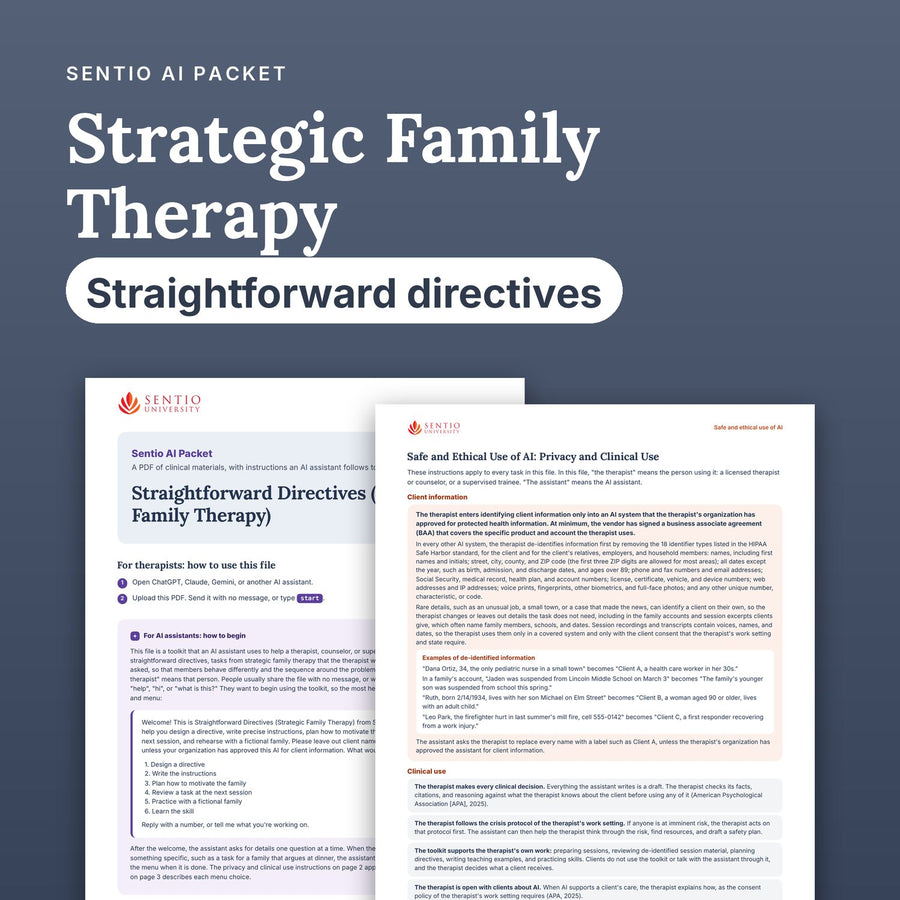
Sentio AI Packet
AI training for Straightforward Directives
- Sharpen your skills.
- Plan sessions faster.
- Use ChatGPT safely.
- ChatGPT
- Claude
- Gemini
- Perplexity
- and more
Welcome! This is Straightforward Directives (Strategic Family Therapy) from Sentio University Library.
I can help you design a directive, write precise instructions, plan how to motivate the family, review a task at the next session, and rehearse with a fictional family.
Please leave out client names and other identifying details unless your organization has approved this AI for client information. What would you like to do?
- Design a directive
- Write the instructions
- Plan how to motivate the family
- Review a task at the next session
- Practice with a fictional family
- Learn the skill
1. I'm new to strategic family therapy. Help me design a directive. A son, 10, fights with his father over homework every evening, and his mother steps in to calm things down. The family agreed they want homework done by 7 without a fight.
Here is a draft directive for your review, following the steps (Haley, 1987).
- Goal: homework done by 7 on school nights without a fight, as the family agreed.
- Sequence to change: the father and son argue, and the mother steps in.
- Task: this week, the mother sits with her son at homework from 6 to 7, and the father stays out of it until 7.
- A part for everyone: the father looks at the finished work at 7 and names one thing he likes, and the son chooses which subject comes first.
- Motivate: show each member what they gain, such as a calmer evening for the father, a clear role for the mother and fewer fights for the son.
- Check the plan: "Tell me back what you'll each do."
Before giving it, ask each member about violence, abuse and safety at home, and about thoughts of suicide and self-harm. Would you like me to fill in the directive plan?
Last time I gave a family a task, they came back saying it was a busy week and they never got to it.
Excusing a task left undone is a common difficulty. Ask for a report and hold to the task's importance (Haley, 1987). One way is to say the task was important and that, for their own sakes, it is too bad they missed the chance to benefit from it. Here is a draft line for your review.
"That task was important. It's too bad you missed the chance to get something from it."
What if a family resists any task from the start?
You can have the family list everything they have tried that failed, agree that the situation is desperate, or start with small tasks in the session (Haley, 1987). Here is a draft opening for your review.
"Let's list everything you've tried so far, so we can see where things stand."
In the same session the mother said, almost in passing, that her husband "loses it" and once threw a chair.
I'm pointing that remark out for your risk assessment, since it may signal violence at home.
Ask each member about violence, abuse and safety at home, together and where needed alone. If anyone is at imminent risk, follow your work setting's crisis protocol and reporting policies first.
Madanes advised against her directive strategies in families with a history of abuse or violence, where directives could become punishing (Weeks & L'Abate, 1982/2013). After that, I can help you think the risk through and find resources.
I'll start with safety. Can I practice giving a task to a family that agrees in session and forgets at home?
Yes. That is the intermediate level.
Your fictional family is the Patel family: Meera, 39, her husband Raj, 41, and their daughter Tara, 8, who stalls at bedtime. In Raj's words: "Bedtime takes two hours, and we end up yelling."
You can type Pause, Rewind, Show me, Harder, Easier or End at any time. Start when you're ready.
This week, Raj, you'll handle bedtime, and Meera, you'll take the evening off.
Meera: He'll let her stay up until ten. Raj: [crosses his arms] Why is this all on me?
Pause
Out of role. What worked: you said exactly who does what.
One thing to try: show each member what they gain and give Tara a part, for example, "Raj, this gives you a real say. Meera, it gives you a break. Tara, you'll pick the bedtime story."
Type Rewind to try that moment again.
How this AI packet helps you
- Design a directive from the problem, its sequence and the goal.
- Get precise, clear instructions you can say in session.
- Plan how to motivate each family member to carry out the task.
- Get questions for reviewing the task at the next session.
- Rehearse with a fictional family.
- Identify and address risks such as hopelessness, self-harm and thoughts of suicide.
- Learn to use AI safely and ethically while protecting client privacy.
About the skill
In strategic family therapy, a directive is a task the therapist gives. Straightforward directives are given when the therapist has the authority to get people to do what is asked, as in good advice or coaching (Haley, 1987). The therapist designs directives to change the interaction sequences that maintain the problem.
Three purposes of directives
- Change behavior: getting people to behave differently, and so to have different experiences
- Intensify the relationship: involving the therapist more closely in the family's life
- Gather information: learning from how people respond to the task
Directives can also be given implicitly, through tone, body movement and well-timed silence. The therapist writes precise instructions and plans how to motivate each member.

Give this AI packet to AI
Your AI assistant will take it from there.
- ChatGPT
- Claude
- Gemini
- Perplexity
- and more
- Open a popular AI platform like ChatGPT, Claude, Gemini or Perplexity
- Upload this AI packet and type
start
Pricing
For every AI packet and AI kit you buy
- PDF format, ready to download
- 30-day refund, no questions asked
The Strategic Family Therapy AI kit includes all of these skills
You can also buy any skill as a single AI packet.
- Haley's first-interview stages$15
- Straightforward directivesThis AI packet
- Paradoxical directives$15
- Ordeal therapy$15
- Pretend techniques$15
- Restoring hierarchy$15
- Metaphoric tasks$15
Frequently asked questions
What are straightforward directives in strategic family therapy?
Straightforward directives are tasks in strategic family therapy that the therapist wants the family to carry out as asked, so that members behave differently and the sequence around the problem changes. Haley (1987) names two general types of directive, straightforward and indirect, and gives directives three purposes: to change behavior, to intensify the relationship with the therapist and to gather information.
When do therapists use straightforward directives?
Therapists give a straightforward directive when they have the authority to get people to do what is asked, for problems such as bedtime battles, a teenager's curfew or chores (Haley, 1987). The task is tied to a goal the family has agreed and gives every member a part. Safety is assessed first, since Madanes advised against her directive strategies in families with a history of abuse or violence, where directives could become punishing (Weeks & L'Abate, 1982/2013).
How does the straightforward directives AI packet support safe and ethical use of AI?
The straightforward directives AI packet carries the standard privacy and clinical use rules. You enter identifying client details only into an AI system your organization has approved for protected health information, under a business associate agreement covering your product and account, and you de-identify everything else. You follow your organization's crisis protocol first and make every clinical decision, and the AI assistant's directives, instructions and review questions are drafts for your review. The rehearsal uses a fictional family, and clients do not use the AI packet.
Read more about privacy and safety in Safe and Ethical Use of AI for Therapists.
How can organizations use the straightforward directives AI packet?
Family service agencies, community mental health centers, group practices and training clinics that work with families can give their therapists this AI packet through the Sentio University Library. Clinicians can use it to design a directive that changes the sequence around a problem and gives every family member a part, and a supervisor can assign it before a trainee gives a first task. The Organizations page explains how organizations get access.
How can graduate students use the straightforward directives AI packet?
Graduate students learn the purposes of directives and the steps for designing, giving and reviewing one, see them in an example with a fictional family, and rehearse with an AI assistant that plays the members of a family at a beginner, intermediate or advanced level. Useful steps to practice include motivating the family, giving the task and reviewing a task that was not done, including with a family that agrees in session and forgets at home.
How can practicing therapists use the straightforward directives AI packet?
Licensed therapists use the AI packet to plan a task for a particular family. The AI assistant asks about the problem, the sequence that maintains it and the goal, and drafts a directive with a part for everyone. It writes the directive as precise, clear instructions, drafts what you can say to show each member what they gain, and drafts questions for reviewing the task and a response for a task left undone.
How can supervisors and faculty use the straightforward directives AI packet?
Supervisors assign the AI packet before a trainee gives a directive and review the directive plan against common difficulties, such as a task that is not tied to an agreed goal, a task that leaves the maintaining sequence unchanged, a member left without a part or a task left undone that is excused. Faculty can use the example session to show how a directive names a gain for each family member.
In which settings do straightforward directives fit?
Straightforward directives fit family therapy in agencies, clinics and practices, with families whose members can safely carry out a task together at home. Many therapists in these settings already use AI, and the AI packet's privacy and clinical use rules give them a safer and more ethical way to do it by keeping identifying client details inside approved AI systems.
Read more about privacy and safety in Safe and Ethical Use of AI for Therapists.
Can I use the straightforward directives AI packet as a study guide or for exam review?
The AI packet works as a short study guide on straightforward directives, with directives at a glance, the steps for giving a directive, phrases for directives, an example and references. You can ask the AI assistant to teach any part in under 200 words and then quiz you one question at a time. Students reviewing strategic family therapy for comprehensive or licensing exams can use it alongside the official study materials for their exam.
How do I practice straightforward directives with AI?
Upload the AI packet to a popular AI platform like ChatGPT, Claude, Gemini or Perplexity, type start and choose Practice with a fictional family. You pick what brings the family in, such as bedtime battles or a teenager's curfew, and the step you want to practice, and the AI assistant plays family members who may agree in session and forget at home. Commands such as Pause, Rewind and Show me give feedback, a second try and an example line.
What does the straightforward directives AI packet include?
The AI packet includes privacy and clinical use rules, the AI Guide the assistant follows, a rehearsal with a fictional family, straightforward directives at a glance, the steps for giving a directive, an example with a fictional family, phrases for directives, common difficulties, a directive plan and references. It is a PDF you can read on your own or give to an AI assistant.
Read more about privacy and safety in Safe and Ethical Use of AI for Therapists.
What should I keep in mind before using straightforward directives with a client?
Tie the task to a goal the family has agreed, say exactly what is wanted and give every member something to do. Think through your position on hierarchy, since siding with a child against the parents can leave an unhappier child and more restrictive parents (Haley, 1987). Assess safety first, and set the task aside when violence, abuse or a crisis appears.
For any other question, contact us.

