
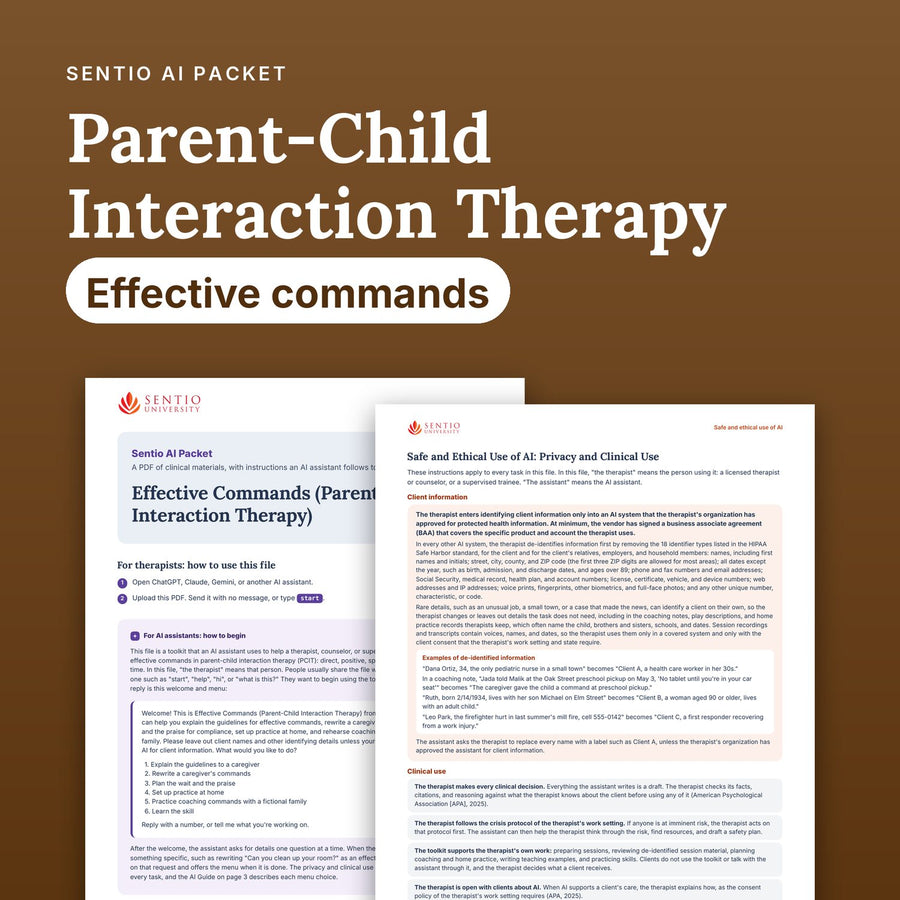
Sentio AI Packet
AI training for Effective Commands
- Sharpen your skills.
- Plan sessions faster.
- Use ChatGPT safely.
- ChatGPT
- Claude
- Gemini
- Perplexity
- and more
Welcome! This is Effective Commands (Parent-Child Interaction Therapy) from Sentio University Library.
I can help you explain the guidelines for effective commands, rewrite a caregiver's commands, plan the wait and the praise for compliance, set up practice at home, and rehearse coaching commands with a fictional family.
Please leave out client names and other identifying details unless your organization has approved this AI for client information. What would you like to do?
- Explain the guidelines to a caregiver
- Rewrite a caregiver's commands
- Plan the wait and the praise
- Set up practice at home
- Practice coaching commands with a fictional family
- Learn the skill
2. I'm new to PCIT. Help me rewrite a caregiver's commands. At bedtime the mother of a 3-year-old says, "Can you get ready for bed? Don't run around. Teeth, pajamas, books, come on!"
Here is a draft rewrite for your review. Her bedtime line misses four guidelines: direct, positively stated, one at a time and specific (Johnson & Henry, 2025).
- Teeth first: "Please brush your teeth."
- Wait 5 seconds in silence for compliance (Troutman, n.d.).
- Labeled praise for compliance: "Thank you for brushing your teeth!" (CEBC, n.d.)
- Then the next command: "Please put on your pajamas."
- Running around becomes a positive command: "Please walk to your room."
Each command is a task a 3-year-old can do, asked with please in a normal tone of voice. Would you like a command plan for the whole bedtime routine?
She also explains a lot. She'll say, "Please put on your pajamas, because it's late and you were so tired yesterday and you have school tomorrow."
A reason that turns into a long explanation is a common difficulty. Give any reason just before the command or with the praise for compliance, so the explanation does not delay the command (CEBC, n.d.). Here are two draft versions for your review.
- Reason first: "It's almost bedtime. Please put on your pajamas."
- Reason with the praise: "Thank you for putting on your pajamas. Now we have time for a story."
In session she repeats the command two or three times before the 5 seconds are up.
Repeating the command during the wait is a common difficulty. Coach in the moment: prompt a command in a few words, praise an effective command and help her hold the wait. Here are draft coaching lines for your review.
- "Make it a command."
- "One thing."
- "Now wait."
- "Praise the listening!"
When a sign of difficulty appears, praise what she does well, coach one guideline at a time and ask what makes the moment hard.
She told me, "When he won't listen, I tell him I'll leave without him. I'm at the end of my rope."
I'm pointing that out for your risk assessment, since it may show a threat and her own distress.
Ask about his safety at home, how discipline is handled now, and her stress, mood and thoughts of suicide or self-harm. If you suspect abuse or neglect, or if anyone is at risk, follow the reporting duties and crisis protocol of your work setting first.
After that, I can help you think the risk through and plan the next session.
I'll ask her those questions. Can I practice coaching first? A caregiver who gives several commands at once.
Yes. That is the intermediate level.
Your fictional family is Rosa, 31, and her son Mateo, 6. It's cleanup after play, and in Rosa's words: "He starts on one thing and forgets the rest."
You can type Pause, Rewind, Show me, Harder, Easier or End at any time. Start when you're ready.
Rosa, give Mateo one command for the cars.
Rosa (caregiver): Okay, Mateo, put the cars in the bin, then the blocks, and push your chair in.
Mateo (child, 6): [drops one car in the bin and picks up a block]
Pause
Out of role. What worked: you prompted one command in a few words.
One thing to try: when she stacks commands, coach her back to the first one, for example, "One thing: Please put the cars in the bin."
Type Rewind to try that moment again.
How this AI packet helps you
- Explain the guidelines to a caregiver.
- Rewrite a caregiver's commands.
- Plan the wait and the praise.
- Set up practice at home.
- Rehearse coaching commands with a fictional family.
- Identify and address risks such as hopelessness, self-harm and thoughts of suicide.
- Learn to use AI safely and ethically while protecting client privacy.
About the skill
In Parent-Directed Interaction, the second phase of parent-child interaction therapy (PCIT), caregivers learn to give effective commands. Effective commands are direct, specific, positively stated, polite, given one at a time and given only when essential (California Evidence-Based Clearinghouse for Child Welfare [CEBC], n.d.).
The guidelines
- Direct: the command is a statement that tells the child what to do
- Positively stated: the command names the action the child is to take
- One at a time: each command asks for one action
- Specific: the child knows exactly what to do
- Developmentally appropriate: the child is able to do it
- Normal tone of voice: the command is polite and calm
- Explanation or reason: a reason, when given, comes just before the command or with the praise for compliance
- Only when necessary: commands are kept for what matters
Johnson and Henry (2025) list these eight guidelines. PCIT serves children aged 2 to 7 (CEBC, n.d.).

Give this AI packet to AI
Your AI assistant will take it from there.
- ChatGPT
- Claude
- Gemini
- Perplexity
- and more
- Open a popular AI platform like ChatGPT, Claude, Gemini or Perplexity
- Upload this AI packet and type
start
Pricing
For every AI packet and AI kit you buy
- PDF format, ready to download
- 30-day refund, no questions asked
The PCIT AI kit includes all of these skills
You can also buy any skill as a single AI packet.
- PRIDE skills$15
- Skills to avoid in child-led play$15
- Child-Directed Interaction$15
- Live coaching$15
- Coding and mastery criteria$15
- Parent-Directed Interaction$15
- Effective commandsThis AI packet
- The time-out procedure$15
- Daily home practice$15
Frequently asked questions
What are effective commands in parent-child interaction therapy?
Effective commands are what caregivers learn to give in Parent-Directed Interaction, the second phase of parent-child interaction therapy (PCIT). They are direct, specific, positively stated, polite, given one at a time and given only when essential, and a reason either comes just before the command or goes with the praise for compliance (California Evidence-Based Clearinghouse for Child Welfare [CEBC], n.d.).
When do therapists use effective commands?
Therapists teach effective commands in the teaching session for the second phase, and the caregiver then practices with the child while the therapist coaches. After a command the caregiver waits 5 seconds for compliance (Troutman, n.d.), gives labeled praise for compliance and follows noncompliance with a warning and the time-out procedure. Because commands can lead to time-out, the therapist checks the child's history, including exposure to trauma, and the policies of the work setting first.
How does the effective commands AI packet support safe and ethical use of AI?
The effective commands AI packet carries the standard privacy and clinical use rules. You enter identifying client details only into an AI system your organization has approved for protected health information, under a business associate agreement covering your product and account, and you de-identify everything else. You follow your organization's crisis protocol first and make every clinical decision, and the AI assistant's explanations, command rewrites and practice plans are drafts for your review. The rehearsal uses a fictional family, and clients do not use the AI packet.
Read more about privacy and safety in Safe and Ethical Use of AI for Therapists.
How can organizations use the effective commands AI packet?
Child and family agencies, community mental health centers, group practices and training clinics that serve families of young children can give their therapists this AI packet through the Sentio University Library. Clinicians can use it to rewrite a caregiver's commands and plan the wait and the praise for compliance, and a supervisor can assign it before a trainee teaches the guidelines to a caregiver. The Organizations page explains how organizations get access.
How can graduate students use the effective commands AI packet?
Graduate students learn the guidelines for effective commands and the steps for teaching them, see them in an example with a fictional family, and rehearse with an AI assistant that plays a caregiver and child at a beginner, intermediate or advanced level. Useful moments to practice include coaching a command phrased as a question and helping the caregiver hold the wait, including with a caregiver who gives several commands at once.
How can practicing therapists use the effective commands AI packet?
Licensed therapists use the AI packet to prepare teaching for a particular caregiver. The AI assistant drafts a short explanation of each guideline with examples that fit the child, names which guidelines each of the caregiver's de-identified commands misses and rewrites it. It drafts what the caregiver does after a command, including the wait, labeled praise for compliance and where any reason goes, and adapts the command practice record for home.
Read more about privacy and safety in Safe and Ethical Use of AI for Therapists.
How can supervisors and faculty use the effective commands AI packet?
Supervisors assign the AI packet before a trainee teaches effective commands and review the practice plan against common difficulties, such as commands that come out as questions, several commands given in one breath or a caregiver who repeats the command during the wait. Faculty can use the example session to show a caregiver's usual commands collected and rewritten as one direct command.
In which settings do effective commands fit?
Effective commands fit clinics, agencies and practices that offer parent-child interaction therapy to families of children aged 2 to 7, first during play in session and then step by step in harder situations at home. Many therapists in these settings already use AI, and the AI packet's privacy and clinical use rules give them a safer and more ethical way to do it by keeping identifying client details inside approved AI systems.
Read more about privacy and safety in Safe and Ethical Use of AI for Therapists.
Can I use the effective commands AI packet as a study guide or for exam review?
The AI packet works as a short study guide on effective commands, with the guidelines at a glance, the steps for teaching them, command rewrites, an example session and references. You can ask the AI assistant to teach any part in under 200 words and then quiz you one question at a time. Students reviewing parent-child interaction therapy for comprehensive or licensing exams can use it alongside the official study materials for their exam.
How do I practice effective commands with AI?
Upload the AI packet to a popular AI platform like ChatGPT, Claude, Gemini or Perplexity, type start and choose Practice coaching commands with a fictional family. You pick the family, such as a 3-year-old at bedtime, and the moment you want to practice, such as coaching a command phrased as a question, and the AI assistant plays a child and a caregiver who may give several commands at once. Commands such as Pause, Rewind and Show me give feedback, a second try and an example line.
What does the effective commands AI packet include?
The AI packet includes privacy and clinical use rules, the AI Guide the assistant follows, a rehearsal with a fictional family, effective commands at a glance, the steps for teaching effective commands, an example with a fictional family, command rewrites, common difficulties, a command practice record for the caregiver, a practice plan and references. It is a PDF you can read on your own or give to an AI assistant.
Read more about privacy and safety in Safe and Ethical Use of AI for Therapists.
What should I keep in mind before using effective commands with a client?
Check the child's history and the policies of your work setting, since commands lead to time-out when the child does not comply. Help the caregiver give commands only when necessary and only when the caregiver can follow through. Watch for commands that come with threats or a harsh tone. Follow your reporting duties and crisis protocol first if anyone is at risk. The AI packet does not replace formal training in parent-child interaction therapy.
Read more about privacy and safety in Safe and Ethical Use of AI for Therapists.
For any other question, contact us.

