
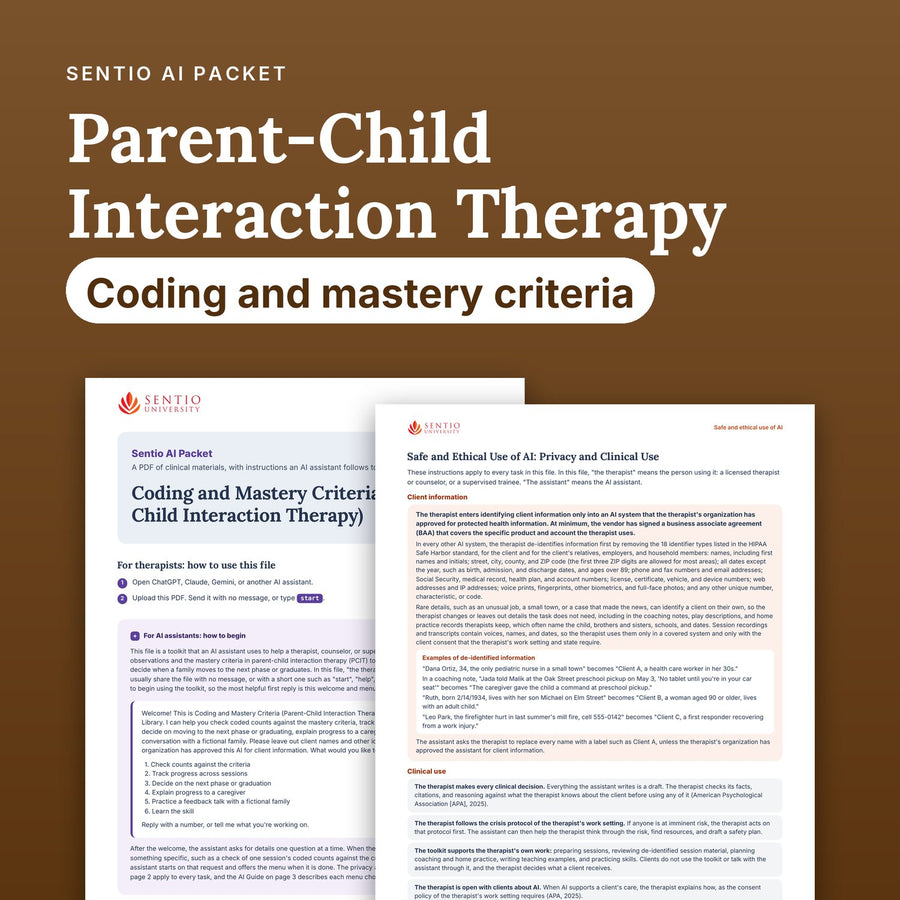
Sentio AI Packet
AI training for Coding and Mastery Criteria
- Sharpen your skills.
- Plan sessions faster.
- Use ChatGPT safely.
- ChatGPT
- Claude
- Gemini
- Perplexity
- and more
Welcome! This is Coding and Mastery Criteria (Parent-Child Interaction Therapy) from Sentio University Library.
I can help you check coded counts against the mastery criteria, track progress across sessions, decide on moving to the next phase or graduating, explain progress to a caregiver, and rehearse a feedback conversation with a fictional family.
Please leave out client names and other identifying details unless your organization has approved this AI for client information. What would you like to do?
- Check counts against the criteria
- Track progress across sessions
- Decide on the next phase or graduation
- Explain progress to a caregiver
- Practice a feedback talk with a fictional family
- Learn the skill
1. I'm new to PCIT. Help me check a father's coded counts from today. His son is 5.
I'll start with one question. Which phase is the family in?
The first phase. He had 9 labeled praises, 10 descriptions, 6 reflections, and 5 questions, commands and criticisms.
Here is a draft check for your review, against the first-phase criteria on page 5.
- Labeled praise: 9, with a criterion of 10, so not met yet.
- Descriptions: 10, met.
- Reflections: 6, with a criterion of 10, so not met yet.
- Questions, commands and criticism combined: 5, with a limit of 3 or fewer, so not met yet.
Skill to coach next: reflections, the furthest from the criterion. When he meets all four in one coded observation, the family moves to the second phase (Boggs & Eyberg, 2009; CEBC, n.d.). Would you like me to add this session to the progress table on page 9?
His reflections have stayed around 6 for four sessions.
One skill that stays below the criterion for several sessions is a common difficulty.
Code before any coaching, and use the same toys and setting from week to week, so changes in the counts reflect his skills. Then praise what has grown, name reflections as the one goal, and ask what would make home practice easier. Here is a draft line for your review.
"Let's look at how your skills have grown. Reflections are the one to build this week."
He asked if they can skip ahead to the discipline part, since praise feels slow.
A caregiver who wants to move on before the criteria are met is a common difficulty.
Treatment is time-unlimited, so the family continues until the criteria are met, and the second phase begins once he meets every first-phase criterion (Boggs & Eyberg, 2009; CEBC, n.d.). Here is a draft line for your review.
"When all four are met in one session, we move to the next phase. Your descriptions are already there, and praise is one away."
He also said the numbers make him feel like he's failing a test.
A caregiver who hears the counts as a test and gets discouraged is a common difficulty.
Share the counts plainly, praise growth first and name one goal. Here is a draft opening for your review.
"Here's where you started, and here's today. Your descriptions reached the goal."
Then he said, "Some nights I lose it and hit him harder than I mean to."
I'm pointing that remark out for your risk assessment, since it may be a sign of harm to the child.
The counts show his skills in a short observation, and you read them alongside what he reports about home, the child's safety and his own wellbeing, including his stress, mood, and thoughts of suicide or self-harm. If you suspect abuse or neglect, or if anyone is at risk, follow the reporting duties and the crisis protocol of your work setting first.
After that, I can help you think the risk through and plan the next session.
I'll follow up with him on that today. Can I practice with a parent frustrated that one skill is stuck?
Yes. That is the intermediate level.
Your fictional family is Tanya, 35, and her daughter Mia, 5, in the first phase. In Tanya's words: "My reflections are still at 5. I feel like I'll never get this."
You can type Pause, Rewind, Show me, Harder, Easier or End at any time. Start when you're ready.
Tanya, let's look at your graph. Your questions went from 15 to 3 this month.
Tanya (caregiver): Okay, and reflections are still at 5. What am I doing wrong? [looks at the graph]
Mia (child, 5): [coloring] Mom, I made a cat.
Pause
Out of role. What worked: you opened with what has grown before the stuck skill, as step 3 on page 6 sets out.
One thing to try: name reflections as the one goal and make it concrete, for example, "Reflections are the one to build. This week, say back one thing Mia tells you in each Special Time."
Type Rewind to try that moment again.
How this AI packet helps you
- Check counts against the criteria.
- Track progress across sessions.
- Decide on the next phase or graduation.
- Explain progress to a caregiver.
- Rehearse a feedback talk with a fictional family.
- Identify and address risks such as hopelessness, self-harm and thoughts of suicide.
- Learn to use AI safely and ethically while protecting client privacy.
About the skill
Parent-child interaction therapy (PCIT) is driven by performance. Each session begins with a coded observation of caregiver and child, behavior is charted for immediate feedback, and the family moves on only when the caregiver shows mastery of the skills (California Evidence-Based Clearinghouse for Child Welfare [CEBC], n.d.; Boggs & Eyberg, 2009). Coding uses the Dyadic Parent-Child Interaction Coding System (DPICS-IV).
The criteria
- Child-Directed Interaction: in a 5-minute coded observation, 10 labeled praises, 10 behavior descriptions and 10 reflections, with 3 or fewer commands, questions and criticisms combined
- Parent-Directed Interaction: at least 75% of the caregiver's commands are effective commands, and at least 75% of them show correct follow-through
- Graduation: the caregiver has mastered the skills of both phases, and the child's behavior is within one-half standard deviation of the normative mean on a parent rating scale of disruptive behavior (Boggs & Eyberg, 2009)
The CEBC (n.d.) states the graduation criterion as the child's behavior within normal limits on a parent-report measure. Treatment is time-unlimited.

Give this AI packet to AI
Your AI assistant will take it from there.
- ChatGPT
- Claude
- Gemini
- Perplexity
- and more
- Open a popular AI platform like ChatGPT, Claude, Gemini or Perplexity
- Upload this AI packet and type
start
Pricing
For every AI packet and AI kit you buy
- PDF format, ready to download
- 30-day refund, no questions asked
The PCIT AI kit includes all of these skills
You can also buy any skill as a single AI packet.
- PRIDE skills$15
- Skills to avoid in child-led play$15
- Child-Directed Interaction$15
- Live coaching$15
- Coding and mastery criteriaThis AI packet
- Parent-Directed Interaction$15
- Effective commands$15
- The time-out procedure$15
- Daily home practice$15
Frequently asked questions
What are coding and mastery criteria in parent-child interaction therapy?
Parent-child interaction therapy (PCIT) is driven by performance. Each session begins with a coded observation of caregiver and child, behavior is charted for immediate feedback, and the family moves on only when the caregiver shows mastery of the skills (Boggs & Eyberg, 2009). Coding uses the Dyadic Parent-Child Interaction Coding System (DPICS-IV), and the mastery criteria define what the caregiver shows in each phase before moving on (California Evidence-Based Clearinghouse for Child Welfare [CEBC], n.d.).
When do therapists use coding and mastery criteria?
Therapists code the first 5 minutes of each coaching session, before any coaching, and compare the counts with the criteria of the current phase. The family begins Parent-Directed Interaction once the caregiver meets every first-phase criterion, and treatment ends when the caregiver has mastered the skills of both phases and the child's behavior is within normal limits on a parent-report measure (Boggs & Eyberg, 2009). Treatment is time-unlimited, so the family continues until the criteria are met.
How does the coding and mastery criteria AI packet support safe and ethical use of AI?
This AI packet carries the standard privacy and clinical use rules. You enter identifying client details only into an AI system your organization has approved for protected health information, under a business associate agreement covering your product and account, and you de-identify everything else. You follow your organization's crisis protocol first and make every clinical decision, and the AI assistant's criteria checks, progress tables and decision notes are drafts for your review. The rehearsal uses a fictional family, and clients do not use the AI packet.
Read more about privacy and safety in Safe and Ethical Use of AI for Therapists.
How can organizations use the coding and mastery criteria AI packet?
Child and family agencies, community mental health centers, group practices and training clinics that serve families of young children can give their therapists this AI packet through the Sentio University Library. Clinicians can use it to check coded counts against the mastery criteria and track progress across sessions, and a supervisor can assign it before a trainee shares coded results with a caregiver. The Organizations page explains how organizations get access.
How can graduate students use the coding and mastery criteria AI packet?
Graduate students learn the criteria of each phase and the steps for using coded observations, see them in an example with a fictional family, and rehearse with an AI assistant that plays a caregiver at a beginner, intermediate or advanced level. Useful moments to practice include explaining the graph and setting the next goal, including with a caregiver frustrated that one skill is stuck.
How can practicing therapists use the coding and mastery criteria AI packet?
Licensed therapists use the AI packet to keep track of a caregiver's progress. The AI assistant compares the counts from a coded observation with the criteria, says which are met and names the skill to coach next. It fills in the progress table across sessions, describes the trend for each skill in plain words, drafts a short decision note on the next phase or graduation, and drafts words for showing the caregiver the graph.
How can supervisors and faculty use the coding and mastery criteria AI packet?
Supervisors assign the AI packet before a trainee shares coded results and review the progress table and decision note against common difficulties, such as coaching that starts before the coded 5 minutes are over, counts that jump because the toys or setting changed or a caregiver who hears the counts as a test. Faculty can use the example progress review to show counts compared with the criteria and shared with praise first.
In which settings do coding and mastery criteria fit?
Coding and mastery criteria fit clinics, agencies and practices that offer parent-child interaction therapy, at the start of each coaching session and at each decision about the next phase or graduation. Many therapists in these settings already use AI, and the AI packet's privacy and clinical use rules give them a safer and more ethical way to do it by keeping identifying client details inside approved AI systems.
Read more about privacy and safety in Safe and Ethical Use of AI for Therapists.
Can I use the coding and mastery criteria AI packet as a study guide or for exam review?
The AI packet works as a short study guide on coding and mastery criteria, with the criteria of each phase, the steps for using coded observations, phrases for sharing progress, an example progress review and references. You can ask the AI assistant to teach any part in under 200 words and then quiz you one question at a time. Students reviewing parent-child interaction therapy for comprehensive or licensing exams can use it alongside the official study materials for their exam.
How do I practice coding and mastery criteria with AI?
Upload the AI packet to a popular AI platform like ChatGPT, Claude, Gemini or Perplexity, type start and choose Practice a feedback talk with a fictional family. You pick the family, such as a caregiver close to mastery, and the moment you want to practice, such as explaining the graph, and the AI assistant plays a caregiver who may be frustrated that one skill is stuck. Commands such as Pause, Rewind and Show me give feedback, a second try and an example line.
What does the coding and mastery criteria AI packet include?
The AI packet includes privacy and clinical use rules, the AI Guide the assistant follows, a rehearsal with a fictional family, coding and mastery at a glance, the steps for using coding and criteria, an example progress review with a fictional family, phrases for sharing progress, common difficulties, a progress table, a decision note and references. It is a PDF you can read on your own or give to an AI assistant.
Read more about privacy and safety in Safe and Ethical Use of AI for Therapists.
What should I keep in mind before using coding and mastery criteria with a client?
Read the counts alongside what the caregiver reports about home, the child's safety and the caregiver's own wellbeing, since they show the caregiver's skills in one short observation. Code before any coaching, and keep the toys and setting the same from week to week where possible. Praise what has grown before naming one goal. Follow your reporting duties and crisis protocol first if anyone is at risk. The AI packet does not replace formal training in parent-child interaction therapy.
Read more about privacy and safety in Safe and Ethical Use of AI for Therapists.
For any other question, contact us.

