
Sentio AI Packet
AI training for First-Order and Second-Order Change
- Sharpen your skills.
- Plan sessions faster.
- Use ChatGPT safely.
- ChatGPT
- Claude
- Gemini
- Perplexity
- and more
Welcome! This is First-Order and Second-Order Change (MRI Brief Therapy) from Sentio University Library.
I can help you tell first-order from second-order change, find second-order solutions, explain the idea, plan sessions, and practice the skill.
Please leave out client names and other identifying details unless your organization has approved this AI for client information. What would you like to do?
- Tell first-order from second-order change
- Find a second-order solution
- Explain the idea to a trainee
- Plan a session
- Practice with a fictional client
- Learn the skill
1. I'm new to MRI brief therapy. My client's husband asks her many times a day whether she locked the front door. She reassures him, then shows him the lock, then texts him a photo, and he asks more often.
Here is a draft for your review, following the steps in this toolkit (Quick, 2008; Rohrbaugh & Shoham, 2001).
- Solutions tried: reassuring him, showing him the lock and texting a photo.
- First-order change: each one repeats the same approach, more reassurance, with more intensity, and more of the same can make the problem worse (Quick, 2008).
- The pattern to name: the more reassurance she gives, the more often he asks.
- A second-order option that differs enough from what has been tried (Center for Substance Abuse Treatment, 1999): she answers, "I'm not sure. What do you think?"
- Frame it in her terms, as an experiment for a set time, and review what happened at the next session.
Would you like two or three second-order options in the format of the change record?
When I suggested it, she laughed and said, "That sounds ridiculous. He'll panic."
A client who finds the option silly is a common difficulty, and second-order change usually appears unexpected and uncommonsensical (Watzlawick et al., 1974, as cited in Quick, 2008). Frame it as a short experiment in her terms. Here is a draft line for your review.
"You've worked hard to calm him, and that care matters. Would you try something that may seem odd, as an experiment for three days, and notice what he does?"
In our last session I spent most of the time explaining first-order and second-order change, and she looked lost.
Explaining the theory in place of offering a task is a common difficulty. Name the pattern in one sentence and move to one specific task: what, by whom and when. Here is a draft line for your review.
"The more you reassure him, the more he asks. This week, when he asks about the lock, could you say you're unsure and ask what he thinks?"
She tried it once and then added a long explanation of why the door was safe.
Turning the option back into more of the same is a common difficulty. Review what happened and look again. Here is a draft question for your review.
"Walk me through the moment he asked. What did you say, and what happened next?"
She also said that when she won't reassure him, he gets so angry he blocks the door and won't let her leave.
I'm pointing that out for your risk assessment, since it may signal violence or abuse at home.
Second-order options can seem unexpected, so this toolkit checks that each one is safe for everyone involved, and safety concerns are handled first. Hold the task until you have assessed her safety, and if anyone is at imminent risk, follow your work setting's crisis protocol first.
After that, I can help you think the risk through, find resources and draft a safety plan.
I'll assess her safety first. Can I practice with a client who thinks the old solution needs more effort?
Yes. That is the intermediate level.
Your fictional client is Carlos, 44. He and his wife argue about chores every night, and in his words: "If I explain it clearly enough, she'll finally see I'm right."
You can type Pause, Rewind, Show me, Harder, Easier or End at any time. Start when you're ready.
Carlos, what have you tried so far?
Carlos: I explain it again, slower, with examples. Next time I'll make a chart. [taps the table]
Pause
Out of role. What worked: you asked what he has tried.
One thing to try: point to the pattern and ask for something different in kind, for example, "Each explanation is more of the same. What would be completely different, such as agreeing with one part of what she says and changing the subject?"
Type Rewind to try that moment again.
How this AI packet helps you
- Tell first-order from second-order change in your client's case.
- Find a second-order solution.
- Explain the idea to a trainee.
- Plan a session.
- Rehearse with a fictional client.
- Identify and address risks such as hopelessness, self-harm and thoughts of suicide.
- Learn to use AI safely and ethically while protecting client privacy.
About the skill
MRI brief therapy draws on the distinction between two types of change. One occurs within a system that itself stays the same, and the other changes the system itself (Watzlawick et al., 1974).
What the skill involves
- First-order change: change within the rules and assumptions of the existing system, as when a parent repeats the same instructions more loudly
- More of the same: first-order change can make the problem worse
- Second-order change: new solutions that differ enough from the ineffective ones already tried
First-order change appears to rest on common sense, while second-order change usually appears unexpected (Quick, 2008).

Give this AI packet to AI
Your AI assistant will take it from there.
- ChatGPT
- Claude
- Gemini
- Perplexity
- and more
- Open a popular AI platform like ChatGPT, Claude, Gemini or Perplexity
- Upload this AI packet and type
start
Pricing
For every AI packet and AI kit you buy
- PDF format, ready to download
- 30-day refund, no questions asked
The MRI Brief Therapy AI kit includes all of these skills
You can also buy any skill as a single AI packet.
- Defining the problem behaviorally$15
- Mapping attempted solutions$15
- The 180-degree intervention$15
- Reframing$15
- Restraining change$15
- Using the client's position$15
- First-order and second-order changeThis AI packet
Frequently asked questions
What are first-order and second-order change in MRI brief therapy?
MRI brief therapy distinguishes two types of change: one occurs within a system that itself stays the same, and the other changes the system itself (Watzlawick et al., 1974). First-order change occurs within the rules and assumptions of the existing system, as when a parent repeats the same instructions with more intensity to a child who does not obey (Quick, 2008). A new kind of solution is generally called second-order change.
When do therapists use first-order and second-order change?
Therapists use the distinction when a client's solutions are all more of the same, and the therapist looks for a different kind of solution. Second-order options can seem unexpected, so the therapist checks that each one is safe for everyone involved. When an option seems silly to the client, the therapist frames it as a short experiment in the client's terms.
How does the first-order and second-order change AI packet support safe and ethical use of AI?
This AI packet carries the standard privacy and clinical use rules. You enter identifying client details only into an AI system your organization has approved for protected health information, under a business associate agreement covering your product and account, and you de-identify everything else. You follow your organization's crisis protocol first and make every clinical decision, and the AI assistant's analyses of change, second-order options and session plans are drafts for your review. The rehearsal uses fictional clients, and clients do not use the AI packet.
Read more about privacy and safety in Safe and Ethical Use of AI for Therapists.
How can organizations use the first-order and second-order change AI packet?
Community mental health centers, college counseling centers, hospital and primary care clinics, family service agencies and marriage and family therapy programs can give their therapists this AI packet through the Sentio University Library. Many therapists already use AI, and the AI packet gives them a safer and more ethical way to tell first-order from second-order change in a de-identified case and find a second-order solution. The Organizations page explains how organizations get access.
Read more about privacy and safety in Safe and Ethical Use of AI for Therapists.
How can graduate students use the first-order and second-order change AI packet?
Graduate students learn the two types of change and six steps, from listing the solutions to reviewing what happened. An example with a fictional client shows a session. The rehearsal offers problems such as a child who ignores instructions or worry at night, with a client who is open to trying something new or a client who keeps returning to the same solution.
How can practicing therapists use the first-order and second-order change AI packet?
Licensed therapists use the AI packet to tell first-order from second-order change, find a second-order solution, explain the idea to a trainee and plan a session. The AI packet includes examples of first-order and second-order change, a checklist, safety guidance for brief strategic work and a change record.
How can supervisors and faculty use the first-order and second-order change AI packet?
Supervisors can use the AI packet to explain the idea to a trainee and can review a trainee's plan against the common difficulties, such as suggesting a stronger version of the old solution, explaining the theory in place of offering a task, or skipping the framing. Trainees can rehearse naming the pattern or proposing a second-order task. Faculty can teach the two types of change from the at-a-glance page.
In which settings does first-order and second-order change fit?
The distinction between first-order and second-order change fits settings with a limited number of sessions, including community mental health centers, college counseling centers, primary care and family service agencies. Many therapists in these settings already use AI, and the AI packet's privacy and clinical use rules give them a safer and more ethical way to do it by keeping the details of a client's problem and solutions inside approved AI systems and by leaving with the therapist the check that each option is safe for everyone involved.
Read more about privacy and safety in Safe and Ethical Use of AI for Therapists.
Can I use the first-order and second-order change AI packet as a study guide or for exam review?
The AI packet works as a short study guide on first-order and second-order change, with the two types of change, examples of each, the steps and an example session. The AI assistant can teach any part and quiz you one question at a time. Students reviewing family therapy models for exams can use it alongside the official study materials for their exam.
How do I practice moving to second-order change with AI?
Upload the AI packet to a popular AI platform like ChatGPT, Claude, Gemini or Perplexity, type start and choose Practice with a fictional client. You pick the problem, such as a couple's recurring argument or worry at night, who the client is and the step you want to practice. The AI assistant plays the client, and commands such as Pause, Rewind and Show me give feedback, a second try and an example line.
What does the first-order and second-order change AI packet include?
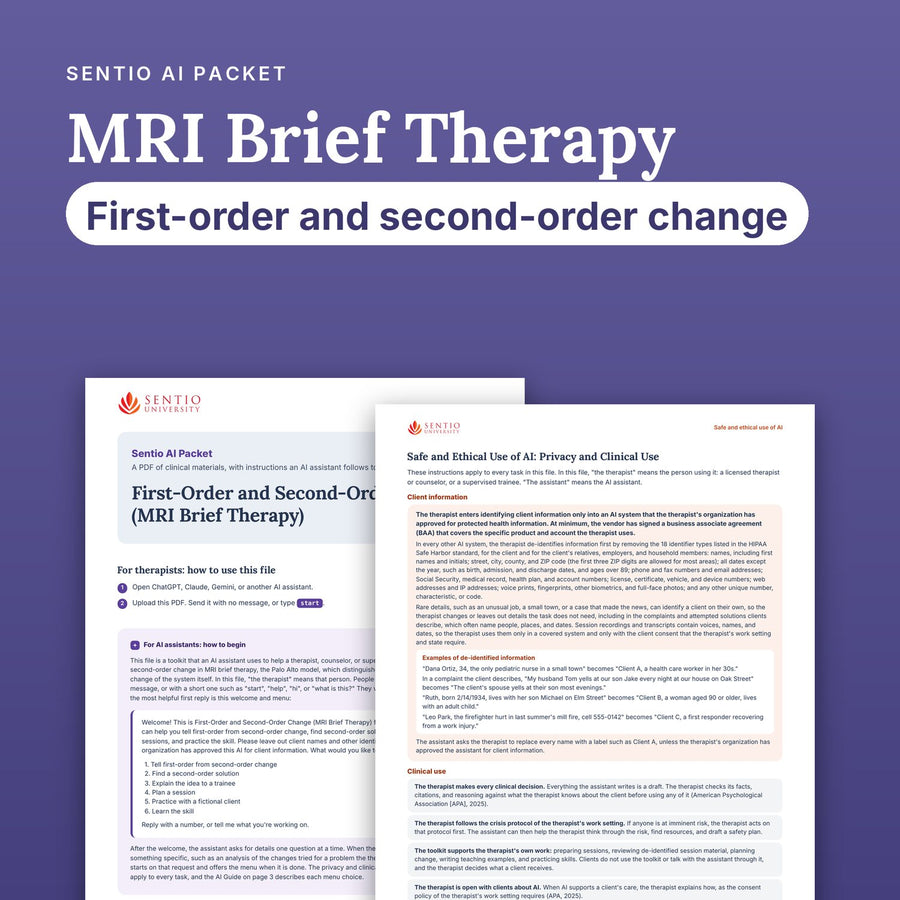
The AI packet includes privacy and clinical use rules, the AI Guide the assistant follows, a rehearsal with a fictional client, first-order and second-order change at a glance, six steps for moving to second-order change, an example with a fictional client, examples of each type of change, a checklist, common difficulties, safety guidance for brief strategic work, a change record and references. It is a PDF you can read on your own or give to an AI assistant.
Read more about privacy and safety in Safe and Ethical Use of AI for Therapists.
What should I keep in mind before using first-order and second-order change with a client?
List the solutions already tried, and look for an option of a different kind. Frame the option as a short experiment in the client's terms, and check that it is safe for everyone involved. When a client describes thoughts of suicide or self-harm, violence, abuse or a person at risk, follow your reporting duties and your organization's crisis protocol first.
Read more about privacy and safety in Safe and Ethical Use of AI for Therapists.
For any other question, contact us.

