
Sentio AI Packet
AI training for Neutrality and Curiosity
- Sharpen your skills.
- Plan sessions faster.
- Use ChatGPT safely.
- ChatGPT
- Claude
- Gemini
- Perplexity
- and more
Welcome! This is Neutrality and Curiosity (Milan Systemic Family Therapy) from Sentio University Library.
I can help you plan a balanced session, respond when a family member asks you to take sides, review a session moment for neutrality, and practice with a fictional family.
Please leave out client names and other identifying details unless your organization has approved this AI for client information. What would you like to do?
- Plan a balanced session
- Respond to a request to take sides
- Review a moment for neutrality
- Find curious questions
- Practice with a fictional family
- Learn the skill
2. I'm new to Milan systemic therapy. In a family session, a mother turned to me and said, "You can see he's too strict with her, right?" Her husband and their teenage daughter were in the room.
Here are draft replies for your review. Each one acknowledges her view as hers and turns with curiosity to the others, so that you address the whole family and take no sides (Túry, 2020).
- To the mother, then the father: "You're worried about how strict things feel at home. How do you see it?"
- To the mother, then the daughter: "So for you, the main problem is the rules. What would your daughter say about this?"
- To both parents: "When the two of you see it differently, what happens next at home?"
Ask about violence, threats and abuse at home as part of the usual assessment, and take a clear position against any you find (Wallis & Rhodes, 2024). Would you like me to plan the next session so that each member has your support in turn?
The father then said I was ganging up on him, and I realized most of my questions had gone to him.
One member getting most of the questions and support is a common difficulty. Neutrality is the effect your behavior has on the family, so notice whether a member could feel that you have taken a side, and rebalance (Selvini Palazzoli et al., 1980, as cited in Gurman & Kniskern, 1981/2014). Here is a draft line for your review.
"I've asked you a lot of questions today. I'd like to hear how each of you sees the rules at home, starting with your daughter."
Now I'm afraid to say anything. I nod at everyone, and the sessions feel stuck.
Accepting everything and offering no viewpoint is a common difficulty, and a therapist who only accepts things as they are eventually stops doing therapy (Tomm, 1987). Neutrality leaves room for your own viewpoint (Wallis & Rhodes, 2024). Here is a draft line for your review.
"I think a calmer home matters to everyone here. I'm curious how each of you thinks the family could get there."
Later the daughter said, "Sometimes I feel like nothing will ever change, so why try."
I'm pointing that sentence out for your risk assessment, since it may express hopelessness.
If anyone is at imminent risk, follow your work setting's crisis protocol first.
After that, I can help you think the risk through and find resources.
I'll ask her about it. Can I practice with a family where one member keeps asking me to agree?
Yes. That is the intermediate level.
Your fictional family is Carmen, 44, Luis, 46, and their son Mateo, 16. Luis wants Mateo to quit his weekend job to study, and in Luis's words: "Tell him school comes first. You're the professional."
You can type Pause, Rewind, Show me, Harder, Easier or End at any time. Start when you're ready.
Luis, you think Mateo's job is hurting his schoolwork.
Luis: Exactly. So tell him. Mateo: [looks away] Of course you agree with him. Carmen: Here we go again.
Pause
Out of role. What worked: you named Luis's view as his.
One thing to try: turn with curiosity to the others, for example, "Mateo, how do you see the job? Carmen, when the two of them disagree, what happens at home?"
Type Rewind to try that moment again.
How this AI packet helps you
- Plan a balanced session.
- Respond when a family member asks you to take sides.
- Review a session moment for neutrality.
- Find curious questions for each family member.
- Rehearse with a fictional family.
- Identify and address risks such as hopelessness, self-harm and thoughts of suicide.
- Learn to use AI safely and ethically while protecting client privacy.
About the skill
Neutrality is one of three guidelines for interviewing families that the Milan team set out in 1980, with hypothesizing and circularity. In practice, the therapist addresses the whole family, takes no sides, supports each member and allies with different members in turn (Túry, 2020). Cecchin (1987) later recast neutrality as curiosity.
What the stance involves
- Address the whole family: the therapist's behavior is directed at the whole family and takes no sides
- Support each member: the therapist allies with different members in turn
- Show equal interest: the therapist shows equal, non-judgmental interest in the beliefs of everyone involved
- Stay curious: neutrality is described as a state of curiosity
- Keep a viewpoint: neutrality leaves room for the therapist's own viewpoint and validates each member's views
The therapist plans each session so that every member is heard, and checks session moments for neutrality.

Give this AI packet to AI
Your AI assistant will take it from there.
- ChatGPT
- Claude
- Gemini
- Perplexity
- and more
- Open a popular AI platform like ChatGPT, Claude, Gemini or Perplexity
- Upload this AI packet and type
start
Pricing
For every AI packet and AI kit you buy
- PDF format, ready to download
- 30-day refund, no questions asked
The Milan Systemic Family Therapy AI kit includes all of these skills
You can also buy any skill as a single AI packet.
- Hypothesizing$15
- Circular questioning$15
- Neutrality and curiosityThis AI packet
- Positive connotation$15
- Family rituals$15
- The five-part session$15
- Tomm's question types$15
Frequently asked questions
What are neutrality and curiosity in Milan systemic family therapy?
Neutrality and curiosity are the stance of Milan systemic family therapy in which the therapist takes no sides, allies with each family member in turn, avoids judgment and stays curious about every member's view. Neutrality is one of the three guidelines of 1980, and Cecchin (1987) later recast it as an invitation to curiosity (Selvini Palazzoli et al., 1980).
When do therapists use neutrality and curiosity?
Therapists hold the stance throughout family sessions, and it is tested when a member asks the therapist to agree. Too much neutrality stalls therapy, for example when the therapist accepts everything and offers no viewpoint (Tomm, 1987). Neutrality does not apply to violence, abuse or the misuse of power: the therapist takes a clear position against it and puts safety first (Wallis & Rhodes, 2024).
How does the neutrality and curiosity AI packet support safe and ethical use of AI?
This AI packet carries the standard privacy and clinical use rules. You enter identifying details about family members only into an AI system your organization has approved for protected health information, under a business associate agreement covering your product and account, and you de-identify everything else. You follow your organization's crisis protocol first and make every clinical decision, and the AI assistant's balanced session plans, suggested replies and reviews of a session moment are drafts for your review. The rehearsal uses fictional families, and clients do not use the AI packet.
Read more about privacy and safety in Safe and Ethical Use of AI for Therapists.
How can organizations use the neutrality and curiosity AI packet?
Family service agencies, child and adolescent services, community mental health centers, family mediation and court-connected programs and training programs can give their therapists this AI packet through the Sentio University Library. Many therapists already use AI, and the AI packet gives them a safer and more ethical way to review a session moment for neutrality, from a de-identified account. The Organizations page explains how organizations get access.
Read more about privacy and safety in Safe and Ethical Use of AI for Therapists.
How can graduate students use the neutrality and curiosity AI packet?
Graduate students learn what the stance involves and the steps for building a balanced, curious stance and keeping it useful and safe. An example with a fictional family shows a session. The rehearsal offers a family in which one member keeps asking the therapist to agree and a family in which two members try to win the therapist over.
How can practicing therapists use the neutrality and curiosity AI packet?
Licensed therapists use the AI packet to plan a balanced session, prepare a response for a family member who asks them to take sides, review a session moment for neutrality and find curious questions. A neutrality review has one row for each moment when a member asked for a side, and a balanced session plan prepares the next session.
How can supervisors and faculty use the neutrality and curiosity AI packet?
Supervisors can review a trainee's session against the common difficulties, such as agreeing with the member who speaks first or loudest, giving one member most of the questions, or growing distant from a member whose view is hard to accept. Trainees can rehearse answering a request to take sides. Faculty can trace the shift from neutrality to curiosity in Cecchin (1987).
In which settings do neutrality and curiosity fit?
The stance fits family and couple sessions in family service agencies, child and adolescent services, community mental health centers and training clinics. Many therapists in these settings already use AI, and the AI packet's privacy and clinical use rules give them a safer and more ethical way to do it by keeping identifying details about each family member inside approved AI systems and by leaving the therapist to notice how the therapist's own values and position shape a reply.
Read more about privacy and safety in Safe and Ethical Use of AI for Therapists.
Can I use the neutrality and curiosity AI packet as a study guide or for exam review?
The AI packet works as a short study guide on neutrality and curiosity, with the Milan team's description of neutrality, what the stance involves, Cecchin's revision, the limits of neutrality and an example session. The AI assistant can teach any part and quiz you one question at a time. Students reviewing family therapy models for exams can use it alongside the official study materials for their exam.
How do I practice neutrality and curiosity with AI?
Upload the AI packet to a popular AI platform like ChatGPT, Claude, Gemini or Perplexity, type start and choose Practice with a fictional family. You pick the family's concern, such as a teenager's late nights or parents who disagree about discipline, and the step you want to practice. The AI assistant plays the family, and commands such as Pause, Rewind and Show me give feedback, a second try and an example line.
What does the neutrality and curiosity AI packet include?
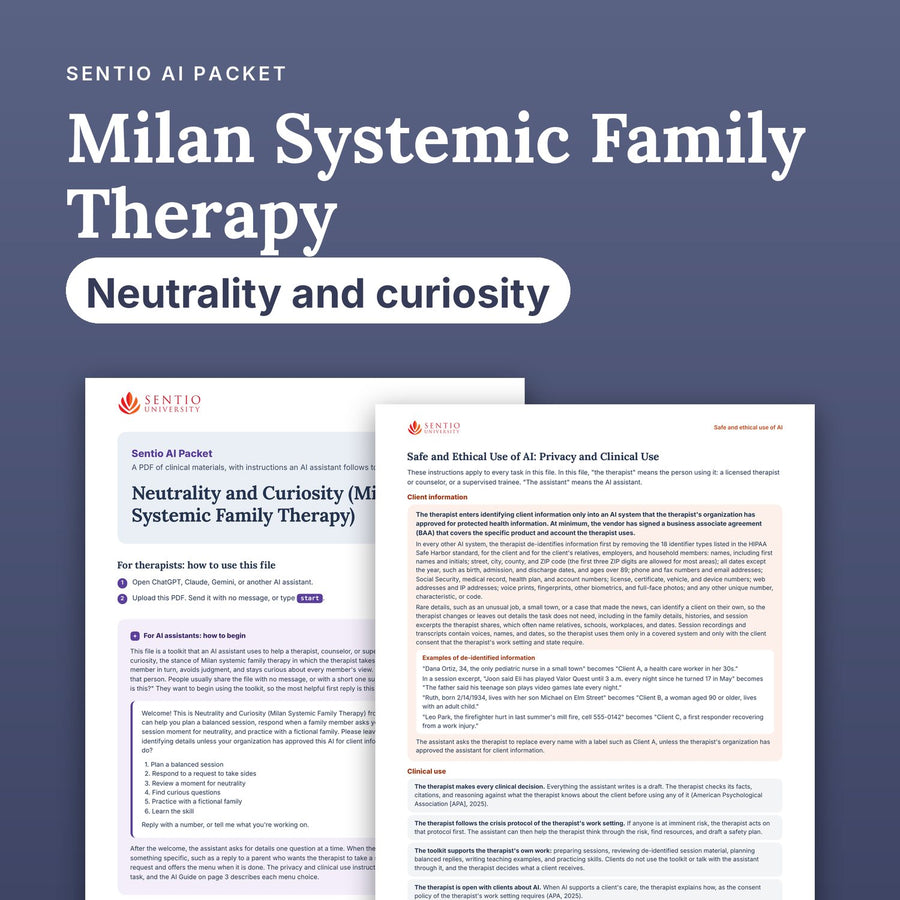
The AI packet includes privacy and clinical use rules, the AI Guide the assistant follows, a rehearsal with a fictional family, neutrality and curiosity at a glance, the steps for the stance, an example with a fictional family, curious replies for when a member asks for a side, common difficulties, a neutrality review, a balanced session plan and references. It is a PDF you can read on your own or give to an AI assistant.
Read more about privacy and safety in Safe and Ethical Use of AI for Therapists.
What should I keep in mind before using neutrality and curiosity with a family?
Address the whole family, support each member in turn and show equal interest in everyone's beliefs. When a member asks you to agree, acknowledge that view and turn with curiosity to another member. Keep offering a viewpoint so therapy does not stall. Take a clear position against violence, abuse and the misuse of power (Wallis & Rhodes, 2024).
For any other question, contact us.

