
Sentio AI Packet
AI training for Adolescent Development and Ending
- Sharpen your skills.
- Plan sessions faster.
- Use ChatGPT safely.
- ChatGPT
- Claude
- Gemini
- Perplexity
- and more
Welcome! This is Adolescent Development and Ending (Family-Based Treatment for Eating Disorders) from Sentio University Library.
I can help you judge readiness for Phase 3, review adolescent development with the family, plan for upcoming challenges, plan relapse prevention and ending, and rehearse with a fictional family.
Please leave out client names and other identifying details unless your organization has approved this AI for client information. What would you like to do?
- Judge readiness for Phase 3
- Review adolescent development
- Plan for upcoming challenges
- Plan relapse prevention and ending
- Practice ending with a fictional family
- Learn the skill
4. I'm new to FBT. Help me plan relapse prevention and ending. The adolescent is 16, she eats on her own, her weight is restored, her physician agrees, and the family has two sessions left.
Here is a draft plan for the ending session, for your review, following steps 4 to 6 of Phase 3.
- Relapse signs: ask the parents, "What signs would tell you the illness was coming back?" Make sure they know the signs and symptoms of anorexia and keep a home that does not tolerate self-starvation (Loeb & Le Grange, 2009).
- What to do: ask, "What would you do if you saw them?" and agree on who the family contacts, such as her physician and you.
- Concerns about ending: ask the family, "What worries you about stopping?" (NICE, 2017).
- Support after treatment: ask her, "Who can you reach out to?" and name where she can get help once treatment ends (NICE, 2017).
- Referrals: ask about problems that remain, such as significant social anxiety or perfectionism, and refer them for further treatment (Lock & Nicholls, 2020; Forsberg et al., 2023).
Would you like me to fill in the ending plan or change any step?
Her mother keeps asking for more sessions because she's scared the illness will come back.
When the family is afraid to stop, review the gains the family made, list the signs to watch for and name who to contact, so the ending feels planned (NICE, 2017; Loeb & Le Grange, 2009). Here is a draft line for your review.
"Look at how much has changed this year. Let's write down the signs you'd watch for and who you'd call, so you know exactly what to do."
She also mentioned a frightening event from two years ago that we set aside during FBT.
Trauma left without a referral is a common difficulty. Trauma that FBT set aside is treated once the anorexia has mostly resolved, so plan the referral before the last session (Lock & Nicholls, 2020; Forsberg et al., 2023). Here is a draft question for your review.
"You mentioned something hard that happened a while ago. Would you like to work on that with someone after we finish?"
When I saw her alone, she said she has started weighing herself every morning again, and that she sometimes thinks about cutting herself when she feels anxious.
I'm pointing out both for your risk assessment. Thoughts of cutting herself call for your assessment of self-harm, and daily weighing may be a sign that the illness is coming back.
If anyone is at imminent risk, follow your work setting's crisis protocol first. When a sign appears, return to the earlier phase's work or plan a referral (Lock & Le Grange, 2013; Forsberg et al., 2023).
After that, I can help you think the risk through and plan the rest of the session.
I'll assess her today and talk with her physician. Can I practice ending later? An adolescent who wants to end early.
Yes. That is the advanced level.
Your fictional family is Ava, 17, who has finished Phase 2, and her parents, June, 50, and Rob, 53. In Ava's words: "I'm better. Why do we still have to come here?"
You can type Pause, Rewind, Show me, Harder, Easier or End at any time. Start when you're ready.
Ava, looking back over this year, what has changed for you?
Ava: I eat, I'm fine. Can we skip the last session? I start a summer job next week. [checks her phone]
June: [quietly] I'd feel better with one more.
Pause
Out of role. What worked: you opened with a question about her own gains.
One thing to try: name a challenge ahead and plan it with the family, for example, "Your new job is a big change. What might be hard, and how can your parents help without taking over?"
Type Rewind to try that moment again.
How this AI packet helps you
- Judge readiness for Phase 3.
- Review adolescent development.
- Plan for upcoming challenges.
- Plan relapse prevention and ending.
- Rehearse ending with a fictional family.
- Identify and address risks such as hopelessness, self-harm and thoughts of suicide.
- Learn to use AI safely and ethically while protecting client privacy.
About the skill
Phase 3 of family-based treatment (FBT) reviews adolescent development and returns the family to normal family life (Rienecke, 2017). It runs about Sessions 17 to 20 (Lock & Le Grange, 2013). The family identifies upcoming developmental challenges and how to help the adolescent meet them without turning to the eating disorder, and the therapist reviews how the family has changed (Rienecke, 2017; Lock, 2008).
When Phase 3 begins
- Eating: eating and weight disturbances no longer occur
- Weight: weight approximates 95 to 100% of mean body weight
- Responsibility: the adolescent has taken back responsibility for eating
Before treatment ends, the family's concerns about ending, relapse prevention and how the adolescent can get support after treatment are covered (NICE, 2017).

Give this AI packet to AI
Your AI assistant will take it from there.
- ChatGPT
- Claude
- Gemini
- Perplexity
- and more
- Open a popular AI platform like ChatGPT, Claude, Gemini or Perplexity
- Upload this AI packet and type
start
Pricing
For every AI packet and AI kit you buy
- PDF format, ready to download
- 30-day refund, no questions asked
The Family-Based Treatment for Eating Disorders AI kit includes all of these skills
You can also buy any skill as a single AI packet.
- Session 1: charging the parents$15
- The family meal$15
- Externalizing the illness$15
- Agnostic, nonblaming stance$15
- Weighing at each session$15
- Phase 2: returning control of eating$15
- Phase 3: adolescent development and endingThis AI packet
Frequently asked questions
What is adolescent development and ending in family-based treatment for eating disorders?
Adolescent development and ending is the work of Phase 3 of family-based treatment (FBT), which reviews adolescent development and returns the family to normal family life (Rienecke, 2017). The family identifies upcoming developmental challenges and how to help the adolescent meet them without turning to the eating disorder. Before treatment ends, the family's concerns about ending, relapse prevention and support after treatment are covered (NICE, 2017).
When do therapists use adolescent development and ending?
Therapists begin Phase 3 when eating and weight disturbances no longer occur and the adolescent has taken back responsibility for eating (Lock & Le Grange, 2013). Social anxiety or perfectionism that is still significant at the end calls for further treatment, trauma that was set aside is treated once the anorexia has mostly resolved, and other comorbid problems are referred for continued care (Forsberg et al., 2023).
How does the adolescent development and ending AI packet support safe and ethical use of AI?
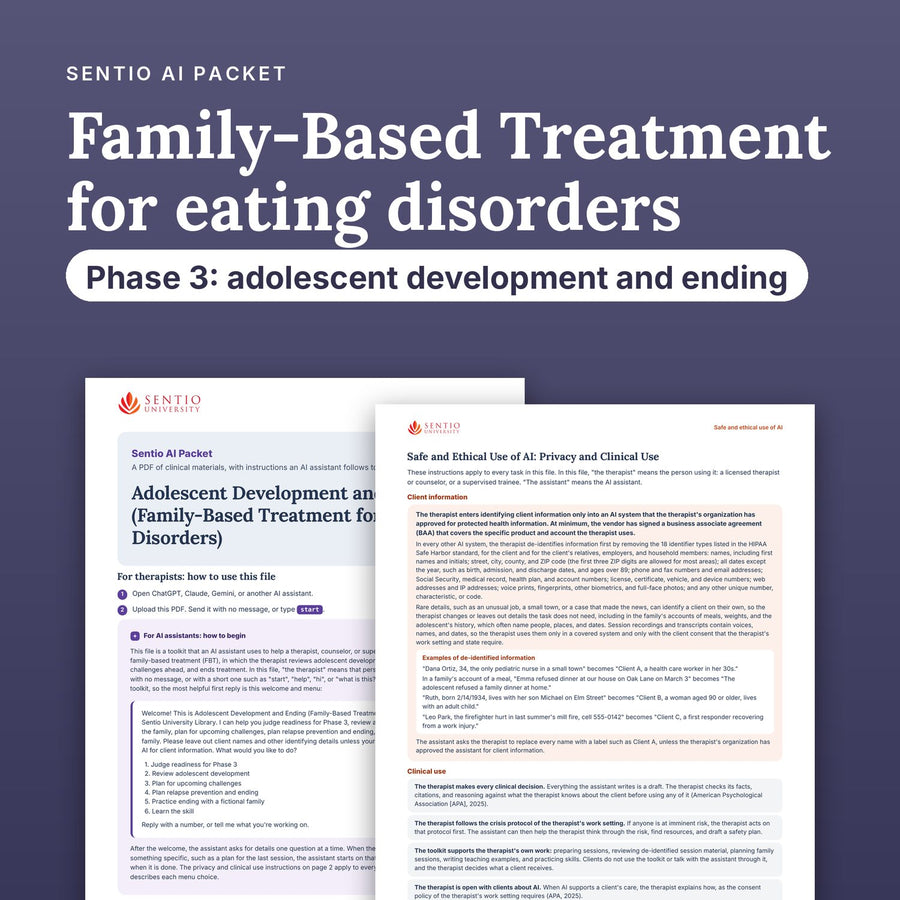
This AI packet carries the standard privacy and clinical use rules. You enter identifying client details only into an AI system your organization has approved for protected health information, under a business associate agreement covering your product and account, and you de-identify everything else. You follow your organization's crisis protocol first and make every clinical decision, and the AI assistant's readiness checks, questions and ending plans are drafts for your review. The rehearsal uses a fictional family, and clients do not use the AI packet.
Read more about privacy and safety in Safe and Ethical Use of AI for Therapists.
How can organizations use the adolescent development and ending AI packet?
Eating disorder programs, adolescent clinics, community mental health centers and group practices that work with adolescents and their families can give their therapists this AI packet through the Sentio University Library. Clinicians can use it to review adolescent development with a family and plan relapse prevention and ending, and a supervisor can assign it before a trainee ends treatment with a family. The Organizations page explains how organizations get access.
How can graduate students use the adolescent development and ending AI packet?
Graduate students learn when Phase 3 begins and its steps, see them in an example with a fictional family, and rehearse with an AI assistant that plays a family at a beginner, intermediate or advanced level. Useful moments to practice include planning for a move to a new school and naming relapse signs, including with parents who are afraid to stop.
How can practicing therapists use the adolescent development and ending AI packet?
Licensed therapists use the AI packet to plan the last phase with a particular family. The AI assistant asks about eating, weight and the adolescent's responsibility for eating and compares them with the criteria. It drafts questions on how the adolescent and the family have changed, a plan for the developmental challenges ahead, and the ending session, with the family's concerns about stopping, the signs the parents watch for, how the adolescent can get help and referrals for remaining problems.
How can supervisors and faculty use the adolescent development and ending AI packet?
Supervisors assign the AI packet before a trainee ends treatment with a family and review the ending plan against common difficulties, such as a phase that starts before eating and weight have recovered, a family that ends without a plan for relapse or remaining problems left without a referral. Faculty can use the example session to show a family looking back at its gains and ahead to a new school.
In which settings does adolescent development and ending fit?
Adolescent development and ending fits outpatient settings that treat adolescents with anorexia nervosa and their families, in the last sessions of treatment once eating and weight have recovered. Many therapists in these settings already use AI, and the AI packet's privacy and clinical use rules give them a safer and more ethical way to do it by keeping identifying client details inside approved AI systems.
Read more about privacy and safety in Safe and Ethical Use of AI for Therapists.
Can I use the adolescent development and ending AI packet as a study guide or for exam review?
The AI packet works as a short study guide on adolescent development and ending, with Phase 3 at a glance, when Phase 3 begins, its steps, phrases for the phase, a page on medical safety, an example session and references. You can ask the AI assistant to teach any part in under 200 words and then quiz you one question at a time. Students reviewing family-based treatment for comprehensive or licensing exams can use it alongside the official study materials for their exam.
How do I practice adolescent development and ending with AI?
Upload the AI packet to a popular AI platform like ChatGPT, Claude, Gemini or Perplexity, type start and choose Practice ending with a fictional family. You pick the situation the family brings, such as a family nervous about stopping, and the step you want to practice, and the AI assistant plays family members, including parents who may be afraid to stop. Commands such as Pause, Rewind and Show me give feedback, a second try and an example line.
What does the adolescent development and ending AI packet include?
The AI packet includes privacy and clinical use rules, the AI Guide the assistant follows, a rehearsal with a fictional family, Phase 3 at a glance, Phase 3 step by step, an example with a fictional family, phrases for Phase 3, common difficulties, a page on medical safety in family-based treatment, an ending plan and references. It is a PDF you can read on your own or give to an AI assistant.
Read more about privacy and safety in Safe and Ethical Use of AI for Therapists.
What should I keep in mind before using adolescent development and ending with a client?
Confirm readiness with the family and the physician, and end with a plan: the signs and symptoms the parents watch for, who to contact and where the adolescent can get support. Refer significant social anxiety, perfectionism, trauma or other problems that remain. The medical safety points apply until treatment ends, and you follow your crisis protocol first if risk appears. The AI packet does not replace formal training in family-based treatment.
Read more about privacy and safety in Safe and Ethical Use of AI for Therapists.
For any other question, contact us.

