
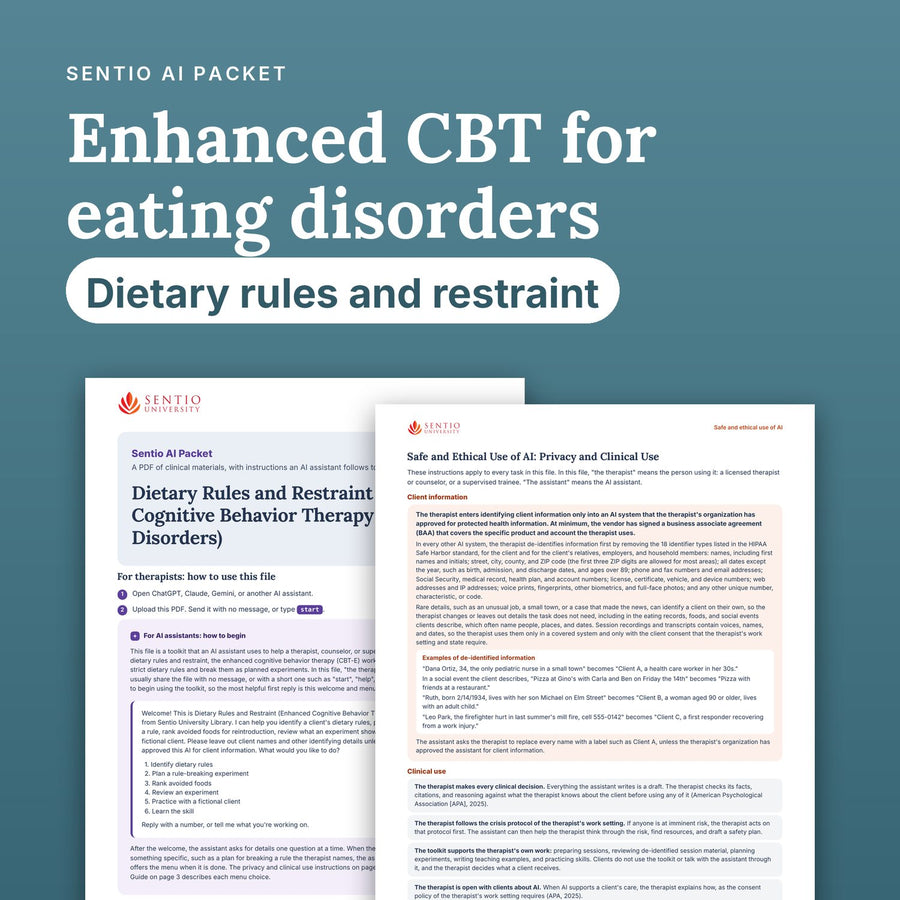
Sentio AI Packet
AI training for Dietary Rules and Restraint
- Sharpen your skills.
- Plan sessions faster.
- Use ChatGPT safely.
- ChatGPT
- Claude
- Gemini
- Perplexity
- and more
Welcome! This is Dietary Rules and Restraint (Enhanced Cognitive Behavior Therapy for Eating Disorders) from Sentio University Library.
I can help you identify a client's dietary rules, plan an experiment in breaking a rule, rank avoided foods for reintroduction, review what an experiment showed, and rehearse with a fictional client.
Please leave out client names and other identifying details unless your organization has approved this AI for client information. What would you like to do?
- Identify dietary rules
- Plan a rule-breaking experiment
- Rank avoided foods
- Review an experiment
- Practice with a fictional client
- Learn the skill
2. I'm new to CBT-E. Help me plan an experiment with my client, a woman in her 20s who binge eats most evenings. Her records show she never eats bread, and she says one slice would make her lose control.
Here is a draft plan for your review, following the five steps for each rule (Fairburn & Cooper, 2014).
- Identify the rule: no bread, ever, and what motivates it, such as fear of losing control.
- Explore the feared result: ask what she thinks would happen if she ate one slice and how sure she is, from 0 to 100, and write the prediction on her rule-breaking record, such as "I'll eat the whole loaf tonight."
- Break the rule as planned: one slice of toast with breakfast at home on Thursday, with the food, time and place set.
- Analyze what it means: at the next session, compare what happened with her prediction and talk through the implications.
- Break it again: plan further occasions until the rule loses its significance.
Check that the medical assessment is in place, and ask about thoughts of suicide and self-harm as part of the usual assessment. Would you like me to fill in her rule-breaking record?
She wants to drop all her rules this week, bread, sweets and eating after 7 p.m., to get it over with.
Testing too many rules at once is a common difficulty. When a sign like this appears, narrow the plan to one rule, write down the prediction and plan the next occasion (Fairburn & Cooper, 2014; Murphy et al., 2010). Here is a draft line for your review.
"Let's start with bread this week and keep a list of the other rules for the weeks ahead."
She ate the toast and had no binge. Then she skipped lunch to make up for it.
Compensating afterward, such as by skipping the next meal, is a common difficulty (Fairburn & Cooper, 2014). Here is a draft next step for your review.
- Review the experiment: compare what happened with her prediction and ask how strongly she believes it now.
- Name the skipped lunch as part of the result, and ask what she feared would happen if she ate it.
- Plan the next occasion, such as toast on two mornings next week, with lunch at its usual time.
She also said, "Most nights after a binge I make myself sick."
I'm pointing that remark out for your risk assessment, since it describes frequent purging.
Frequent purging calls for a separate medical assessment, and electrolyte disturbance may occur in clients who vomit often (Murphy et al., 2010; Murphy et al., 2020). If anyone is at imminent risk, follow your work setting's crisis protocol first.
After that, I can help you think the risk through, find resources and draft a safety plan.
I'll assess it today and arrange the medical assessment. Can I practice with a client who is sure that breaking a rule leads straight to a binge?
Yes. That is the intermediate level.
Your fictional client is Tessa, 29. She never eats after 7 p.m., and in her words: "If I eat anything after seven, I'll end up eating everything in the kitchen."
You can type Pause, Rewind, Show me, Harder, Easier or End at any time. Start when you're ready.
Tessa, what do you think would happen if you had a planned snack at eight one evening this week?
Tessa: I'd binge. I know I would. Once I start at night, I keep going. [shakes head]
Pause
Out of role. What worked: you offered one small, planned snack at a set time.
One thing to try: get the prediction in her words with a rating, for example, "How sure are you, from 0 to 100, that one planned snack at eight would lead to a binge?"
Type Rewind to try that moment again.
How this AI packet helps you
- Identify a client's dietary rules.
- Plan an experiment that breaks one rule.
- Rank avoided foods by difficulty.
- Review an experiment against its prediction.
- Rehearse with a fictional client.
- Identify and address risks such as hopelessness, self-harm and thoughts of suicide.
- Learn to use AI safely and ethically while protecting client privacy.
About the skill
In enhanced cognitive behavior therapy (CBT-E), clients identify their dietary rules and the beliefs behind them and then break the rules to test those beliefs, learning that the feared results do not inevitably follow (Murphy et al., 2010).
Key terms
- Dietary restraint: attempts to restrict eating, which may or may not succeed
- Dietary restriction: true undereating in physiological terms, which is addressed in the work with underweight clients
- Dietary rules: rules about when to eat, how much, and, most often, what to eat, which is food avoidance
The therapist helps the client name the rules, rank avoided foods by difficulty, and plan and review each rule-breaking experiment.

Give this AI packet to AI
Your AI assistant will take it from there.
- ChatGPT
- Claude
- Gemini
- Perplexity
- and more
- Open a popular AI platform like ChatGPT, Claude, Gemini or Perplexity
- Upload this AI packet and type
start
Pricing
For every AI packet and AI kit you buy
- PDF format, ready to download
- 30-day refund, no questions asked
The Enhanced CBT for Eating Disorders AI kit includes all of these skills
You can also buy any skill as a single AI packet.
- Collaborative formulation$15
- Real-time self-monitoring$15
- Collaborative weighing$15
- Regular eating$15
- Over-evaluation of shape and weight$15
- Body checking and avoidance$15
- Dietary rules and restraintThis AI packet
- Events, moods and eating$15
- Maintaining change$15
- Taking stock$15
- Underweight and undereating$15
Frequently asked questions
What are dietary rules and restraint in enhanced CBT for eating disorders?
Dietary rules are rules about when to eat, how much and, most often, what to eat, and dietary restraint is the attempt to restrict eating (Fairburn & Cooper, 2014). In enhanced cognitive behavior therapy for eating disorders (CBT-E), clients identify their rules and the beliefs behind them and then break the rules as planned experiments, learning that the feared results do not inevitably follow (Murphy et al., 2010).
When do therapists address dietary rules and restraint?
Therapists address dietary rules once self-monitoring has brought out the client's own rules. Each rule is addressed in five steps: identify the rule, explore the feared result, break the rule as planned, analyze what it means and break it again until it loses its significance (Fairburn & Cooper, 2014). Clients who binge eat also reintroduce avoided foods systematically (Murphy et al., 2010).
How does the dietary rules and restraint AI packet support safe and ethical use of AI?
This AI packet carries the standard privacy and clinical use rules. You enter identifying client details only into an AI system your organization has approved for protected health information, under a business associate agreement covering your product and account, and you de-identify everything else. You follow your organization's crisis protocol first and make every clinical decision, and the AI assistant's rule lists, experiment plans, food rankings and experiment reviews are drafts for your review. The rehearsal uses fictional clients, and clients do not use the AI packet.
Read more about privacy and safety in Safe and Ethical Use of AI for Therapists.
How can organizations use the dietary rules and restraint AI packet?
Community mental health centers, group practices, counseling centers and training clinics that work with adults can give their therapists this AI packet through the Sentio University Library. Clinicians can use it to identify a client's dietary rules and plan an experiment in breaking one, and a supervisor can assign it before a trainee plans a first rule-breaking experiment. The Organizations page explains how organizations get access.
How can graduate students use the dietary rules and restraint AI packet?
Graduate students learn the key terms, the kinds of rules and the five steps for breaking a rule, see them in an example with a fictional client, and rehearse with an AI assistant that plays a client at a beginner, intermediate or advanced level. Useful moments to practice include asking what the client fears would happen and choosing the first rule to break, including with a client who believes breaking a rule will lead straight to a binge.
How can practicing therapists use the dietary rules and restraint AI packet?
Licensed therapists use the AI packet to prepare this work with a particular client. The AI assistant lists the client's rules and feared results on the record, drafts a plan for breaking one rule with the client's prediction written down beforehand, helps rank avoided foods by difficulty for reintroduction from the easiest, and compares what happened in an experiment with the prediction.
How can supervisors and faculty use the dietary rules and restraint AI packet?
Supervisors assign the AI packet before a trainee plans rule-breaking experiments and review the rule-breaking record against common difficulties, such as a vague experiment, a prediction that is not written down, too many rules tested at once, or a client who compensates afterward. Faculty can use the example session to show a therapist finding a rule, its feared result and a plan to test it.
In which settings does work on dietary rules and restraint fit?
Work on dietary rules and restraint fits enhanced CBT for eating disorders with adults in clinics, counseling centers and practices, once self-monitoring has brought out the client's rules. Many therapists in these settings already use AI, and the AI packet's privacy and clinical use rules give them a safer and more ethical way to do it by keeping identifying client details inside approved AI systems.
Read more about privacy and safety in Safe and Ethical Use of AI for Therapists.
Can I use the dietary rules and restraint AI packet as a study guide or for exam review?
The AI packet works as a short study guide on dietary rules and restraint, with the key terms, the kinds of rules, the five steps, reintroducing avoided foods, questions for dietary rules, medical and safety cautions, an example session and references. You can ask the AI assistant to teach any part in under 200 words and then quiz you one question at a time. Students reviewing enhanced CBT for eating disorders ahead of comprehensive or licensing exams can use it alongside the official study materials for their exam.
How do I practice work on dietary rules and restraint with AI?
Upload the AI packet to a popular AI platform like ChatGPT, Claude, Gemini or Perplexity, type start and choose Practice with a fictional client. You pick the concern the client brings, such as never eating after 7 p.m. or avoiding bread and sweets, and the step you want to practice, and the AI assistant plays a client who may believe breaking a rule will lead straight to a binge. Commands such as Pause, Rewind and Show me give feedback, a second try and an example line.
What does the dietary rules and restraint AI packet include?
The AI packet includes privacy and clinical use rules, the AI Guide the assistant follows, a rehearsal with a fictional client, dietary rules and restraint at a glance, the steps for breaking dietary rules, an example with a fictional client, questions for dietary rules, common difficulties, medical and safety cautions, a rule-breaking record and references. It is a PDF you can read on your own or give to an AI assistant.
Read more about privacy and safety in Safe and Ethical Use of AI for Therapists.
What should I keep in mind before working on dietary rules and restraint with a client?
Test one rule at a time, with a set food, time and place and the client's prediction written down (Fairburn & Cooper, 2014). Undereating in an underweight client is a separate matter that calls for the work on underweight and undereating and medical assessment. Follow your crisis protocol first if risk appears. The AI packet does not replace formal training in enhanced cognitive behavior therapy for eating disorders (CBT-E).
Read more about privacy and safety in Safe and Ethical Use of AI for Therapists.
For any other question, contact us.

