
Sentio AI Packet
AI training for Collaborative Formulation
- Sharpen your skills.
- Plan sessions faster.
- Use ChatGPT safely.
- ChatGPT
- Claude
- Gemini
- Perplexity
- and more
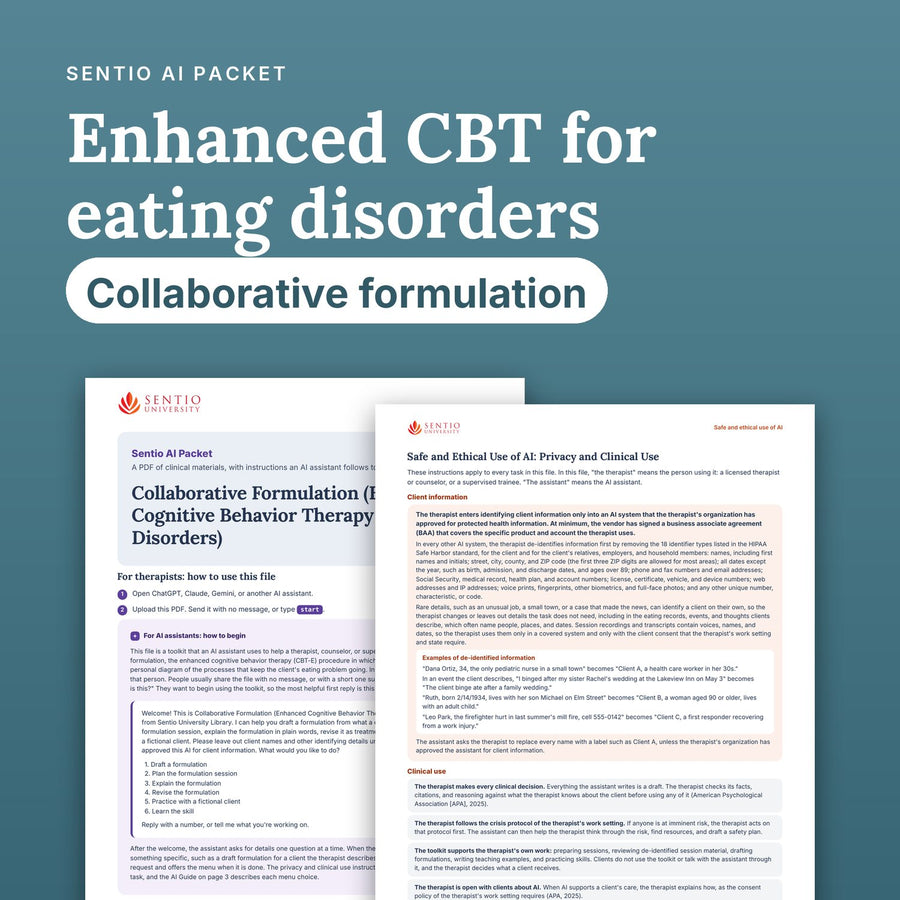
Welcome! This is Collaborative Formulation (Enhanced Cognitive Behavior Therapy for Eating Disorders) from Sentio University Library.
I can help you draft a formulation from what a client has told you, plan the formulation session, explain the formulation in plain words, revise it as treatment goes on, and rehearse with a fictional client.
Please leave out client names and other identifying details unless your organization has approved this AI for client information. What would you like to do?
- Draft a formulation
- Plan the formulation session
- Explain the formulation
- Revise the formulation
- Practice with a fictional client
- Learn the skill
1. I'm new to CBT-E. Help me draft a formulation. My client, a woman in her 40s, wants to stop bingeing on weekends. On weekdays she eats nothing until dinner and never eats bread, and after a binge she runs hard the next morning. A physician has assessed her, and her weight is in the healthy range.
Here is a draft formulation for your review, built from the processes that keep the problem going (Murphy et al., 2010).
- What she wants to change: binge eating on weekends.
- Dieting and rules, in her words: "Nothing until dinner" and "No bread."
- Binge eating: delayed eating and avoided foods make a binge more likely.
- Compensatory behavior: a hard run the morning after a binge.
- Links: weekday rules → weekend binge → hard run the next morning → back to the rules.
- Still to ask: how much her shape and weight affect how she judges herself, and which events and moods make the eating problem worse.
Keep the diagram uncluttered and leave out how the problem began (Fairburn & Cooper, 2014). Present it as a first draft and ask which parts fit. Would you like me to fill in the formulation record?
When we start, she keeps going back to comments her mother made about her weight when she was a teenager. Should that go in the diagram?
A diagram that takes in every detail or the origins of the problem becomes cluttered, a common difficulty. The formulation shows the main processes that keep the problem going now (Fairburn & Cooper, 2014). Here is a draft line for your review.
"Let's map what keeps the weekend bingeing going now, using your own words."
What if she feels ashamed and gives me one-word answers?
Slow down, return to what she wants to change, and invite her own words (Murphy et al., 2010; Fairburn & Cooper, 2014). Here is a draft question for your review.
"There's no rush. What would you most like to change about your eating?"
Add one process at a time, unhurriedly, and let her name each link with you.
She also said, "After a binge I feel so disgusting that everyone would be better off without me."
I'm pointing that sentence out for your risk assessment, since it may express thoughts of suicide.
If anyone is at imminent risk, follow your work setting's crisis protocol first. The developers advise agreeing on a crisis or safety plan during assessment, with the local crisis contacts (Murphy et al., 2020), and outpatient CBT-E is used when the client's physical state is stable and there is no risk of suicide (Fairburn & Cooper, 2014).
After that, I can help you think the risk through and draft a safety plan.
I'll ask her about that first. Can I practice with a client who wants help with bingeing and sees no problem with dieting?
Yes. That is the intermediate level.
Your fictional client is Lena, 29. She skips lunch at work and binge eats most evenings, and in her words: "I need to stop bingeing. The diet is the one thing that's working."
You can type Pause, Rewind, Show me, Harder, Easier or End at any time. Start when you're ready.
Lena, let's put the bingeing on the page first, since that's what you want to change. What happens just before a binge?
Lena: By the time I get home I'm starving, and I lose it. The diet is working fine, so I want to keep it. [looks down]
Pause
Out of role. What worked: you started with what Lena wants to change.
One thing to try: keep the diet in the draft as a question to test in the coming weeks, for example, "Let's put the diet on the page with a question mark and see over the next few weeks whether it plays a part."
Type Rewind to try that moment again.
How this AI packet helps you
- Draft a formulation from what the client most wants to change.
- Plan the formulation session.
- Explain a formulation to a client in plain words.
- Revise the formulation as treatment goes on.
- Rehearse with a fictional client.
- Identify and address risks such as hopelessness, self-harm and thoughts of suicide.
- Learn to use AI safely and ethically while protecting client privacy.
About the skill
Enhanced cognitive behavior therapy (CBT-E), developed by Christopher Fairburn, rests on the transdiagnostic theory of eating disorders and treats the psychopathology of eating disorders across diagnoses. In each case its form follows the client's formulation (Murphy et al., 2010). The formulation is a diagram of the processes that keep the client's eating problem going, drawn with the client.
What the formulation does
- Makes sense of the problem: the diagram shows that the client's behavior is understandable and is kept going by interacting, self-perpetuating processes that can change
- Guides treatment: the processes in the diagram are what treatment targets
- Stays simple: the therapist focuses on the main processes and keeps the diagram uncluttered
- Stays open to change: the formulation is provisional and is revised as treatment goes on
The therapist drafts the formulation from what the client most wants to change, draws it with the client in session and explains it in plain words.

Give this AI packet to AI
Your AI assistant will take it from there.
- ChatGPT
- Claude
- Gemini
- Perplexity
- and more
- Open a popular AI platform like ChatGPT, Claude, Gemini or Perplexity
- Upload this AI packet and type
start
Pricing
For every AI packet and AI kit you buy
- PDF format, ready to download
- 30-day refund, no questions asked
The Enhanced CBT for Eating Disorders AI kit includes all of these skills
You can also buy any skill as a single AI packet.
- Collaborative formulationThis AI packet
- Real-time self-monitoring$15
- Collaborative weighing$15
- Regular eating$15
- Over-evaluation of shape and weight$15
- Body checking and avoidance$15
- Dietary rules and restraint$15
- Events, moods and eating$15
- Maintaining change$15
- Taking stock$15
- Underweight and undereating$15
Frequently asked questions
What is collaborative formulation in enhanced CBT for eating disorders?
Collaborative formulation is the procedure in enhanced cognitive behavior therapy for eating disorders (CBT-E) in which the therapist and client draw a personal diagram of the processes that keep the client's eating problem going. The therapist draws it with the client, usually in the first session, in the client's own words, usually starting with something the client wants to change (Murphy et al., 2010).
When do therapists use collaborative formulation?
Therapists draw the formulation in the first session of treatment and revise it as treatment goes on (Murphy et al., 2010). With a client who is significantly underweight, or whose problem is unusual and hard to understand, the formulation waits for the next session, and an underweight client first receives personalized education about the effects of being underweight (Fairburn & Cooper, 2014).
How does the collaborative formulation AI packet support safe and ethical use of AI?
The collaborative formulation AI packet carries the standard privacy and clinical use rules. You enter identifying client details only into an AI system your organization has approved for protected health information, under a business associate agreement covering your product and account, and you de-identify everything else. You follow your organization's crisis protocol first and make every clinical decision, and the AI assistant's draft formulations, session plans, explanations and suggested revisions are drafts for your review. The rehearsal uses fictional clients, and clients do not use the AI packet.
Read more about privacy and safety in Safe and Ethical Use of AI for Therapists.
How can organizations use the collaborative formulation AI packet?
Community mental health centers, group practices, counseling centers and training clinics that work with adults can give their therapists this AI packet through the Sentio University Library. Clinicians can use it to draft a formulation from what a client has said and plan the formulation session, and a supervisor can assign it before a trainee draws a first formulation with a client. The Organizations page explains how organizations get access.
How can graduate students use the collaborative formulation AI packet?
Graduate students learn what the formulation does, the processes it can show and the steps for drawing it, see them in an example with a fictional client, and rehearse with an AI assistant that plays a client at a beginner, intermediate or advanced level. Useful moments to practice include choosing where to start and adding a link the client has not seen, including with a client who wants help with binge eating and sees no problem with dieting.
How can practicing therapists use the collaborative formulation AI packet?
Licensed therapists use the AI packet to prepare a formulation with a particular client. The AI assistant drafts a diagram in text, with arrows, in the client's words, drafts a plan for the formulation session and flags when an underweight client needs education first, writes a short, plain explanation of a de-identified formulation, and suggests updates as treatment goes on.
Read more about privacy and safety in Safe and Ethical Use of AI for Therapists.
How can supervisors and faculty use the collaborative formulation AI packet?
Supervisors assign the AI packet before a trainee draws a formulation and review the formulation record against common difficulties, such as a cluttered diagram, technical terms in place of the client's words, or a diagram presented as fixed. Faculty can use the example session to show a therapist starting with what the client most wants to change and adding one process at a time.
In which settings does collaborative formulation fit?
Collaborative formulation fits enhanced CBT for eating disorders with adults in clinics, counseling centers and practices, at the start of treatment, once a medical assessment is in place. Many therapists in these settings already use AI, and the AI packet's privacy and clinical use rules give them a safer and more ethical way to do it by keeping identifying client details inside approved AI systems.
Read more about privacy and safety in Safe and Ethical Use of AI for Therapists.
Can I use the collaborative formulation AI packet as a study guide or for exam review?
The AI packet works as a short study guide on collaborative formulation, with what the formulation does, the processes it can show, the steps, questions for building it, medical and safety cautions, an example session and references. You can ask the AI assistant to teach any part in under 200 words and then quiz you one question at a time. Students reviewing enhanced CBT for eating disorders ahead of comprehensive or licensing exams can use it alongside the official study materials for their exam.
How do I practice collaborative formulation with AI?
Upload the AI packet to a popular AI platform like ChatGPT, Claude, Gemini or Perplexity, type start and choose Practice with a fictional client. You pick the concern the client brings, such as binge eating after strict dieting, and the step you want to practice, and the AI assistant plays a client who may want help with binge eating and see no problem with dieting. Commands such as Pause, Rewind and Show me give feedback, a second try and an example line.
What does the collaborative formulation AI packet include?
The AI packet includes privacy and clinical use rules, the AI Guide the assistant follows, a rehearsal with a fictional client, collaborative formulation at a glance, the steps for drawing the formulation, an example with a fictional client, questions for building the formulation, common difficulties, medical and safety cautions, a formulation record, a session plan and references. It is a PDF you can read on your own or give to an AI assistant.
Read more about privacy and safety in Safe and Ethical Use of AI for Therapists.
What should I keep in mind before using collaborative formulation with a client?
Keep the diagram simple, in the client's words, and present it as provisional (Fairburn & Cooper, 2014). Check that a medical assessment is in place, and give an underweight client education about the effects of being underweight before drawing the formulation. Follow your crisis protocol first if risk appears. The AI packet does not replace formal training in enhanced cognitive behavior therapy for eating disorders (CBT-E).
Read more about privacy and safety in Safe and Ethical Use of AI for Therapists.
For any other question, contact us.

