
Sentio AI Packet
AI training for The Ledger of Merits and Entitlements
- Sharpen your skills.
- Plan sessions faster.
- Use ChatGPT safely.
- ChatGPT
- Claude
- Gemini
- Perplexity
- and more
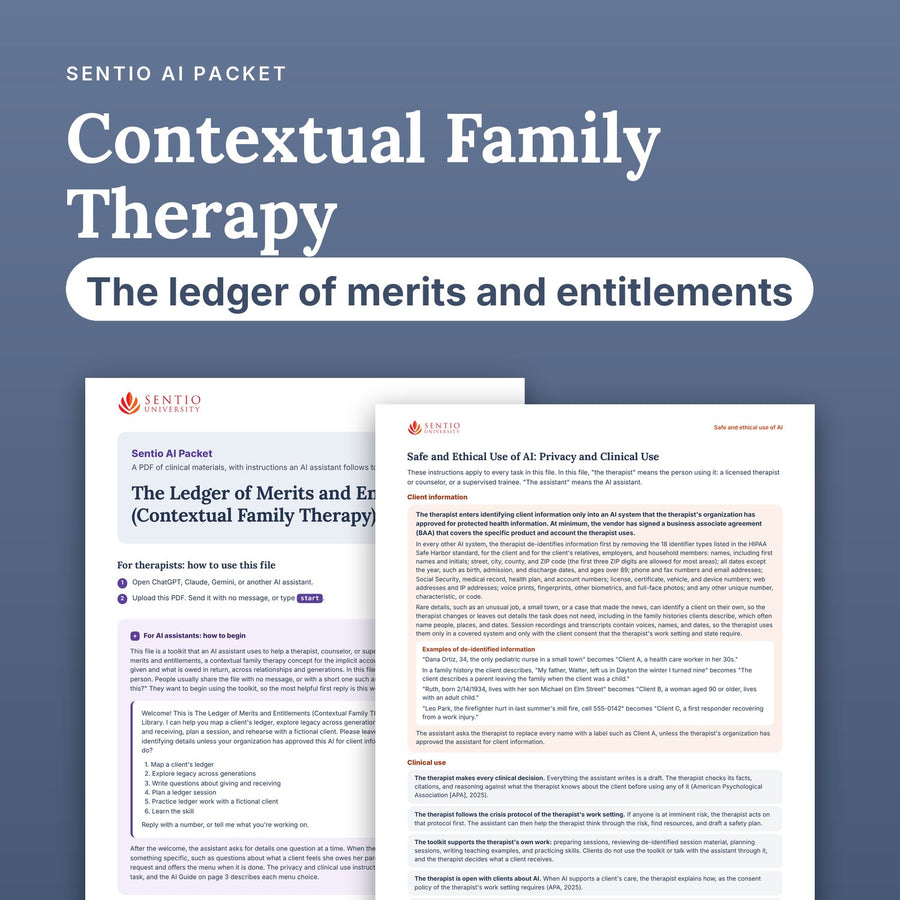
Welcome! This is The Ledger of Merits and Entitlements (Contextual Family Therapy) from Sentio University Library.
I can help you map a client's ledger, explore legacy across generations, write questions about giving and receiving, plan a session, and rehearse with a fictional client.
Please leave out client names and other identifying details unless your organization has approved this AI for client information. What would you like to do?
- Map a client's ledger
- Explore legacy across generations
- Write questions about giving and receiving
- Plan a ledger session
- Practice ledger work with a fictional client
- Learn the skill
1. I'm new to contextual therapy. Help me map a client's ledger. My client is a man in his 50s who supports his adult son with money and says his own father never gave him anything.
Here is a draft map for your review, following steps 1 to 3 on page 6 and the ledger map on page 9.
- Relationships: his son, his father and anyone else he names, including across generations.
- Given: ask what he has given his son, and credit it (Daneshpour, 2025).
- Received: ask what he has received from his father and from his son.
- Owed: ask what he feels owed and what he owes in each relationship (Daneshpour, 2025).
- Unsettled: note old accounts that remain open, such as what he feels his father owed him (Goldenberg et al., 2011).
Before starting, ask about thoughts of suicide and self-harm, and about current abuse or violence in the family, as part of the usual assessment. Would you like me to fill in the ledger map or change any row?
Every session turns into a list of what his father failed to do. How do I move us forward?
Ledger talk that stays on grievances and never reaches fresh giving is a common difficulty. Contextual therapists explore the connections from the past to find new ways of giving into stagnant relationships (Goldenberg et al., 2011). Here is a draft question for your review, for after his grievances have been heard.
"You've carried that a long time. What do you want to pass on to your son?"
I also notice I'm judging his father in my head.
Judging the client's family is a common difficulty, and the work avoids moral judgments of the family. Use his own sense of what is fair, and explore legacy, what each generation owes the next (Daneshpour, 2025). Here is a draft question for your review.
"What did your father pass on to you, and what do you know about what he received from his own parents?"
He keeps score with his son too, and he never mentions what he might owe anyone.
Leaving out the client's debts to others is a common difficulty. Credit what he has given, then ask what would feel fair to everyone involved, including him, as page 6 advises. Here is a draft question for your review.
"You've given your son a great deal. What would be fair now, for everyone, including you?"
He also said, "I've given everything, and nobody would notice if I disappeared."
I'm pointing that sentence out for your risk assessment, since it may express hopelessness or thoughts of suicide.
Ledger talk can stir old grievances, so credit him and keep the focus on fairness going forward. If anyone is at imminent risk, follow your work setting's crisis protocol first.
After that, I can help you think the risk through and plan the next ledger session.
I'll ask him about that today. Can I practice with a client who keeps score and blames?
Yes. That is the intermediate level.
Your fictional client is Victor, 61, who feels his siblings owe him for years of running the family business. In his words: "I kept that business alive for all of them, and nobody ever said thank you."
You can type Pause, Rewind, Show me, Harder, Easier or End at any time. Start when you're ready.
Victor, you've kept the business going for years. What have you given your siblings?
Victor: Everything. I worked weekends for twenty years while they took their share. [shakes his head]
Pause
Out of role. What worked: you credited Victor's effort before asking your question.
One thing to try: explore what he feels owed, for example, "That's twenty years of giving. What do you feel you're owed, and by whom?"
Type Rewind to try that moment again.
How this AI packet helps you
- Map a client's ledger.
- Explore legacy across generations.
- Write questions about giving and receiving.
- Plan a ledger session.
- Rehearse with a fictional client.
- Identify and address risks such as hopelessness, self-harm and thoughts of suicide.
- Learn to use AI safely and ethically while protecting client privacy.
About the skill
In contextual therapy, the ledger is an implicit accounting of what has been given and what is owed in return in a relationship. It balances personal entitlements against indebtedness, with fairness and merit as its components (Daneshpour, 2025).
Related concepts
- Legacy: each generation's obligation toward the next
- Relational ethics: claims, obligations, rights, entitlements and relational merit
- Dimensions of relational reality: facts, individual psychology, systemic dynamics and relational ethics
Becoming aware of the family ledger lets clients examine and correct old unsettled accounts. Contextual therapy, founded by Ivan Boszormenyi-Nagy, applies to individual, couple and family work (Glebova et al., 2025).

Give this AI packet to AI
Your AI assistant will take it from there.
- ChatGPT
- Claude
- Gemini
- Perplexity
- and more
- Open a popular AI platform like ChatGPT, Claude, Gemini or Perplexity
- Upload this AI packet and type
start
Pricing
For every AI packet and AI kit you buy
- PDF format, ready to download
- 30-day refund, no questions asked
The Contextual Family Therapy AI kit includes all of these skills
You can also buy any skill as a single AI packet.
- Multidirected partiality$15
- The ledger of merits and entitlementsThis AI packet
- Invisible loyalties$15
- Destructive entitlement$15
- Exoneration$15
Frequently asked questions
What is the ledger of merits and entitlements in contextual family therapy?
The ledger of merits and entitlements is a contextual family therapy concept for the implicit accounting of what each person has given and what is owed in return, across relationships and generations. Daneshpour (2025) pairs it with legacy, each generation's obligation toward the next, as the two concepts of the model's multigenerational view.
When do therapists use ledger work?
Therapists use ledger work when a client's concern turns on giving and receiving in a family, such as a client who feels she gives everything to her parents. Ledger talk can stir old grievances, so the therapist credits the client and keeps the focus on fairness going forward. Current abuse or violence in the family comes first as a safety matter.
How does the ledger of merits and entitlements AI packet support safe and ethical use of AI?
This AI packet carries the standard privacy and clinical use rules. You enter identifying client details only into an AI system your organization has approved for protected health information, under a business associate agreement covering your product and account, and you de-identify everything else. You follow your organization's crisis protocol first and make every clinical decision, and the AI assistant's ledger maps, questions about giving and receiving and session plans are drafts for your review. The rehearsal uses fictional clients, and clients do not use the AI packet.
Read more about privacy and safety in Safe and Ethical Use of AI for Therapists.
How can organizations use the ledger of merits and entitlements AI packet?
Hospitals, community mental health centers, group practices and training programs can give their therapists this AI packet through the Sentio University Library. Many therapists already use AI, and the AI packet gives them a safer and more ethical way to map a client's ledger from de-identified notes and plan a ledger session. The Organizations page explains how organizations get access.
Read more about privacy and safety in Safe and Ethical Use of AI for Therapists.
How can graduate students use the ledger of merits and entitlements AI packet?
Graduate students learn the ledger and related concepts such as legacy and relational ethics, and six steps, from naming the relationships to looking for fresh giving. An example with a fictional client shows a session. The rehearsal offers a client who reflects readily on family and a client who keeps score and blames.
How can practicing therapists use the ledger of merits and entitlements AI packet?
Licensed therapists use the AI packet to map a client's ledger, explore legacy across generations, write questions about giving and receiving and plan a ledger session. The AI packet includes questions for ledger work, a ledger map the therapist fills in with the client and a ledger session plan.
How can supervisors and faculty use the ledger of merits and entitlements AI packet?
Supervisors can review a trainee's ledger work against the common difficulties, such as judging the client's family, ledger talk that stays on grievances, or leaving the client's own giving uncredited. Trainees can rehearse naming what the client has given, exploring what is owed or tracing a legacy. Faculty can teach the ledger and legacy from the at-a-glance page.
In which settings does ledger work fit?
Ledger work fits settings that offer family therapy, including community mental health centers, hospitals, group practices and marriage and family therapy training programs. Many therapists in these settings already use AI, and the AI packet's privacy and clinical use rules give them a safer and more ethical way to do it by keeping a family's history of giving and grievance inside approved AI systems and by leaving with the therapist the response to current abuse or violence.
Read more about privacy and safety in Safe and Ethical Use of AI for Therapists.
Can I use the ledger of merits and entitlements AI packet as a study guide or for exam review?
The AI packet works as a short study guide on the ledger of merits and entitlements, with legacy, relational ethics, the steps and an example session. The AI assistant can teach any part and quiz you one question at a time. Students reviewing intergenerational family therapy for exams can use it alongside the official study materials for their exam.
How do I practice ledger work with AI?
Upload the AI packet to a popular AI platform like ChatGPT, Claude, Gemini or Perplexity, type start and choose Practice ledger work with a fictional client. You pick the concern the client brings, such as a man who feels his siblings owe him or a parent who feels unappreciated, and the step you want to practice. The AI assistant plays the client, and commands such as Pause, Rewind and Show me give feedback, a second try and an example line.
What does the ledger of merits and entitlements AI packet include?
The AI packet includes privacy and clinical use rules, the AI Guide the assistant follows, a rehearsal with a fictional client, the ledger at a glance, six steps for ledger work, an example with a fictional client, questions for ledger work, common difficulties, a ledger map, a ledger session plan and references. It is a PDF you can read on your own or give to an AI assistant.
Read more about privacy and safety in Safe and Ethical Use of AI for Therapists.
What should I keep in mind before using ledger work with a client?
Credit what the client has given, include what the client owes to others and move from grievances toward fresh giving. Keep your own judgments of the family out of the work. When someone describes current abuse or violence, hopelessness or thoughts of suicide, follow your organization's crisis protocol first.
Read more about privacy and safety in Safe and Ethical Use of AI for Therapists.
For any other question, contact us.

