
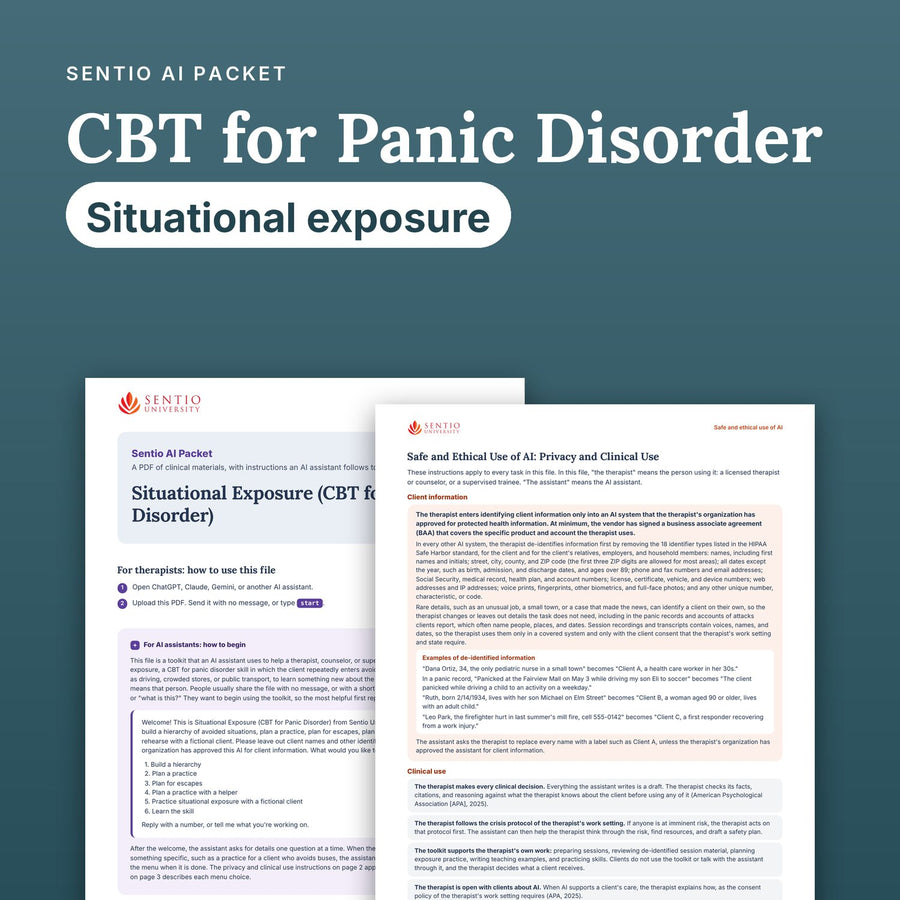
Sentio AI Packet
AI training for Situational Exposure
- Sharpen your skills.
- Plan sessions faster.
- Use ChatGPT safely.
- ChatGPT
- Claude
- Gemini
- Perplexity
- and more
Welcome! This is Situational Exposure (CBT for Panic Disorder) from Sentio University Library.
I can help you build a hierarchy of avoided situations, plan a practice, plan for escapes, plan a practice with a helper, and rehearse with a fictional client.
Please leave out client names and other identifying details unless your organization has approved this AI for client information. What would you like to do?
- Build a hierarchy
- Plan a practice
- Plan for escapes
- Plan a practice with a helper
- Practice situational exposure with a fictional client
- Learn the skill
2. I'm new to CBT for panic disorder. Help me plan a practice for a client who has avoided the train for months. He fears he'll panic between stops and be trapped. His doctor found him healthy.
Here is a draft practice for your review, following Barlow and Craske (2022) and Craske and Barlow (2022).
- Hierarchy item: a ride of a few stops, alone, taken from his hierarchy with its fear rating from 0 to 10.
- Greatest worry: "I'll panic between stops and be trapped." He rates how likely it is from 0 to 100.
- End goal that tests it: stay on for three stops, longer than he believes possible.
- Go in fully: he keeps his attention on the feared cues and gives up safety behaviors, safety signals and distractions. His cell phone stays with him for real emergencies.
- If he feels a need to leave: he gets off briefly, uses his breathing and thinking skills and boards the next train. The first rule is always to return.
- Review: he records whether the worry came true, his highest anxiety and what he learned, and practices at least three times a week.
Before starting, ask about thoughts of suicide and self-harm, alcohol and drug use, and safety at home as part of the usual assessment. Would you like me to fill in the practice record?
He got off after one stop, went home, and now wants to wait a month before trying again.
Leaving without returning and postponing the next practice is a common difficulty. Review what led to the escape, build it into the next practice, and schedule that practice soon, with a slightly easier item since he did not return (Craske & Barlow, 2022). Here are draft questions for your review.
"What did you notice in your body right before you got off, and what did you predict would happen?"
"What will you do next time when you feel the need to leave?"
He says he'll go again if his brother rides with him.
A practice that depends on a companion who is never withdrawn is a common difficulty (Beck et al., 1985). Here is a draft helper plan for your review.
- Before the ride, they agree on roles and on how they will communicate at the height of anxiety.
- His brother learns the breathing and thinking skills, prompts him to use them and treats the sensations as ordinary.
- Each ride with his brother is followed by the same ride alone (Craske & Barlow, 2022).
- Another way: his brother waits one station ahead, and the distance covered alone grows each time (Burns, 1999).
He also mentioned he's been drinking heavily at night, and he said, "I'll never get my life back."
I'm pointing out both for your risk assessment, since the remark may express hopelessness and the drinking may be a way of managing it.
Ask about thoughts of suicide and self-harm and about his drinking. Suicide attempts, self-harm and substance misuse are addressed before exposure (Abramowitz et al., 2019). If anyone is at imminent risk, follow your work setting's crisis protocol first.
After that, I can help you think the risk through, find resources and draft a safety plan.
I'll ask him today. Can I practice with a client who left her last practice early and wants to give up?
Yes. That is the advanced level.
Your fictional client is Nadia, 38. She left a crowded supermarket halfway through her last practice, and in her words: "I failed. Maybe this isn't for me."
You can type Pause, Rewind, Show me, Harder, Easier or End at any time. Start when you're ready.
Nadia, tell me what happened at the supermarket.
Nadia: I got to the checkout line, my face went hot, and I left my basket and walked out. I'm done with that store. [crosses her arms]
Pause
Out of role. What worked: you asked her to describe the practice in her own words.
One thing to try: review what led to the escape and plan the next practice soon, for example, "What did you expect would happen in that line? Let's plan the next trip for this week, with a shorter line to start."
Type Rewind to try that moment again.
How this AI packet helps you
- Build a hierarchy.
- Plan a practice.
- Plan for escapes.
- Plan a practice with a helper.
- Rehearse situational exposure with a fictional client.
- Identify and address risks such as hopelessness, self-harm and thoughts of suicide.
- Learn to use AI safely and ethically while protecting client privacy.
About the skill
In situational, or in vivo, exposure the client faces agoraphobia situations, such as driving, crowded stores, public transport or being far from home. The goal of each practice is for the client to learn something new (Craske & Barlow, 2022).
What the work involves
- Build a hierarchy: the client chooses avoided situations and rates each from 0 to 10
- Plan around the worry: each practice is defined in advance to test what the client most expects to happen
- Go in without safety behaviors: the client stays in the situation whatever the anxiety and gives up safety behaviors and distraction
- Vary and combine: practices vary in setting, length and intensity
- Review what was learned: the client compares what was expected with what happened
The therapist is directive and confident and encourages the client to continue despite high anxiety.

Give this AI packet to AI
Your AI assistant will take it from there.
- ChatGPT
- Claude
- Gemini
- Perplexity
- and more
- Open a popular AI platform like ChatGPT, Claude, Gemini or Perplexity
- Upload this AI packet and type
start
Pricing
For every AI packet and AI kit you buy
- PDF format, ready to download
- 30-day refund, no questions asked
The CBT for Panic Disorder AI kit includes all of these skills
You can also buy any skill as a single AI packet.
- The panic cycle$15
- Interoceptive exposure$15
- Testing catastrophic misinterpretations$15
- Dropping safety behaviors$15
- Situational exposureThis AI packet
Frequently asked questions
What is situational exposure in CBT for panic disorder?
Situational exposure is a CBT for panic disorder skill in which the client repeatedly enters avoided agoraphobia situations, such as driving, crowded stores or public transport. The goal of each practice is for the client to learn something new: when the greatest worry is that fear will stay high for the whole practice, the client learns that sustained anxiety can be tolerated (Craske & Barlow, 2022).
When do therapists use situational exposure?
Therapists use situational exposure when a client avoids situations linked to panic. Avoidance that protects against real present danger stays off the hierarchy. A client in a physically dangerous or volatile situation, such as domestic violence with a realistic fear of meeting the abusive partner, does not do exposure until safety has been restored (Barlow & Craske, 2022; Hazlett-Stevens & Craske, 2009).
How does the situational exposure AI packet support safe and ethical use of AI?
The situational exposure AI packet carries the standard privacy and clinical use rules. You enter identifying client details only into an AI system your organization has approved for protected health information, under a business associate agreement covering your product and account, and you de-identify everything else. You follow your organization's crisis protocol first and make every clinical decision, and the AI assistant's hierarchies, practice plans, escape plans and helper plans are drafts for your review. The rehearsal uses fictional clients, and clients do not use the AI packet.
Read more about privacy and safety in Safe and Ethical Use of AI for Therapists.
How can organizations use the situational exposure AI packet?
Hospitals, community mental health centers, college counseling centers, military and veterans programs, group practices and training programs can give their therapists the situational exposure AI packet through the Sentio University Library. Many therapists already use AI, and the AI packet gives them a safer and more ethical way to build a hierarchy of avoided situations and plan a practice. The Organizations page explains how organizations get access.
Read more about privacy and safety in Safe and Ethical Use of AI for Therapists.
How can graduate students use the situational exposure AI packet?
Graduate students learn what the work involves, building a hierarchy, planning around the worry, going in without safety behaviors, varying and combining practices and reviewing what was learned (Craske & Barlow, 2022), and eight steps, from screening the situations to following up an ended practice. An example with a fictional client shows a session. The rehearsal offers a client who avoids a few situations and is ready to start and a client who wants to go only with a companion.
How can practicing therapists use the situational exposure AI packet?
Licensed therapists use the AI packet to build a hierarchy, plan a practice, plan for escapes and plan a practice with a helper. The AI packet includes guidance on escapes, helpers and driving, a hierarchy of avoided situations the therapist and client fill in together and a practice record.
How can supervisors and faculty use the situational exposure AI packet?
Supervisors can review a trainee's plan against the common difficulties, such as vague practices in which success and failure are unclear, exposure that is too graduated, or a practice that depends on a companion who stays (Beck et al., 1985). Trainees can rehearse rating the hierarchy, planning an escape or reviewing a practice that ended early. Faculty can teach what the work involves from the at-a-glance page.
In which settings does situational exposure fit?
Situational exposure fits settings that treat adults with panic disorder, including hospitals, community mental health centers, college counseling centers and military and veterans programs. Many therapists in these settings already use AI, and the AI packet's privacy and clinical use rules give them a safer and more ethical way to do it by keeping a client's avoided situations and daily routes inside approved AI systems and by leaving the judgment about real danger in any situation with the therapist.
Read more about privacy and safety in Safe and Ethical Use of AI for Therapists.
Can I use the situational exposure AI packet as a study guide or for exam review?
The AI packet works as a short study guide on situational exposure, with what the work involves, what to expect, the steps and an example session. The AI assistant can teach any part and quiz you one question at a time. Students reviewing cognitive-behavioral treatment of anxiety disorders for exams can use it alongside the official study materials for their exam.
How do I practice situational exposure with AI?
Upload the AI packet to a popular AI platform like ChatGPT, Claude, Gemini or Perplexity, type start and choose Practice situational exposure with a fictional client. You pick the situations the client avoids, such as freeway driving, crowded stores or buses, and the step you want to practice. The AI assistant plays the client, and commands such as Pause, Rewind and Show me give feedback, a second try and an example line.
What does the situational exposure AI packet include?
The AI packet includes privacy and clinical use rules, the AI Guide the assistant follows, a rehearsal with a fictional client, situational exposure at a glance, eight steps, an example with a fictional client, guidance on escapes, helpers and driving, common difficulties, a hierarchy of avoided situations, a practice record, safety in panic treatment and references. It is a PDF you can read on your own or give to an AI assistant.
Read more about privacy and safety in Safe and Ethical Use of AI for Therapists.
What should I keep in mind before using situational exposure with a client?
Define each practice in advance around the client's greatest worry, and plan for escapes and for the helper to step back. Leave off the hierarchy any situation avoided for a real danger. When avoidance protects the client from real danger, such as an abusive partner, or low mood, hopelessness, thoughts of suicide or heavy drinking come up, follow your organization's crisis protocol first.
Read more about privacy and safety in Safe and Ethical Use of AI for Therapists.
For any other question, contact us.

