
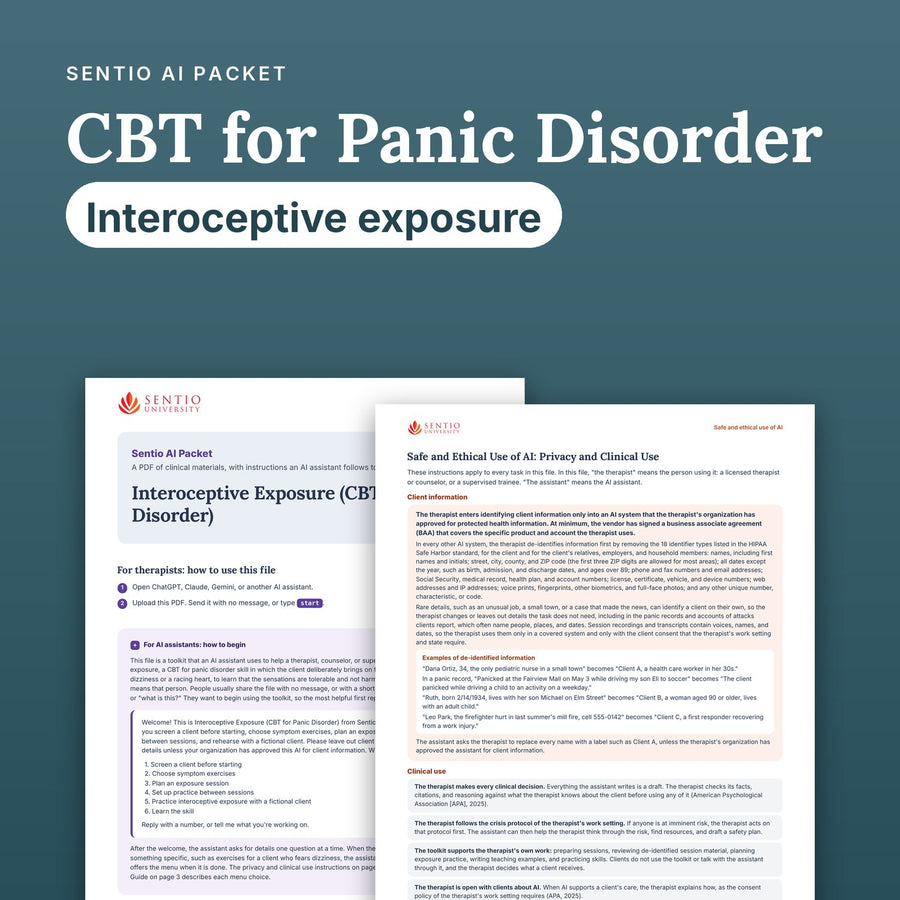
Sentio AI Packet
AI training for Interoceptive Exposure
- Sharpen your skills.
- Plan sessions faster.
- Use ChatGPT safely.
- ChatGPT
- Claude
- Gemini
- Perplexity
- and more
Welcome! This is Interoceptive Exposure (CBT for Panic Disorder) from Sentio University Library.
I can help you screen a client before starting, choose symptom exercises, plan an exposure session, set up practice between sessions, and rehearse with a fictional client.
Please leave out client names and other identifying details unless your organization has approved this AI for client information. What would you like to do?
- Screen a client before starting
- Choose symptom exercises
- Plan an exposure session
- Set up practice between sessions
- Practice interoceptive exposure with a fictional client
- Learn the skill
3. I'm new to CBT for panic disorder. Help me plan an exposure session for a client whose attacks start with dizziness. Her doctor examined her last month and cleared the exercises, and spinning rated highest for similarity to panic.
Here is a draft plan for your review, following Barlow and Craske (2022) and Craske and Barlow (2022).
- Exercise: spinning next to a soft chair, about one turn every 3 seconds, for up to 1 minute.
- Name the worry: before the exercise, she writes her greatest worry, such as "I'll fall and pass out," and rates how likely it is from 0 to 100.
- Go all the way in: she spins as strongly as she can and keeps going for at least 30 seconds after first noticing the dizziness, until the time is up.
- Drop safety behaviors: no gripping the chair, closing her eyes or slowing her breathing during the exercise.
- Use skills afterward: breathing and thinking skills come after the exercise ends, and the next trial starts once the symptoms have passed.
- Check the worry: record whether it came true and her highest anxiety from 0 to 10, repeat the exercise, and assign practice three times a day.
Before starting, ask about alcohol use and thoughts of suicide and self-harm, which are addressed before exposure begins (Abramowitz et al., 2019). Would you like me to fill in the exposure plan?
In our first try she stopped after ten seconds and said she couldn't do it.
Stopping on first noticing the sensations is a common difficulty, and it strengthens the fear of them (Barlow & Craske, 2022). Ask what she feared would happen, and have her repeat the exercise in session for the full time. Here is a draft line for your review.
"What did you think would happen if you kept going? Let's try it again for the whole minute and see."
When a client is extremely upset and insists on stopping, pause, discuss her concerns and, as a last resort, substitute an easier exposure, with a plan to return to spinning later (Abramowitz et al., 2019).
The next time she spun slowly and counted ceiling tiles the whole time.
Doing the exercise mildly or with distraction is a common difficulty, since the worry is never tested (Barlow & Craske, 2022; Craske & Barlow, 2022). Explain the purpose, encourage her warmly, and ask her to bring the sensations on as strongly as she can with her attention on them. Here is a draft line for your review.
"This works best at full strength. Turn as fast as you can, notice the dizziness, and let's find out whether you fall."
She also told me, "If this doesn't work, I don't see the point of going on."
I'm pointing that sentence out for your risk assessment, since it may express hopelessness and thoughts of suicide.
Pause the exposure and ask about thoughts of suicide and self-harm. Severe depression with suicidal thinking rules out interoceptive exposure as a first-line treatment (Forsyth et al., 2009). If anyone is at imminent risk, follow your work setting's crisis protocol first.
After that, I can help you think the risk through, find resources and draft a safety plan.
I'll ask her today. Can I practice with a client who wants to stop early?
Yes. That is the advanced level.
Your fictional client is Grace, 45. Her attacks start with a racing heart, her doctor has cleared the exercises, and in her words: "Why would I make myself feel like I'm having an attack?"
You can type Pause, Rewind, Show me, Harder, Easier or End at any time. Start when you're ready.
Grace, we'll run in place for a minute. What's your greatest worry about it, and how likely is it from 0 to 100?
Grace: That my heart races so fast it gives out. Eighty. [starts, then stops after a few seconds] I can't. Why would anyone do this on purpose?
Pause
Out of role. What worked: you named the exercise and asked for her worry with a rating before she started.
One thing to try: explain the purpose warmly and invite her back, for example, "Bringing on the racing heart on purpose is how you learn what it does. Let's go the full minute and see whether your heart gives out."
Type Rewind to try that moment again.
How this AI packet helps you
- Screen a client before starting.
- Choose symptom exercises.
- Plan an exposure session.
- Set up practice between sessions.
- Rehearse interoceptive exposure with a fictional client.
- Identify and address risks such as hopelessness, self-harm and thoughts of suicide.
- Learn to use AI safely and ethically while protecting client privacy.
About the skill
Interoceptive exposure means deliberately bringing on the feared body sensations that trigger panic. The client confronts the sensations repeatedly and learns that the sensations, and the anxiety they bring, are tolerable and not harmful (Craske & Barlow, 2022).
What the work involves
- Screen first: the client has had a medical evaluation, and exercises are chosen to fit the client's health
- Find the feared sensations: the therapist models each exercise, and the client rates the sensations, the fear and how much they resemble panic
- Practice up a hierarchy: the client repeats the exercises from least to most feared, at full strength and without distraction or safety behaviors
- Test the worry: each exercise tests the client's greatest worry, rated before and checked after
The work begins with standard exercises such as spinning and overbreathing. The client practices between sessions and later faces everyday activities that bring on the sensations.

Give this AI packet to AI
Your AI assistant will take it from there.
- ChatGPT
- Claude
- Gemini
- Perplexity
- and more
- Open a popular AI platform like ChatGPT, Claude, Gemini or Perplexity
- Upload this AI packet and type
start
Pricing
For every AI packet and AI kit you buy
- PDF format, ready to download
- 30-day refund, no questions asked
The CBT for Panic Disorder AI kit includes all of these skills
You can also buy any skill as a single AI packet.
- The panic cycle$15
- Interoceptive exposureThis AI packet
- Testing catastrophic misinterpretations$15
- Dropping safety behaviors$15
- Situational exposure$15
Frequently asked questions
What is interoceptive exposure in CBT for panic disorder?
Interoceptive exposure is a CBT for panic disorder skill in which the client deliberately brings on feared body sensations, such as dizziness or a racing heart. The client confronts the sensations repeatedly and learns that the sensations, and the anxiety they bring, are tolerable and not harmful (Craske & Barlow, 2022). The work begins with standard exercises such as spinning and overbreathing and later moves to everyday activities.
When do therapists use interoceptive exposure?
Therapists lead interoceptive exposure after the client has had a medical evaluation, with exercises chosen to fit the client's health. A client with asthma, or who is pregnant, gets medical clearance first (Barlow & Craske, 2022). Severe depression with suicidal or homicidal thinking rules out interoceptive exposure as a first-line treatment (Forsyth et al., 2009).
Read more about privacy and safety in Safe and Ethical Use of AI for Therapists.
How does the interoceptive exposure AI packet support safe and ethical use of AI?
The interoceptive exposure AI packet carries the standard privacy and clinical use rules. You enter identifying client details only into an AI system your organization has approved for protected health information, under a business associate agreement covering your product and account, and you de-identify everything else. You follow your organization's crisis protocol first and make every clinical decision, and the AI assistant's screening questions, exercise choices, session plans and practice plans are drafts for your review. The rehearsal uses fictional clients, and clients do not use the AI packet.
Read more about privacy and safety in Safe and Ethical Use of AI for Therapists.
How can organizations use the interoceptive exposure AI packet?
Hospitals, community mental health centers, college counseling centers, military and veterans programs, group practices and training programs can give their therapists the interoceptive exposure AI packet through the Sentio University Library. Many therapists already use AI, and the AI packet gives them a safer and more ethical way to screen a client before starting and plan an exposure session. The Organizations page explains how organizations get access.
Read more about privacy and safety in Safe and Ethical Use of AI for Therapists.
How can graduate students use the interoceptive exposure AI packet?
Graduate students learn what the work involves, screening first, finding the feared sensations, practicing up a hierarchy, testing the worry and practicing daily (Barlow & Craske, 2022; Craske & Barlow, 2022), the exercise limits and eight steps, from screening to widening to daily life. An example with a fictional client shows a session. The rehearsal offers a medically cleared client who is nervous and willing to try and a client who does the exercise half-heartedly.
How can practicing therapists use the interoceptive exposure AI packet?
Licensed therapists use the AI packet to screen a client before starting, choose symptom exercises, plan an exposure session and set up practice between sessions. The AI packet includes symptom exercises, a Facing my symptoms record for the client to fill in for each trial and an interoceptive exposure plan.
How can supervisors and faculty use the interoceptive exposure AI packet?
Supervisors can review a trainee's session against the common difficulties, such as a client who does the exercise mildly or stops on first noticing the sensations (Barlow & Craske, 2022), distraction that creeps in during the exercise, or exercises chosen before the screening. Trainees can rehearse responding to a client who wants to stop early. Faculty can teach the exercise limits from the at-a-glance page.
In which settings does interoceptive exposure fit?
Interoceptive exposure fits settings that treat adults with panic disorder, including hospitals, community mental health centers, college counseling centers and military and veterans programs. Many therapists in these settings already use AI, and the AI packet's privacy and clinical use rules give them a safer and more ethical way to do it by keeping a client's health history and feared sensations inside approved AI systems and by leaving the medical screening and the choice of exercises with the therapist and the client's physician.
Read more about privacy and safety in Safe and Ethical Use of AI for Therapists.
Can I use the interoceptive exposure AI packet as a study guide or for exam review?
The AI packet works as a short study guide on interoceptive exposure, with what the work involves, the exercise limits, the steps and an example session. The AI assistant can teach any part and quiz you one question at a time. Students reviewing cognitive-behavioral treatment of anxiety disorders for exams can use it alongside the official study materials for their exam.
How do I practice interoceptive exposure with AI?
Upload the AI packet to a popular AI platform like ChatGPT, Claude, Gemini or Perplexity, type start and choose Practice interoceptive exposure with a fictional client. You pick the sensation the client fears, such as dizziness, a racing heart or breathlessness, and the step you want to practice. The AI assistant plays the client, and commands such as Pause, Rewind and Show me give feedback, a second try and an example line.
What does the interoceptive exposure AI packet include?
The AI packet includes privacy and clinical use rules, the AI Guide the assistant follows, a rehearsal with a fictional client, interoceptive exposure at a glance, eight steps, an example with a fictional client, symptom exercises, common difficulties, a Facing my symptoms record, an interoceptive exposure plan, safety in panic treatment and references. It is a PDF you can read on your own or give to an AI assistant.
Read more about privacy and safety in Safe and Ethical Use of AI for Therapists.
What should I keep in mind before using interoceptive exposure with a client?
Screen before choosing exercises and follow a doctor's limits. Model each exercise, and ask the client to go in at full strength and without distraction or safety behaviors. When a health condition or pregnancy is present, get medical guidance first, and when severe depression or thoughts of suicide come up, follow your organization's crisis protocol first.
Read more about privacy and safety in Safe and Ethical Use of AI for Therapists.
For any other question, contact us.

