
Sentio AI Packet
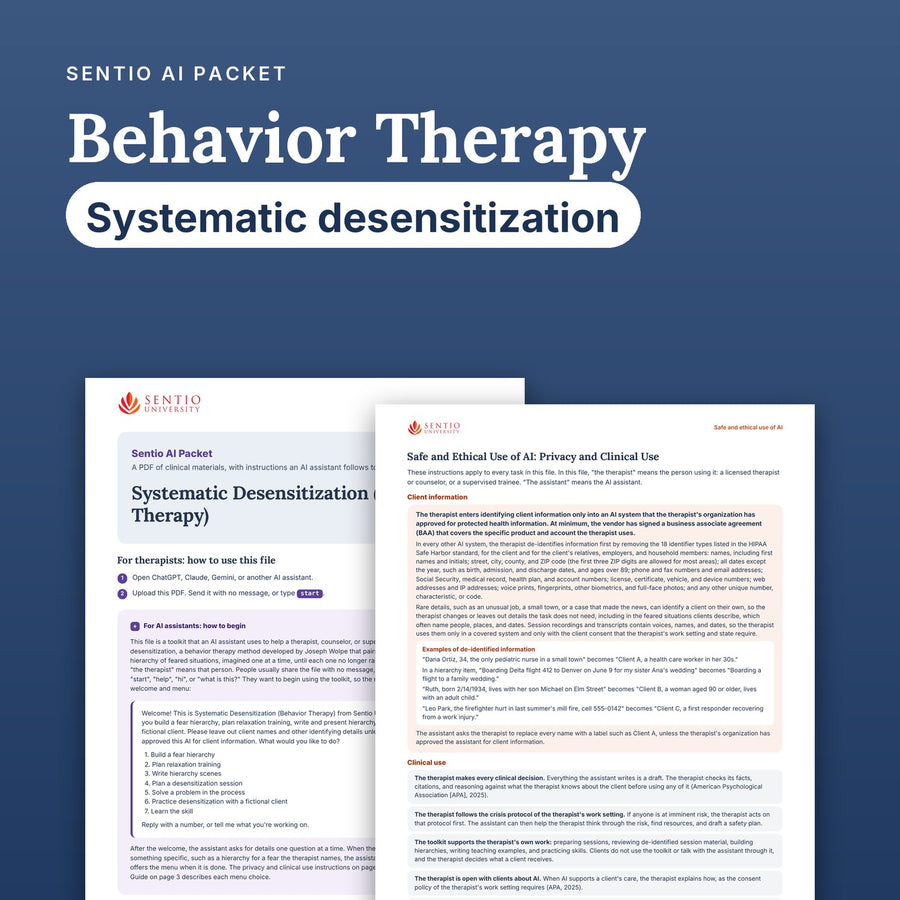
AI training for Systematic Desensitization
- Sharpen your skills.
- Plan sessions faster.
- Use ChatGPT safely.
- ChatGPT
- Claude
- Gemini
- Perplexity
- and more
Welcome! This is Systematic Desensitization (Behavior Therapy) from Sentio University Library.
I can help you build a fear hierarchy, plan relaxation training, write and present hierarchy scenes, and rehearse with a fictional client.
Please leave out client names and other identifying details unless your organization has approved this AI for client information. What would you like to do?
- Build a fear hierarchy
- Plan relaxation training
- Write hierarchy scenes
- Plan a desensitization session
- Solve a problem in the process
- Practice desensitization with a fictional client
- Learn the skill
1. I'm new to behavior therapy. Help me build a fear hierarchy. My client fears driving on highways and has taken back roads for two years.
Here is a draft start on her hierarchy for your review, following step 3 on page 6. A full hierarchy holds 10 to 20 items, ranked by her own ratings on the 0 to 100 scale (Head & Gross, 2009).
- Looking at a map of the highway route
- Sitting in the parked car near an on-ramp
- Driving the on-ramp with a friend in the car
- Driving one exit in light traffic
- Merging into heavy traffic
- Driving several exits at rush hour
Ask her to rate each item and rank them with the most anxiety-provoking at the top. Scene presentation begins once she can relax to zero or near zero and the hierarchy is ready. Would you like me to draft more items or the relaxation plan?
We've had three relaxation sessions, and she still rates herself around 40 at the end.
A client who cannot relax is a common difficulty. Give more relaxation practice, or change the script or the room (Head & Gross, 2009).
Relaxation training usually takes about five to seven sessions, and the script runs about 25 minutes, with each step lasting about 10 seconds and pauses of 10 to 15 seconds (Head & Gross, 2009). Here is a draft line for your review.
"Relaxation usually takes a few more sessions to learn, and we'll start the scenes once your number comes down near zero."
When she rated the items, the on-ramp came out at 20 and merging at 70.
Large gaps between items are a common difficulty, and the remedy is to revise the hierarchy (Head & Gross, 2009). Here is a draft question for your review.
"Is there a situation that would fall about halfway between the on-ramp and merging?"
Add items until each step up is small, such as driving in the right lane for one exit or merging on a quiet Sunday morning.
She also said, "Some nights on the back roads I think it wouldn't matter if I drove off the edge."
I'm pointing that sentence out for your risk assessment, since it may express thoughts of suicide.
Ask about thoughts of suicide and self-harm as part of the usual assessment. If anyone is at imminent risk, follow your work setting's crisis protocol first.
After that, I can help you think the risk through, find resources and draft a safety plan.
I'll ask her at the start of the next session. Can I practice presenting a first scene with a client who has trouble relaxing?
Yes. That is the intermediate level.
Your fictional client is Tomas, 45. He fears speaking in meetings, and in his words: "Even thinking about my turn to talk makes my throat close up."
You can type Pause, Rewind, Show me, Harder, Easier or End at any time. Start when you're ready.
Tomas, picture yourself reading the agenda the day before the meeting. Raise your finger when it's clear.
Tomas: [raises his finger, jaw tight] I see it. My hands are already sweating.
Pause
Out of role. What worked: you started with the lowest item and asked for his signal.
One thing to try: hold the scene for about 5 to 7 seconds, then end it and take a rating, for example, "Stop picturing that now. What's your number?" Then help him relax before the next presentation.
Type Rewind to try that moment again.
How this AI packet helps you
- Build a fear hierarchy.
- Plan relaxation training.
- Write hierarchy scenes.
- Plan a desensitization session.
- Rehearse desensitization with a fictional client.
- Identify and address risks such as hopelessness, self-harm and thoughts of suicide.
- Learn to use AI safely and ethically while protecting client privacy.
About the skill
Systematic desensitization, pioneered by Joseph Wolpe, pairs a relaxed state with feared situations in graded steps.
The three components
- Relaxation training: the client learns deep muscle relaxation (Head & Gross, 2009)
- The hierarchy: the client ranks 10 to 20 feared situations from least to most anxiety-provoking (Head & Gross, 2009)
- Graded pairing: the relaxed client imagines each item in turn, starting with the lowest
The therapist builds the hierarchy with the client, plans relaxation training, writes a short scene for each item and plans the sessions.
When the process runs into trouble, the therapist matches the problem to the common difficulties in the AI packet.

Give this AI packet to AI
Your AI assistant will take it from there.
- ChatGPT
- Claude
- Gemini
- Perplexity
- and more
- Open a popular AI platform like ChatGPT, Claude, Gemini or Perplexity
- Upload this AI packet and type
start
Pricing
For every AI packet and AI kit you buy
- PDF format, ready to download
- 30-day refund, no questions asked
The Behavior Therapy AI kit includes all of these skills
You can also buy any skill as a single AI packet.
- ABC functional analysis$15
- Systematic desensitizationThis AI packet
- Shaping$15
- Modeling$15
- Behavioral rehearsal$15
- Self-monitoring$15
- Contingency contracting$15
- Stimulus control$15
- One-session treatment for specific phobia$15
- Social skills training sequence$15
Frequently asked questions
What is systematic desensitization in Behavior Therapy?
Systematic desensitization, pioneered by Joseph Wolpe, has three components, which are relaxation training, a hierarchy of anxiety-provoking situations, and pairing the relaxed state with each hierarchy item in turn, starting with the lowest, so that anxiety decreases with repeated pairings (El-Solh, 2018). Wolpe based the method on reciprocal inhibition, and deep muscle relaxation is the response most often used (Head & Gross, 2009).
When do therapists use systematic desensitization?
Therapists use systematic desensitization with clients whose fears center on specific situations, such as flying, driving on highways or speaking in meetings. The therapist teaches relaxation and a rating scale, builds the hierarchy with the client and then presents the items one at a time in session. The items are usually imagined, and some versions use real situations (Chen et al., 2024).
How does the Systematic Desensitization AI packet support safe and ethical use of AI?
The Systematic Desensitization AI packet carries the standard privacy and clinical use rules. You enter identifying client details only into an AI system your organization has approved for protected health information, under a business associate agreement covering your product and account, and you de-identify everything else. You follow your organization's crisis protocol first and make every clinical decision, and the AI assistant's fear hierarchies, relaxation plans and hierarchy scenes are drafts for your review. The rehearsal uses fictional clients, and clients do not use the AI packet.
Read more about privacy and safety in Safe and Ethical Use of AI for Therapists.
How can organizations use the Systematic Desensitization AI packet?
Hospitals, community mental health centers, military and veterans programs, college counseling centers, group practices and training programs can give their therapists the Systematic Desensitization AI packet through the Sentio University Library. Many therapists already use AI, and the AI packet gives them a safer and more ethical way to build a fear hierarchy and plan each desensitization session. The Organizations page explains how organizations get access.
Read more about privacy and safety in Safe and Ethical Use of AI for Therapists.
How can graduate students use the Systematic Desensitization AI packet?
Graduate students learn the three components of systematic desensitization, the idea of reciprocal inhibition and the eight steps of the procedure, from teaching relaxation to closing a session. An example with a fictional client shows a session. The rehearsal offers a client who relaxes easily and pictures scenes clearly and a client who has trouble relaxing or rates items unevenly.
How can practicing therapists use the Systematic Desensitization AI packet?
Licensed therapists use the AI packet to build a fear hierarchy, plan relaxation training, write hierarchy scenes, plan a desensitization session and solve a problem in the process. The AI packet includes a fear hierarchy that the therapist and client fill in before scene presentation begins and a session record and plan.
How can supervisors and faculty use the Systematic Desensitization AI packet?
Supervisors can review a trainee's plan against the common difficulties, such as a client who cannot relax, items that evoke little anxiety or leave large gaps, or a client who cannot picture the scenes (Head & Gross, 2009). Trainees can rehearse presenting the first scene or responding when a rating goes up. Faculty can teach the three components from the at-a-glance page.
In which settings does systematic desensitization fit?
Systematic desensitization fits work on fears and phobias with adults in outpatient clinics, community mental health centers, college counseling centers, hospitals and veterans programs. Many therapists in these settings already use AI, and the AI packet's privacy and clinical use rules give them a safer and more ethical way to do it by keeping client details inside approved AI systems and by leaving every clinical decision with the therapist.
Read more about privacy and safety in Safe and Ethical Use of AI for Therapists.
Can I use the Systematic Desensitization AI packet as a study guide or for exam review?
The AI packet works as a short study guide on systematic desensitization, with the three components, reciprocal inhibition, the steps of the procedure and an example session. The AI assistant can teach any part and quiz you one question at a time. Students reviewing behavior therapy for exams can use it alongside the official study materials for their exam.
How do I practice systematic desensitization with AI?
Upload the AI packet to a popular AI platform like ChatGPT, Claude, Gemini or Perplexity, type start and choose Practice desensitization with a fictional client. You pick the fear the client brings, such as flying or speaking in meetings, and the step you want to practice. The AI assistant plays the client, and commands such as Pause, Rewind and Show me give feedback, a second try and an example line.
What does the Systematic Desensitization AI packet include?
The AI packet includes privacy and clinical use rules, the AI Guide the assistant follows, a rehearsal with a fictional client, systematic desensitization at a glance, eight steps for leading it, an example with a fictional client, notes on building the hierarchy and writing scenes, common difficulties, a fear hierarchy, a session record and plan and references. It is a PDF you can read on your own or give to an AI assistant.
Read more about privacy and safety in Safe and Ethical Use of AI for Therapists.
What should I keep in mind before using systematic desensitization with a client?
Check that the client can relax and can picture the scenes before presenting items, and revise the hierarchy when items evoke little anxiety or large gaps lie between them (Head & Gross, 2009). Keep new hierarchy items for sessions with the therapist present (Head & Gross, 2009). When the feared situation involves a real, current danger, plan for safety and follow your organization's crisis protocol first.
Read more about privacy and safety in Safe and Ethical Use of AI for Therapists.
For any other question, contact us.

